
You're probably here because you've picked out a placement you love, saved a few photos, and now you're trying to separate good advice from random internet noise. That's a smart place to start.
A cartilage ear piercing can look delicate, bold, minimal, or dramatic, but it isn't the same as a standard lobe piercing. The tissue is firmer, healing is slower, and the margin for poor jewellery or rough technique is much smaller. If you understand that early, you're already more likely to have a smooth experience.
The good news is that cartilage piercings can heal beautifully when they're done well and looked after properly. The aim isn't to make you nervous. It's to help you know what matters, what questions to ask, and what to expect in real life.
Your First Cartilage Ear Piercing What to Know
You've picked a placement, opened your camera roll to compare inspiration photos, and now you're wondering whether getting a cartilage piercing is exciting, sensible, or slightly intimidating. For a first-time client, it is usually all three.

What makes cartilage different
Cartilage is not just “the top part of the ear.” It behaves differently from the soft tissue in the lobe, so the piercing has to be approached differently too.
Your lobe is softer and usually more forgiving. Cartilage is firmer, springier, and has less blood flow. A simple way to picture it is the difference between pushing a needle through a cushion versus a flexible plastic card. Both can be pierced, but one gives way easily and the other needs a steadier angle, better support, and more care afterward.
That is why professional technique matters more here. The placement has to suit your anatomy, the jewellery has to sit at the right angle, and the initial fit has to leave room for swelling without shifting around so much that it gets irritated. Small errors that a lobe might tolerate can cause months of aggravation in cartilage.
Why first-timers get caught off guard
A lot of people expect a cartilage piercing to behave like a lobe piercing with a slightly longer healing time. In real life, it asks for more patience than that.
Cartilage heals slowly because the tissue does not get the same easy blood supply as the lobe. Healing cells and nutrients still reach the area, just less efficiently. So even when the outside looks calm, the channel inside may still be fragile. That is why a piercing can seem fine for weeks, then flare up after being slept on, snagged on a jumper, or changed too early.
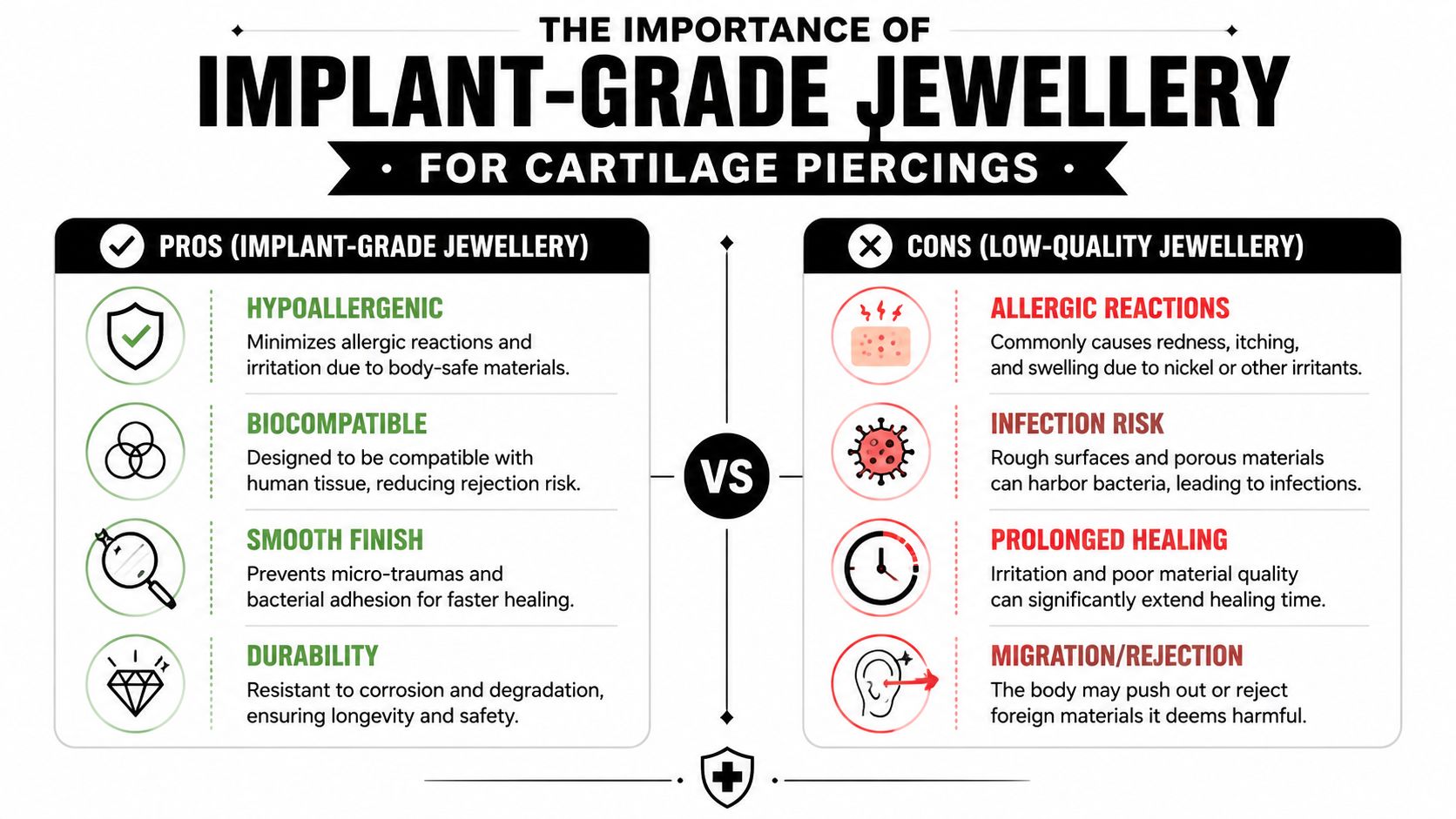
This is also why good jewellery matters from the start. Poorly finished metal, awkward shapes, or incorrect sizing create friction inside a piercing that is already slow to settle. Implant-grade titanium is usually recommended because it is lightweight, stable, and far less likely to trigger irritation in sensitive tissue.
What this means before you book
Choose your studio with the tissue in mind. You want a piercer who checks your anatomy, explains jewellery options clearly, uses sterile single-use needles, and is upfront about healing time instead of promising a quick, easy process.
It also helps to go in with realistic expectations:
- Expect tenderness. Cartilage often feels sharper and more reactive than a lobe piercing, especially in the first few days.
- Expect a long healing window. You are usually looking at months, not days or a couple of weeks.
- Expect to protect it. Pressure from sleep, headphones, helmets, hairbrushes, and early jewellery changes can all slow healing.
None of that is meant to put you off. It is meant to help you make good choices early, because cartilage piercings usually reward careful decisions and punish rushed ones.
A Tour of Popular Cartilage Piercing Placements
The easiest way to choose a cartilage piercing is to stop thinking in names first and start thinking in locations on the ear. Once you can picture the anatomy, the names make much more sense.
The outer edge
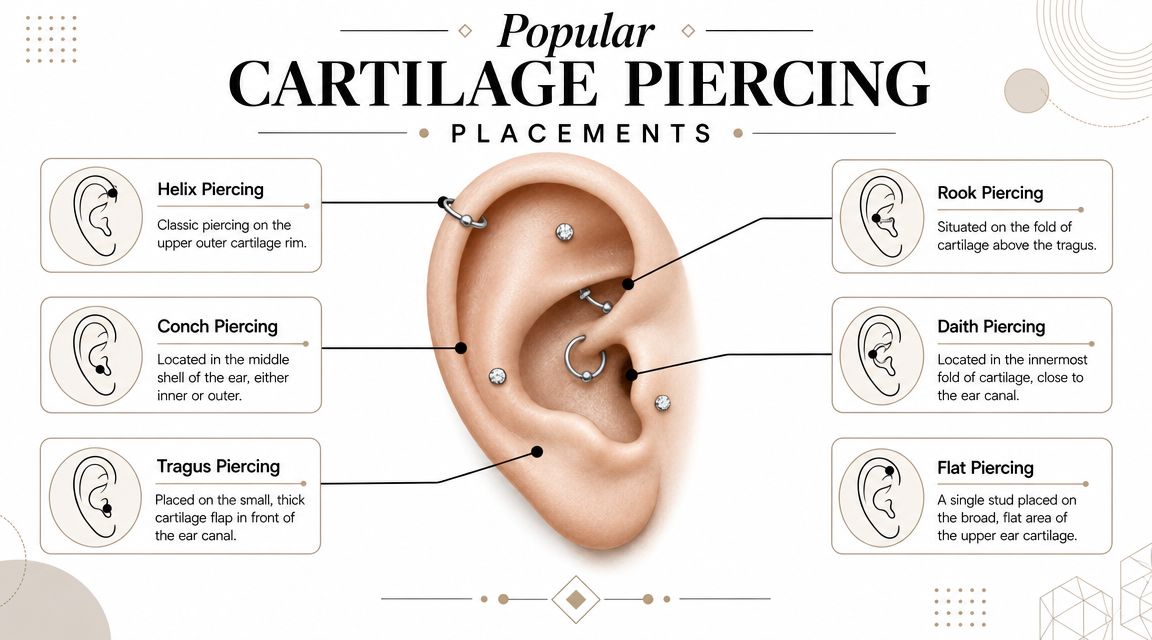
The helix sits on the upper outer rim of the ear. If you've seen a small stud or ring on that top curve, that's usually a helix. It's one of the most requested cartilage placements because it's versatile and works well on its own or as part of a stacked look.
The forward helix moves that idea towards the front of the ear, where the rim begins near the side of the head. It's a smaller area, so delicate studs are common here.
The flat is on the broad, flatter panel of upper ear cartilage rather than the rim itself. It's great if you want a placement that feels clean and decorative without hugging the edge of the ear.
The inner ear shapes
A conch sits in the inner bowl of the ear. Some people love it with a simple stud while it heals, then switch to a ring later for a bold frame around the ear.
The daith sits in the innermost cartilage fold close to the ear canal. It has a tucked-in look that many people find striking because the jewellery appears nested inside the ear rather than on the outer edge.
The rook sits on the fold of cartilage above the tragus. It often suits curved jewellery because of the way that part of the ear is shaped.
Some placements look simple in photos but are anatomy-dependent in real life. A good piercer will check whether your ear shape can support the placement safely, rather than forcing a trend onto the wrong anatomy.
The smaller statement placements
The tragus is the small flap in front of the ear canal. It's compact, visible, and often chosen by people who want something subtle but distinctive.
Some clients ask for a ring straight away in multiple placements because that's the finished look they want. That makes sense from a style point of view, but the best initial jewellery isn't always the most decorative option. In many placements, a well-fitted stud gives calmer healing conditions.
Here's a quick visual guide to how people often think about these placements:
| Placement | Where it sits | Typical healed look |
|---|---|---|
| Helix | Outer upper rim | Minimal edge detail |
| Forward helix | Front upper rim | Small clustered accent |
| Flat | Broad upper cartilage area | Decorative stud focus |
| Conch | Inner bowl of ear | Central statement piece |
| Tragus | Small flap by ear canal | Tiny, neat focal point |
| Daith | Inner fold near canal | Tucked-in ring look |
| Rook | Fold above tragus | Curved, sculptural look |
If you're unsure what to ask for, bring inspiration photos and let the piercer translate the style into a placement that suits your ear.
Pain Healing and Realistic Timelines
You get your piercing done, glance in the mirror, and think, “That wasn't too bad.” Then day three arrives, your ear feels hot and puffy after sleeping on it, and you wonder whether that is normal.
For cartilage, that kind of wobble in the healing process is common.
Pain questions usually contain two different concerns. One is the quick sting and pressure of the piercing itself. The other is the longer, less obvious part. How the ear behaves over the next several months while the tissue settles around the jewellery.
A cartilage piercing usually feels sharper and more pressurised than a lobe piercing because the needle is passing through firmer tissue. The actual procedure is brief. Healing is the part that asks more of you, because cartilage has less blood flow than the soft lower lobe. Less blood flow means repairs happen more slowly, a bit like a road crew working with fewer materials arriving each day.
What realistic healing looks like
Cartilage is slower and less forgiving than the lobe. As noted earlier, clinical evidence has found higher complication rates with cartilage piercings than with lobe piercings. That does not mean cartilage piercings are unsafe when done properly. It means technique, jewellery choice, and aftercare matter more.
A realistic full healing window is often six months to a year, and sometimes longer if the piercing is knocked, slept on, or changed too soon. If you want a clearer week-by-week picture, this cartilage piercing healing guide explains how healing tends to progress and why patience saves problems later.
That long timeline surprises first-time clients.
The reason is simple. A cartilage piercing can look calm on the surface before the inside has finished repairing. The outside may seem fine after a few weeks, while the channel inside is still delicate. That is why people get caught out by early jewellery changes, tight headphones, or one rough night's sleep.
Cartilage vs lobe piercing comparison
| Attribute | Earlobe Piercing | Cartilage Piercing (e.g. Helix) |
|---|---|---|
| Tissue type | Soft tissue | Firm cartilage |
| Initial sensation | Usually milder | Often sharper or more pressured |
| Healing pattern | Generally simpler | Often slower and more reactive |
| Jewellery sensitivity | More forgiving | Less forgiving |
| Pressure from sleep | Often manageable sooner | Common cause of irritation |
| Complication profile | Lower | Higher commitment and higher risk |
Healing is rarely a straight line. A cartilage piercing can feel settled for two weeks, then swell after a snagged jumper, a phone pressed against the ear, or sleeping on that side.
A better way to judge pain
Number scores do not help much here. One person's “4 out of 10” is another person's “7.”
A more useful question is this. How much daily protection does this piercing need while it heals?
That is why professional technique matters more than many people expect. With a lobe piercing, the tissue is softer and often more forgiving of small mistakes. With cartilage, angle, placement, and jewellery fit all affect how evenly pressure sits on the tissue for months afterwards. A well-placed piercing with room for swelling usually behaves better than one that started slightly crooked or too tight.
So yes, the piercing itself can sting.
But the commitment is keeping that ear out of trouble while it heals. If you go in expecting care, patience, and a longer timeline than a lobe, you are far less likely to panic at normal ups and downs.
Why Implant Grade Jewellery Is Non-Negotiable
If I could make first-time clients remember one technical detail, it would be this. Initial jewellery is not a fashion extra. It's part of the healing plan.
Cartilage has relatively low blood supply compared with the lobe, so when something irritates it, the tissue often stays irritated for longer. Cheap metal, plated finishes, poor polish, and bad fit can all keep a piercing in a constant cycle of swelling and friction.
Why titanium is the usual first choice
Professional piercers and UK jewellery suppliers favour implant-grade titanium (ASTM F-136) for initial cartilage piercings because it is hypoallergenic, nickel-free, and designed for long-term wear inside the body, according to this guide to implant-grade titanium piercing jewellery.
That matters because “hypoallergenic” as a marketing word isn't enough on its own. You want a material with a recognised implant-grade standard, not a vague promise on a display card.
Material is only half the story
A great metal in the wrong shape can still cause problems.
For most fresh cartilage piercings, a simple stud or labret-style piece is often the calmest starting point because it reduces movement. Heavy ends, awkward curves, or jewellery that presses into the ear can create repeated micro-trauma. The piercing then stays irritated, not because you cleaned it badly, but because the jewellery keeps mechanically bothering the tissue.
A few common problem choices for fresh cartilage include:
- Gold-plated pieces because the surface can wear down and expose less suitable base metal
- Sterling silver because it isn't ideal for initial healing
- Mystery alloys because you can't verify what they contain
- Oversized decorative tops because extra weight and mechanical stress can increase motion
A well-fitted implant-grade titanium stud may look simpler on day one, but it often gives you the best chance of wearing the jewellery you actually want later.
What to ask at your appointment
You don't need to sound technical. Just ask direct questions.
- Ask about material: “Is this implant-grade titanium?”
- Ask about fit: “Is there enough room for swelling without it being too long?”
- Ask about shape: “Is a stud better than a ring for this placement while it heals?”
A good piercer won't be annoyed by those questions. They'll welcome them.
The Complete Cartilage Piercing Aftercare Routine
You leave the studio feeling great, then later that night your hair wraps around the jewellery, your hoodie catches it, and you start wondering if you should clean it again. That is how a lot of cartilage irritation starts. Not from one dramatic mistake, but from small bits of pressure and movement repeated through everyday life.
Aftercare works best when it stays simple and consistent. Cartilage heals more like a slow-mending sprain than a quick surface scratch. The outside can look calm while the inside is still building a stable channel, which is why patience matters so much here.
Your daily routine
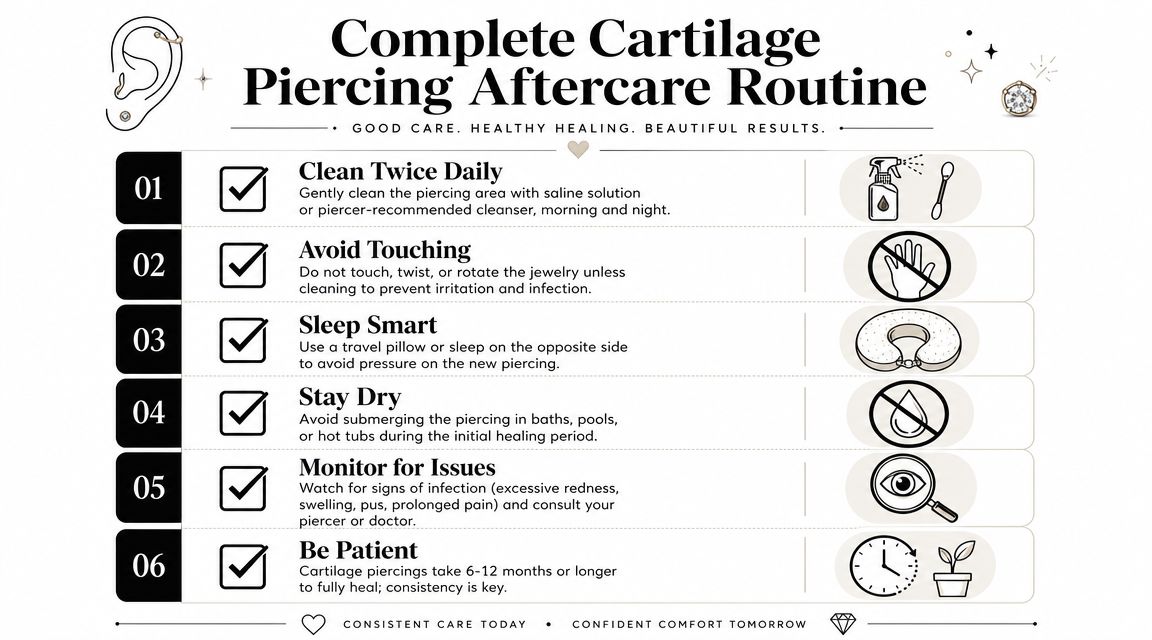
Use sterile saline, clean hands, and a light touch. The goal is to keep away dried discharge and surface debris without irritating the tissue that is trying to repair itself.
A simple routine looks like this:
Wash your hands first
If you need to go near the piercing, start with clean hands. This reduces the chance of transferring bacteria from your phone, hair, or daily surfaces.Use sterile saline
Spray or rinse the piercing gently. Saline works like a rinse, not a disinfecting scrub. You are softening buildup so it can lift away without friction.Leave the jewellery alone
Don't twist, rotate, or slide it back and forth. A fresh piercing channel is delicate, and movement can irritate the inside even if the outside looks fine.Dry it carefully
Pat the area dry or let it air dry fully. Damp skin can become more easily irritated, and rough towels can catch the jewellery.
That's the routine. Short, repeatable, and calm.
What usually delays healing
Healing often takes longer than first-time clients expect because cartilage has a limited blood supply compared with soft lobe tissue. Less circulation means slower repair. It does not mean something is wrong. It means the area needs more time and less disturbance.
Professional piercer Lynn Loheide explains in a helix healing guide that cartilage piercings can take many months to fully heal, and that pressure, snagging, and jewellery changes too soon can drag the process out. That matches what many experienced piercers see in the studio every day.
Common causes of setbacks include:
- Sleeping on the piercing, which presses on the angle and can keep it swollen
- Hair wrapping around the jewellery, especially with helix and forward helix placements
- Headphones or earbuds rubbing the area, depending on placement
- Towels, hoodies, and jumpers snagging the jewellery
- Changing jewellery early because the outside looks healed
If you want a smoother healing period, build your routine around reducing pressure. A travel pillow, careful hair brushing, and a bit more awareness when changing clothes can make a bigger difference than any fancy product.
What patience looks like in practice
Cartilage healing is rarely perfectly linear. You may have a week where it feels settled, then a day where it becomes sore after sleeping on it or catching it while brushing your hair. That pattern can be normal.
Here is a simple guide:
| Stage | What you may notice | What matters most |
|---|---|---|
| Early healing | Warmth, tenderness, swelling | Gentle cleaning and no pressure |
| Mid healing | On-and-off irritation, crusting, sensitivity | Consistency and low movement |
| Later healing | Looks much better but still reactive if disturbed | Wait before changing jewellery |
A useful rule is this: calm is good, but calm does not always mean healed.
What to avoid
A lot of aftercare mistakes come from trying too hard.
Avoid:
- Alcohol-heavy cleaners or strong antiseptics unless a clinician tells you to use them, because they can dry and irritate the area
- Ointments and creams that trap residue around the piercing
- Repeated checking in the mirror if it leads to touching or moving the jewellery
- Swimming or soaking if your piercer has advised you to avoid submerging a fresh piercing
If you are unsure whether what you are seeing is normal irritation or something that needs attention, contact your piercer sooner rather than later. If you need help finding someone reputable for a second opinion, this guide to professional piercers near me is a useful place to start.
Risks and How to Choose a Professional Piercer
A safe cartilage piercing starts before the needle ever touches your ear. It starts with who does it, what they use, and whether they treat cartilage like a specialised procedure rather than a quick add-on.
Cartilage infections can be more serious than ordinary lobe irritation. UK medical literature has highlighted that high ear piercings carry a significant risk of auricular perichondritis, a serious cartilage infection. Because cartilage has limited blood supply, infection is harder for the body to clear, and severe cases can lead to cartilage collapse and permanent disfigurement, as discussed in the medical report on high ear piercing complications.
What can go wrong
Not every problem is an emergency, but every problem deserves attention.
A fresh cartilage piercing may develop:
- Irritation bumps from pressure, poor jewellery fit, or movement
- Persistent swelling if the jewellery is too tight or the area is repeatedly knocked
- Migration if placement or jewellery choice isn't suitable
- Infection concerns if symptoms are escalating rather than gradually improving
The point isn't to scare you away from cartilage. It's to show why technique and environment matter more here than many first-time clients realise.
Green flags in a studio
When you're choosing a studio, look for signs that the team takes process seriously.
Good signs include:
- Single-use sterile needles rather than piercing guns for cartilage
- Clear discussion of jewellery materials including implant-grade options
- A clean, organised workspace
- Time for consultation rather than rushing you into the chair
- Aftercare guidance you can follow
- A willingness to say no if your anatomy doesn't suit a placement
You can also compare studios by checking a directory of professional piercers near you and then following up with direct questions before booking.
Red flags people often miss
Sometimes the warning signs aren't dramatic. They're subtle.
Be cautious if a studio:
- Uses a gun for cartilage
- Can't tell you what metal the jewellery is
- Dismisses healing questions
- Pushes decorative jewellery before discussing fit
- Acts as if all ear piercings are basically the same
The best piercers don't just perform the piercing. They explain the decision-making behind placement, jewellery choice, and healing.
That's what keeps a stylish idea from turning into a frustrating recovery.
Book Your Piercing in Croydon or Bournemouth
If you're ready to book, keep the process simple. Choose your preferred location, ask for a consultation if you're unsure about placement, and be ready to discuss jewellery options, anatomy, and healing expectations.
Studios in Croydon and Bournemouth can guide you through common cartilage options such as helix, conch, tragus, daith, rook, and flat piercings. If you're torn between placements, bring inspiration photos and let the piercer advise on what will sit well on your ear and heal reliably.
Before you confirm, ask what initial jewellery materials are available and whether implant-grade titanium is offered for fresh cartilage piercings. It's also worth checking whether the studio accepts walk-ins, appointments, or both, and whether you should avoid booking around travel, sports, or events where the piercing might get knocked.
For bookings and questions, call 01202 900050 (Bournemouth) / 020 8686 7730 (Croydon) or message WhatsApp 07752 913846 (Bournemouth) / 07902 490584 (Croydon). If you're nervous, that first message can be as simple as asking which cartilage placement is best for a first-timer.
Frequently Asked Questions About Cartilage Piercings
When can I switch to a hoop
Not just because the outside looks settled. Wait until your piercer is happy that the piercing is well healed and stable. Hoops can add movement and pressure in some placements, so switching too early often causes irritation.
What if I get an irritation bump
Don't panic, and don't start experimenting with random products. Irritation bumps often come from pressure, movement, sleeping on the ear, or jewellery issues. Go back to basics, keep the area calm, and ask your piercer to assess fit and placement.
Can I wear headphones with a new tragus or daith piercing
Sometimes, but it depends on the placement and the shape of your headphones or earbuds. If they press directly on the jewellery or trap moisture, it's better to avoid them while the piercing is fresh.
Is it safe to get both ears done at once
It can be, but think about how you sleep and how much healing effort you can realistically manage. If both sides are healing at once, you may struggle to sleep comfortably without putting pressure on one of them.
Should I clean crust off the jewellery
Only gently, and usually after saline or a warm shower has softened it. Don't pick at dry crust, because that can pull healing tissue and restart irritation.
How do I know if my anatomy suits a placement
You usually can't tell from online photos alone. A proper in-person assessment is the best way to know whether a placement is safe, stable, and likely to heal well on your ear.
If you're looking for a safe place to start, Piercing Near Me helps you find professional piercing services with a focus on experienced technique, implant-grade jewellery, and clear aftercare support. Whether you're planning your first cartilage ear piercing or comparing studios in Croydon or Bournemouth, you can explore your options and book with more confidence.