
You're standing in front of the bathroom mirror, turning your head from side to side. Your new helix, tragus, or conch piercing looks hotter and more swollen than it did yesterday. It's tender when your hair catches it, uncomfortable against your pillow, and you can't decide whether the crust around the jewellery is normal healing or the start of an infection.
That uncertainty is common, but cartilage deserves a more careful decision than an earlobe. This guide explains what may be happening, how to separate irritation from infection, when home care is reasonable, and when you should contact a GP, NHS 111, or hospital services. It also covers the studio choices and daily habits that reduce risk next time.
When a Cartilage Piercing Starts to Feel Wrong
You wake after sleeping on your new helix and find the ear more swollen than yesterday. The jewellery feels tight, your hair catches on it, and pale crust has formed around the entry point. The immediate question is whether this is normal irritation or an infection that needs medical attention.
Some early tenderness, mild warmth after cleaning, and a small amount of pale crust can occur during healing. A knock, pressure from a pillow, or clothing rubbing the site can make these symptoms more noticeable. They should gradually settle rather than steadily spread.
Pay closer attention if the ear becomes increasingly puffy, pain changes from a mild ache to a persistent throb, or redness extends beyond the piercing. Repeatedly cleaning or twisting the jewellery will not necessarily solve the problem and may further irritate the tissue.
The useful question isn't only “Does it look infected?” It's “Is it settling, staying localised, or getting worse?”
A large English population survey provides helpful context. Researchers surveyed 10,503 people and recorded complication information for 1,940 non-earlobe piercings. Complications occurred in 533 cases, or 27.5%, and infection was recorded in 73 of 754 piercings, or 9.7%. Professional help was sought for 51 cases, or 6.8%. These results include body-piercing sites beyond cartilage, so they are not a cartilage-specific rate. They do show why careful aftercare and early recognition matter.
Use a simple UK triage rule: mild, localised symptoms that are settling can usually be monitored with gentle aftercare; worsening symptoms should prompt contact with a GP or NHS 111; rapid swelling, severe pain, spreading redness, fever, or feeling very unwell warrants urgent medical assessment, including A&E when appropriate. You do not need to finish reading before seeking help.
Why Cartilage Infections Are Different from Lobe Infections
A sore lobe and a sore helix can look similar at first, but they involve different tissue. The earlobe is soft and has a relatively good blood supply. The firm upper ear is cartilage, which relies on the thin surrounding layer called the perichondrium for oxygen, nutrients, immune support, and access for medicines.
If bacteria reach that layer, the infection can become perichondritis, inflammation and infection around the cartilage. An abscess may develop between the perichondrium and cartilage. Reduced blood flow can then damage or kill cartilage, potentially changing the ear's shape.
A helix, flat, tragus, or conch piercing therefore needs a different level of attention. It is a different biological problem, not just a more painful lobe piercing. Pain alone does not decide the risk. The location, swelling, and direction of change matter.
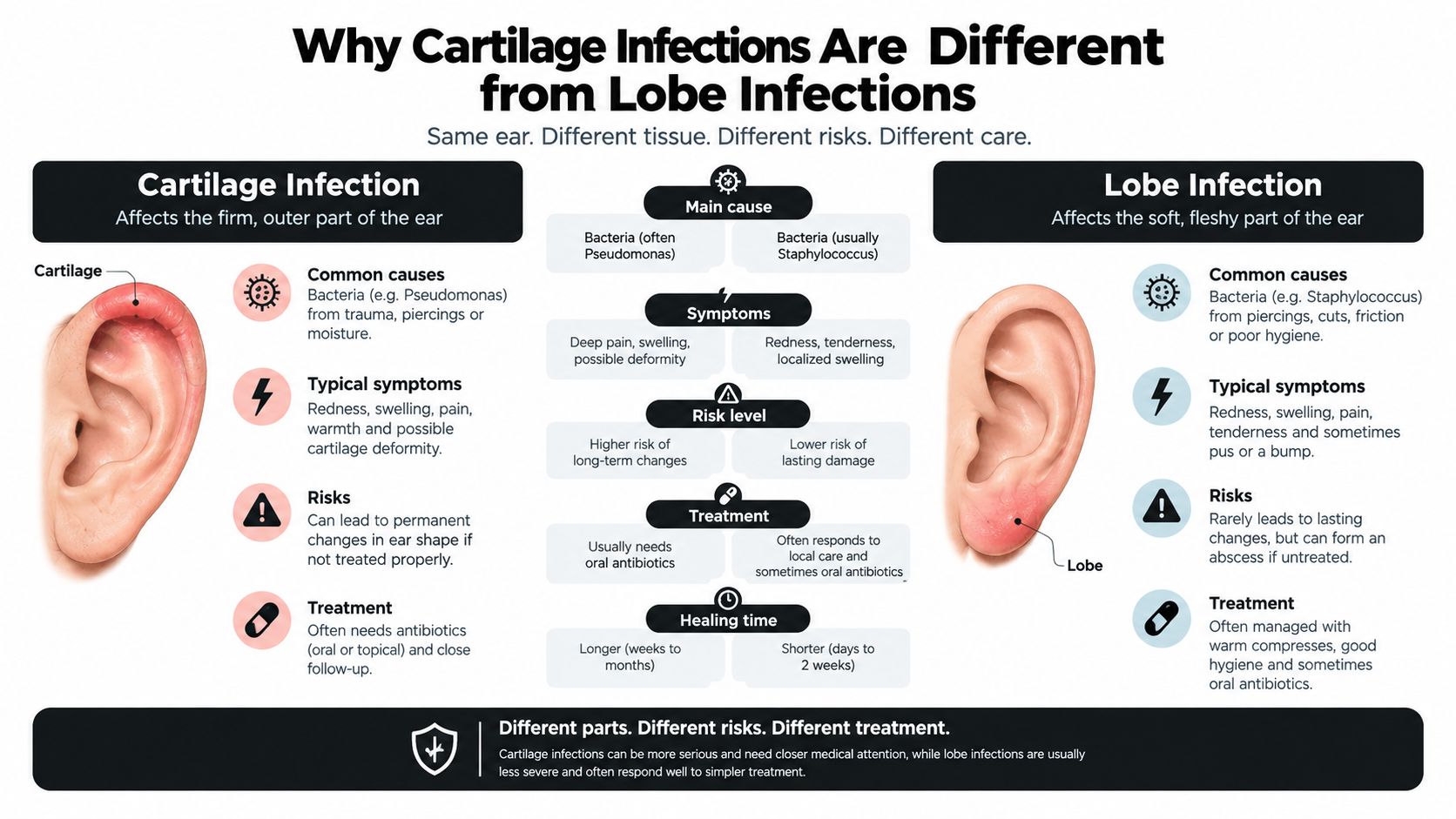
The UK Health Security Agency guidance on piercing-associated Pseudomonas identifies Pseudomonas aeruginosa as the usual cause of piercing-associated perichondritis. Staphylococcus aureus and other organisms can also cause infection. Pseudomonas may be difficult to manage without suitable medical treatment, so worsening cartilage symptoms deserve prompt assessment.
A 2016 English outbreak illustrates the concern. Public Health England identified 162 outbreak cases of Pseudomonas aeruginosa linked to body piercing. All confirmed cases involved ear piercings, and 93% affected cartilage (Public Health England's outbreak information for piercing businesses). Some infections required hospital care, procedures, and surgery. That is why cartilage infection should not be managed like ordinary lobe irritation when symptoms are spreading or intensifying.
What Causes Cartilage Piercing Infections and Who Is Most at Risk
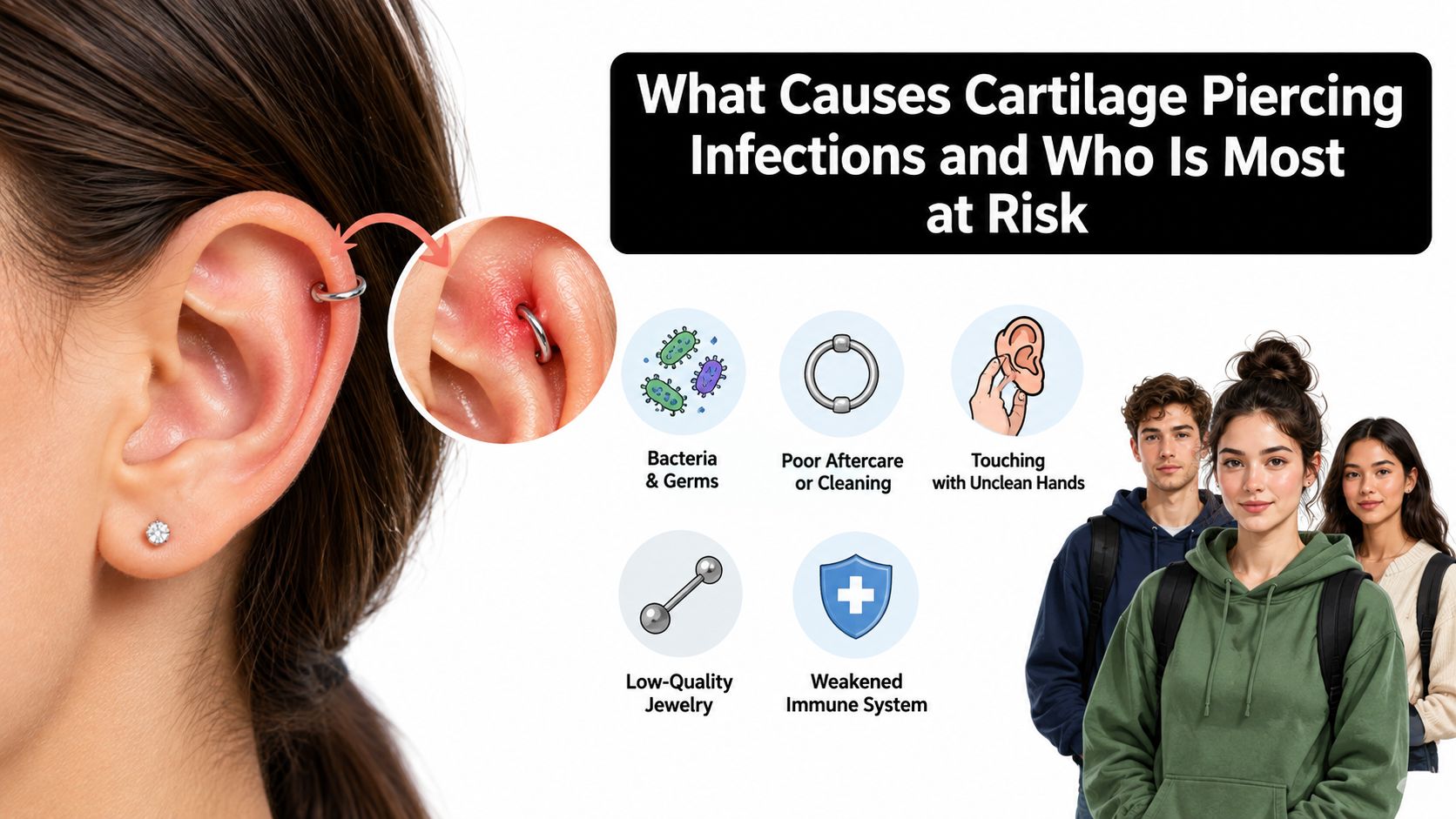
A cartilage piercing can become infected when bacteria enter through the healing channel. They may come from the original procedure, jewellery, hands, water, equipment, or repeated friction. A clean studio lowers the risk, but aftercare cannot make contaminated jewellery or liquid safe.
Common routes include:
- Unwashed hands: Touching, turning, or repeatedly checking jewellery transfers bacteria to the healing channel.
- Contaminated liquids: Tap water, homemade mixtures, reused bottles, or an applicator touching the wound can introduce organisms.
- Pressure and friction: Sleeping on a new piercing, wearing tight headphones, or catching a helix on clothing can keep tissue inflamed and weaken its protective barrier.
- Jewellery irritation: Low-quality alloys or nickel may cause contact dermatitis. The result can be red, itchy, swollen, or crusty skin without a bacterial infection. Damaged skin can then give bacteria an easier entry point.
- Poor equipment hygiene: Reusable equipment that has not been properly sterilised creates an avoidable exposure.
The aftercare product problem
The 2016 English outbreak shows that infection risk involves more than careless touching. Testing linked illness to a contaminated aftercare solution distributed to eight piercing studios. Use of that solution was associated with an adjusted odds ratio of 4.60, with a 95% confidence interval of 1.65 to 12.90, for infection, according to the UK Health Security Agency outbreak analysis.
The outbreak involved 162 cases, with 93% affecting cartilage, and 19 patients requiring surgery under general anaesthetic. The figures come from the government outbreak guidance. They do not mean every swollen piercing will need surgery. They show why a sealed, appropriate product matters and why worsening symptoms need medical assessment rather than more vigorous cleaning.
Age can affect who needs clearer guidance. In the English population survey, people aged 16 to 24 had complications in 233 of 754 piercings, or 31.0%, and professional help was sought for 115 cases, or 15.2%, as reported in the English survey data. These figures cannot predict what will happen to one person. They support careful aftercare explanations for first-time clients and parents, especially when someone is unsure whether normal healing has changed into a problem.
Recognising the Warning Signs at Every Stage
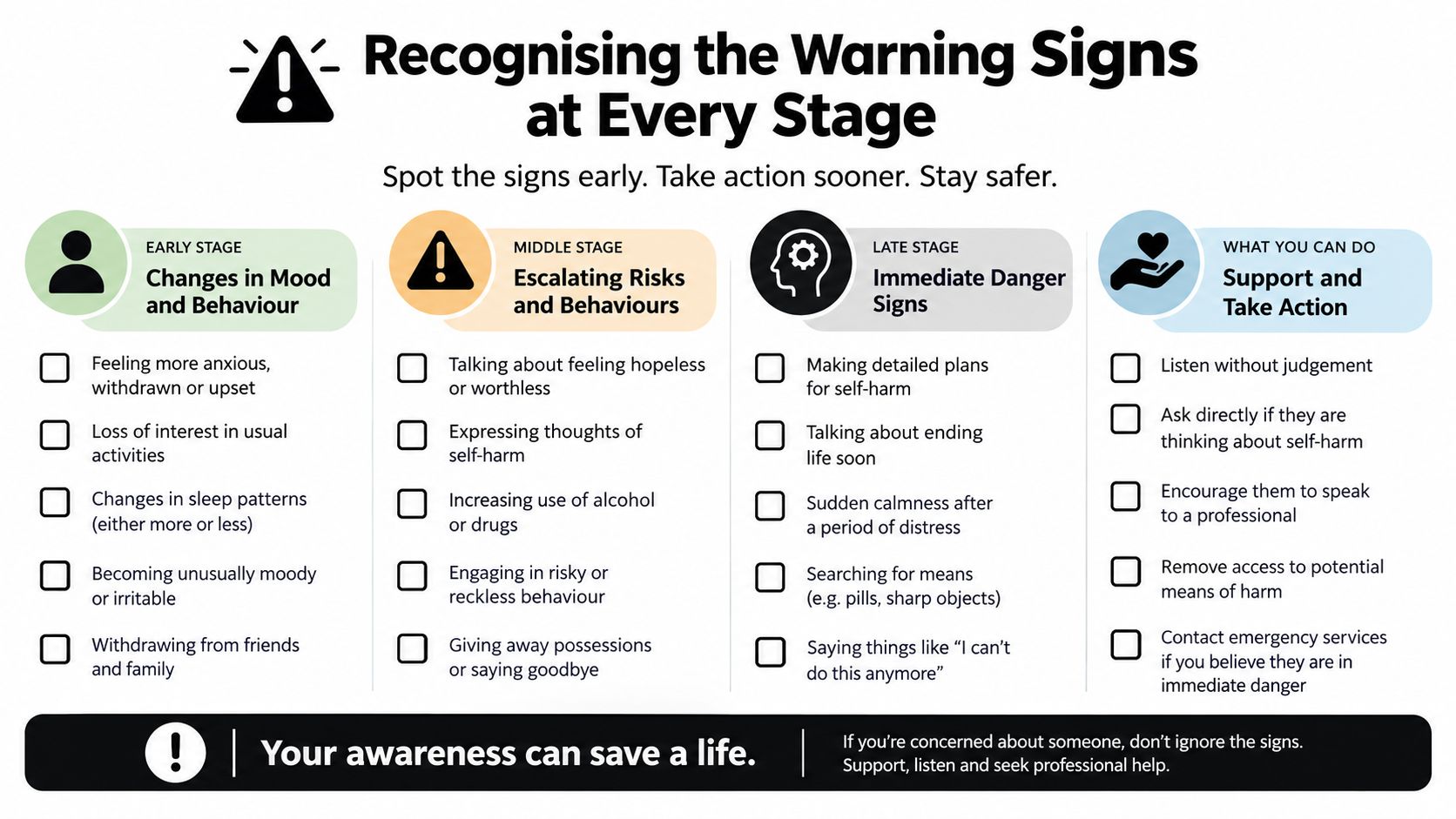
A sore cartilage piercing can look alarming after a night of sleeping on it. The useful question is how the symptoms are changing, not what one photograph shows. Slight tenderness and pinkness can fit normal healing, while a serious infection may start subtly.
Stage one, likely irritation
Mild tenderness, limited redness, and a little pale crust can occur during ordinary healing. A small bump may be a granuloma, where trapped fluid creates a lump without proving infection. The NHS advises that a warm-water compress once daily may help some granulomas (NHS advice on infected piercings).
Irritation usually stays close to the jewellery and follows an obvious trigger, such as sleeping on the ear, catching it with a towel, or pressing it with headphones. Remove the trigger and monitor the direction of change. Pain, heat, swelling, or redness that steadily increases needs a higher level of care.
Stage two, prompt medical assessment
Arrange an urgent GP appointment or contact NHS 111 if you develop swelling, pain, heat, marked redness or darkening, or blood or pus around the piercing. Discharge may be white, green, or yellow. Feeling hot, cold, shivery, or generally unwell also warrants medical advice.
A guide to telling whether a piercing is infected can help you compare symptoms, but it cannot examine the ear. Cartilage needs particular caution because infection there can affect firmer tissue rather than only the soft skin around a lobe piercing.
Stage three, same-day hospital care
Seek same-day urgent care if pain is rising quickly, the outer ear is intensely hot or swollen, bleeding develops, or the ear starts to look misshapen. Fever or significant illness increases the urgency. These signs can fit perichondritis, an abscess, or infection spreading beyond a small local reaction.
The 2016 outbreak shows why delayed escalation can lead to more involved treatment. Among cases with available information, 39% attended primary care, 34% attended hospital, and 29% required a medical procedure. 13% needed surgery under general anaesthetic (UK outbreak guidance for businesses, 2016: 39% primary care, 34% hospital, 29% procedure, 13% surgery).
A visibly changing ear, severe pain, fever, or spreading redness needs medical assessment, not more vigorous cleaning at home.
Evidence-Based Treatment from Self-Care to Hospital
Treatment depends on whether you're dealing with irritation, a local infection, or perichondritis. Home care can protect a healing piercing from further trauma, but it can't replace antibiotics or drainage when infection has entered deeper tissue.
For minor irritation with no worsening redness, pus, fever, or spreading swelling, keep the area simple. Wash your hands before touching it, rinse with sterile saline intended for wound care, and dry gently without rubbing. Don't rotate the jewellery, squeeze a bump, or use alcohol, hydrogen peroxide, tea tree oil, or harsh antiseptic sprays. These products can irritate healing tissue and make the situation harder to judge.
The NHS advises people in the UK to seek an urgent GP appointment or NHS 111 help if they think a piercing is infected. It also generally advises leaving jewellery in unless a doctor tells you to remove it. Treatment may include an antibiotic cream, ointment, or tablets, depending on the assessment (NHS guidance on infected piercings).
What clinicians may do
A GP or other clinician will assess the location, progression, discharge, swelling, and your general health. They may prescribe treatment for a local bacterial infection. Don't use leftover antibiotics or someone else's prescription, because the correct medicine depends on the suspected organism and the seriousness of the infection.
Suspected perichondritis may need faster escalation. UK guidance explains that initial intravenous antibiotics can be necessary rather than topical antiseptics or leftover medication. Oxford University Hospitals recommends antipseudomonal treatment for pinna cellulitis involving a piercing or evidence of perichondritis, including intravenous ceftazidime with a switch to oral ciprofloxacin when clinically appropriate (Oxford University Hospitals guidance).
If an abscess has formed or cartilage has become damaged, hospital teams may need to drain the collection or remove damaged tissue. That's why worsening symptoms deserve assessment even if you've been cleaning carefully.
For practical aftercare information alongside medical advice, see this infected piercing treatment guide. If your ear is rapidly deteriorating, contact NHS 111 or seek urgent hospital care rather than waiting for a routine appointment.
Studio Best Practices and Jewellery Choices That Prevent Infection
Prevention starts before the needle touches your ear. A professional consultation should include placement, anatomy, jewellery fit, sterilisation, and aftercare, not just a quick choice of stud.
| What to check | Safer approach | Why it matters |
|---|---|---|
| Piercing method | A single-use sterile needle | It creates a controlled channel without using a piercing gun on cartilage |
| Reusable equipment | Autoclave sterilisation and routine spore testing | The studio can verify that its steriliser is working properly |
| Jewellery packaging | Individually packed jewellery opened for you | Packaging helps protect the jewellery before insertion |
| Jewellery material | Implant-grade titanium or solid 14k or 18k nickel-safe gold | Known materials reduce avoidable irritation |
| Studio questions | Ask how equipment is sterilised and which material standards are stocked | A clear answer shows that safety is part of the process |
Piercing guns are not appropriate for cartilage. They use force to push jewellery through tissue, and their design makes thorough sterilisation between clients difficult. A sterile hollow needle gives the piercer better control over placement and tissue handling.
Jewellery needs equal attention. Implant-grade titanium is a practical choice for many clients. Solid 14k or 18k nickel-safe gold can also be suitable when it meets appropriate standards. Mystery metals, plated items, and very cheap alloys make it harder to identify whether ongoing redness comes from infection, pressure, or contact dermatitis.
Questions to ask before booking
- Sterilisation: “Do you use an autoclave, and how do you test it?”
- Packaging: “Will I see the sterile needle and jewellery opened for my appointment?”
- Material: “Is the jewellery implant-grade titanium or a documented nickel-safe gold?”
- Aftercare: “What should I use, and who do I contact if the piercing worsens?”
- Anatomy: “Is this placement suitable for the shape and thickness of my ear?”
A reputable piercer won't be offended by these questions. They'll explain the process, check the fit, and avoid rushing you into several healing cartilage piercings at once.
Aftercare Habits That Keep Cartilage Healing Clean
Consider three common situations. A helix catches on a hoodie every morning, so the wearer changes clothes slowly and keeps hands away from the jewellery. A tragus is pressed by in-ear headphones, so the headphones are paused while the area settles. A conch is sore each morning because the sleeper rolls onto that side, so pressure is removed rather than answered with extra cleaning.
Use sterile saline as directed for wound care, then let the area dry naturally or pat it gently with a clean disposable product. Wash your hands first, keep hair products and cosmetics away from the piercing, and clean your phone and headphones regularly. Don't twist the jewellery to “keep it from sticking”.
Swimming pools, hot tubs, open water, sweaty gym equipment, and contact sports can expose a fresh piercing to contamination or knocks. You may need to pause activities, protect the ear from impact, and ask your piercer for placement-specific advice. Never cover a worsening infection with a plaster and carry on as normal.
For a simple routine, follow this guide to cleaning a cartilage piercing. If pain, heat, swelling, discharge, or redness is increasing, cleaning alone isn't enough. Use the triage framework above and seek medical help promptly.
A quick check today is practical: compare both ears in good light, note whether symptoms are improving or spreading, remove pressure from the piercing, and contact NHS 111 or an urgent GP service if infection seems likely. For future appointments, ask about sterile needles, implant-grade jewellery, and personalised aftercare before you book.
If you need help finding a professional studio for a new piercing or an aftercare conversation, visit Piercing Near Me, which lists piercing services connected with Timebomb Tattoo & Piercing studios in Croydon and Bournemouth. You can also contact the team on 01202 900050 (Bournemouth) / 020 8686 7730 (Croydon) or WhatsApp 07752 913846 (Bournemouth) / 07902 490584 (Croydon) to discuss your appointment needs.