
If you're staring at photos of a helix, conch, or tragus piercing and thinking, “I love it, but how much is this going to hurt?”, that's a very normal place to be. The concern isn't the jewellery. It's the apprehension of the unknown.
The good news is that cartilage piercing pain is usually much easier to handle when you understand what's normal, what makes it worse, and what counts as a genuine warning sign. The piercing itself is quick. The part that catches people off guard is the healing phase, because cartilage can stay tender far longer than a lobe.
What matters most is having realistic expectations. You want to know the difference between a brief sharp pinch, a few days of throbbing, and the kind of worsening pain that needs attention. That's where clear guidance helps.
Your Guide to Understanding Cartilage Piercing Pain
A lot of nervous clients expect one of two extremes. Either they imagine unbearable pain because of stories online, or they assume it's just like a lobe and they'll forget about it by the next day. The truth sits in the middle.
Most cartilage piercings feel sharp and pressurised at the moment of piercing, then settle into soreness, warmth, and sensitivity. After that, healing becomes a slow process of keeping the area calm. That's why two people can both say “it hurt”, but mean very different things. One may be describing the split-second needle pass. The other may be talking about the next few weeks of sleeping carefully and avoiding knocks.
Practical rule: Judge a cartilage piercing by its healing behaviour, not just by the first second.
If you're informed before you book, you're far less likely to panic over normal tenderness or ignore symptoms that need medical review. That balance matters. Reassurance is helpful, but so is honesty.
Why Cartilage Piercings Feel Different Than Lobes
Your earlobe is soft tissue. Cartilage is firmer, denser tissue with less direct blood supply. That's why a cartilage piercing doesn't feel like a simple lobe sting.
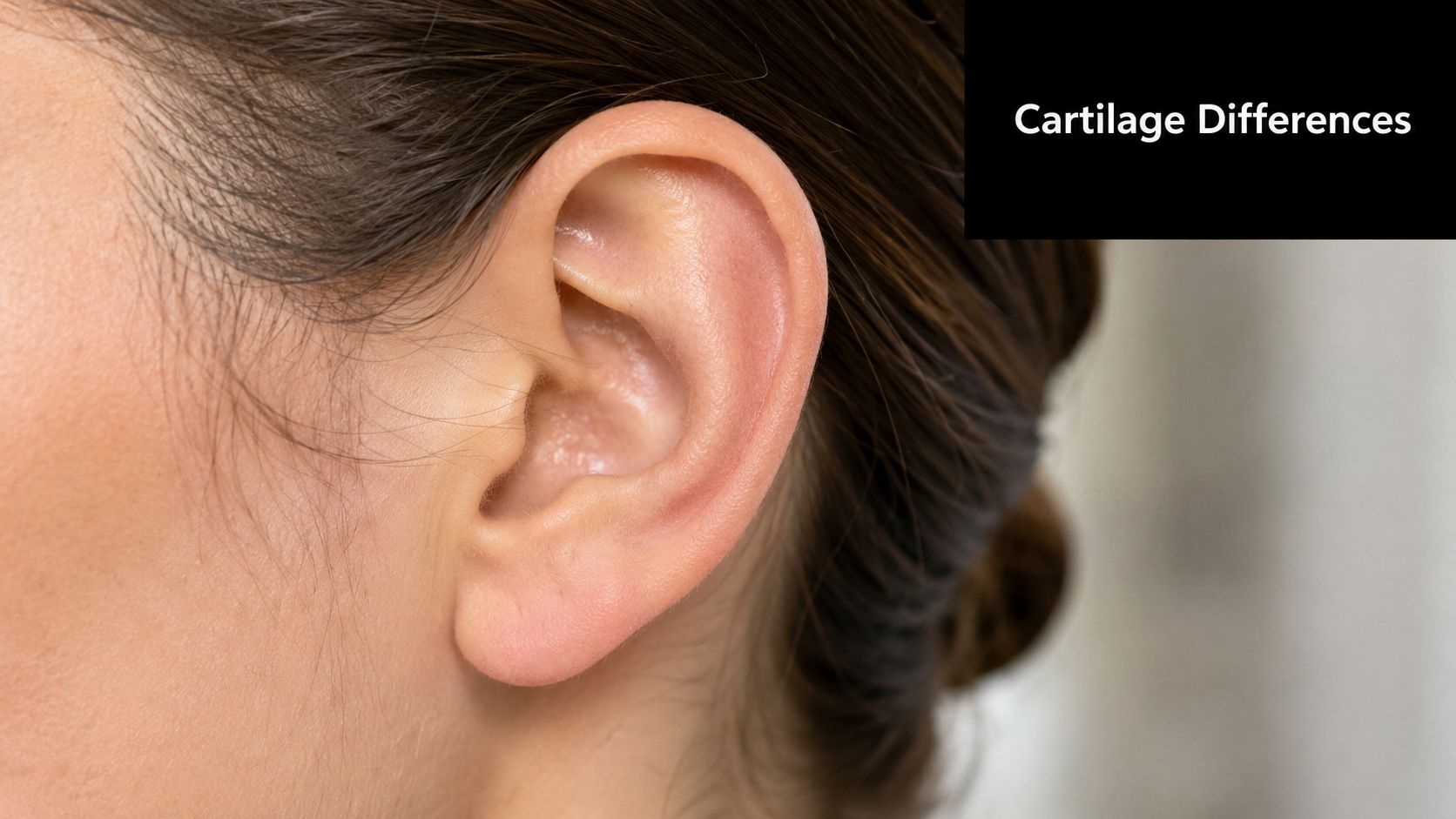
A needle passing through a lobe moves through something soft and flexible. A needle passing through cartilage meets more resistance, so the sensation is often described as sharp pressure or pinching rather than a quick flick. Guidance discussed by WebMD on cartilage piercings also notes that cartilage is dense and avascular, and that healing commonly takes 4 to 12 months.
Why the healing feels slower
That longer healing time affects the pain experience. The actual piercing may be brief, but a cartilage piercing can become sore again if you catch it with a hairbrush, sleep on it, or wear jewellery that irritates the channel.
That's why people sometimes get confused. They think, “It was fine at first, so why is it still tender?” Usually, it's because cartilage doesn't like repeated pressure.
A calm cartilage piercing usually improves gradually. An irritated one often feels like it keeps getting reset.
Cartilage Piercing Pain Scale and Healing Timeline
People often ask for a number, which is fair. Pain scales aren't perfect, but they do help set expectations.
One cartilage piercing pain guide places many common cartilage piercings such as helix, flat, tragus, conch and daith at 4 to 5 out of 10, while another guide in the same source ranks helix at 5 to 6 out of 10 and tragus or daith at 6 to 7 out of 10. The same source notes that the needle pass takes less than a second, while healing commonly takes 3 to 6 months for upper-ear cartilage and 6 to 12 months for inner cartilage such as tragus or conch.
Cartilage Piercing Pain & Healing Times
| Piercing Type | Initial Pain (1-10) | Average Healing Time |
|---|---|---|
| Helix | 4-5 or 5-6 | 3-6 months |
| Flat | 4-5 | 3-6 months |
| Tragus | 4-5 or 6-7 | 6-12 months |
| Conch | 4-5 | 6-12 months |
| Daith | 4-5 or 6-7 | 6-12 months |
If you want a deeper breakdown of placement-by-placement recovery, this guide on cartilage piercings healing is a useful next read.
What the numbers actually mean
A 4 or 5 out of 10 usually means “noticeably sharp, but very manageable”. A 6 or 7 out of 10 often means “more intense pressure and a stronger immediate ache”, not “unbearable”.
The bigger issue is patience. A helix may settle faster than a deeper inner-ear placement, but any cartilage piercing can become grumpy if it gets knocked repeatedly.
What Can Make Cartilage Piercing Pain Worse
Most long-lasting cartilage piercing pain isn't caused by the piercing appointment. It's caused by what happens afterwards.
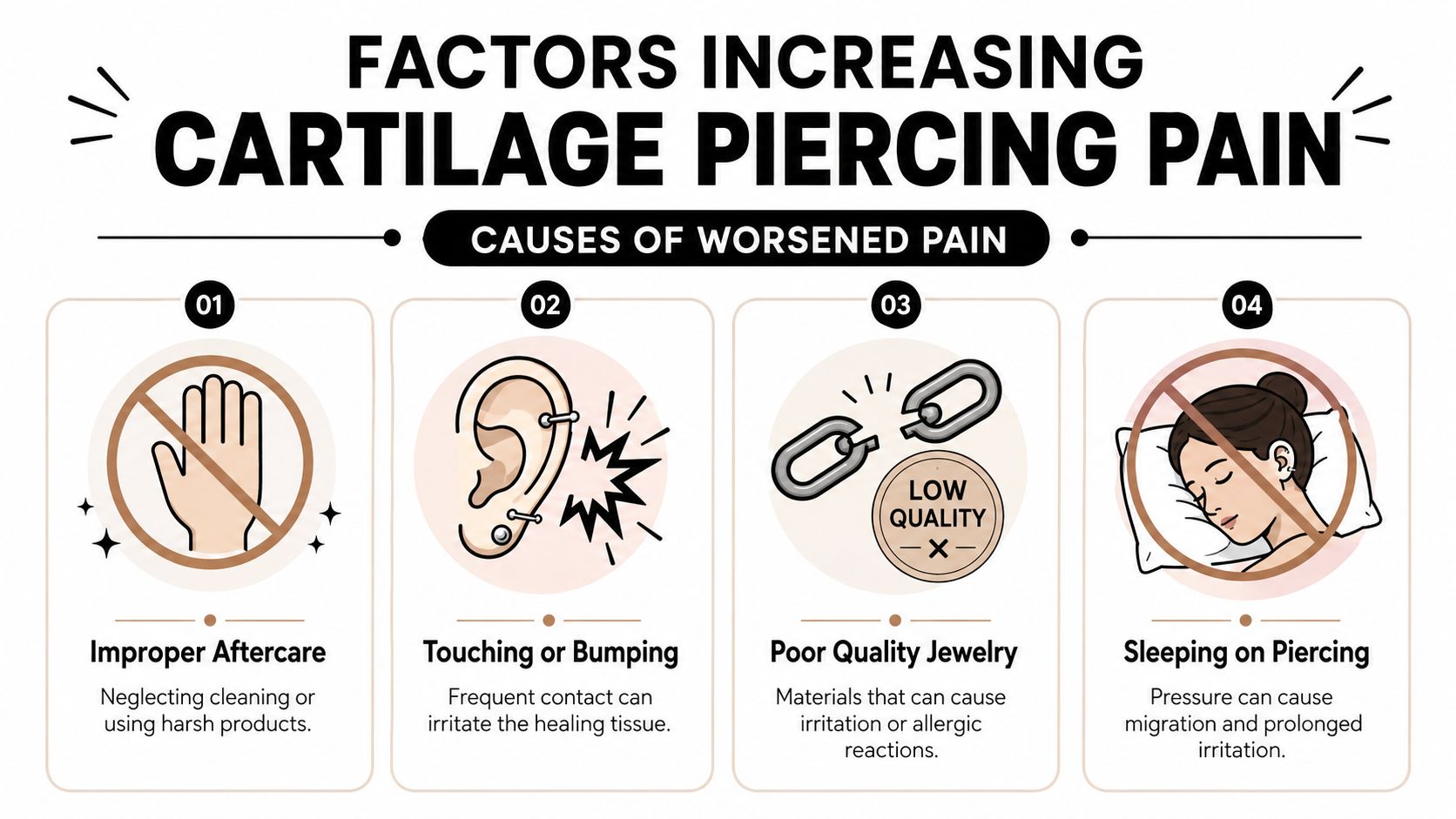
Guidance from Smoothie London on why cartilage piercings won't heal points to mechanical irritation as a major pain amplifier. In plain terms, that means the piercing gets bothered over and over again.
Common causes of extra soreness
- Touching and twisting. Fresh cartilage doesn't need movement. Twisting can reopen the fragile channel your body is trying to heal.
- Sleeping on it. Pressure can make a piercing swell, ache, and stay tender for much longer.
- Low-quality jewellery. Poor materials can irritate the tissue and keep inflammation going.
- Snagging and bumping. Towels, hair, headphones, phones, and clothing all cause more trouble than people expect.
The same guidance recommends implant-grade titanium or solid gold and minimal handling. That advice matters because material quality and stability affect how reactive the tissue becomes.
A simple way to think about it
Cartilage likes stillness. If the jewellery is appropriate and the area is left alone, discomfort usually settles. If the piercing gets pressure every day, pain often lingers.
If a piercing feels fine until you sleep on it, wear tight headphones, or catch it while brushing your hair, irritation is the likely culprit.
How to Manage Pain and Promote Healing
The goal isn't to make a fresh piercing feel like nothing happened. The goal is to keep it clean, settled, and protected so your body can do the healing work.
What helps most
- Sterile saline. Use a simple sterile saline wound wash as directed for gentle cleaning. If you want to understand what to buy and why it matters, read this guide to saline spray for piercing care.
- Warm water in the shower. Let clean warm water run over the area. Don't scrub it.
- Hands off. Don't twist, spin, or keep checking it.
- Reduced pressure. A travel pillow or donut-style pillow can help side sleepers keep the ear suspended.
- Calm swelling support. A cold compress can be soothing in the early stage if used carefully and cleanly.
What to avoid
Harsh products often cause more trouble than they solve. Alcohol, hydrogen peroxide, strong oils, and random home remedies can dry and irritate healing tissue.
Jewellery changes should also wait until the piercing is ready and your piercer says it's appropriate. Early changes are a common reason cartilage becomes angry again.
If you're unsure whether what you're feeling is normal, ask. A quick check can prevent a small irritation from turning into a bigger problem. You can call 01202 900050 (Bournemouth) / 020 8686 7730 (Croydon) or send a photo on WhatsApp to 07752 913846 (Bournemouth) / 07902 490584 (Croydon) for guidance.
Normal Soreness vs Infection Warning Signs
This is the often-overlooked aspect that is rarely explained properly. Cartilage piercing pain isn't just about “does it hurt?”. It's about how the pain behaves over time.
Clinical and consumer guidance often leaves a gap here, even though Mayo Clinic's piercing overview notes that upper-ear cartilage piercings can lead to perichondritis and abscess formation. That's why a practical red-flag guide matters.
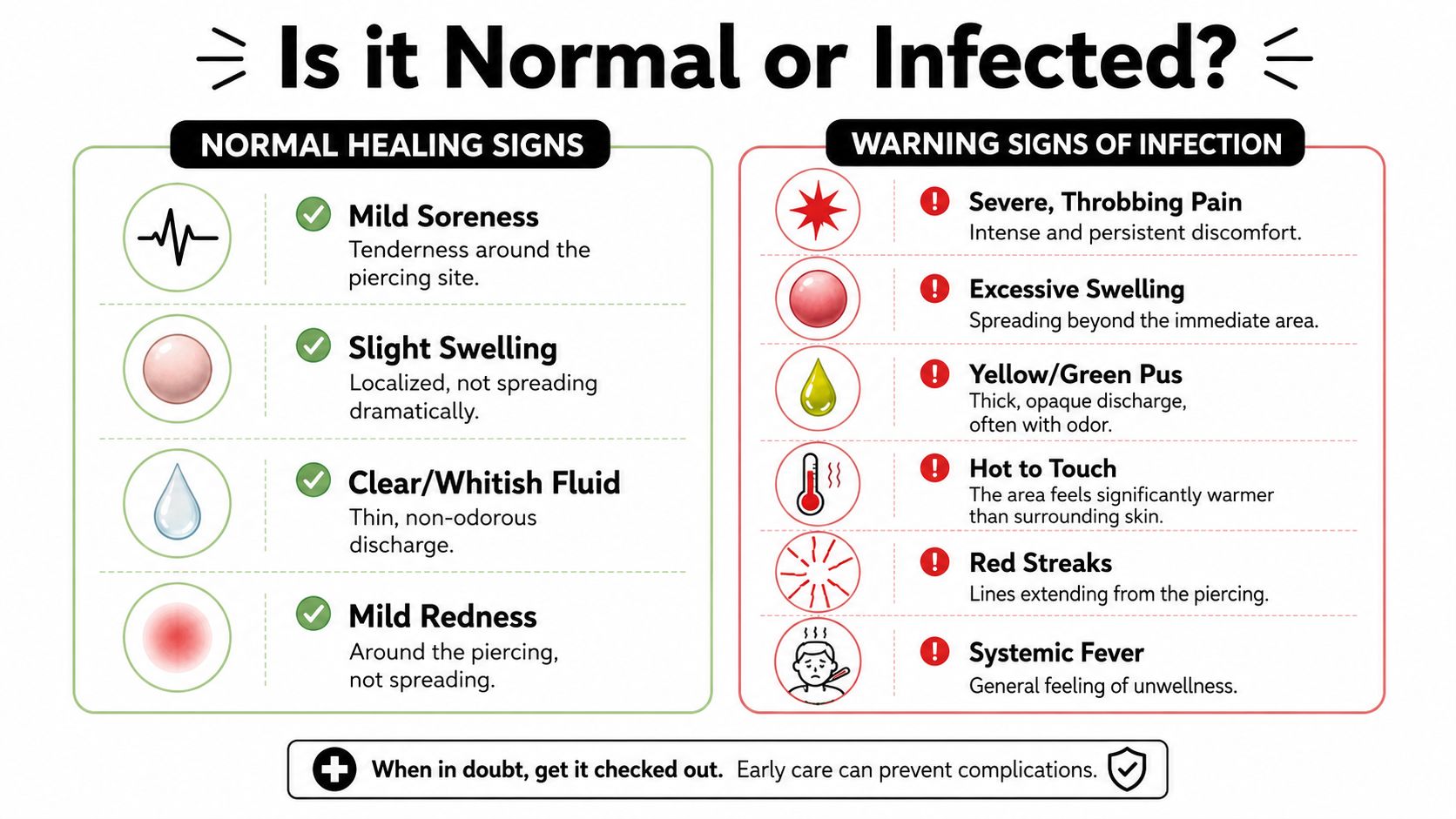
What usually counts as normal
A healing cartilage piercing often has:
- Mild to moderate soreness
- Localised swelling
- Tenderness when knocked
- Mild redness close to the entry point
- Clear or whitish fluid that dries into crust
These signs can come and go. A piercing may seem settled, then flare slightly after being bumped.
What should make you pay attention
Pain becomes more concerning when it stops acting like healing pain and starts acting like inflammation or infection.
Look out for:
- Pain that gets worse rather than better
- Throbbing that feels stronger over time
- Heat in the surrounding tissue
- Swelling that spreads beyond the piercing area
- Thick yellow or green discharge
- A bad smell
- Red streaking or feeling generally unwell
If you want a fuller checklist, this guide on how to tell if a piercing is infected can help.
When to worry
A good rule is this: normal healing tends to fluctuate but gradually improve. Infection or perichondritis often shows up as escalating symptoms.
The UK clinical picture is worth taking seriously. A BMJ report on piercing complications found that the incidence of auricular perichondritis in England and Wales more than doubled between 1990–91 and 1997–98, linked “high” transcartilaginous ear piercing to infection and cartilage damage, and noted a Rochdale survey where 95% of local general practitioners had treated body-piercing complications, mainly infections.
Don't wait for severe pain before acting. Hot, worsening, spreading symptoms deserve prompt review.
If you have intense pain, marked heat, significant swelling, pus, or you feel unwell, contact a medical professional urgently. If symptoms are mild but worrying, contact your piercer promptly for advice and then seek medical care if symptoms progress.
Book Your Piercing with Confidence
A good cartilage piercing starts long before the needle touches your ear. It starts with safe technique, suitable jewellery, and clear aftercare.
If you're choosing between studios, focus on the basics that affect outcome. Ask what jewellery they use for fresh piercings. Ask how they clean and set up. Ask what support you'll get if the piercing becomes irritated during healing.
What builds confidence
- Sterile single-use needles
- Quality initial jewellery
- A piercer who explains placement clearly
- Aftercare you can follow
- Support if healing becomes confusing
You shouldn't feel rushed or talked into a placement that doesn't suit your anatomy or lifestyle. If you sleep heavily on one side, wear helmets or earbuds often, or know you're prone to touching piercings, that should be part of the conversation.
If you've still got questions before booking, you can call 01202 900050 (Bournemouth) / 020 8686 7730 (Croydon) or message 07752 913846 (Bournemouth) / 07902 490584 (Croydon) on WhatsApp.
Frequently Asked Questions
Does cartilage piercing pain last longer than lobe pain
Yes, in most cases it does. The main reason isn't that the actual piercing takes longer. It's that cartilage tends to stay tender for longer during healing.
A lobe often settles more quickly because it's softer tissue. Cartilage is less forgiving. That's why people who cope well with the appointment itself sometimes get frustrated later. The ear may still react to pressure, accidental knocks, or sleeping on that side long after the excitement of getting pierced has passed.
That doesn't mean something is wrong. It means the tissue needs more patience and less interference.
Which cartilage piercing hurts the most
There isn't one universal answer because anatomy, thickness, and personal pain tolerance all matter. Even so, many people find inner or thicker placements such as daith, tragus, or conch feel more intense than a standard helix.
The better question is often not “which hurts most?” but “which will suit my ear and my lifestyle best?”. A slightly more intense piercing that you can protect properly may be easier overall than a “milder” one you keep catching on hair, glasses, or pillows.
Is the needle part the worst bit
The sharpest sensation is the needle pass itself, but it's very brief. What follows is usually a hot, pressurised, or throbbing feeling that fades into soreness.
That's why experienced piercers often say the appointment is the easy part. Healing is what asks something of you. You need to clean gently, avoid pressure, and not fiddle with the jewellery every time you pass a mirror.
How long should a new cartilage piercing feel sore
There's no single neat answer because soreness comes in phases. A piercing often feels most obviously fresh in the early days, then improves, then gets irritated again if something presses on it.
The key pattern matters more than the exact timeline. If the piercing is generally settling, even with occasional flare-ups after bumps, that tends to fit normal healing. If pain is intensifying, spreading, or becoming hot and throbbing without a clear cause, that needs closer attention.
Is throbbing normal after a cartilage piercing
A bit of throbbing can be normal early on, especially after the procedure or after accidental irritation. The concern is when throbbing becomes stronger rather than milder, or arrives with heat, spreading redness, marked swelling, or discoloured discharge.
People often worry because they feel a pulse-like ache and assume infection straight away. That isn't always the case. Fresh wounds can pulse a little. What matters is whether the overall trend is improving or worsening.
Why does my piercing feel fine some days and painful on others
That pattern is very common with cartilage. The ear can look calm one day and feel annoyed the next because small things matter. You may have slept on it without realising, caught it while changing clothes, used over-ear headphones, or brushed against it with a phone.
Cartilage healing isn't always linear. Think of it as “generally getting better, with setbacks if disturbed”. That's frustrating, but normal.
Do cartilage piercings always swell a lot
No. Some swell very little. Others puff up noticeably. Swelling depends on the placement, your body's response, and how much the area gets disturbed afterwards.
The more useful point is whether the swelling is local and stable, or whether it's increasing and spreading. Local swelling around the site is expected. Swelling that keeps building, especially with strong pain and heat, deserves attention.
Can I sleep on a fresh cartilage piercing if it doesn't hurt
It's better not to. Pain isn't the only issue. Pressure can shift the angle of healing, cause irritation, and keep the channel inflamed even before you feel obvious pain.
Some people only realise they've been sleeping on the piercing when they wake up with tenderness or swelling. A pillow with an ear gap can make a big difference if you naturally roll onto that side.
Should I twist the jewellery to stop it sticking
No. Twisting is one of the most common habits that keeps cartilage irritated.
A fresh piercing isn't a dry hole that needs loosening. It's a healing channel trying to form stable tissue around the jewellery. Twisting disrupts that tissue, introduces bacteria from your hands, and can restart soreness.
What does normal discharge look like
Normal healing fluid is usually clear or whitish and may dry into pale crusts around the jewellery. That can look dramatic if you weren't expecting it, but it's often just part of the healing process.
What's more concerning is thick yellow or green discharge, especially if there's odour, heat, and increasing pain. Context matters. Discharge on its own isn't enough to diagnose a problem, but discharge plus worsening symptoms is much more significant.
Is a bump always a sign of infection
No. Irritation bumps are common with cartilage piercings. They often happen because of pressure, snagging, sleeping on the ear, unsuitable jewellery, or over-cleaning.
An irritation bump usually sits close to the piercing and may be annoying rather than severely painful. Infection tends to look and feel more inflamed overall. If you're unsure, get it assessed instead of guessing.
Can low-quality jewellery make cartilage piercing pain worse
Yes, absolutely. Material and fit both matter. Jewellery that irritates the tissue, sits too tightly, or moves too much can keep the area sore.
That's one reason professionals prefer high-quality materials for fresh piercings. A healing piercing needs stability and biocompatibility. It doesn't need extra stress from mystery metals or badly fitted pieces.
Why does my cartilage piercing hurt weeks later
Because cartilage can react late. A piercing may feel mostly fine, then become sore after pressure or irritation. That doesn't automatically mean infection.
What matters is the cause and the pattern. If you can connect the soreness to sleeping on it, catching it, or changing your routine, irritation is a strong possibility. If there's no obvious trigger and symptoms are escalating, it's worth asking for help.
Can infections appear later, not just right after the piercing
Yes. That catches many people out. Some assume that if the first week went smoothly, they're in the clear.
Cartilage infections can develop later, especially if the piercing becomes irritated repeatedly or bacteria are introduced during touching, aftercare mistakes, or jewellery problems. That's why you shouldn't stop paying attention once the first soreness fades.
What does perichondritis mean in simple terms
Perichondritis is an infection or inflammation affecting the tissue around the ear cartilage. In simple terms, it's not the kind of problem you want to brush off as “probably just irritation” if symptoms are worsening.
Because cartilage doesn't heal as easily as a lobe, serious inflammation there can become a bigger issue. That's why hot, swollen, worsening cartilage piercings need prompt medical review.
Should I remove the jewellery if I think it's infected
Don't make that decision casually on your own. If you suspect infection, speak to your piercer and seek medical advice promptly.
People often assume removing jewellery is always the safest move, but that isn't automatically true in every situation. What matters is getting proper assessment. The wrong move at the wrong time can complicate things.
Are headphones bad for fresh cartilage piercings
They can be. Over-ear headphones may press on helix or flat piercings. Earbuds can bother placements closer to the ear canal, depending on the design and fit.
If a device puts pressure on the area, heats it up, or nudges the jewellery, it can slow healing. During the early stage, comfort and space matter more than convenience.
Can I get more than one cartilage piercing at once
Some people do, but more piercings mean more healing to manage. If you're nervous about pain or you know you struggle with aftercare, starting with one is often the easier route.
It also gives you a chance to learn how your body heals. Some people are excellent healers. Others find one cartilage piercing demanding enough. There's no prize for doing everything at once.
Why do people say cartilage piercing pain is manageable if it lasts so long
Because “manageable” doesn't mean invisible. It means individuals can cope with it when they know what to expect.
A cartilage piercing usually doesn't leave people unable to function. It asks for care, awareness, and patience. That's different from severe pain. The challenge is that the healing period is long enough to become annoying if you weren't prepared for it.
How do I know whether to contact my piercer or a doctor
Contact your piercer for advice on normal healing, irritation, bumps, cleaning questions, jewellery concerns, and mild changes that aren't clearly severe. Contact a doctor urgently if symptoms suggest infection that is worsening or spreading.
A simple guide
- Contact your piercer if it's sore, crusty, slightly swollen, or irritated after a knock and you want help working out what's normal.
- Seek medical care promptly if it's hot, increasingly painful, producing thick discoloured pus, or the swelling is spreading.
- Seek urgent medical attention if you feel unwell, have fever, or there are clear signs the infection may be progressing.
If you're unsure, it's better to ask early than wait too long. You can call 01202 900050 (Bournemouth) / 020 8686 7730 (Croydon) or send a photo by WhatsApp to 07752 913846 (Bournemouth) / 07902 490584 (Croydon) for guidance on whether what you're seeing looks like normal healing or something that needs escalation.
If you're ready to find a reputable studio, compare placements, and book with more confidence, Piercing Near Me makes it easy to explore trusted options, learn about healing, and connect with professional support before and after your appointment.
Trackbacks/Pingbacks