
You're standing in front of the bathroom mirror with a thin metal hoop between your thumb and forefinger, wondering which end should pass through your piercing first. There's a slight gap beneath your fingertip, the metal resists when you try to move it, and then you realise there's no obvious hinge or clasp. The circle is designed to look uninterrupted.
That hidden closure is the key to understanding continuous hoop earrings. The way the ring bends open affects how it's fitted, how it sits in a helix or lobe, which materials are appropriate, and whether it's sensible for a healing piercing. The labels used by UK shops can add more confusion, particularly when "continuous" and "endless" describe different constructions.
I've fitted enough hoops to know that most problems start before the jewellery reaches the ear. This guide covers the mechanics, sizing, metals, insertion, aftercare, and the checks that matter when choosing a piercer in Croydon or Bournemouth.
The Hoop in the Mirror
The client in the mirror turns the hoop again. One end seems slightly longer, but neither end looks like a conventional post. She can feel the junction with her nail, yet the circle still appears whole from the front. When she tries to pull the sides apart, the ring loses its shape almost immediately.
That's the first practical lesson. A continuous hoop isn't opened by stretching the circle wider. You twist the ends out of alignment, guide one end through the piercing, then bring the ends back together so the closure becomes difficult to see.
Practical rule: The ring should open at the junction, not by forcing the entire circle apart.
The closure usually rests behind or beneath the ear, where the seam is visually discreet. On a healed lobe, that can create the clean, uninterrupted look people want from a small hoop. On cartilage, the same design needs more care because the channel is less forgiving and the ring can move against the surrounding tissue.
Continuous hoops also vary in stiffness. Thin, small-diameter rings can feel surprisingly resistant, while repeated bending can leave the ends misaligned. That small junction is the part I inspect most closely before fitting one.
The following distinction matters before you buy. A continuous hoop may be marketed as endless, but that word doesn't always tell you how the closure works. Ask whether the ring is a flexible single-piece hoop, a hinged segment design, or a fully closed ring that can't be opened without flexing it through the piercing.
What Continuous Hoop Earrings Actually Are
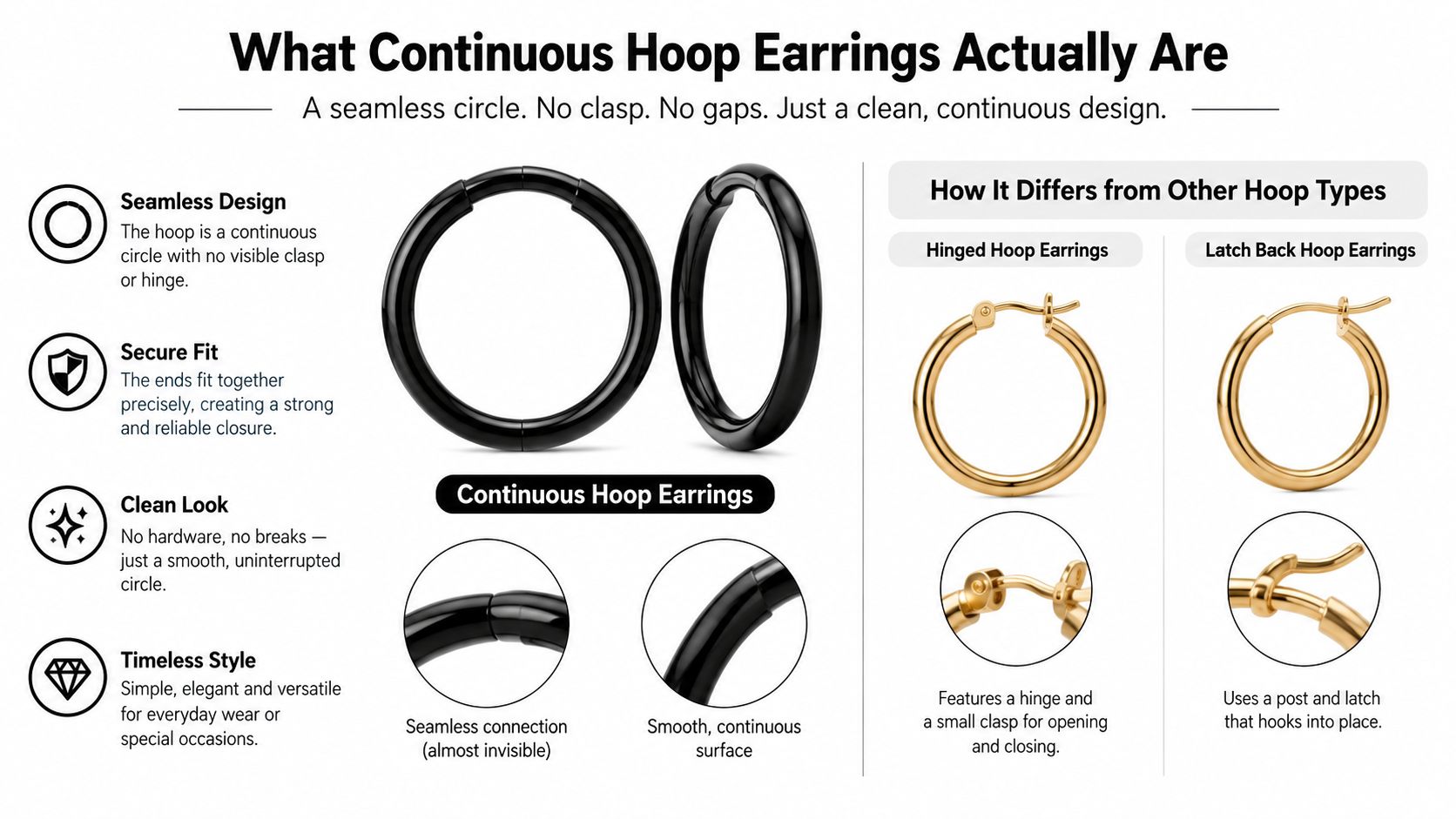
A continuous hoop is a single piece of wire or tubing formed into a circle, with one junction where the ends meet or slightly overlap. You open it by twisting the ends apart vertically, insert one end through the piercing, and realign the junction afterwards.
A useful comparison is a stiff paperclip. Hold the ends just past one another and twist them out of line, rather than pulling the whole loop wider. A hinged hoop works differently. It has a visible pin-and-sleeve hinge, while a segment clicker uses a small internal hinge and a section that closes with a click, more like a tiny jewellery box clasp.
Where the design works
Correct sizing makes a continuous hoop suitable for healed lobes, helixes, daiths, conches, rooks, and nostrils. The hoop must follow the angle and depth of the placement without pressing into the tissue or rotating aggressively.
A fresh piercing is different. The seam passes through the fistula during insertion, and the ring must flex around sensitive tissue. That movement can create friction, disturb the developing channel, and make swelling harder to manage. For those reasons, a straight labret is often a more controlled first choice, especially for cartilage.
A continuous hoop isn't automatically unsafe in every healing placement. Implant-grade titanium, professional sizing, and careful fitting can make a hoop technically defensible in specific situations. The decision belongs with an experienced piercer who can assess anatomy, swelling, jewellery diameter, gauge, and the amount of movement the site will experience.
A hoop that looks perfect in a product photograph may be completely wrong for the angle, thickness, or healing stage of your ear.
The clean appearance comes from the hidden junction, not from the absence of a closure. Understanding that distinction prevents the common mistake of treating every “seamless-looking” hoop as the same product.
Continuous vs Endless vs Seamless Explained
UK retailers often use continuous, endless, and uninterrupted as overlapping style names. Those labels can describe the appearance, but they don't reliably identify the mechanism.
| Feature | Continuous Hoop | Endless Hoop | Seamless Hoop |
|---|---|---|---|
| Construction | Single flexible ring with a meeting junction | Retail term that may describe a continuous ring or friction-fit design | Fully soldered or permanently closed circle |
| Opening method | Ends twist apart vertically | Depends on the seller's actual construction | No intended opening |
| What passes through the piercing | The end and junction move through the channel | Varies by design | The whole ring must be threaded through |
| Closure appearance | Ends realign to form a discreet seam | Near-invisible closure, but construction must be confirmed | No visible opening |
| Typical use | Healed lobe and suitable healed cartilage placements | Fashion use or suitable healed placements, after checking the mechanism | Healed piercings only, where the ring can be threaded safely |
“Endless” is the least dependable label. A fashion brand may use it for a continuous hoop, while another seller may use it for a small friction-fit ring with a tiny gap. The name tells you what the item looks like, not necessarily how it opens.
A continuous hoop is often a fully closed ring. It can work in a healed piercing if the ring can be threaded through without forcing or damaging the channel. It isn't a sensible choice for a fresh piercing because there's no controlled closure to open and realign.
What to ask before ordering
Ask the seller three direct questions:
- How does it open? You want a clear explanation of the closure, not just the word "continuously closing".
- Where is the junction? It should close smoothly, without a sharp step or exposed edge.
- Is it intended for a healing piercing? If the answer is vague, treat it as fashion jewellery for healed tissue.
For a healing placement, the viable options are usually a correctly fitted continuous hoop or a segment clicker chosen by a professional. Don't rely on the product title alone.
Sizing, Gauge, and Fit for Different Ear Placements
Two measurements decide whether a hoop feels comfortable: gauge, which describes the wire thickness, and inner diameter, measured across the widest inside point of the ring. A ruler can help with larger jewellery, while digital calipers give a more reliable reading for small hoops. The mm to gauge conversion guide can help translate measurements, but your piercer should confirm the fit before a cartilage change.
Common starting points include 1.2 mm, or 16g, for much cartilage jewellery, and 0.8 mm, or 20g, for some nostrils and fine lobe jewellery. Those are not universal prescriptions. Changing gauge without advice can stress the channel, contribute to tearing, or alter how the jewellery sits.
Inner diameter by placement
| Placement | Typical Gauge | Typical Inner Diameter | Fit Notes |
|---|---|---|---|
| Lobe | 0.8 to 1.2 mm | 10 mm | Allow room for the lobe and avoid pinching |
| Helix | 1.2 mm | 8 to 10 mm | A snug healed helix may suit 8 mm, but swelling needs more space |
| Conch | 1.2 to 1.6 mm | 12 mm or more | Depends heavily on piercing depth and ear anatomy |
| Nostril | 0.8 to 1.2 mm | Placement-specific | The ring must clear the nostril without pressing into the channel |
For a helix, start by measuring the inside of your existing ring across its widest point. Compare that measurement with the distance from the piercing channel to the outer edge of the ear. Add a small clearance, approximately 0.5 to 1 mm, so the hoop can move without pinching. If the piercing is fresh or still healing, a piercer may choose a larger inner diameter to accommodate swelling rather than aiming for a close fit.
Heavy jewellery creates a separate problem. A weighty continuous hoop in thin cartilage can pull downwards, irritate the channel, and create a cheese-cutter effect over time. The most attractive fit is not the smallest ring possible. It's the ring that clears the tissue, follows the placement, and doesn't create constant pressure.
Materials, Hallmarks, and Skin-Safe Metals
The material should be verified before you think about colour or price. For a fresh or healing piercing, implant-grade titanium is the most technically defensible continuous-hoop material because it's nickel-free, hypoallergenic, and described as suitable through the stages of healing. Titanium piercing jewellery information can help you understand why the alloy and finish matter.
ASTM F136 titanium is commonly used for body jewellery, and a UK body-jewellery source describes professional fitting of ASTM F136 titanium helix hoops from the point of piercing, with helix healing typically taking 6 to 12 months. That doesn't mean every helix should start with a hoop. The piercer still needs to control the inner diameter, gauge, rotation, and pressure.
Niobium and suitable solid gold can also be appropriate when the studio can verify the material and finish. London body-piercing guidance lists solid 14ct or 18ct gold, niobium, titanium, and platinum among suitable materials for jewellery that contacts broken skin. UK local authority guidance also stresses that jewellery must remain sterile until insertion.
Verification matters more than marketing language
“Hypoallergenic” is a marketing description, not a complete material specification. Ask for the alloy, grade, manufacturer, and whether the piece can be sterilised safely. A polished surface matters too. Scratches, rough seams, and poor finishing can catch tissue even when the base metal is suitable.
UK hallmarking rules create a useful but limited check. Precious-metal pieces described as silver, gold, platinum, or palladium must carry a hallmark above the relevant legal weight threshold. The thresholds are 7.78g for silver, 1g for gold, 0.5g for platinum, and 1g for palladium, according to the UK endless hoop jewellery marketplace guidance. Small hoops may fall below those weights and therefore may legally be sold without a hallmark, so the absence of one doesn't prove that a lightweight piece is fake.
| Metal | Healing Piercing | Healed Piercing | What to Check |
|---|---|---|---|
| Implant-grade titanium | Strong choice when professionally fitted | Suitable for sensitive skin | ASTM grade, manufacturer, polished finish |
| Niobium | May be suitable with professional advice | Suitable option | Confirm solid niobium and finish |
| Solid 14ct or 18ct gold | Suitable when verified and correctly fitted | Suitable | Purity, hallmark where applicable, alloy composition |
| Sterling silver | Generally avoid during healing | Often acceptable for healed tissue if tolerated | 925 mark, tarnish, skin response |
| Plated or mystery alloy | Avoid | Risky for sensitive skin | Full composition, plating quality, return policy |
A cheap hoop introduced into a fresh piercing is an avoidable source of irritation. If the seller can't identify the metal, don't put it through healing tissue.
Safe Insertion, Removal, and Aftercare
Start with clean hands, clean jewellery, and a well-lit mirror. Find the seam before the hoop touches your ear. Hold both ends and twist them apart vertically, keeping the circular shape intact. Pulling the sides away from each other distorts the ring and can leave the closure uneven.
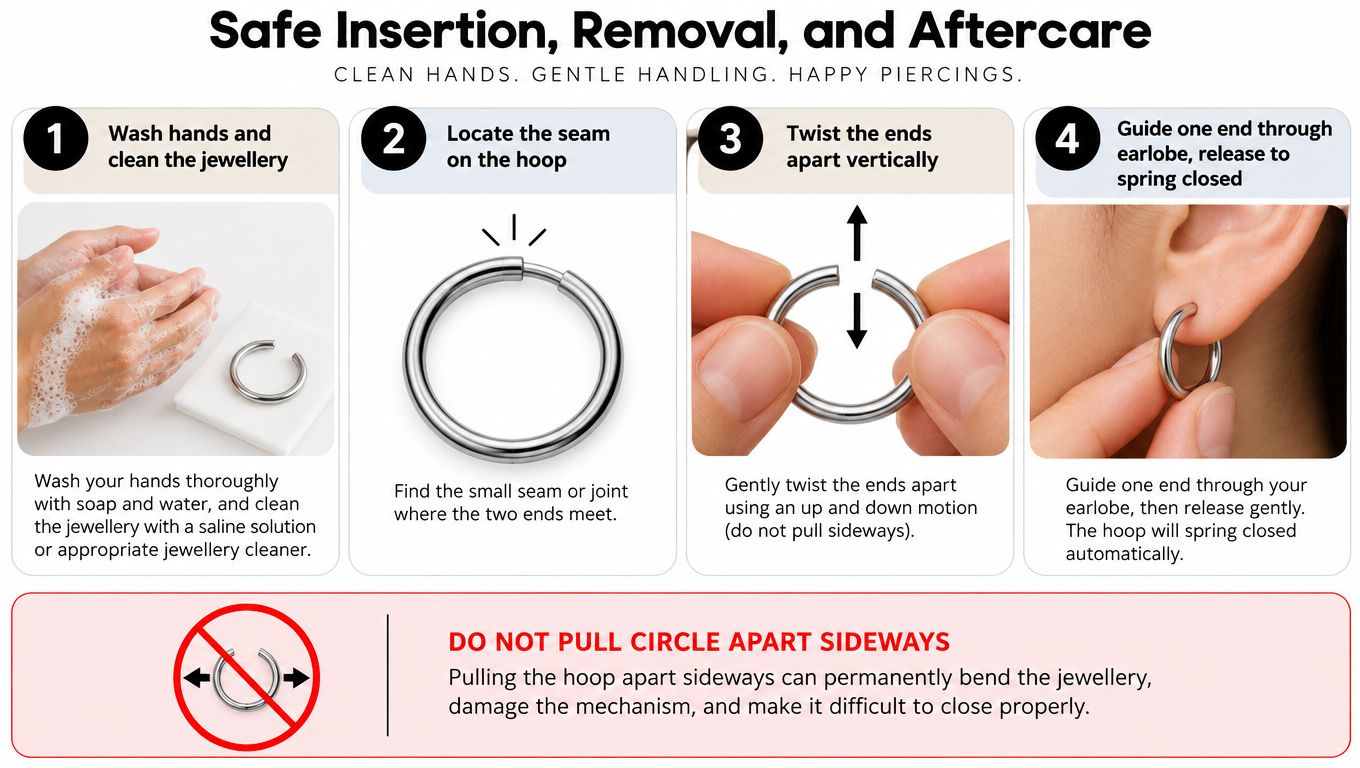
Guide one end through the channel without forcing it. Once the end emerges, realign the two ends slowly until they sit flush. The closure should form a smooth circle with no sharp step, visible misalignment, or gap large enough to catch hair.
Treat the seam as a delicate component
Continuous hoops are mechanically more likely to deform than hinged or clicker designs because the ring opens by twisting the ends sideways relative to one another. UK jewellery guidance warns against pulling the circle apart, and notes that hoops below 10 mm can be harder to close because the tolerances become tighter as the diameter decreases. See guidance on helix hoop handling for the practical reason to work slowly with small rings.
Don't repeatedly practise opening and closing the hoop. Each cycle can weaken the closure and make the ends harder to align. If the ring won't close cleanly, stop and ask a piercer or jeweller to realign it rather than forcing it through the ear.
For removal, reverse the process. Twist the ends out of alignment, guide the ring back through the channel, and never push past tightness or sharp pain.
Aftercare depends on anatomy
UK guidance commonly recommends sterile saline, clean hands, and avoiding unnecessary rotation. A sterile saline spray for piercing is practical for routine care, particularly when the piercing is difficult to reach.
Lobes may settle sooner than cartilage, but healing isn't determined by the calendar alone. Cartilage placements such as helixes, conches, and rooks can take 6 to 12 months to heal, and changing jewellery early can trigger irritation. Keep hair products, alcohol-based cleaners, swimming water, pressure from sleeping, and deliberate twisting away from a healing site.
Return to your piercer if pain persists, the area becomes hot or increasingly swollen, or you notice dark discharge. Regional NHS-style guidance also advises seeking medical review if soreness, inflammation, or yellowish discharge suggest infection. Don't treat a worsening problem by repeatedly removing and reinserting the hoop.
Choosing a Reputable Piercer in Croydon or Bournemouth
A responsible studio should discuss the placement before opening jewellery. That conversation should cover anatomy, gauge, inner diameter, expected swelling, material, sterilisation, and aftercare. If a piercer sells a tiny continuous hoop as the default first jewellery for a fresh helix without explaining the movement and swelling trade-offs, choose another consultation.
Look for a piercer aligned with recognised UK professional standards, such as APP-UK principles or UK BAP registration where applicable. Ask to see steriliser records, in-date autoclave spore testing, and the jewellery manufacturer or mill certificate. “Surgical steel” on its own is too vague to establish the alloy or suitability for your skin.
Questions for Croydon clients
Croydon clients should ask whether the studio displays current spore-testing evidence and whether its titanium is identified by manufacturer and grade. Names such as Anatometal, Neometal, and Industrial Strength are more useful than a generic label because the studio can explain the product's specifications and finish.
A professional should also examine the ear rather than sizing from a photograph. The same nominal diameter can sit neatly on one helix and press into another because cartilage depth and piercing angle vary.
Questions for Bournemouth clients
For studios around Bournemouth, including the BH1 to BH5 postcode areas, ask whether the autoclave meets EN 285 requirements and whether the piercing room is separate from reception. These checks don't replace a consultation, but they show that the studio takes equipment, hygiene, and workflow seriously.
Avoid practitioners who refuse to discuss materials, use piercing guns for cartilage, or can't provide written aftercare. UK local authority guidance says clients should receive verbal and written aftercare information, while London borough guidance requires sterile jewellery for contact with broken skin and advice about possible complications.
Call 01202 900050 (Bournemouth) / 020 8686 7730 (Croydon) before travelling, or message 07752 913846 (Bournemouth) / 07902 490584 (Croydon) on WhatsApp, to confirm jewellery availability for your placement. Ask whether the piercer will assess and downsize your hoop around the six-to-eight-week point where appropriate, rather than assuming the first fit should remain unchanged.
Quick Checklist Before You Buy or Book
Use this list before ordering online or changing jewellery in a studio:
- Identify the mechanism: Confirm whether the item is truly continuous, a segment clicker, a friction-fit ring, or a fully closed unbroken ring.
- Inspect the junction: The ends should meet smoothly, without a sharp edge, uneven step, or forced bend.
- Verify the metal: For healing tissue, ask about implant-grade titanium, verified solid gold, or niobium. Don't rely on “hypoallergenic” alone.
- Match the gauge: Compare the jewellery with your existing piercing and get professional advice before changing thickness.
- Measure the inner diameter: The ring should clear the tissue without pinching or sitting under constant pressure.
- Check the healing stage: A fresh cartilage piercing usually needs controlled jewellery and professional assessment, not an automatically snug hoop.
- Confirm the studio process: Ask about sterile insertion, autoclave procedures, aftercare, and what happens if the fit is wrong.
- Inspect the return policy: Jewellery that has been opened or sterilised may have specific exchange restrictions, so check before purchase.
Keep the checklist on your phone. A clean-looking closure isn't enough. The right continuous hoop combines a sound mechanism, verified material, suitable dimensions, and a placement that can tolerate its movement.
Piercing Near Me helps clients compare and book professional piercing services through its Croydon and Bournemouth studios, with consultations, implant-grade jewellery options, sterile single-use needles, and personalised aftercare. Visit Piercing Near Me to discuss your placement, confirm continuous hoop availability, and arrange a fitting with a trained piercer.