
A daith piercing is usually a brief sharp pressure-and-pop lasting seconds, around 5/10, but the tenderness that follows can last weeks because it sits in dense cartilage. The piercing itself is over quickly, while healing is the part that needs patience.
Why does a daith piercing hurt more for some people than others, even when the needle is in the ear for only a moment? The answer lies in the difference between the piercing sensation and the healing experience. A daith passes through the innermost cartilage fold of the ear, so you're dealing with firm tissue rather than the soft flesh of the lobe.
The immediate feeling is commonly described as pressure, a sharp pinch, and a brief pop. After that, you may notice warmth, tenderness, or sensitivity when the ear is touched or pressed. A calm studio, suitable jewellery, sterile technique, and sensible aftercare can make the whole process much more predictable.
What the Question Is Really Asking
The daith is the small, innermost fold of cartilage just above the ear canal. It's a popular placement for its appearance, although many people also discover it while searching for information about migraine or anxiety piercings. A daith should be treated as an aesthetic piercing, not as a proven medical treatment. A UK review notes that there are no standard recommendations supporting daith piercing as a medical treatment, while also reporting that complications may occur with ear piercings. The UK review and its discussion of daith piercing provide useful context.
The question “does a daith piercing hurt?” really contains two separate questions.
The moment of piercing
First, there's the needle passing through the cartilage. UK practitioner commentary commonly describes this as sustained pressure followed by a brief sharp “pop”, with immediate discomfort around 5/10 and the strongest sensation lasting only seconds. Grazia Daily's guide to daith piercings offers that practical comparison, although no UK medical source provides a precise national pain score.
The healing experience
Second, there's the period after the jewellery goes in. Cartilage can remain tender, throb mildly, or feel sensitive when bumped because it heals more slowly than soft tissue. UK aftercare guidance places ear cartilage healing at 6 to 8 weeks as a commonly cited minimum window, while daith-specific expectations can extend much longer, often around 6 to 12 months, depending on anatomy, jewellery, pressure, and irritation. Torbay Council's cartilage aftercare guidance explains the longer healing pattern associated with cartilage.
So, the honest answer is simple: the piercing is usually manageable and very quick, but the healing window deserves more attention than the needle itself.
Why a Daith Piercing Feels the Way It Does
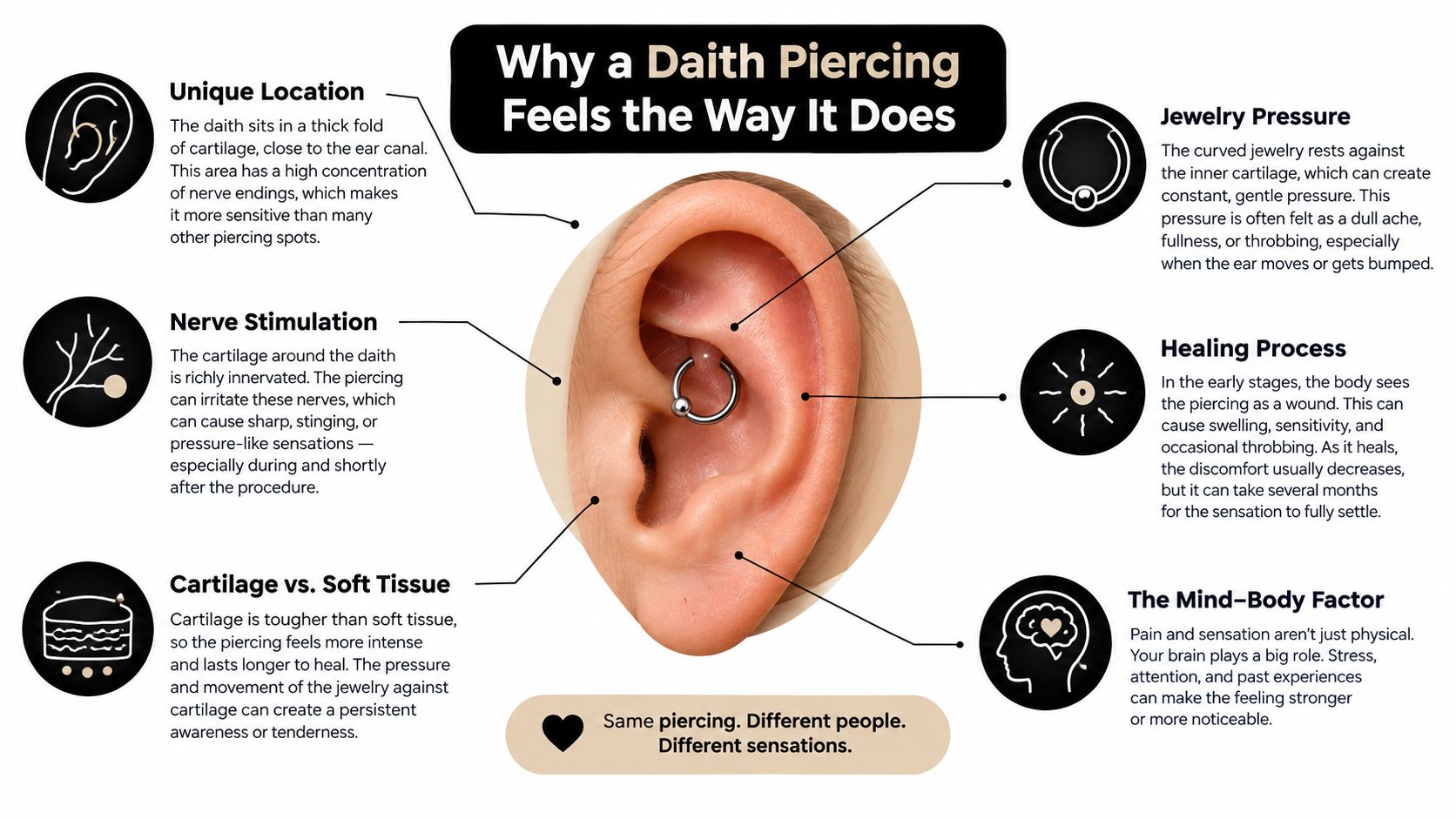
Your earlobe and your daith are made of very different tissue. The lobe is soft and fleshy, while the daith is a small, cupped ridge of firm cartilage above the ear canal. That difference explains why a lobe often feels like a quick pinch, whereas a daith tends to create deeper pressure as the needle passes through.
Cartilage is denser and less flexible than lobe tissue. The needle has to move through a firm fold, so you may feel a push, resistance, and then the characteristic pop as it exits. The sensation isn't usually a long, burning pain. It's more concentrated, with the pressure noticeable because the placement is compact and close to other sensitive parts of the ear.
Why soreness lingers
Cartilage has a more limited blood supply than soft tissue, so it generally settles more slowly. That doesn't mean your piercing is failing. It means tenderness can return after sleeping on the ear, catching the jewellery, using in-ear headphones, or touching the area unnecessarily.
Your anatomy also matters. A thicker or more tightly curled daith ridge may feel more intense than a thinner, flatter fold. A professional piercer should assess the ear before accepting the placement, because not every daith has enough room for safe jewellery or a comfortable angle.
Jewellery affects early comfort as well. A properly fitted curved barbell in implant-grade titanium can place less pressure on a fresh piercing than a heavy or poorly fitted ring. The right fit gives swelling room and reduces catching, snagging, and movement while the tissue settles.
Practical rule: The shape of your ear matters more than an online pain score. A consultation can tell you far more than comparing strangers' numbers.
Daith Pain Compared to Other Ear Piercings
A comparison helps, but it shouldn't be treated as a promise. Pain depends on anatomy, preparation, stress, the piercer's technique, and how much pressure the area experiences afterwards. UK piercing content is inconsistent, with daith ratings ranging from mild to moderate, so the most useful conclusion is that daith pain is anatomy-dependent rather than universally the worst.
A standard lobe is the familiar baseline. It passes through soft tissue and usually feels like a quick sting or pinch. A helix passes through the outer cartilage rim and can feel sharper, while a conch goes through a broader central cartilage area. The rook sits in another tight inner cartilage fold and may feel more intense for some clients because the tissue is dense and access is limited.
| Piercing | Average Pain During Piercing | Notes |
|---|---|---|
| Lobe | Lower than a daith | Soft tissue, quick pinch, usually easier to settle |
| Helix | Comparable for some people | Outer cartilage, with anatomy affecting pressure |
| Daith | Around 5/10 | Dense inner cartilage, brief pressure and pop |
| Conch | Similar for some people | Central cartilage can create firm pressure |
| Rook | Sometimes more intense | Tight folded cartilage, with limited room |
| Tragus | Sharp but brief | Small cartilage flap near the ear canal |
The daith may feel more intense than a lobe because the needle passes through cartilage. It may feel similar to a helix or conch for one person and closer to a rook for another. A professional assessment is especially useful if you're choosing between placements. You can also compare options in this guide to the least painful ear piercings, but use those descriptions as broad orientation rather than a fixed ranking.
What Happens During the Piercing Appointment
A good appointment starts before the needle appears. During the consultation, the piercer examines the fold, checks whether the anatomy can support a daith, discusses jewellery style and size, and asks about relevant medical history. Mention bleeding disorders, a tendency to develop keloids, pregnancy, allergies, and any medication or condition that could affect healing.
Placement comes first
The piercer cleans the area and marks the intended entry and exit points with a surgical pen. You should be able to check the marks in a mirror and ask questions before anything is pierced. This pause matters because placement affects jewellery fit, pressure, appearance, and the way the piercing behaves during healing.
The studio should then prepare a clean field. A reputable UK studio uses an autoclave for reusable equipment, a single-use hollow needle, and fresh gloves for every client. Forceps may support the firm cartilage while the needle passes through, and the jewellery is inserted in a controlled motion.
A hollow needle is designed for piercing tissue cleanly. If you're unsure why a professional studio uses a needle rather than a gun, read this explanation of piercing gun versus needle. The choice is particularly relevant for cartilage, where unnecessary trauma can add to swelling and prolong discomfort.
What you'll feel
You'll usually feel firm pressure first, then a short sharp sensation as the needle passes through. The jewellery insertion can create another moment of pressure, followed by warmth or mild throbbing. Most clients are surprised by how quickly the active part ends.
Before you leave, the piercer should explain cleaning, sleeping, jewellery care, and warning signs. Written aftercare instructions are useful because nervous clients often forget details once the appointment is finished.
Ways to Reduce Pain and Stay Comfortable
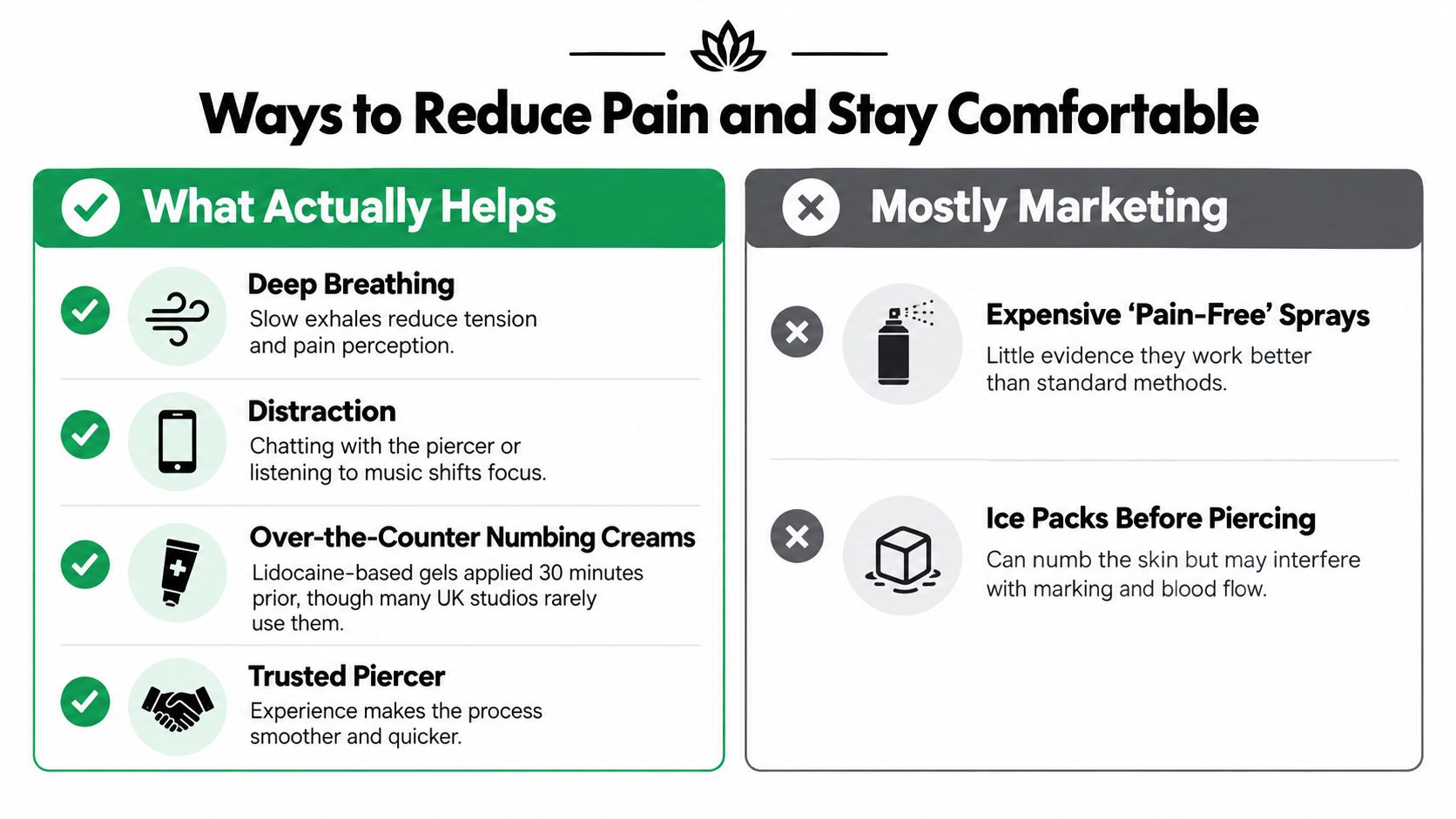
No preparation trick removes the brief pop completely. It can, however, stop tension, light-headedness, and unnecessary irritation from making the experience harder than it needs to be.
Numbing creams deserve an honest explanation. Lidocaine-based gels may sound appealing, but many UK studios rarely use them for daith piercings because the appointment is short and cartilage doesn't absorb topical products in the same way as surface skin. A cream may also interfere with marking or the piercer's assessment of the tissue, so ask the studio before applying anything.
Cold can dull sensation for some people, but an ice pack pressed against the ear can interfere with marking and blood flow. Don't place ice directly on the skin or apply pressure to the planned piercing site without the piercer's approval.
Small choices that help
- Breathe slowly: Longer exhales can help relax your shoulders, jaw, and hands.
- Use distraction: Chat with the piercer, listen to music, or focus on a fixed point rather than watching the needle.
- Eat a light meal: Arriving fed and hydrated can make it easier to stay steady.
- Avoid alcohol: Alcohol can increase bleeding and bruising, so don't drink before the appointment.
- Be cautious with caffeine: If caffeine makes you jittery, skip it beforehand so your nerves don't build.
- Wear practical clothing: A button-down shirt reduces the chance of fabric dragging across fresh jewellery.
- Choose a suitable time: A morning appointment may feel easier if waiting all day increases your anxiety.
The piercing should never be rushed, but it also shouldn't become a drawn-out ordeal. Tell your piercer you're nervous, agree on a breathing cue, and ask them to explain each stage before it happens.
Healing Timeline and First Weeks of Aftercare
A daith can feel much better before it has finished healing internally. A practical expectation is a healing process of roughly 6 to 12 months, while UK council guidance commonly gives 6 to 8 weeks for ear cartilage as a standard aftercare reference. UK cartilage healing guidance supports the need for patience.
| Time Window | What You Will Feel | Aftercare Focus | Things to Avoid |
|---|---|---|---|
| Weeks 1 to 2 | Tenderness, mild throbbing, slight swelling | Gentle saline cleaning and dry hands | Pressure, touching, snagging |
| Weeks 3 to 6 | Sensitivity may fluctuate | Continue consistent care | Twisting jewellery and sleeping on it |
| Weeks 7 to 12 | Often calmer, but not fully healed | Keep protecting the channel | Early jewellery changes and friction |
| Twelve-plus | May feel settled while healing continues | Follow professional guidance | Assuming it's healed because it looks calm |
Clean the piercing gently with saline twice daily, unless your piercer gives different medically appropriate advice. UK guidance describes saline made with 1/4 level teaspoon of sea salt in an egg cup or shot glass of warm water, or a warm gauze compress, followed by drying with fresh disposable paper towel or kitchen roll. Official UK aftercare advice also warns against communal towels.
Don't twist, spin, or slide the jewellery. Sleep on the opposite side, or use a travel pillow so the ear sits in the central gap. Avoid swimming pools, hot tubs, saunas, and hair dye during the vulnerable early period, and follow the more specific restrictions given by your piercer.
UK local guidance advises avoiding submersion or direct handling of a newly pierced site for at least 4 days, while NHS advice says not to swim for the first 24 hours after a piercing. Bradford's body-piercing safety guidance explains the practical reason for limiting contact and contamination.
Mild redness, clear lymph fluid, slight throbbing, and tenderness can be normal during the first stage. By around month three, a healthy daith should look calm and feel easy to forget, even though the inside may still need protection. For more detail on cartilage recovery, use this cartilage piercing healing guide.
Warning Signs, Infections, and When to Seek Help
Normal healing should gradually become easier. It may fluctuate after accidental pressure, but the overall pattern should move towards less tenderness, not steadily worsening pain.
Contact a piercer or healthcare professional if you notice:
- Spreading redness: Redness moves away from the piercing rather than staying local.
- Worsening swelling: Swelling increases after the early phase instead of settling.
- Hot skin: The area feels distinctly hot around the piercing.
- Yellow or green discharge: UK guidance identifies coloured discharge and an offensive smell as infection concerns.
- Increasing throbbing pain: A deepening, pulsating pain is more concerning than mild soreness.
- Red streaks or feeling unwell: These need prompt medical assessment.
- Embedded jewellery: The bar or ring feels tight, sinks into the tissue, or appears trapped.
- Changed angle: The piercing looks pulled, tilted, or increasingly irritated.
The NHS describes an infected piercing as painful, swollen, hot, and very red or dark, and advises seeking medical help. NHS guidance on infected piercings is the appropriate reference if symptoms are increasing or you're unsure whether the change is normal.
Why cartilage infections need attention
Perichondritis is an infection affecting cartilage. UK Health Security Agency guidance highlights the link between ear piercing and perichondritis, including the risk of bacteria from tap water or contaminated solutions. UKHSA information for piercing businesses explains why sterile technique and careful aftercare matter.
If you suspect infection, contact NHS 111, your GP, or an appropriate walk-in service. Don't squeeze a bump, pour harsh antiseptic onto the area, or remove the jewellery impulsively. Removing jewellery can allow the channel to close and trap infection, so leave it in unless a clinician or experienced piercer advises removal. If jewellery is embedded, a clinician or piercer should decide how to manage it.
Seek help early when the pattern changes. Prompt assessment can limit prolonged discomfort and reduce the chance of lasting scarring or cartilage damage.
Booking a Daith Piercing with Confidence
The studio you choose affects both parts of the pain story. An experienced piercer can assess whether your daith has suitable anatomy, choose jewellery that allows for swelling, and create a clean opening that is less likely to become irritated.
Before booking, look for clear evidence of safe practice:
- Sterile equipment: The studio should use single-use needles and explain how reusable tools are sterilised in an autoclave.
- Jewellery quality: Ask about implant-grade titanium or solid 14k to 18k gold, and check that the design suits a fresh daith.
- Anatomy assessment: The piercer should inspect your ear rather than promising every client the same placement.
- Recent reviews: Look for comments about daith piercings, cleanliness, communication, and aftercare rather than judging a studio only by photographs.
- Written guidance: You should receive practical aftercare instructions before leaving.
- A proper consultation: Ask what you'll feel, how swelling will be managed, and when jewellery can be assessed for a change.
A professional won't guarantee that you'll feel nothing. They'll explain that the needle sensation is short, while cartilage tenderness can return if you sleep on it, catch it, or clean it aggressively. That honesty is more useful than a promise of a pain-free appointment.
If you're arranging a consultation or have questions about suitability, jewellery, or aftercare, Piercing Near Me can help you explore professional piercing options connected with studios in Croydon and Bournemouth. You can contact the team on 01202 900050 (Bournemouth) / 020 8686 7730 (Croydon) or by WhatsApp on 07752 913846 (Bournemouth) / 07902 490584 (Croydon).
The right preparation makes the appointment feel far less intimidating. You'll know what the pressure means, what tenderness is expected, and which changes deserve medical attention.
Piercing Near Me helps clients explore consultations, appointments, jewellery choices, and aftercare for professional piercing services in Croydon and Bournemouth. Visit Piercing Near Me to ask questions, compare suitable options, and arrange your daith piercing with clearer expectations.