
Timebomb Tattoo & Piercing on 109 Old Christchurch Road, BH1 1EP, is a central, registered Bournemouth studio with piercing hours 11am–5:30pm Monday to Saturday. Booking can be done via Piercing Near Me.
If you're sitting there wondering whether to get that first lobe piercing or finally book the cartilage piece you've been thinking about for months, Bournemouth gives you a straightforward answer. The local scene has proper, registered studios, clear age rules, and enough ear-piercing experience to make a first appointment feel routine rather than intimidating.
Why Bournemouth Is a Strong Place to Get Your Ears Pierced
Bournemouth is a good place to get your ears pierced because the service is treated as everyday studio work, not some rare speciality. A central option like Timebomb Tattoo & Piercing at 109 Old Christchurch Road, BH1 1EP, with piercing hours from 11am–5:30pm Monday to Saturday, makes the process easy to fit around work, college, or a day out in town. That kind of access matters, because a piercing you can reach easily is a piercing you're more likely to manage properly during healing.
The local market also suits first-timers. Ear placements dominate piercing demand. In one large Canadian studio’s published figures, earlobes alone made up 3,235 procedures, 57.4% of all its piercings. That lines up with what people want in Bournemouth: a low-drama lobe piercing, then maybe a helix, conch, or tragus once they're comfortable.
What a first visit should give you
You shouldn't be guessing about jewellery, age limits, hygiene, or aftercare. A solid Bournemouth studio should spell out the placement options, explain the healing window, and show you how the piercing will be done before anything touches your ear. If it can't do that clearly, walk away.
Practical rule: choose the studio that talks about registration, sterile consumables, and aftercare in plain English. That's the difference between a professional appointment and a rushed add-on.
Bournemouth also has a useful local advantage, you can compare services without travelling far. That means you can pick based on facts, not on whoever has the flashiest social feed. If you want a simple ear piercing in Bournemouth, you don't need hype. You need a registered studio, decent jewellery, and a piercer who can answer basic questions without getting defensive.
The Ear Anatomy That Decides Which Piercings Work
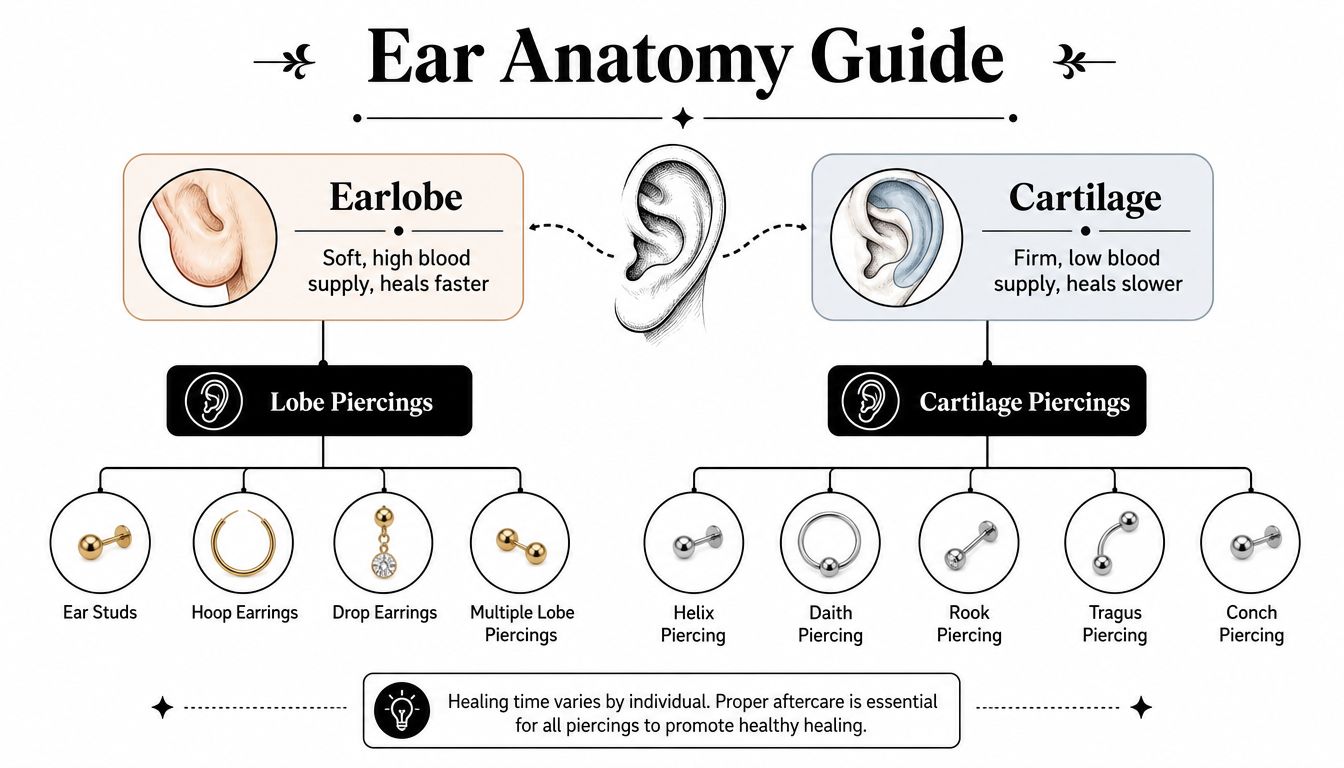
Your ear isn't one flat canvas. The soft lower earlobe and the firmer outer cartilage behave differently, and that difference decides what heals quickly, what takes months, and what's likely to get annoyed by pressure or poor placement. The lobe has better blood supply, so it repairs faster. Cartilage has less, so it lags behind and complains more when you sleep on it or knock it.
Which placements belong where
Lobe piercings sit in soft tissue and are the usual starting point for a reason. They're quicker to settle, easier to sleep around, and simpler for first-time clients who want the least disruptive option.
Cartilage placements include helix, forward helix, tragus, conch, rook, daith, and industrial/scaffold. These sit in firmer tissue and need more patience because the ear can't mend them as fast. At Timebomb Bournemouth, lobe piercings typically heal in 6–8 weeks, while helix, tragus, and conch are usually listed at 6–12 months, and daith and rook at 9–12 months Timebomb's ear piercing chart.
That difference changes how you should choose. If you want something easy to maintain, start with a lobe. If you're ready for a cartilage placement, go in knowing you're signing up for a long heal, not a quick cosmetic tweak.
Cartilage piercings don't fail because they're fashionable. They fail because people treat them like lobes.
A good piercer will use the anatomy in front of them, not just the style you've saved on your phone. If the shape of your ear makes a certain placement awkward, they should say so. That's not rejection. That's competence.
Jewellery Materials That Protect Healing Ears
The jewellery in a fresh piercing isn't decoration, it's the thing sitting in a wound while it heals. That makes material choice essential. Reputable studios generally steer you towards implant-grade titanium or solid 14k or 18k gold because those materials are meant to stay in contact with tissue without causing unnecessary irritation.
What to expect and what to avoid
Think of jewellery like the tyres on a car. You wouldn't fit a cheap, unstable tyre and hope the suspension makes up for it. The same logic applies here, the jewellery has to be reliable because it's part of the healing environment.
That's why plated fashion jewellery, acrylic, and low-grade mixed metals are poor choices for initial piercings. They can wear badly, irritate healing tissue, or give you a more awkward recovery than you needed. Butterfly backs, heavy designs, and bulky hoops are also bad ideas for a fresh ear piercing because they can catch, move too much, or put pressure on the channel.
The standard you want to hear from a Bournemouth studio is simple, clear, and boring in the best way. It should talk about inert materials, not “cute” options first. It should be happy to explain why a labret post, flat back, or titanium piece makes sense for the placement you've chosen.
For a deeper product comparison, this guide is useful: best earrings for newly pierced ears.
A studio that pushes style before safety is doing you a disservice. Fresh piercings are not the place to compromise. If you're paying for the piercing itself, the jewellery should protect the healing process, not complicate it.
UK Safety Standards and Bournemouth Registration Rules
A Bournemouth ear piercing should start with paperwork and hygiene, not a sales pitch. Under section 15 of the Local Government (Miscellaneous Provisions) Act 1982, ear-piercing businesses in England and Wales must be registered with the local authority before they trade. If someone carries on without registration, that is a criminal offence the legislation text.
What registered actually means locally
In Bournemouth and Poole, the council says cosmetic piercing businesses must register both the person carrying out the piercing and the premises where it happens, with a stated registration fee of £133 BCP Council registration page. That is the local standard, and it tells you exactly what “safe and registered” should mean on the ground.
Timebomb on Old Christchurch Road is a good example of the level you should expect. Their age rules are spelled out by piercing type, which is what you want to see from a studio that takes compliance seriously. Clear age limits, clear booking rules, and clear opening hours show the studio is used to dealing with first-timers, parents, and under-18s without guesswork. If a place cannot explain those basics cleanly, walk away.
The hygiene standard should sit on top of the legal one. UK cosmetic-piercing guidance calls for a controlled aseptic workflow, with hands washed and dried at the start, the ear marked before piercing, skin cleaned with spirit swabs, and a pre-sterilised pack opened immediately before the piercing. The same guidance says keeping the ear clean and dry should be adequate, and antibiotic creams or ointments should not be used unless prescribed.
Ask this before you book: “Are you registered, what do you use for skin prep, and do you open a pre-sterilised pack in front of me?” If the answer is vague, you have learned enough.
That is what safe and registered looks like in Bournemouth. It is legal registration, a visible sterile workflow, and a studio that can explain its process without bluster or hand-waving. If a piercer cannot give you straight answers on those points, choose someone else.
What Happens at a Bournemouth Ear Piercing Appointment
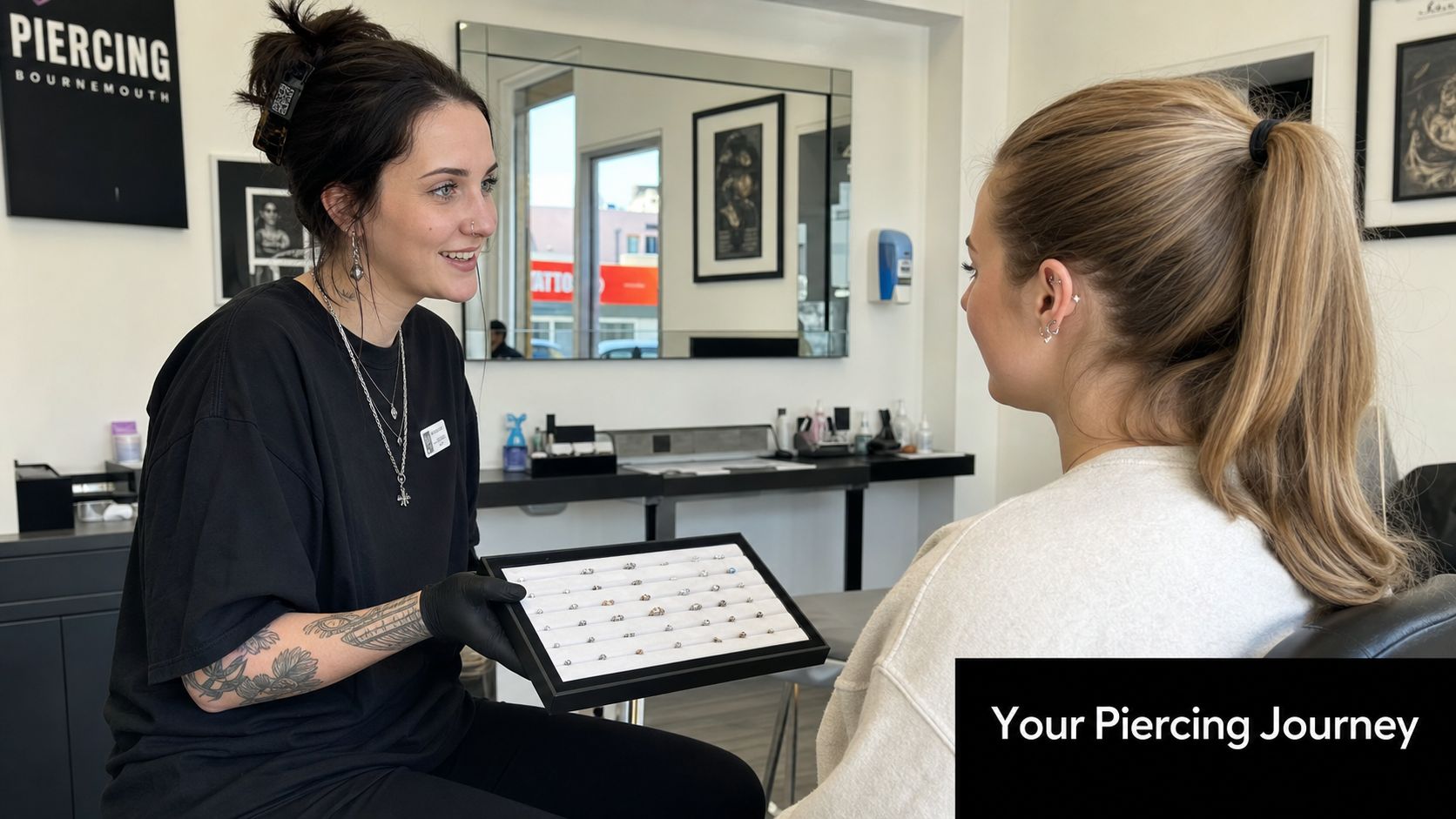
A good appointment feels calm and methodical. You arrive, talk through the placement, choose the jewellery, and the piercer marks the ear so you can check it in the mirror before anything is done. That part matters because you should approve the position, not discover it after the fact.
The visit, step by step
First comes the consultation. A proper piercer will ask about your placement, healing expectations, and any practical issues like sport, work, headphones, or sleeping habits. Then they'll clean the ear, mark the entry and exit points, and get you to confirm the placement.
Next is the actual piercing. You should expect single-use sterile equipment and a clear, quick insertion followed immediately by the jewellery being put in place. Then the piercer should give you aftercare instructions that make sense for the exact placement you chose, not just a generic leaflet.
Age rules in Bournemouth are category-based, not one blanket number. At Timebomb, lobe piercings are from age 10+, cartilage-style ear work such as tragus, helix, conch, and rook is from 14+, industrial/scaffold is from 16+, and nipple piercings are from 18+ Timebomb age policy. Under-16s must be accompanied by a parent or legal guardian, while 16–17-year-olds can be pierced without a parent present but need valid ID.
The point of that structure is simple. It keeps younger clients in the right category and stops people pushing for a placement they're not ready to manage. If a studio ignores those rules, that's not flexibility. That's bad judgment.
Step-by-Step Aftercare for the Full Healing Window
Aftercare starts the moment you leave the chair. For an ear piercing in Bournemouth, the right approach is plain, keep it clean and dry, leave it alone, and match your care to the tissue you pierced. A lobe heals on a shorter timeline. Cartilage takes longer and reacts badly to fussing.
First 24 hours and first week
In the first 24 hours, leave any dressing alone if one was applied, and expect mild tenderness. Do not keep touching the area to check it. Fingers are not sterile, and that habit creates avoidable problems.
During the first week, clean with sterile saline, avoid twisting the jewellery, and skip swimming. Keep the area simple, clean, and dry. Do not add creams or ointments unless a clinician has told you to use them. The calmer the site stays, the less the ear has to deal with.
First month and the long heal
The first month is where sleep pressure starts causing trouble. Use a travel pillow if you keep rolling onto that side, and avoid headphones that clamp the ear. Cartilage especially hates pressure, and repeated compression turns a straightforward heal into an irritated one.
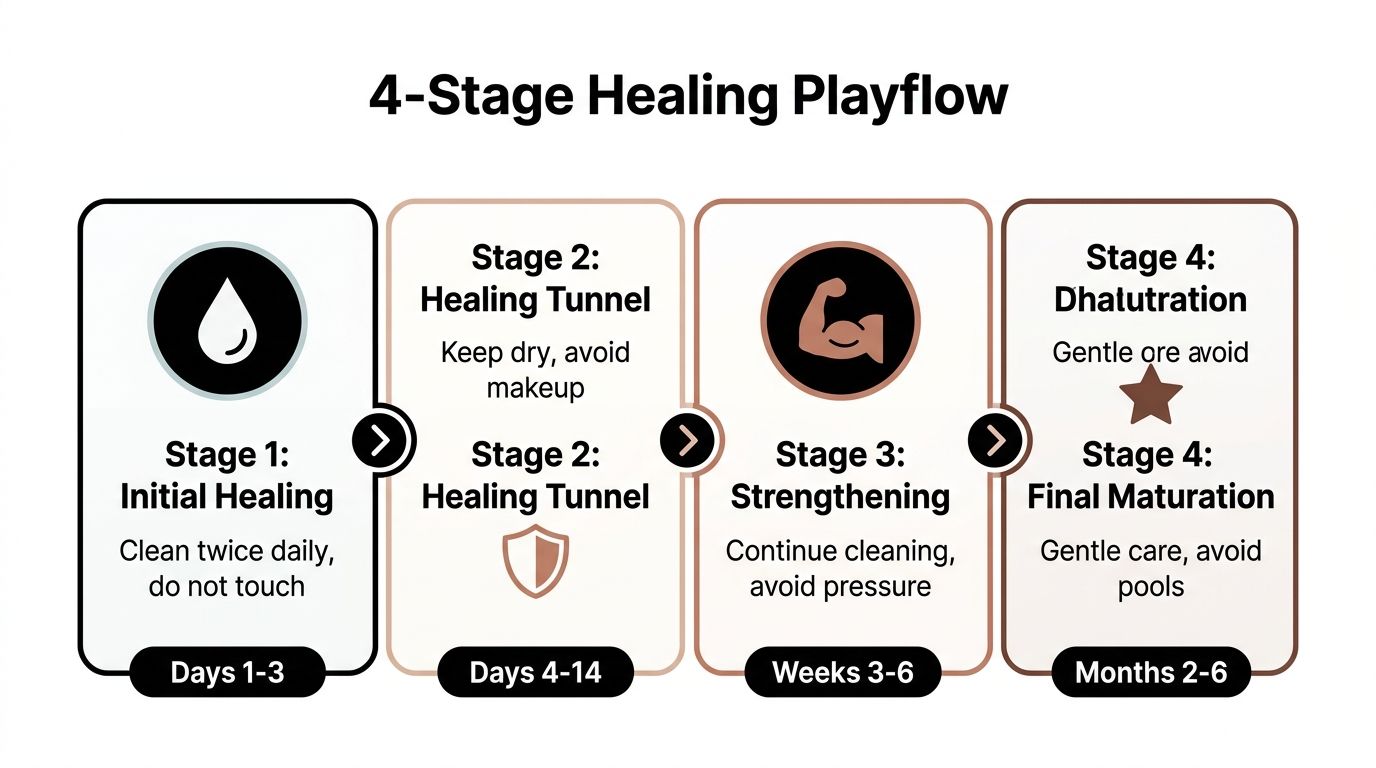
Do not rush jewellery changes during the full healing window. Lobes usually settle in 6–8 weeks, while cartilage can need 6–12 months or longer depending on placement and irritation ear piercing healing times. If you want a clearer overview of the healing stages, use this guide: An infographic detailing the 4-stage healing playflow process for ear piercings with daily care instructions.
Know the difference between normal healing and a problem. Mild redness, tenderness, and some discharge can be part of recovery. Heat that gets worse, swelling that spreads, or pain that ramps up instead of easing needs attention from a professional or clinician.
Pricing, Booking, and How to Actually Secure Your Slot
The right price is the one that tells you exactly what you are paying for. A proper ear piercing quote should cover the piercing itself, the jewellery, and the aftercare guidance, not hide the total cost behind extras that appear later. Lobe work is usually the simpler, cheaper appointment. Cartilage placements cost more because the technique, placement, and jewellery choice matter more.
Booking without faff
If you want to book in Bournemouth, use the direct contact route, 01202 9000 50 or 07752913846 on WhatsApp, or book via the Piercing Near Me site, which also lists a Bournemouth ear piercing option: find professional ear piercing near me. If you are under 18, have your ID ready. If you already know the placement you want, say it plainly. If you are still deciding, say that too.
A good booking conversation should be short and practical. You are confirming age, placement, jewellery preference, and availability. That is it.
Timebomb's central address at 109 Old Christchurch Road, BH1 1EP, plus the 11am–5:30pm Monday to Saturday schedule, makes it easy to plan around a lunch break or a town-centre trip. If you want a studio that is safe and properly registered, ask how it meets the local piercing rules and be ready to check the council registration details yourself through BCP Council. The local registration fee sits behind that service model, so a studio that answers those questions clearly is doing the right thing.
First-Timer Questions Answered Before You Book
Pain is the question asked first, and the answer is straightforward. Lobes usually feel like a short sting, while cartilage feels sharper and more forceful, but brief. The difference isn't just the moment of piercing, it's how the ear behaves for weeks afterwards.
The practical worries that matter
Can you bring your own jewellery for the initial piercing? No, you shouldn't. A reputable studio will use its own sterile, suitable starter jewellery because it controls the material, size, and cleanliness of the piece going into your ear.
How do you spot infection versus normal healing? Normal healing is usually local and settles down gradually. If redness spreads, the area becomes hotter, pain increases instead of easing, or the discharge changes in a way that looks wrong, get it checked. Don't assume every sore piercing is infected, and don't assume every irritated one is fine.
What if the stud snags on a towel or pillow? Leave it alone and inspect it gently. Snagging doesn't automatically ruin the piercing, but repeated catching is a sign your jewellery or sleeping habits need fixing fast.
If you're unsure about anything after the appointment, contact the studio sooner rather than later. Quiet problems stay small when you ask early.
That's why Bournemouth clients should use a studio that's easy to reach, explains aftercare clearly, and doesn't disappear once you've paid. If you want a straightforward next step, book through Piercing Near Me, call 01202 9000 50, or message 07752913846 on WhatsApp and get the appointment moving.