
Sterling silver contains 92.5% silver and 7.5% strengthening metal, but that doesn't automatically make a helix earring suitable for a fresh piercing. For healing cartilage, implant-grade titanium is the safer first choice because the finished jewellery must meet a stricter nickel-release limit than ordinary jewellery.
A 925 stamp can describe the metal accurately and still leave an important question unanswered: how much nickel can the complete earring release into pierced tissue? That distinction surprises many first-time clients. Sterling silver is a genuine precious-metal alloy, but a piercing is not the same as wearing a necklace or a pair of earrings through a fully healed lobe.
The helix passes through cartilage, not soft lobe tissue. Cartilage has a limited blood supply, so inflammation can be slower to settle and infection can have more serious consequences. Choosing a pretty silver flower, crystal stud, or small hoop is the easy part. Choosing a material, surface and fit that respect the healing piercing requires more care.
Understanding Helix Earring Sterling Silver Safety
The common misconception is that precious metal automatically equals piercing-safe metal. It doesn't. A sterling silver helix earring may be well made and perfectly appropriate for a healed piercing, yet still be a poor choice for a fresh or healing one.
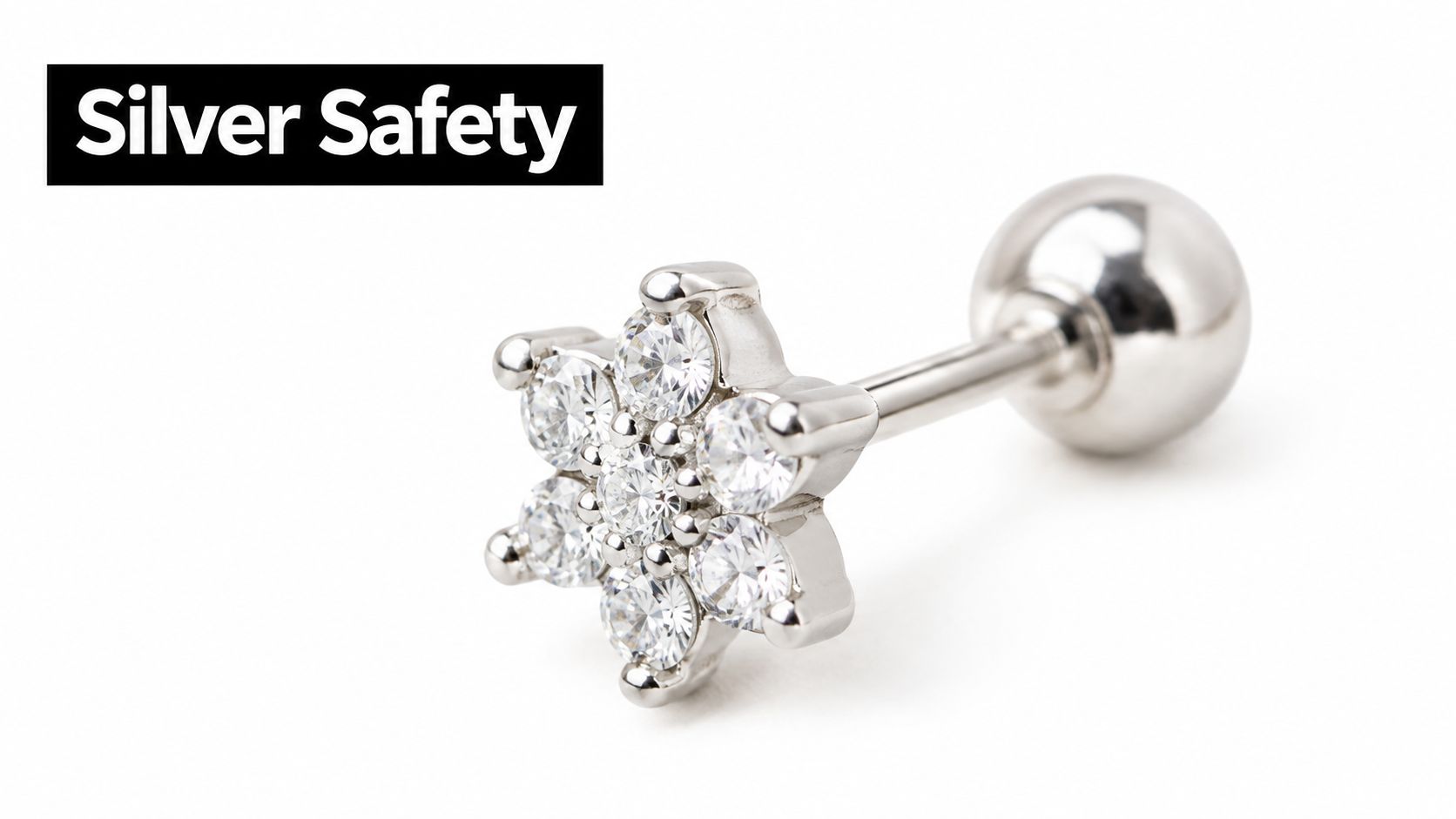
The reason is that piercing jewellery has to work inside a healing channel. The post passes through tissue, the backing can press against the ear, and the surface may remain in contact with the wound for a prolonged period. A decorative front that looks smooth from the outside tells you very little about the post, solder, plating or alloy beneath it.
The label isn't the whole product
Think of sterling silver as a material description, not a complete safety certificate. It tells you the fineness of the silver alloy. It doesn't, by itself, confirm that the finished post assembly has been tested for nickel release, that the surface is suitable for healing tissue, or that the dimensions match your ear.
That's why “silver-coloured”, “silver plated” and “925” shouldn't be treated as interchangeable terms. A plated item may have a different underlying metal, and a coating can wear through with movement, cleaning or friction. Even a solid sterling silver piece still needs to be assessed as a complete item if it's going into a fresh helix.
Practical rule: Choose initial jewellery for the piercing channel first, then choose the decorative style.
Why cartilage changes the decision
A helix can become irritated by pressure from sleeping, headphones, hair, helmets or a post that's too short. Mechanical irritation may cause swelling and tenderness that look similar to a material reaction, while a metal allergy can produce itching, redness, scaling or persistent dermatitis.
This doesn't mean every sterling silver helix earring will cause a problem. It means a first-time client shouldn't rely on the word “sterling” alone. For new cartilage, ask a qualified piercer to assess the complete jewellery, its fit and its documented material information before it's inserted.
What Sterling Silver Actually Means
Sterling silver is an alloy, because pure silver is too soft for many everyday jewellery designs. The standard composition is 92.5% silver and 7.5% strengthening metal, commonly copper. The fineness number 925 means that at least 925 parts in every 1,000 are silver, with the balance made from other metal.
That explains both the value and the limitation of the stamp. A 925 helix earring is not “pure silver”, and the stamp doesn't identify every metal used in the piece. The strengthening portion, solder, post and any coating all matter when the jewellery will sit in a healing piercing.
What UK hallmarking adds
The UK has a long history of testing precious-metal goods. In 1300, Edward I required silver articles sold in England to meet the sterling standard and undergo official testing. Early British items carried an identifying mark, initially a leopard's head in London, to show that they had passed assay. The lion passant later became the best-known British symbol for sterling silver. The history of UK hallmarking shows why these marks still matter when buyers assess jewellery quality.
A full UK hallmark can provide information about several parts of an item's history:
- Fineness mark: This identifies the precious-metal standard, such as 925 for sterling silver.
- Sponsor or maker mark: This points to the registered business responsible for submitting the article.
- Assay office mark: This identifies where the item was tested.
- Additional date or traditional marks: These can appear depending on the article and marking system used.
A small helix earring may not carry a complete UK hallmark because exemptions can apply to low-weight articles. That doesn't automatically make it poor quality. It does mean you should distinguish between a retailer's stated 925 specification and a complete hallmark, then look for clear product documentation.
Read beyond the front of the earring
Before buying, check whether the description identifies the post material, any plating, coatings, solder and nickel-containing components. “925 silver” is useful information, but it shouldn't be the only information available.
Silver is also a major part of the UK jewellery supply chain. In 2024, silver jewellery accounted for 714 tonnes of UK jewellery imports and 82% of total jewellery imports by weight, according to UK jewellery import market data. That demonstrates how widely silver is used, but import tonnage doesn't prove that every item is sterling silver or suitable for a piercing.
Why Sterling Silver Is Risky for Fresh Piercings
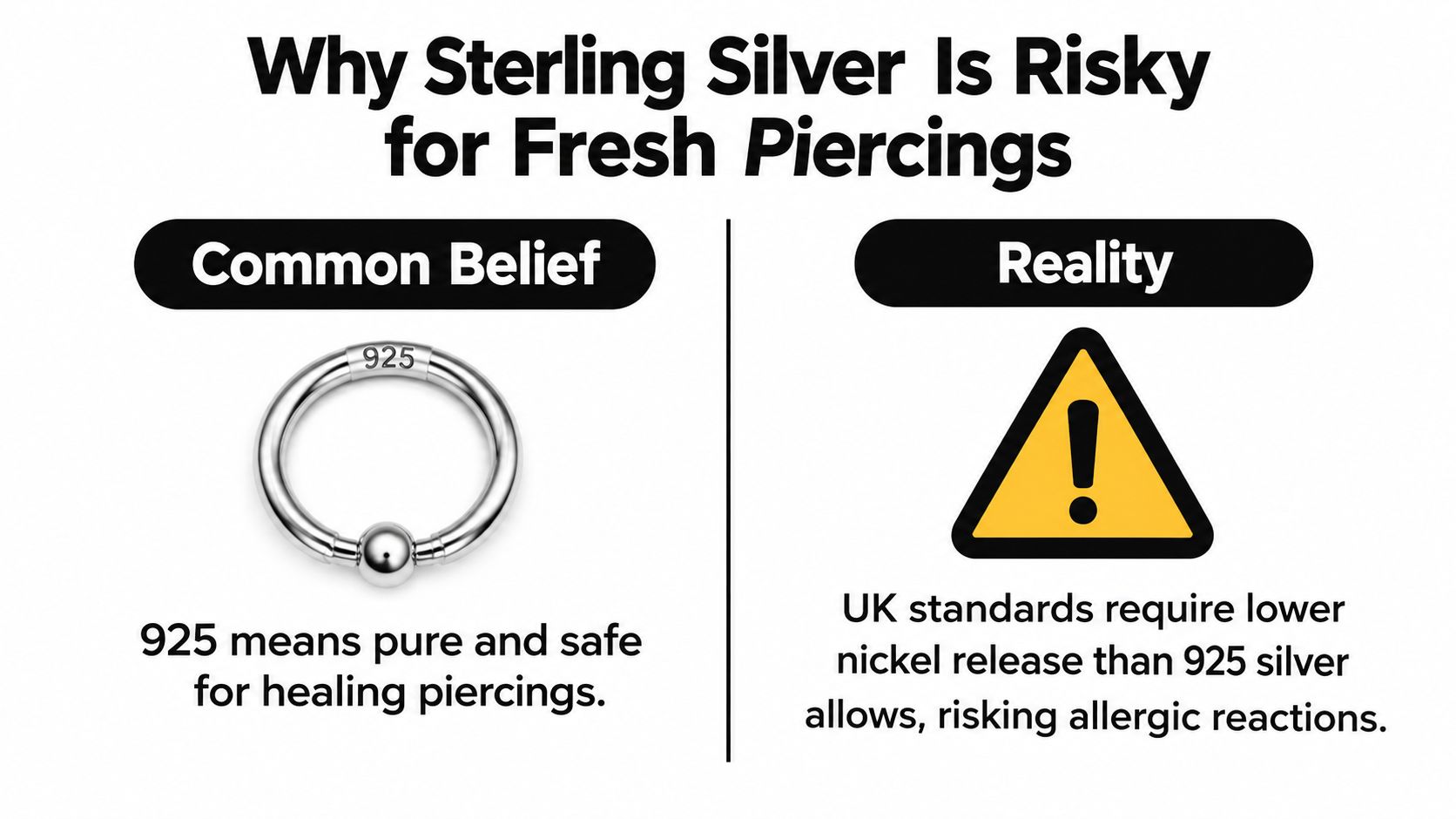
925 does not prove that a helix earring is suitable for a fresh piercing. It identifies the silver standard, not the nickel-release performance of the complete jewellery assembly. That distinction is easy to miss when a product page presents “925 sterling silver” as the main safety detail.
UK guidance treats jewellery resting against intact skin differently from jewellery used in a piercing. For a finished post assembly intended for a fresh or healing piercing, nickel release must be below 0.2 micrograms per square centimetre per week. Jewellery made for prolonged skin contact has a limit of 0.5 micrograms per square centimetre per week. A post passes through pierced tissue, so the stricter requirement applies to the part inside the channel. The UK guidance on nickel, precious metals and hallmarking explains why the complete assembly, rather than the decorative front alone, needs attention.
Sterling silver contains silver and strengthening metals. The finished earring may also include solder, a separate post, a backing or a decorative coating. The practical question is therefore: what can the finished post release, and is there evidence from testing that covers that complete part?
Ask the retailer to identify the alloy composition, including metals beyond silver. Confirm the post material, because the front and the section passing through tissue may differ. Check whether the item is solid, plated or coated, and request a nickel-release result for the complete post assembly. Also confirm the intended use. Jewellery designed for a healed helix is not automatically appropriate as initial jewellery.
A coating can wear through with cleaning, movement or everyday friction, exposing the alloy beneath. A solid, documented composition gives clearer information for long-term skin contact than an unclear plated product. Even solid sterling silver, however, does not automatically meet the requirements for fresh cartilage.
Words such as “hypoallergenic”, “nickel-free” and “nickel-safe” need careful interpretation. They may describe marketing claims rather than a test result for the finished post. A product can comply with a legal release limit while still releasing a small amount of nickel, and someone with a history of metal allergy may react to an amount another wearer tolerates.
Sterling silver can have a place in jewellery, while remaining an uncertain choice for a healing channel. For design comparisons, use this sterling silver piercing jewellery guide as a starting point, then ask the piercer or retailer for material and testing information.
Safer Alternatives for Healing Helix Piercings
For initial helix jewellery, implant-grade titanium is usually the most straightforward material to discuss with a professional piercer. It avoids the uncertainty that can come with an undocumented silver alloy, and it can be supplied with information about the grade and finished construction. A suitable titanium flat-back can also be made to fit the ear without unnecessary movement or pressure.
This isn't a choice between attractive jewellery and safe jewellery. Titanium can support a clean, understated look, a small stone, a bezel setting or a more distinctive decorative front. The material and the design are separate decisions.
Compare the practical options
| Material | Best use to discuss | What to verify |
|---|---|---|
| Implant-grade titanium | Fresh or healing helix jewellery | Grade documentation, surface finish, post construction and fit |
| Solid gold | A possible option when properly specified | That it's solid, suitable for piercing use and free from problematic alloy uncertainty |
| Sterling silver | More appropriate for a fully healed helix | Solid composition, finish, fit and the wearer's sensitivity |
| Plated jewellery | Fashion styling rather than a healing channel | What sits underneath the coating and whether the coating can wear through |
Allergy UK identifies pure gold of 18 carats or higher, solid silver and platinum as usually safer jewellery alternatives for people concerned about nickel allergy, while also reporting that nickel allergy commonly develops after ear piercing and jewellery use. Nickel allergy guidance from Allergy UK supports a cautious approach, especially if you've previously experienced itching, redness or dermatitis from jewellery.
Match the choice to your situation
If the piercing is fresh, choose documented jewellery through a reputable piercer rather than buying a decorative earring and asking someone to insert it. If your skin has reacted to earrings before, tell the piercer before the appointment. If you're styling a settled helix, you have more freedom, but the piece still needs a smooth finish and comfortable fit.
A reputable studio should discuss your anatomy, the post length, the backing and your everyday habits. The implant-grade titanium jewellery guide can help you compare the type of jewellery commonly selected for healing placements.
Choosing Jewellery for Healed Versus Fresh Helix Piercings
A sterling silver helix earring can suit a healed piercing and still be the wrong choice for a fresh one. The difference is the healing channel. Fresh tissue needs jewellery selected for material safety, surface quality and fit, while a settled piercing allows more freedom with colour and design.
For a new helix, ask the piercer to explain what will be inserted and why. The post should be made from a documented material intended for piercing use, with information about nickel release for the complete piece, not just its decorative front. UK studios should also be able to discuss the jewellery's compliance and construction rather than relying on a vague “silver” label.
Run through these practical checks during the appointment:
- Material: Is the post suitable for a healing piercing?
- Testing: Is there evidence covering the finished post and backing?
- Surface: Is it smooth, polished and free from rough edges or oxidation?
- Fit: Has the piercer chosen the post length and backing for your ear?
- Construction: Are the threads, joins and front decoration unlikely to catch or scrape?
- Daily life: Could hair, headphones, glasses or sleeping pressure pull against it?
A flat-back design can reduce contact behind the ear because its disc sits close to the skin. It does not make an unsuitable alloy appropriate, and the wrong post length can still create pressure. Jewellery should stay stable without pressing into swelling.
A healed helix gives you more options. After a piercer confirms that the channel has healed, solid sterling silver may work as a decorative choice for someone who tolerates it. Check that the item is sterling silver, rather than silver-coloured or plated, and consider any previous reaction to earrings.
Hoops need particular care because their diameter and movement can press on the rim. Studs may catch on hair or clothing. Persistent itching, scaling or redness needs professional assessment, whether the piece is labelled sterling silver or not. An ear can look settled outside while the channel remains vulnerable inside, so have a qualified piercer check it before a significant jewellery change.
Essential Aftercare for Helix Piercings
Aftercare cannot make unsuitable jewellery safe, but it can reduce irritation while the cartilage heals. Wash your hands before touching the area. Follow the saline routine recommended by your piercer, allow the jewellery to remain still, and leave normal crusting to soften rather than repeatedly picking at it.
Keep alcohol, hydrogen peroxide and other harsh products away from the piercing. They may irritate healing tissue without addressing the reason for soreness. Hair products, cosmetics, unclean headphones, hats and pillows can also transfer dirt or create pressure. Choose a sleeping position that leaves the ear uncovered.
Reduce mechanical irritation
A suitable post can still cause problems if it is too tight, too long or constantly moving. Ask your piercer to assess the fit if the backing presses into the ear, the front tilts, or swelling leaves little space around the post. Hair, headsets and glasses can pull on a helix without causing an obvious injury at the time.
Small amounts of tenderness or dried fluid may occur during healing. Repeated handling usually prolongs irritation, so keep the routine simple:
- Clean gently: Use the saline method advised by your piercer. Do not scrub or rotate the jewellery.
- Dry carefully: Pat around the piercing with a clean disposable product. Rubbing can catch the post and disturb the tissue.
- Leave it alone: Do not change, twist or remove initial jewellery without professional guidance.
- Protect the ear: Reduce contact with pillows, headsets, hats, hair and anything that catches the front.
The helix piercing aftercare guide offers practical advice for fitting these habits around everyday activities.
Know why cartilage needs attention
UK Health Security Agency guidance describes perichondritis as infection in the tissue covering outer-ear cartilage. Severe cases may involve an intensely painful, red and swollen ear, sometimes with bleeding, and treatment may initially require intravenous antibiotics. The UK government guidance on piercing-associated perichondritis explains why worsening cartilage symptoms should not be dismissed as routine irritation.
A small lump can result from trapped fluid and form a granuloma, but appearance alone cannot confirm the cause. Do not squeeze it or keep changing the jewellery. Seek medical advice if the area becomes increasingly painful, hot, swollen or discoloured.
When to Seek Professional Help
Contact your piercer when the problem may be related to fit, pressure, movement or jewellery construction. They can assess whether the post is too short, whether the backing is pressing into the cartilage, whether the decorative front is catching, and whether the material documentation matches what you were told.
Medical help is more urgent when symptoms are escalating. The NHS lists swelling, increasing pain, heat, pronounced redness or darkening, blood, white, green or yellow pus, and feeling hot, cold, shivery or generally unwell as warning signs of an infected piercing. Its guidance on infected piercings advises urgent GP assessment or NHS 111 advice, particularly for cartilage piercings.
Don't remove jewellery during suspected infection
Leave the jewellery in unless a doctor tells you to remove it. Taking it out can allow the surface to close while infection remains inside, which may make assessment and treatment more difficult. Don't squeeze the ear, force the post through swelling or apply strong household products.
If you have a known history of metal allergy, tell the piercer and clinician. Nickel sensitisation can cause localised eczema or dermatitis, with itching, redness and scaling that may persist even when there's no infection. A professional can help separate a material reaction from a fit problem, ordinary healing and symptoms that need medical treatment.
For advice about jewellery selection or an appointment, keep our contact details available. Our phone number is 01202 900050 (Bournemouth) / 020 8686 7730 (Croydon), and our WhatsApp number is 07752 913846 (Bournemouth) / 07902 490584 (Croydon). For WhatsApp, save it in international format as +447752913846.
Piercing Near Me helps you find professional piercing services and compare suitable jewellery options for placements such as the helix, including guidance on implant-grade materials and personalised aftercare. Visit Piercing Near Me to arrange a consultation in Croydon or Bournemouth and discuss whether titanium, solid gold or sterling silver is appropriate for your piercing stage.