

You've found the pair you want. They're bright, flattering, and exactly the shape you've been looking for. Then they arrive, and the clasp catches in your hair, the hoop pulls on your lobe, or your ear becomes sore after a few hours. A beautiful photograph doesn't tell you whether a pair of hoop gold earrings will suit your piercing, your skin, or your daily routine.
The right choice depends on more than colour and diameter. You need to understand gold purity, UK hallmarking, nickel exposure, clasp design, weight, placement, and healing before you commit. That knowledge turns an attractive impulse purchase into jewellery you can wear comfortably and safely.
Why Choosing Gold Hoops Feels Overwhelming
You find a pair that looks perfect online, then notice the details that the product photo hides. The hoop may be plated rather than solid, the post may contain a metal your skin dislikes, or the weight may pull on your lobe before the day is over. Several designs can look almost identical while creating very different wearing experiences.
Jewellery shops often use polished descriptions without making the material, fineness, hallmark, or nickel content easy to identify. “Gold” can describe solid gold, plating, or a gold-coloured finish over base metal. That wording matters because the part touching your piercing may be the first place where wear, moisture, or irritation becomes a problem.
Online photographs also conceal construction. A large hollow hoop may feel lighter than a smaller solid hoop, while a hinge can sit awkwardly if its angle does not suit your piercing. A closure that appears perfectly aligned on a model may press against your ear or catch your hair in daily use. Choose the design first and you may discover the compromise only after buying it.
Trend coverage adds pressure to an already crowded choice. TH March reports that the UK jewellery market reached £6.78 billion in 2025, online sales made up 32.7% of total revenue, and online sales grew by nearly 14%. Its coverage also says that over half a million people searched online for gold earrings last year, helping drive interest in sculptural hoops, oval profiles, and larger statement shapes. TH March's UK jewellery trends coverage offers useful market context, but search demand cannot tell you whether a hoop suits your ear.
The attractive mistake
Style is often given priority over wearability. A bold hoop chosen for everyday use can drag on the lobe, catch on knitwear, or pull when hair is brushed. A low-priced plated pair may look convincing at first, then expose its base metal at the post or hinge, where it contacts the skin. If you have reacted to jewellery before, ask about nickel content before judging the colour or shape.
Use a practical order: material first, construction second, fit third, style fourth. This filter keeps an attractive finish from distracting you from the parts that affect comfort, skin contact, and durability.
What a confident purchase looks like
Ask what the seller means by “gold”. Check the karat or fineness, whether the hoop is solid or plated, and which metal forms the post, hinge, and clasp. Then inspect the closure, contact points, and likely movement during an ordinary day.
Practical rule: If a listing makes the colour clear but leaves the metal composition vague, treat that as missing information.
UK buyers also have a legal check. Under the Hallmarking Act 1973 and GOV.UK hallmarking guidance, a gold item sold to the public and described as gold must carry a legally recognised hallmark when it reaches the minimum legal threshold of 1.0 gram. Where the law applies, selling an unhallmarked item is a crime. Dealers must display official hallmark information, allowing you to check an assay office-backed mark instead of relying only on marketing language.
Understanding Purity, Hallmarks, and Metal Safety
A hoop can look like solid gold in a product photo and still leave a plated base metal against your piercing. Check the material before judging the finish. “Gold” describes several levels of fineness, while colour alone says little about what sits beneath the surface.
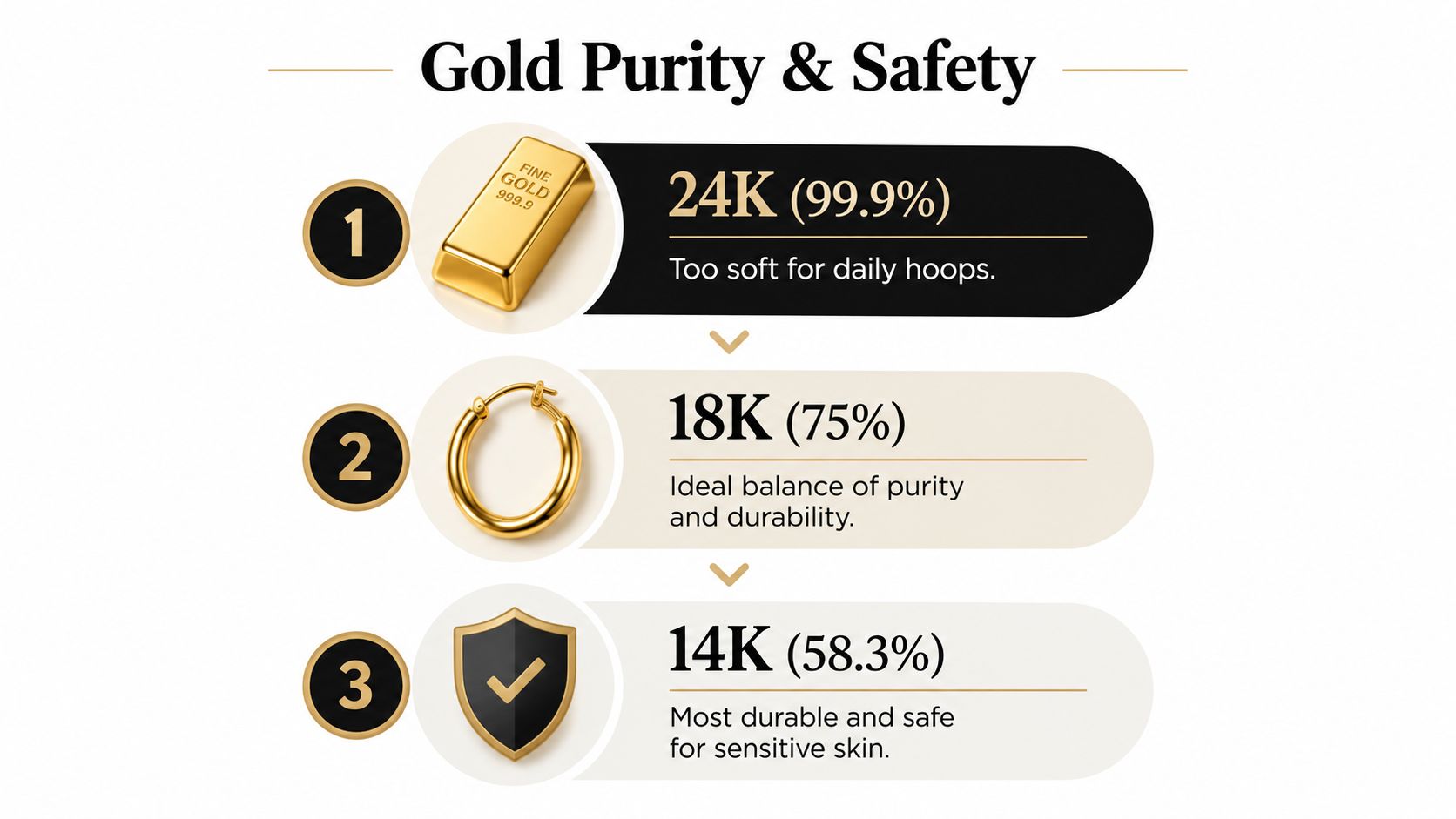
UK gold fineness marks include 375, 585, 750, and 916, corresponding to 9ct, 14ct, 18ct, and 22ct gold. The GOV.UK guidance for businesses complying with hallmarking law explains these recognised marks and the hallmarking requirements. A hallmark shows that the item has been independently tested for purity or fineness. On a hoop, inspect the post, hinge, or another discreet area because the mark may be very small.
Read the description, not just the colour
The listing should state whether the hoop is solid gold, gold plated, or another metal with a gold-coloured finish. Plating commonly wears first at the post, hinge, and inner surface, where friction, moisture, and movement are highest. That affects appearance and durability, and it can expose a base metal against skin during healing.
9ct gold can work well for a durable everyday hoop, but its alloy includes other metals, so fineness alone does not answer a nickel-safety question. 18ct gold or above contains more gold and is generally the safer direction for people concerned about nickel exposure. Allergy UK identifies 18 carat or more gold as a usually safer alternative in its nickel allergy guidance. If you already know that nickel causes a reaction, ask for the alloy composition rather than relying on the karat label.
A healed piercing may tolerate more material variation than a fresh or irritated one. During healing, choose a smooth, verified surface and avoid jewellery that rubs, flakes, or leaves residue in the channel. Clean the piercing as advised by your piercer, and do not rotate the hoop to compensate for a poor fit.
Why nickel deserves attention
Nickel may occur in mixed-metal jewellery or beneath worn plating. A reaction can cause itching, redness, tenderness, scaling, or persistent irritation around the post and clasp. Previous trouble with earrings may reflect the metal rather than inadequate cleaning or a short adjustment period.
A solid, properly verified gold hoop reduces uncertainty, but it does not remove the need to assess construction. Check that the surface is smooth, the finish reaches every skin-contact area, and the post or hinge does not press repeatedly against the piercing.
UK hallmarking rules have covered earrings for decades. Under the Hallmarking Act 1973, a gold item sold to the public and described as gold must meet the applicable hallmarking requirements, including the legal threshold of 1.0 gram. A reputable seller should show the fineness mark on the post or hinge instead of relying on colour-based wording.
For a further comparison of solid gold piercing jewellery options, check the construction and material details before choosing a hoop style.
The Three Dimensions That Define the Perfect Fit
A hoop has three physical decisions that affect comfort more than its colour: gauge, diameter, and weight. Treating them separately makes fitting much easier.
Gauge describes the thickness of the wire or post. A thin hoop can look delicate and feel unobtrusive, while a thicker hoop creates a stronger visual line and may feel more substantial. For a fresh or unsettled piercing, a thick, heavy design often creates unnecessary pressure. A healed lobe may tolerate more choice, but the piercing channel still has to accommodate the jewellery without force.
Diameter determines how far the hoop sits from the piercing. A close-fitting sleeper follows the lobe and usually moves less. A larger circle frames the face more strongly but can catch on hair, scarves, and clothing. Measure from the piercing hole to the edge of the lobe or cartilage, then allow enough clearance for the curve and the closure. A hoop that presses continuously into tissue is too small, even if the look is appealing.
Weight is separate from size. A large hollow hoop may be easier to wear than a small, thick solid hoop. If the lobe stretches downward during the day, the design is asking too much of the tissue. This is especially noticeable with statement hoops, where the lower edge can pull away from the lobe and make the piercing look uneven.
Use the piercing, not the product photo
Hold a ruler beside an existing earring or measure the inside diameter of a hoop that already feels comfortable. Check the opening as well as the outside diameter, because a thick wire reduces the usable space. For cartilage, measure from the hole to the nearest edge of the ear rather than copying a lobe size.
A good fit should allow natural movement without constant rotation. It shouldn't pinch, embed, or sit at an angle that puts pressure on one side of the channel. If you're unsure, a piercer can assess the anatomy while the ear is relaxed, which is more reliable than judging from a front-facing photograph.
Confirm the metal mark at the same time
The UK hallmarking threshold also affects how you evaluate a substantial hoop. Gold hoop earrings sold as precious-metal jewellery must generally carry an approved hallmark when they reach 1 gram, and the mark confirms independent testing of the stated fineness. The recognised marks are 375, 585, 750, and 916, representing 9ct, 14ct, 18ct, and 22ct gold.
That information is useful when comparing size and construction. A heavier-looking pair may have a clear fineness mark, while a lightweight plated pair may only describe its colour. Mixed-metal pieces are assessed against the fineness rules for their gold component, so ask the seller how the description applies to each part of the earring.
| Dimension | What it changes | What to check |
|---|---|---|
| Gauge | Visual weight and pressure at the channel | Whether the post or wire suits the piercing |
| Diameter | Clearance, movement, and face-framing effect | Whether the hoop touches the ear or catches on clothing |
| Weight | Long-term comfort and lobe pull | Whether the earring remains comfortable after several hours |
Matching Clasp Types to Everyday Wear
A clasp decides how a hoop behaves in daily use. It affects how easily you insert it, how firmly it stays shut, and whether the closure presses against the piercing site.
Hinged snap hoops suit everyday wear because the post folds into the opposite side of the hoop. The shape stays tidy, and the closure is usually easier to manage than a separate back. Check that the hinge opens smoothly and that the post clicks fully into place. A weak click, a visible gap, or a closure that opens too easily is a problem before the earring ever reaches the ear.
Sleeper-style and continuous hoops have a simple profile and little hardware, which can make them comfortable for long wear. They are harder to fit if fine wire and a small opening are difficult to line up. Do not twist the hoop hard to insert it. That can bend the circle, leave a permanent gap, and weaken the closure.
Screw-back closures give a deliberate fastening method, but the small thread can be awkward for anyone with limited dexterity. They suit wearers who want a fixed closure and do not mind taking time to fit it. Keep the thread clean, because residue can stop the back from tightening properly.
Lever-back designs are secure and fairly easy to handle, but they add bulk behind the ear. That extra hardware may sit comfortably on a lobe and feel awkward on a tight cartilage placement. Check the rear profile before buying, especially if you sleep on that side.
Match the closure to your routine
If you change jewellery often, a smooth hinged design is usually the most practical. If you rarely remove your hoops and want a clear physical click when the closure shuts, choose a clasp that gives that feedback. People who wear headphones, helmets, or glasses should check that the rear mechanism does not press into nearby equipment.
The metal at the contact points matters most. Plating wears fastest at the post and hinge, so ask what metal sits there rather than relying on the surface colour. A closure can look polished and still fail in use if the working parts are made from a less suitable base metal.
The best clasp is the one you can close fully, check quickly, and wear without rubbing.
Do not force a clasp through a tender piercing. If the post catches, stop and have the fit checked instead of turning a jewellery change into irritation or a tear.
Selecting Hoops for Different Piercing Placements
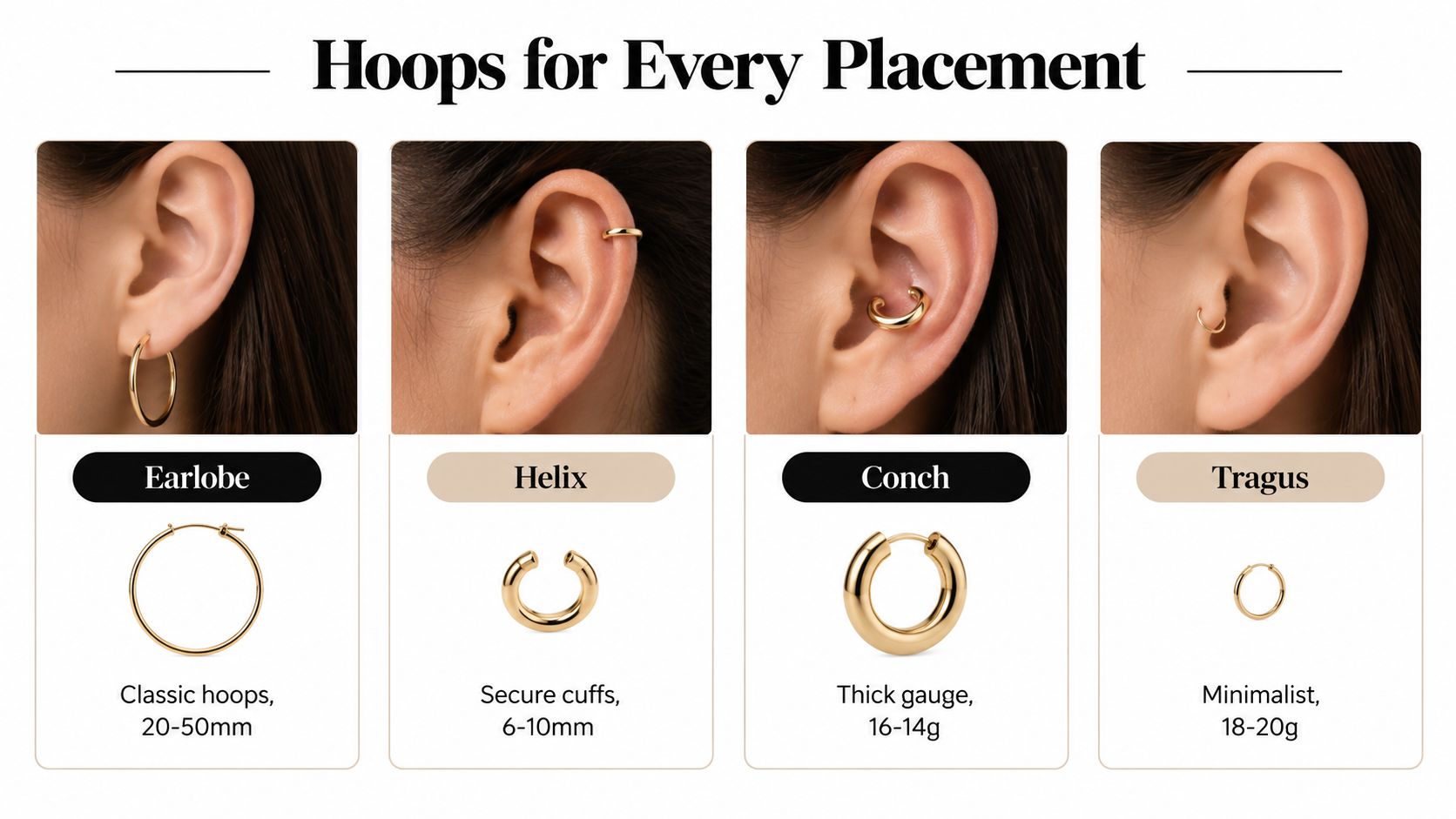
A lobe hoop and a helix hoop may share the same circular shape, but they don't face the same mechanical demands. The lobe has softer, more flexible tissue and usually offers more room. Cartilage is firmer, less forgiving, and more easily irritated by pressure, movement, and poorly chosen angles.
Compare placement by placement
For a standard lobe, classic round or oval hoops give you the broadest styling range. Small, close-fitting designs are suitable for discreet daily wear, while larger hoops create more movement and face-framing impact. Keep the weight under control, particularly if the piercing sits low on the lobe.
A helix usually needs a smaller profile that follows the ear without pressing on its rim. A hinged hoop can work after healing if the diameter and post length are correct, but a snug ring that rotates constantly can irritate the channel. Avoid choosing a size based only on the hoop's outside measurement.
A conch placement can support a more visible hoop, but the curve must clear the ear's inner structure. A thick or heavy ring may look strong while placing sideways pressure on the piercing. The shape should sit naturally rather than forcing the channel to accommodate the jewellery.
A tragus is a particularly poor candidate for a bulky closure. The front and rear hardware can interfere with earbuds, and a rotating hoop can catch during use. A small, smooth design is more practical once the piercing is settled, but the anatomy and jewellery angle need an individual assessment.
For more placement-specific comparisons, see this guide to hoops for cartilage piercings.
Check the safety of the material
UK local authority jewellery guidance sets a nickel release rate below 0.2 micrograms per square centimetre per week for post assemblies used for piercings. Products that directly and prolongedly contact skin must remain at or below 0.5 micrograms per square centimetre per week, according to local authority guidance on jewellery safety.
Those limits matter because a gold-coloured hoop can still contain nickel underneath plating. Ask the seller for material and compliance information, especially for cartilage jewellery that stays in contact with skin for long periods. A vague “nickel free” badge is less useful than a clear description of the metal used in the post, hoop, hinge, and closure.
New cartilage piercings shouldn't be treated like ready-made accessories. The safest hoop is often the one you wear later, after the tissue has settled and a piercer confirms that the ring won't create pressure or repeated movement.
Navigating Healing Stages and Aftercare
A fresh piercing needs stability more than decoration. Hoops move, rotate, catch, and collect residue more readily than a simple, well-fitted initial piece. For that reason, switching to a hoop too early often creates problems that have nothing to do with the quality of the gold.
Keep the routine simple
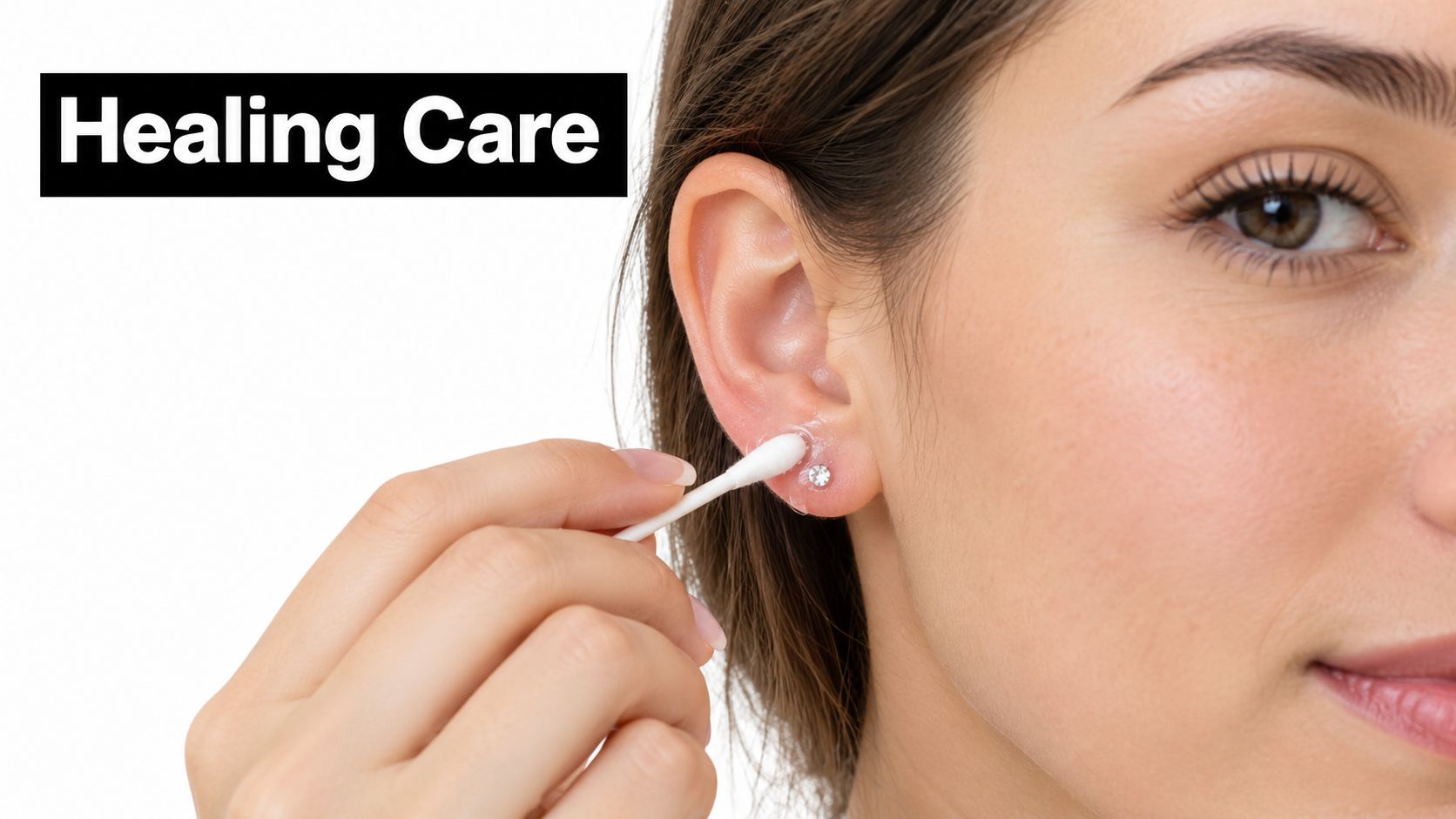
The NHS advises cleaning a new piercing twice a day with warm salty water. Crusting should soften rather than being picked, jewellery shouldn't be twisted while dry, and the area should be dried with a clean paper towel. The NHS guidance for infected piercings also advises avoiding swimming for the first 24 hours after piercing.
Wash your hands before touching the area. Use the recommended cleaning method without adding harsh products, scrubbing, or unnecessary movement. A hoop that keeps turning because hair or clothing catches it can prolong irritation, so keep the jewellery still and protect the ear from avoidable friction.
Healing priority: A piercing should feel progressively calmer, not repeatedly challenged by a fashionable change.
Wait until the piercing is ready before changing jewellery. UK NHS-linked aftercare guidance advises washing hands before contact, cleaning with warm water and liquid soap, and drying only with fresh disposable paper towel or kitchen roll. It also notes that jewellery should generally remain in place for at least 6 weeks before changing it. This NHS-linked piercing aftercare document supports a cautious approach, but individual healing can take longer.
Know when to pause
Heat, worsening swelling, increasing pain, spreading redness, or discharge deserves proper attention rather than a jewellery experiment. Don't remove jewellery in a panic if you suspect infection without seeking appropriate advice, because closing the channel can complicate drainage.
Once the piercing is settled, choose a hoop with enough clearance and a smooth closure. If insertion causes resistance, pain, or bleeding, stop. A professional can check the channel and fit the jewellery without forcing it.
Styling and Caring for Your Gold Hoops
Good styling starts with proportion. A small, smooth hoop can anchor a stack without competing with other pieces, while a sculptural oval or thicker statement hoop can act as the main feature. Mixing several bold shapes often creates visual clutter and adds unnecessary weight, so let one earring provide the emphasis and keep neighbouring pieces quieter.
For daily wear, choose a profile that won't constantly meet hair, collars, masks, or headphones. Remove hoops before sleeping, swimming, exercise, or activities where they can snag. Wipe them with a soft cloth after wear, and store each pair separately so the posts and closures don't scratch one another.
Keep the finish and closure clean
Use gentle cleaning suited to the jewellery's construction, then dry the piece thoroughly before storage. Don't use abrasive materials on a plated surface, and don't assume a strong household cleaner is safe for gold alloys, stones, or delicate hinges. Check the closure regularly for a loose post, a gap, or a hinge that no longer clicks securely.
Your ears need care as well. For practical cleaning steps, use this guide on how to clean piercing jewellery. If irritation continues, remove guesswork by asking a qualified piercer or healthcare professional to assess the piercing and the material.
UK consent rules also matter when arranging a piercing for someone else. Parliamentary and local authority guidance confirms that there's no statutory minimum age for cosmetic ear piercing, but valid consent is required, and under-16s may need a parent or guardian depending on the setting. Some councils require under-16s to be accompanied by a parent or guardian for ear and other listed piercings, as outlined in UK parliamentary guidance on young people and skin piercing.
Piercing Near Me helps people find and book professional piercing services, including studios in Croydon and Bournemouth, with information about jewellery, placement, sterile needles, and aftercare. You can contact the team on 01202 900050 (Bournemouth) / 020 8686 7730 (Croydon) or WhatsApp 07752 913846 (Bournemouth) / 07902 490584 (Croydon) when you need help choosing a suitable hoop or planning a safe jewellery change.
Visit Piercing Near Me to explore professional piercing services, placement advice, and jewellery guidance for comfortable hoop wear. Contact 01202 900050 (Bournemouth) / 020 8686 7730 (Croydon) or WhatsApp 07752 913846 (Bournemouth) / 07902 490584 (Croydon) to discuss your piercing, material choice, and the right time to move into gold hoops.