

You're probably holding a browser tab open right now, comparing shiny cartilage hoops and wondering why one looks perfect in the photo but feels like a bad idea the minute you imagine sleeping on it. The main problem with hoops for cartilage is that the ring can look effortless and still sit too tight, press too hard, or catch every time you brush your hair back. The right choice has to balance style, diameter, gauge, metal quality, and healing stage, because cartilage doesn't forgive guesswork.
For UK clients, this isn't just about looks. Cartilage piercing jewellery has to work with the tissue, not against it, and the safest choices follow the same logic you'd use with any precision fit, measure carefully, leave room where the body needs room, and avoid force where pressure can irritate. The same practical approach sits behind clinical guidance on piercing hygiene, nickel rules, and the way professionals choose jewellery for fresh versus healed piercings.
Understanding Why Hoop Choice Matters
A common mistake is choosing a hoop for its online appearance alone, then finding out later that the fit feels wrong once the ear has to deal with swelling, movement, and everyday friction. A cartilage hoop can look polished in a product photo and still turn into a pressure point after a few hours of wearing it.
That pressure matters because cartilage is firm, slow to settle, and quick to complain if jewellery sits too tightly. UK guidance notes that cartilage piercings typically take 6 to 12 months to fully heal, and that initial jewellery is chosen to minimise pressure and movement. That helps explain why a ring that feels “only a little snug” can become irritating very quickly.
Fit is part of the design
A hoop is more than a circle. It has to clear the piercing channel, rest comfortably against the ear, and leave enough space for the tissue around it. If the inner diameter is too small, the metal can press into the cartilage. If it is too large, the ring may swing, twist, and catch on hair, clothing, or a pillow.
Practical rule: if you notice the jewellery every time you move your jaw, sleep, or wash your hair, the fit is probably asking the piercing to do too much.
This is also where material choice matters. A lighter, high-quality metal can feel close to invisible, while a heavier or lower-grade option stays noticeable all day. Many people do better with implant-grade titanium or 14k gold when their ears are sensitive, especially while they are still learning what their anatomy tolerates. For a closer look at material choices, see this guide to titanium piercing jewellery.
The shape and the metal work together. A neat-looking hoop that is the wrong size can feel more awkward than a simpler piece that sits properly, while the right fit should blend into your routine instead of competing with it.
Understanding Hoops for Cartilage Types and Materials
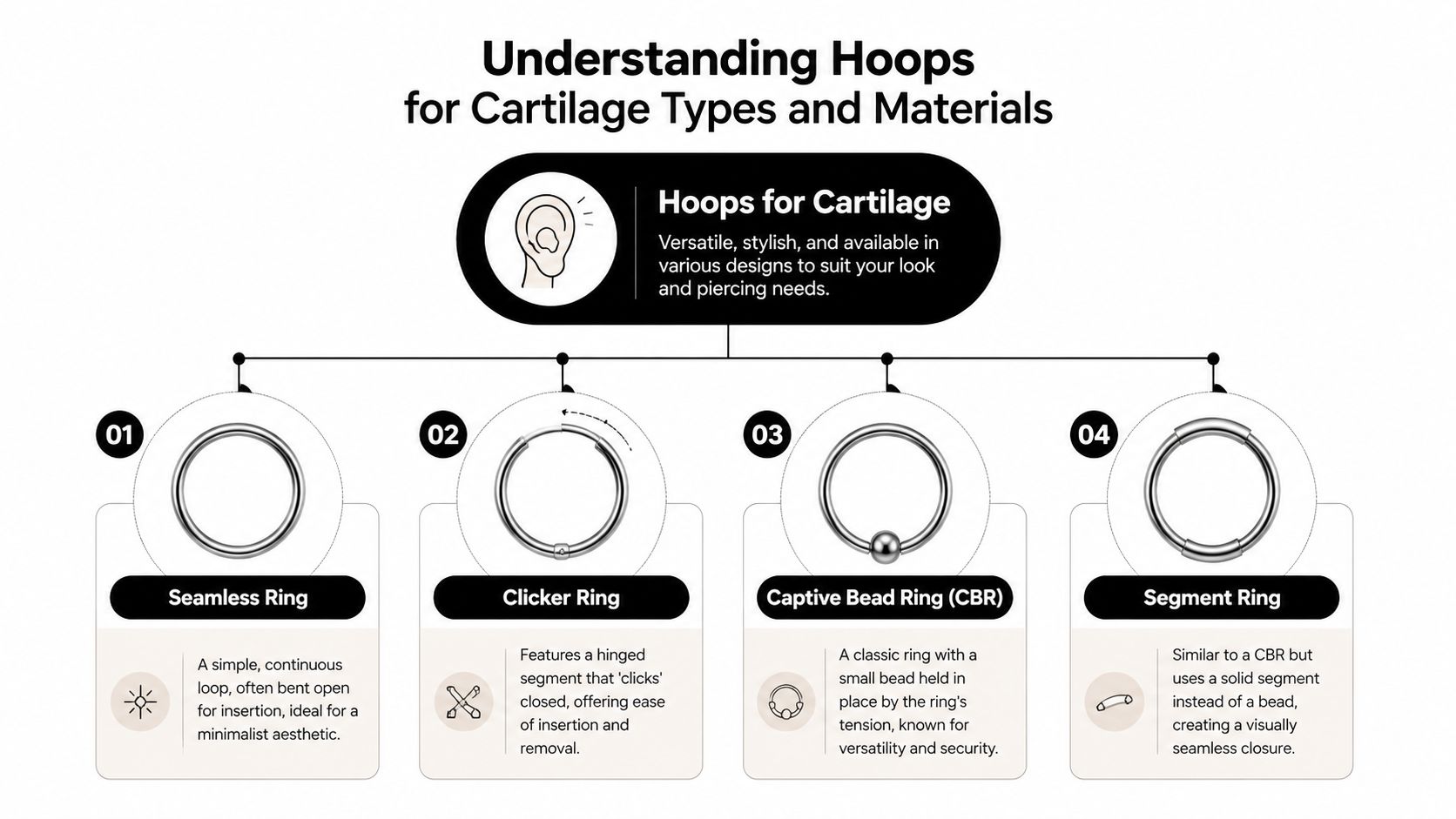
A client can love the look of a hoop and still hate the way it sits. That usually comes down to the type of closure, the weight of the metal, and how closely the ring follows the curve of the ear. A snug-looking fit can be stylish, but if the ring is too tight, it starts pressing on the piercing channel instead of resting around it.
The four common styles
Continuous rings are the cleanest-looking option. They form a smooth circle with no obvious join, so the finish looks simple and refined. In practice, that same clean look can make insertion more fiddly, since the ends need to line up properly.
Clicker rings open on a hinged segment, then close with a click. That makes them easier to handle for day-to-day wear, especially if you want something that opens and closes without much fuss.
Captive bead rings use tension to hold a bead in place. They have a classic piercing-shop feel and stay secure once fitted, but the bead can be awkward to remove or replace if your fingers are cold or the piercing is still tender.
Segment rings close with a removable section rather than a bead. Once in place, they give a neat finish that looks very close to a continuous ring, while still letting the closure work independently from the ring body.
Materials change the experience
The ear notices weight, finish, and surface quality straight away. Implant-grade titanium is a common choice for sensitive clients because it is light and widely used in professional piercing settings. You can see more about implant-grade titanium piercing jewellery. 14k gold is another good option when it is made properly for body wear and the surface is smooth. For sensitive ears, the safer approach is to pay attention to the material and the finish, not just the colour or how polished it looks in a photo.
A hoop that feels “luxury” is the one your ear stops noticing.
For UK clients, fitting is usually measured by inner diameter, because that tells you how much room the ring leaves inside the curve. The exact diameter that works depends on anatomy, so a hoop that looks neatly snug on one person can sit too tightly on another. That difference matters most in cartilage, where a small change in fit can turn a tidy look into a piece that rubs through the day.
That is why a piercer's eye can help. A proper check of the ear makes it easier to choose a ring that follows the shape of the cartilage without squeezing it, which is especially useful if you want the jewellery to sit close but still feel comfortable when you sleep, wash your hair, or wear headphones.
Choosing the Right Size by Gauge and Diameter
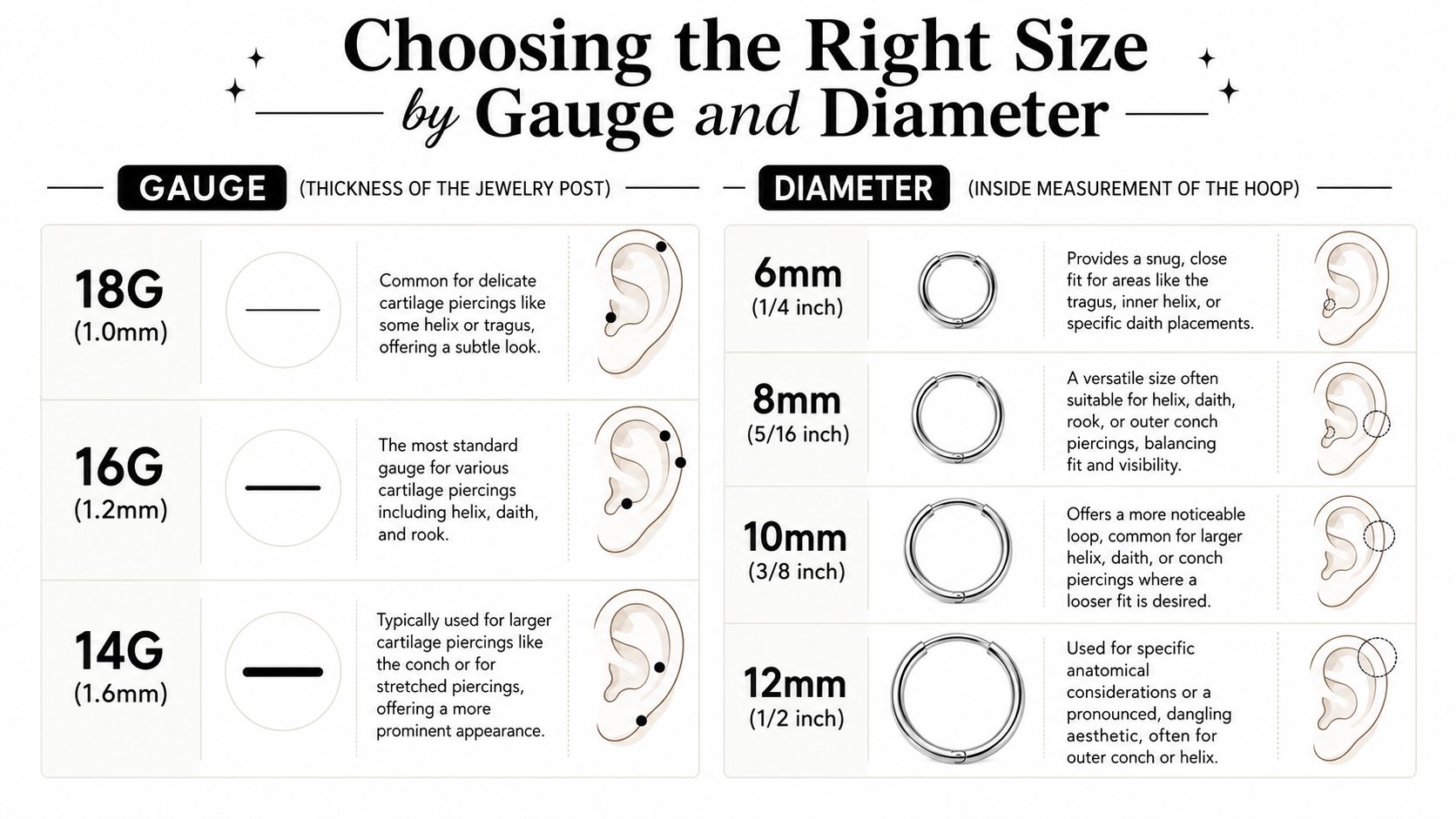
The easiest way to get sizing wrong is to mix up gauge and diameter. Gauge is the thickness of the metal. Diameter is the inside width of the ring. If one is right and the other is wrong, the hoop can still feel awkward, even if it looks good in the mirror.
Measure the right way
Start with the jewellery you already wear, if there is any. A professional piercer can measure the ear for comfort instead of guessing, and that's usually the safer route for cartilage because tiny differences in anatomy change the fit a lot (Lux Punk on correct hoop size in cartilage piercings). If you're shopping online, check the inner diameter rather than relying on vague labels like “small” or “medium”.
A simple working method looks like this.
- Check the gauge first. Most cartilage pieces sit in the common ranges listed below, but the exact choice depends on the piercing site and the jewellery style.
- Measure the space your ear gives you. Don't measure the photo or the packaging, measure your anatomy.
- Choose a little extra room if the piercing is healed but sensitive. A slightly larger ring often feels better than a ring that hugs the tissue too tightly.
- Look for the ring to sit, not clamp. The hoop should follow the ear's shape without digging in.
Common gauge and diameter references
- 18G, 1.0 mm, suits more delicate cartilage placements and gives a subtler look.
- 16G, 1.2 mm, is the most standard gauge for many cartilage piercings.
- 14G, 1.6 mm, is used for larger or more prominent placements.
For diameter, the common reference points are 6 mm, 8 mm, 10 mm, and 12 mm. Smaller diameters sit closer, while larger ones create a looser, more visible loop.
Good fit feels calm. If the ring has to be forced into place, the size is wrong even if the style is right.
If you're comparing sizes across shops, mm to gauge conversion can help you translate the numbers without second-guessing yourself.
Assessing Suitability for New Versus Healed Piercings
Fresh cartilage and healed cartilage ask for different things. A new piercing needs space, sterility, and very little movement. A healed piercing can handle more style choices, but it can still react badly if the ring sits too snugly or the metal is not suitable.
A helpful way to judge the fit is to start with the healing stage, then match the jewellery to it. In a fresh piercing, the channel is still forming, so a hoop behaves a bit like a door that keeps opening and closing when you want it to stay still. In a healed piercing, the same hoop may feel perfectly settled because the tissue is no longer trying to recover from every small shift.
Fresh piercings need restraint
UK skin-piercing guidance says jewellery for body piercing must be sterile when inserted, and only pre-sterilised single-use studs and clasps from a previously intact package should be used for ear piercing (West Suffolk skin piercing guidelines). That is one reason many piercers do not begin a cartilage piercing with a hoop. A ring moves more, catches more, and can crowd the healing channel while the tissue is still new.
Fresh piercings also need the cleanest possible handling. New disposable gloves and aprons for each client, plus decontaminated equipment, are part of professional hygiene practice, as set out in the same guidance (West Suffolk skin piercing guidelines). For clients comparing starter jewellery, best earrings for newly pierced ears is a useful guide for separating healing-first choices from style-first choices.
Healed piercings can be more selective
Once the channel is settled, the question becomes comfort as much as appearance. A hoop can look very clean in a healed cartilage piercing, especially if you want the soft curve of a ring instead of the look of a stud. The detail people often miss is pressure. A healed piercing can look fine in the mirror and still feel irritated if the ring presses at the wrong point or rubs every time you sleep on it.
The same applies to metal quality. A healed ear is less fragile than a fresh one, but poor-quality jewellery can still cause trouble. Nickel exposure and rough finishes may still lead to irritation, so “healed” should never mean “anything goes”.
Healed does not mean invincible. It just means the ear can finally tell you what it prefers.
The safest change is a measured one, moving from stable starter jewellery to a hoop that leaves room, sits smoothly, and does not make the piercing adapt too quickly.
Fitting Tips and Common Problems and How to Solve Them
A well-sized hoop can still feel wrong if the closure is awkward, the ring is stiff, or the ear isn't ready for the exact shape. Most problems here aren't dramatic. They're the kind that slowly become annoying, the little rub that turns into redness, or the ring that spins once and then starts catching every time you put on a jumper.
What usually goes wrong
The most common issue is simple pressure. A hoop that's too tight can create soreness where the ring meets the cartilage. A hoop that's too loose can swing and snag, which is just as frustrating because it keeps reminding the piercing that it's there.
Nickel exposure is another problem worth checking before you blame the fit. UK consumer-safety guidance sets a nickel-release limit of less than 0.2 micrograms per square centimetre per week for items inserted during healing, and 0.5 micrograms per square centimetre per week for prolonged skin contact, because higher release increases irritation risk in sensitive cartilage tissue (Pembrokeshire jewellery safety guidance). That's one of the clearest reasons to avoid low-grade alloys even when the ring looks polished.
Small fixes that help
- Check the closure before wearing it. A clicker that hasn't fully locked can feel fine for an hour and then open at the worst moment.
- Match the ring to the ear's movement. If you sleep on that side, wear headphones, or tuck hair behind the ear often, a slightly more forgiving fit can save a lot of irritation.
- Look for surface quality. Smooth edges and a clean finish make a bigger difference than most first-time buyers expect.
- Don't keep twisting the jewellery. The more a piercing is handled, the more likely it is to stay irritated.
If a ring keeps spinning, the issue is often fit rather than bad luck. If it keeps catching, the hoop may be too large for the placement or the closure may be sitting where your hair and clothing constantly brush it.
Helpful habit: if the hoop hurts more after you clean it, the problem may be the jewellery size, not your aftercare routine.
For clients who feel stuck between two sizes, the better-looking option isn't always the better-feeling one. The softer choice is usually the one that lets the tissue settle without constant reminders.
Aftercare Guidelines and When to Consult a Professional
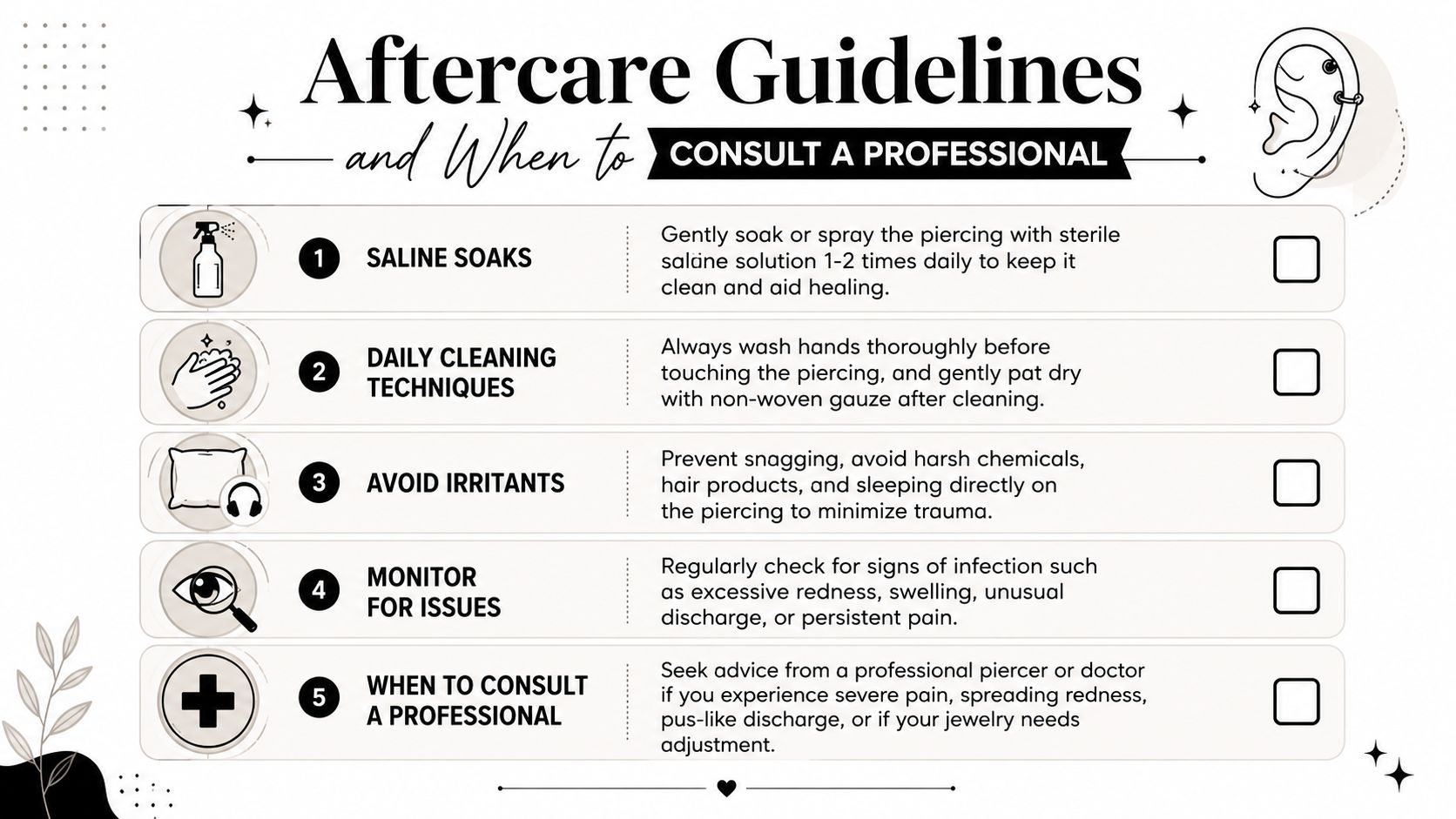
Good aftercare doesn't make cartilage heal overnight. It gives the tissue a cleaner, calmer environment so the jewellery can do less fighting and more settling.
A simple routine that keeps things manageable
- Use sterile saline, gently, rather than harsh products. Keep it light and consistent.
- Wash your hands before touching the area. Clean hands prevent a lot of avoidable trouble.
- Pat dry with non-woven gauze after cleaning if the area stays damp.
- Keep irritants away. Hair products, snagging clothing, and sleeping pressure can all annoy the piercing.
- Watch for changes. More redness, more swelling, odd discharge, or increasing pain are signs to pay attention to.
Know when the hoop needs human eyes
If the jewellery starts to feel embedded, the skin starts swallowing the edge, or pain increases instead of easing, don't wait it out too long. A professional piercer can tell you whether the issue is sizing, placement, or a reaction to the metal. A doctor is the better call if the area looks infected or the symptoms are spreading.
The infographic above gives a practical checklist, but the essential rule is easier than it sounds. If the piercing gets worse after several days instead of gradually calmer, it needs a proper look.
A clean hoop choice still depends on how you care for it. The less drama you create around the piercing, the more likely it is to settle into the kind of quiet wear people want from cartilage jewellery.
Booking and Safety Notes for Croydon and Bournemouth Studios
If you want the hoop fitted properly, choose a studio that treats sizing as part of the service, not an afterthought. Timebomb Tattoo & Piercing's Croydon and Bournemouth studios are set up around single-use sterile needles, implant-grade jewellery sourcing, and experienced piercers who can help you match the ring to your anatomy rather than to a guess.
For UK clients under 16, ear or nose piercing should only be booked with a parent or guardian present to sign consent forms, and younger clients are generally not eligible for most other body piercings (Islington piercing standards). That matters when you're planning a family visit or booking a teen's first ear work.
For appointments and questions, call 01202 900050 (Bournemouth) / 020 8686 7730 (Croydon) or message 07752 913846 (Bournemouth) / 07902 490584 (Croydon) on WhatsApp. If you're ready to choose the right hoop with proper guidance, book through Piercing Near Me and get the fit checked before you commit to jewellery that has to live on your ear every day.
Trackbacks/Pingbacks