
You've probably seen lower back piercings on social media and thought the same thing many clients do: they look sharp, symmetrical, and a bit more unusual than the standard navel or cartilage option. On the right body, with the right jewellery, they can look brilliant.
What is often unseen in the photo is the daily reality. This isn't a piercing you get and forget. The lower back is one of those placements that can look low-effort once healed, but it usually isn't low-effort while healing. Waistbands rub it. Towels catch it. Gym benches, bedding, shapewear, belts, and even your usual way of getting dressed can all work against it.
That's why the right question isn't just “Will it suit me?” It's also “Will it last on my body and in my routine?” If you're weighing up lower back piercings, that's the decision worth making properly.
Considering a Lower Back Piercing
You like the look, book the appointment, and then the practical questions start. Can you wear your usual jeans? Will gym sessions keep catching it? If it settles well, will it still be in place a year from now?
Those are the right questions.
Lower back piercings are chosen for symmetry and impact, but they need to be judged on long-term wearability, not just how they look in a mirror on day one. In studio conversations, I treat this area as a commitment piercing. The placement sits in a high-friction part of the body, and that affects healing, comfort, and how long the piercing is likely to remain stable. If you are new to this style of body jewellery, it helps to understand how a microdermal anchor piercing works before deciding whether the lower back is the right place for it.
Lower back work is often called a back dimple piercing, but the bigger question is suitability. A client can love the look and still be a poor match for the placement if their routine keeps irritating the area.
Who usually regrets this placement
Regret usually comes from lifestyle conflict, not lack of pain tolerance.
Clients tend to struggle if they:
- Wear tight clothing around the waist most days. Belts, shapewear, fitted uniforms, and high-waisted trousers keep pressing and rubbing on the site.
- Train in ways that load the lower back. Benches, floor work, stretching, sweat, and repeated contact all make healing harder.
- Sleep on their back for long periods. Nightly pressure slows things down and can keep the area irritated.
- Want a low-effort piercing. This placement often needs more attention, more protection, and more patience than clients expect.
A lower back piercing can look neat and minimal. Healing it rarely feels that way.
The honest trade-off
The trade-off is simple. You get a striking placement, but you give up some predictability.
Some lower back piercings heal well and stay put for a good stretch of time, especially on clients who dress around them, clean them properly, and avoid constant snagging. Others migrate, catch, stay irritated, or need removal even when the client has done plenty right. That uncertainty is part of the decision. Clinical reviews of piercing complications also describe infections in piercings as wound infections, with signs like ongoing redness, swelling, heat, discharge, or fever needing prompt medical assessment.
If your priority is a piercing that is easy to heal and easy to forget about, I would steer you toward another placement. If your priority is the look, and you are prepared to protect it and accept that it may not be a forever piercing, then it can still be a reasonable choice. The clients happiest with lower back piercings are usually the ones who went in with realistic expectations.
Dermal Anchors Versus Surface Bars
The first thing to clear up is that people often use “lower back piercing” as if it means one specific thing. It doesn't. In practice, you're usually choosing between two different concepts with different mechanics.
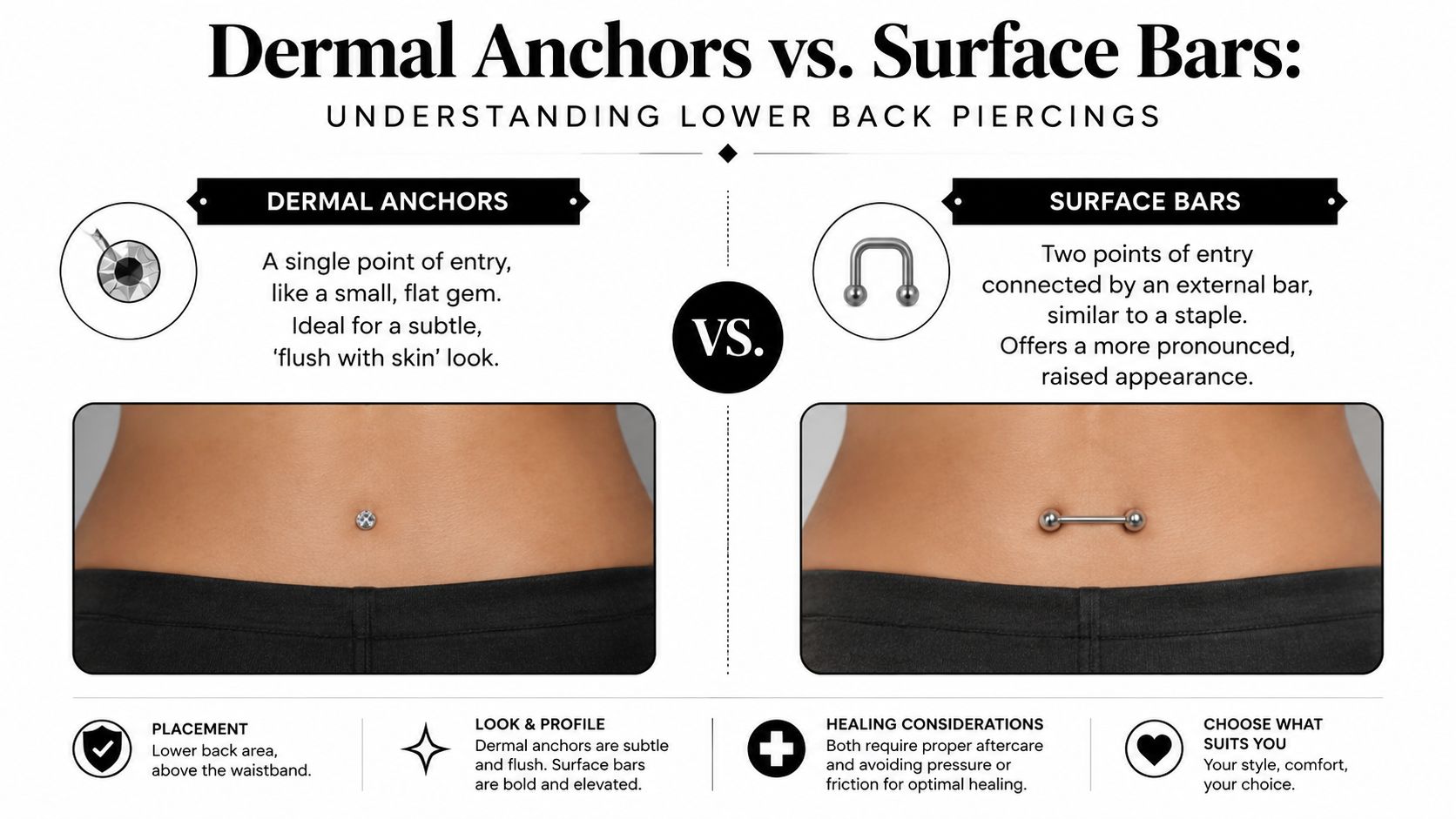
A dermal anchor is a single-point piercing. It features a small anchor sitting under the skin with one visible top. A surface bar is closer to a staple shape under the skin, with two visible ends connected by a bar beneath the surface.
Why most lower back work is dermal
Lower-back piercings are usually dermal piercings placed in the dimples of Venus area. Because they don't have an exit hole, they rely on a subdermal anchor or diver-style implant, which makes them more exposed to displacement, snagging, and rejection than a standard through-and-through piercing, as explained in this guide to back dimple piercings.
That mechanical vulnerability is the whole issue. The lower back bends, twists, rubs against fabric, and catches more easily than clients expect. A single-point dermal can look cleaner and more delicate, but it's also sitting in a hostile location.
If you want a closer look at the jewellery style itself, this guide to microdermal anchor piercing options is useful for understanding how the visible tops and anchor systems differ.
Dermal Anchor vs Surface Bar at a Glance
| Feature | Dermal Anchor | Surface Bar |
|---|---|---|
| Visible look | One visible top per piercing | Two visible ends linked by one bar |
| Structure | Single-point anchor under the skin | Bar sits under the skin with two exits |
| Common use on lower back | Most common choice for back dimples | Less commonly chosen for this exact look |
| Appearance | Minimal, flush, jewellery-forward | More obvious, raised, structured |
| Snag risk | High if tops protrude or clothing catches | Also vulnerable, especially if bar sits under tension |
| Replacement issues | Anchor migration can mean removal | Surface irritation can affect both entry points |
What works visually versus what works mechanically
Clients often choose dermals because they want two separate gems that sit neatly in the back dimples. That makes sense aesthetically. Surface bars don't create the same effect.
But the better visual choice isn't always the easier long-term choice. Surface work in high-movement areas can become stressed by skin tension, and dermals in the lower back can be knocked off course by repeated snagging. There isn't a “risk-free version” here. There's only the version whose compromises you understand before booking.
Placement Pain and The Piercing Process
Pain is usually not the deciding factor once someone understands the maintenance. The appointment itself is short. The commitment afterwards is the harder part.
For placement, most clients ask about the dimples of Venus, because that's where lower back piercings tend to sit best visually. Symmetry matters here. Good marking matters even more. A millimetre off can look fine standing up and crooked once the body moves naturally.
Who is and isn't a strong candidate
Not every lower back suits this piercing well. The best candidates usually have a placement area where the skin can support the jewellery without constant folding, rubbing, or torque from movement.
A poor candidate might be someone whose clothing always sits directly over the proposed placement, someone whose job involves repeated bending and lifting, or someone who wants the look but can't avoid pressure on the area. Anatomy and routine have to agree with each other.
Practical rule: If your waistband, belt, or uniform sits exactly where the jewellery would go, treat that as a serious obstacle, not a minor inconvenience.
What the appointment usually looks like
At a reputable studio, the process is straightforward and methodical:
Consultation first
The piercer checks anatomy, discusses your routine, and decides whether the placement is realistic.Marking the site
This part takes longer than people expect, especially with paired piercings. Balance is everything.Skin preparation and sterile setup
The area is cleaned and the station is prepared using sterile, single-use tools.Piercing and jewellery insertion
For a dermal, the piercer creates the placement and seats the anchor before attaching the top.Aftercare briefing
You should leave knowing how to clean it, how to dress around it, and what signs mean trouble.
What pain actually feels like
Clients usually describe lower back piercing pain as sharp but brief. It's often more intense than a standard earlobe because the tissue and placement are different, but it's over quickly in experienced hands.
The more useful thing to expect is not the moment of piercing. It's the tenderness after, the awareness of it when dressing, and the need to move more carefully than usual for a while. If you go in expecting that, you'll handle the day much better.
Understanding the Realistic Risks and Complications
Lower back piercings either make sense for your life or they don't. The problem isn't that the piercing is “bad”. The problem is that the lower back is mechanically unforgiving.
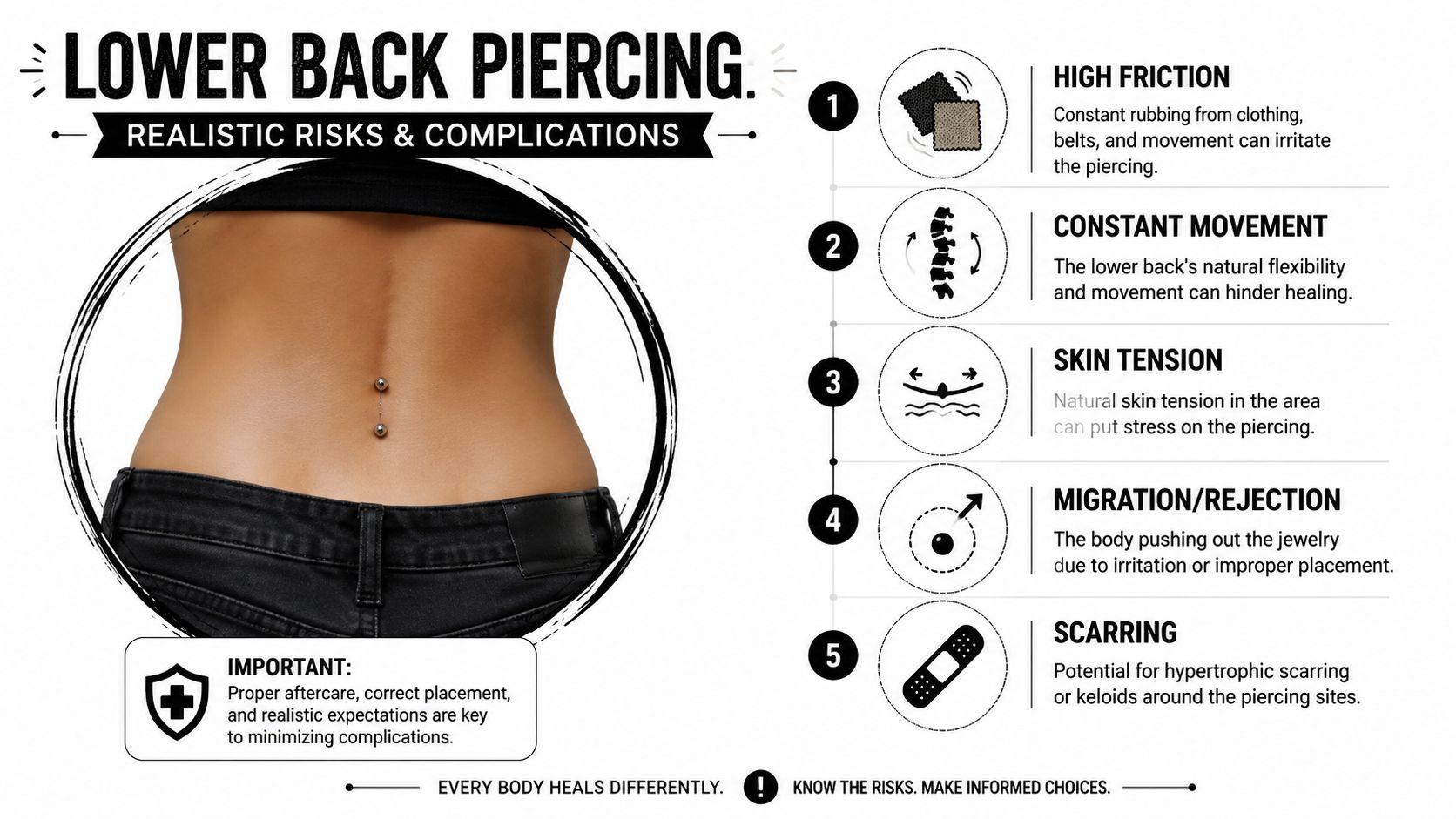
Back dermals have a high complication risk because they snag on clothing and can be rejected when irritated. One piercer estimate cited by Healthline suggests healing can take 3 to 4 months if nothing hits them, but up to a year if they're repeatedly irritated, which is why the key question is whether the piercing will survive your lifestyle, as discussed in this back dimple piercing guide.
The risks clients underestimate most
The word “friction” sounds minor until you apply it to this area every day.
Clothing rub
Waistbands, zips, underwear seams, and fitted dresses can all irritate the site repeatedly.Movement stress
Twisting to drive, bending to lift, stretching in the gym, and rolling in bed all put motion through the area.Snagging
Towels, loofahs, hands while dressing, and bedding are common causes of accidental trauma.Migration and rejection
If the body decides the jewellery is under too much stress, it may start pushing it towards the surface.Scarring
Even if the jewellery is removed, you may still be left with visible marks.
Ask better questions before you commit
Instead of asking whether it hurts, ask these:
What do I wear most days?
If the honest answer is leggings, jeans, belts, or anything high on the waist, your piercing will notice.How do I exercise?
Floor work, contact sports, weight training, and classes with repeated twisting can all be rough on healing dermals.How do I sleep?
If you always land on your back and don't stay still, that matters.Can I leave it alone?
Fidgeting, checking, twisting tops, and changing plasters constantly all make things worse.
Irritation versus infection versus rejection
These three get confused all the time.
Irritation often means redness after catching it, tenderness, or a bit of local swelling. It's still a problem, but it doesn't automatically mean infection.
Infection is more serious. Persistent redness, swelling, warmth, pus, or fever need prompt medical attention. That's not the time for guessing or home remedies.
Rejection usually looks like the piercing becoming shallower, more visible under the skin, or increasingly unstable. If the body is pushing it out, no amount of wishful thinking will reverse that.
If a lower back dermal keeps getting hit, it rarely “settles down on its own”. Repeated trauma usually leads somewhere, and that somewhere isn't good.
Your Healing Timeline and Aftercare Routine
The biggest mistake people make is treating lower back piercings like a quick-heal body piercing. They aren't. This placement rewards boring, consistent care and punishes shortcuts.
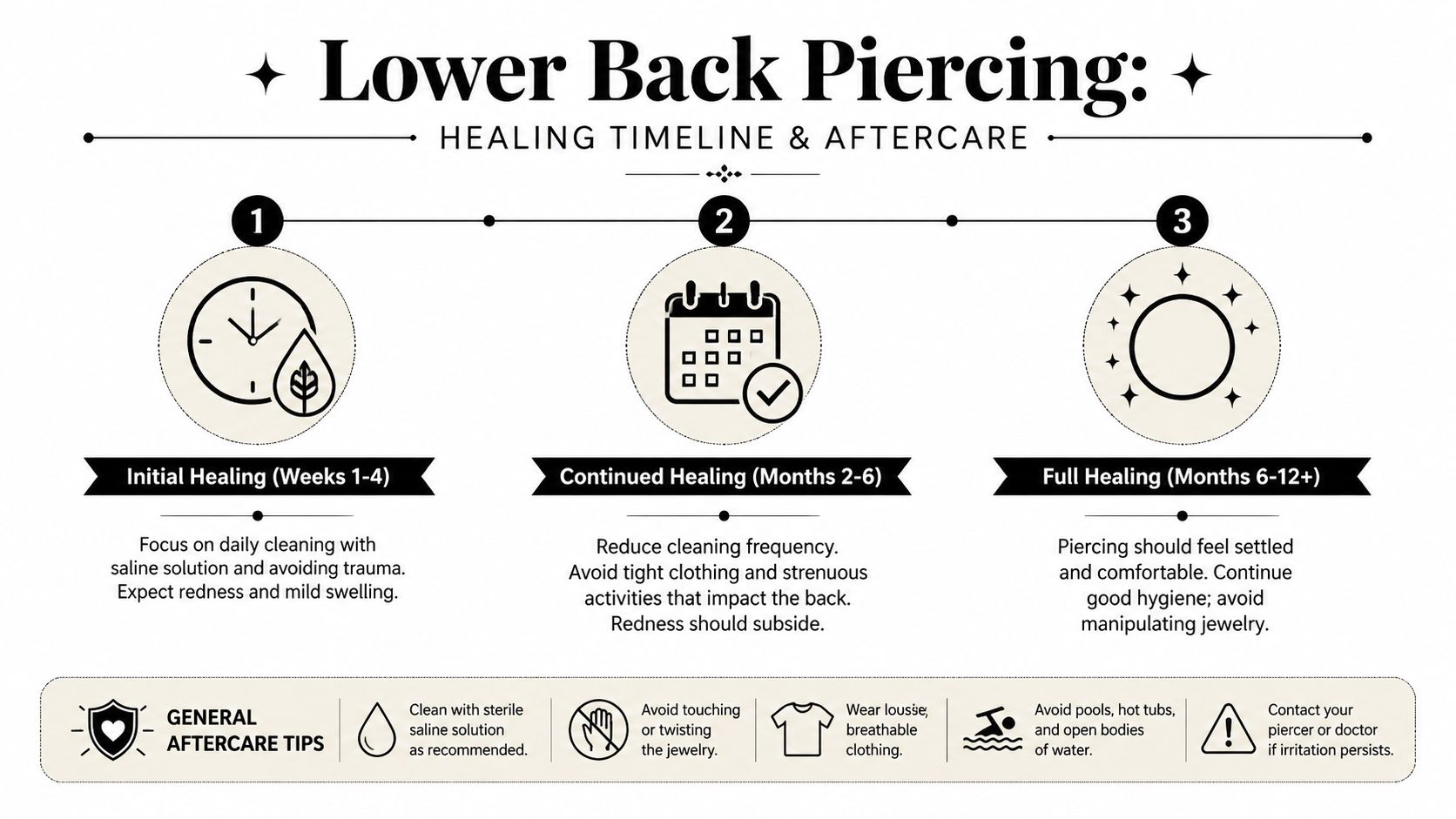
Back dimple dermals usually cost from about £45 each at UK studios; at Timebomb, a pair is £70 in Bournemouth and £85 in Croydon. They may require 2 to 3 months of initial healing and 6 months or more for full recovery, with friction increasing the risk of rejection and tearing.
For day-to-day care, a simple product matters more than a complicated routine. This guide to saline spray for piercing aftercare covers the kind of cleaning product most piercers recommend.
What the first weeks usually involve
The area may feel tender, slightly swollen, and easy to annoy. That's normal. What isn't normal is treating it like healed skin just because it looks decent on the surface.
Your early routine should be simple:
Clean gently with sterile saline
Don't scrub. Soak or spray, then let the area settle.Keep it dry afterwards
Damp skin under clothing tends to get angry quickly.Avoid pressure
Be careful with chairs, benches, lying flat on the site, and anything that compresses the area.Leave the jewellery alone
Don't twist tops, test tightness, or keep touching it to “check”.
The do's and don'ts that matter
Do
- Choose loose clothing when you can, especially in the first part of healing.
- Pat dry carefully after showering with clean disposable paper product rather than a rough towel.
- Return to your piercer if the placement starts looking uneven, shallow, or persistently inflamed.
Don't
- Don't soak in baths, pools, or hot tubs during early healing.
- Don't use harsh soaps, tea tree oil, creams, or antiseptics unless a medical professional has told you to.
- Don't sleep directly on it if you can avoid it.
- Don't change jewellery early because you're bored of the top.
What actually helps healing
Consistency helps. So does reducing the number of times the piercing gets “just lightly” knocked.
A lot of clients focus on cleaning and forget protection. Cleaning matters, but preventing trauma matters just as much. The best aftercare routine in the world can't fully compensate for daily friction from tight clothes and constant movement.
Healing goes better when the piercing is boring. Quiet skin, little movement, no snagging, no fiddling.
Choosing Your Jewellery and Professional Piercer
You can have a beautiful lower back piercing on day one and still lose it later because the jewellery was wrong or the placement was chosen by someone who did not respect how much this area moves. That is the real decision here. You are not only choosing a look. You are choosing the setup that gives the piercing its best chance of lasting.
Jewellery should be selected for stability first, appearance second. For fresh dermals and surface work, implant-grade titanium is usually the material I would choose first because it is well tolerated and practical for long healing periods. On the lower back, profile matters too. Smaller, lower-sitting tops usually cause fewer problems with waistbands, towels, gym clothing, and bed linen than tall or heavily set ends.
If you want to compare materials, finishes, and thread types before your appointment, this guide to UK body jewellery standards and options is a useful place to start.
The prettiest jewellery is not always the jewellery that lasts best in this placement. Large tops, sharp edges, and ornate designs give fabric more to catch. That does not mean you can never wear them. It means they are often a better choice later, if the piercing proves stable enough.
Choosing the piercer matters just as much as choosing the metal. Lower back work needs accurate depth, angle, spacing, and realistic planning around your clothing and daily movement. A weak decision at the start can turn into months of irritation, repeated snagging, or a piercing that slowly sits shallower until it needs to come out.
Look for these signs:
A studio that feels consistently clean and controlled
Hygiene should look routine, not theatrical.Single-use sterile needles and properly sterilised jewellery
These are baseline standards.Photos of healed lower back work, not only fresh piercings
Fresh work shows styling. Healed work shows judgement.A piercer who asks about your routine
Waistbands, uniforms, driving, gym training, and how you sleep all affect whether this piercing is realistic.Honest advice, even if that means refusing the piercing
A good piercer protects your skin, not just the booking.Clear review and troubleshooting support
You want someone available if one side starts sitting differently, swelling lingers, or the jewellery begins catching more than expected.
The strongest sign of professionalism is restraint. If a piercer talks openly about rejection, visible scarring, short lifespan, and the fact that some lower back piercings are poor candidates for long-term wear, pay attention. That honesty usually comes from experience.
For this placement, good work is not the one that looks best for a week. It is the one that still makes sense for your body and your routine months later.
Book Your Consultation in Croydon or Bournemouth
If you've read this far and still want lower back piercings, that's a good sign. You're looking at the decision properly. This placement can work well, but it works best for people who accept the maintenance, protect it from friction, and choose their piercer carefully.
A consultation is the right next step if you want a proper answer on anatomy, placement, jewellery, and whether your routine makes you a strong candidate. That conversation matters more here than it does with easier piercings.
For bookings and enquiries, use the studio contact details directly:
- Phone 01202 900050 (Bournemouth) / 020 8686 7730 (Croydon)
- WhatsApp 07752 913846 (Bournemouth) / 07902 490584 (Croydon)
If you're deciding between the Croydon and Bournemouth studios, send clear photos of the area if requested, mention the clothing you wear most often, and be honest about work, gym, and sleep habits. That makes the consultation more useful and helps your piercer tell you whether the look you want is realistic on your body.
A good appointment for this piercing should feel calm, specific, and honest. If the answer is yes, you'll know why. If the answer is no, you'll know that before you commit to a difficult heal.
If you want help finding a safe studio, comparing jewellery, or booking with an experienced team, Piercing Near Me makes it easy to explore professional options and take the next step with confidence.