
You're sitting in the studio with a few saved photos open on your phone. One shows a small stud low on the nostril, another has a ring, and a third seems to sit much higher. Then someone mentions a septum, bridge, or mantis piercing, and “a nose piercing” suddenly becomes several completely different procedures.
A useful nose piercing placement diagram should do more than place decorative dots on a face. It should show anatomical boundaries, explain how placement affects jewellery and healing, and reflect the hygiene controls expected in a professional UK setting. The right mark depends on your nose, your jewellery plans, and the tissue a piercer can safely access.
Why a Nose Piercing Placement Diagram Matters
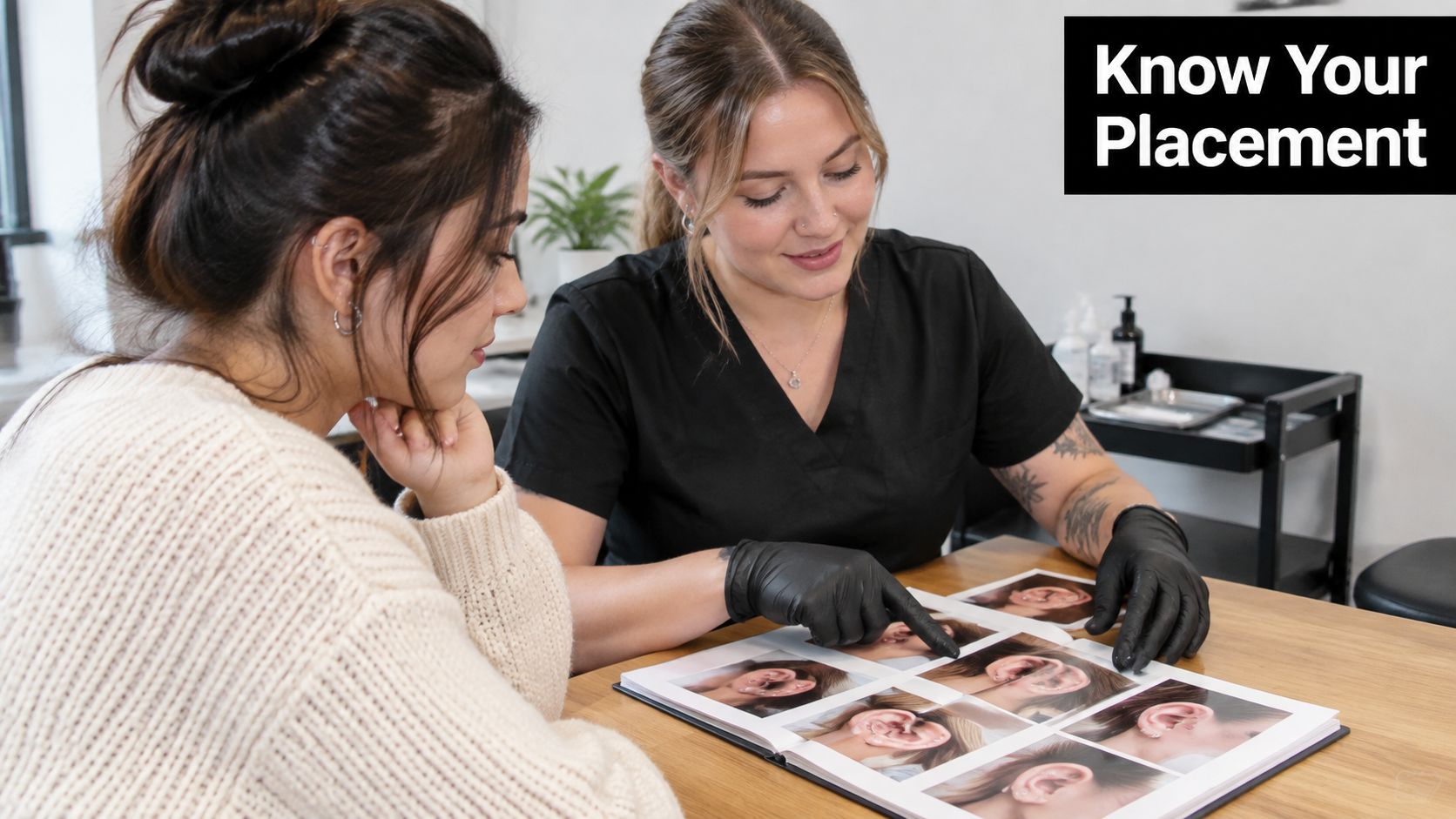
A first consultation usually starts with an image. You point to a placement you like, and the piercer studies the position against your nostril edge, crease, tip, and overall facial balance. A responsible professional won't copy the dot from a photograph, because the same mark can sit safely on one nose and poorly on another.
UK local authority guidance defines cosmetic nose piercing narrowly as piercing the nasal cavity walls only, as described in Islington Council's ear and nose piercing standards. That distinction matters. A diagram should separate nostril-wall placement from septum work, rather than presenting every mark around the nose as one interchangeable option.
Studio rule: A placement mark must make anatomical sense before it looks symmetrical in a photograph.
The diagram also sits inside a legal and hygiene framework. UK council standards refer to sterile jewellery and purpose-designed nose-piercing equipment that pierces the nasal wall without a butterfly clasp. Other council guidance lists suitable jewellery materials including 18K gold, niobium, titanium, platinum, and dense low-porosity plastic, as set out in Bromley's cosmetic-piercing conditions.
Age controls can also form part of the consultation. Multiple UK councils set a minimum client age of 16 for nose piercing, with parent or guardian involvement required for some under-16 clients under local conditions. A professional studio should be ready to explain its own age policy clearly before you book.
Placement affects practical details long after the initial appointment. A low mark may leave less room for a ring, a higher nostril can be harder to clean and more prone to snagging, and a septum diagram must show soft tissue rather than cartilage. In Croydon or Bournemouth, you can use Piercing Near Me as a booking destination for consultations and professional piercing services. Call 01202 900050 (Bournemouth) / 020 8686 7730 (Croydon) or message 07752 913846 (Bournemouth) / 07902 490584 (Croydon) on WhatsApp to discuss your options.
Core Placements Shown on a Nose Piercing Diagram
Read a diagram by locating the tissue being pierced, not just by counting dots. The four familiar placements below look distinct on paper, but their entry points and jewellery requirements aren't interchangeable.
Standard nostril
A standard nostril mark usually sits on the side wall of the nostril, below the nasal crease. UK-facing placement guidance commonly positions it about 8 mm up from the bottom edge of the nostril, while avoiding the crease itself, as explained in this UK piercing guide to nose placement.
The reason is anatomical. The crease can contain thicker cartilage where two cartilage plates meet. Piercing through that area may create more trauma and make healing less predictable, so a diagram that places the dot directly in the crease is missing an important warning.
High nostril
A high nostril sits above the standard nostril position, closer to the upper sidewall and bridge. On a diagram, it should be clearly separated from the crease and from any bridge mark. The available tissue varies considerably, so the final position needs an in-person assessment rather than a copied measurement.
High nostrils often suit a flat-backed stud during healing. Their higher position can create a layered look beside a standard nostril, but it can also change cleaning access and the angle needed for jewellery.
Septum
A septum piercing belongs in the soft-tissue area of the nasal septum, excluding the cartilage-heavy zones. UK guidance distinguishes septum work from nostril work by identifying the septum area separately, which is why a trustworthy diagram must show the soft-tissue “sweet spot” rather than a ring placed through the hard central cartilage.
For more detail on this distinct placement, see this guide to septum piercing placement. A piercer checks the internal anatomy by touch, not by relying on the front view alone.
Bridge
A bridge piercing passes horizontally across the upper bridge of the nose. It isn't the same as piercing the nasal cavity wall, and it should appear as a separate category on a diagram. Because bridge jewellery sits across surface tissue, the piercer must assess available tissue, pressure, movement, and the possibility of migration.
How Anatomy Changes Your Ideal Placement
Two noses can look similar from the front and feel completely different during a consultation. A piercer assesses the thickness of the nostril wall, the shape of the tip, internal space, asymmetry, and any deviation before deciding where an entry point can sit comfortably.
Nostril thickness and the crease
A thicker nostril or a pronounced crease can limit the most obvious mark. The piercer may move the position slightly away from the crease so the channel passes through more suitable tissue. That adjustment can change the angle of the jewellery and the size of a future hoop.
Asymmetry doesn't automatically rule out paired or layered piercings. Instead, the piercer may position each side to create visual balance rather than measure an identical distance from each nostril edge. The finished result should look balanced on your face, not merely match a ruler measurement.
Septum deviation
A septum that deviates from the centre can make a front-view diagram misleading. The piercer needs to feel for the available soft tissue and identify an entry path that avoids cartilage. The ring may then sit visually central even when the internal pathway isn't identical on both sides.
You should ask whether the proposed mark follows your anatomy, where the soft tissue is, and how the jewellery will sit when your face is relaxed. These questions are more useful than asking for a universal “correct” dot.
Advanced nostril placements
Mantis, or forward-facing nostril, placements need especially careful assessment. The visible shape of the tip matters, but the piercer also needs to feel the internal space. A narrow or asymmetric tip may offer fewer options for matching the two sides, while a broader, flatter tip can provide more surface area.
A good consultation should cover your intended jewellery, whether the pieces could press against the septum, and how easily they might catch during face washing, dressing, or sleep. The diagram is a conversation starter. It can't show the internal anatomy that determines whether the proposed placement is workable.
Jewellery Options for Each Placement
Jewellery should be planned with the placement, tissue thickness, angle, and lifestyle in mind. Nose size alone doesn't determine fit. A low nostril mark close to the edge can require a smaller hoop than a higher mark, even on the same person.
The UK sizing guidance below gives useful planning examples. Your piercer should still measure the healed channel and assess swelling before fitting a final ring.
Jewellery fit by placement
| Placement | Distance from Edge | Hoop Size | Healing Timeline |
|---|---|---|---|
| Low nostril | 6–7 mm | 6–7 mm hoop | Start with a stud, then change after at least 4–6 months or when fully healed around 6–9 months |
| Standard nostril | Around 7 mm | 8 mm hoop | Start with a stud, then change after at least 4–6 months or when fully healed around 6–9 months |
| High nostril | Around 8–9 mm | 9–10 mm hoop | Stud-first planning is usually more practical, with ring fitting dependent on complete healing |
These measurements and fitting examples come from this UK nose hoop size guide. A professional may choose a standard position around 8 mm from the edge because it can leave the option of a snug ring later, but that doesn't mean a ring belongs in a fresh piercing.
For the initial jewellery, a flat-backed stud is often easier to protect than a hoop. A ring moves with facial expressions, towels, clothing, and sleep, which can irritate a new channel before it has stabilised. The recommended change point is at least 4–6 months, or around 6–9 months when fully healed, rather than a date chosen only for appearance.
Material matters as much as shape. UK council standards identify 18K gold, niobium, titanium, platinum, and dense low-porosity plastic as approved material categories in relevant conditions. For nickel-sensitive clients, London borough guidance on nickel release gives a threshold of less than 0.2 micrograms per square centimetre per week for post assemblies used in piercings.
For placement-specific jewellery ideas, you can review nostril piercing jewellery options before your consultation, then let the piercer adapt the choice to your anatomy.
Placement-Specific Aftercare and Healing Notes
Aftercare advice can sound contradictory because some older UK-facing sources still tell clients to rotate or turn jewellery. More recent guidance generally takes the quieter approach: leave the jewellery alone, clean gently with saline, and reduce irritation.
A practical routine starts with saline cleaning twice daily, a recommendation described in UK nose-piercing aftercare guidance. Apply saline to the front of the piercing, allow it to work gently, and dry with clean gauze or a paper towel. Don't twist the post or drag a cotton bud through the channel.
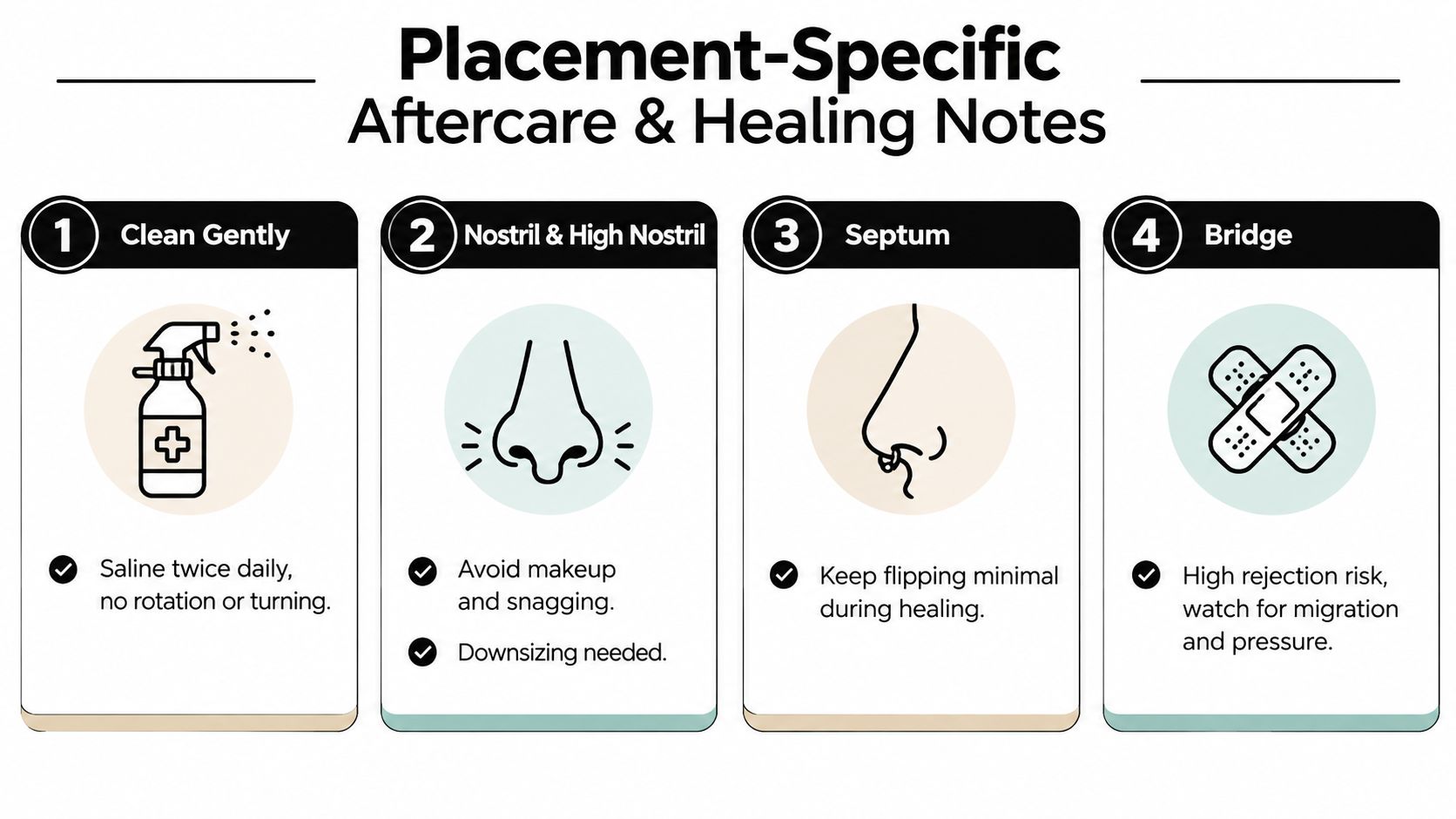
Match the routine to the placement
- Standard and high nostrils: Keep makeup and facial creams away from the area during the first two weeks, following the guidance linked above. Take care with towels, clothing, glasses, and hands, because a sidewall stud can snag during ordinary routines.
- Septum: Keep handling minimal. Repeatedly flipping a horseshoe or moving a ring can irritate the channel, especially when the jewellery is being repositioned with unwashed hands.
- Bridge: Watch for pressure and migration. Sunglasses, masks, sleeping positions, and accidental knocks can place force across surface tissue, so report persistent movement or changing angles to your piercer.
- Any placement: Keep jewellery in during healing unless a qualified professional tells you otherwise. Removing it can allow the channel to narrow or close while it is still settling.
Aftercare advice: Cleaning should remove buildup without turning the piercing into a daily handling exercise.
Placement changes access. A low nostril can collect makeup near the crease, a high nostril may be harder to reach without touching the post, and a septum can collect moisture internally. These differences explain why “clean it more” isn't automatically better. Gentle, consistent care protects the channel more effectively than aggressive scrubbing or repeated movement.
Booking a Safe and Professional Piercing
A placement consultation should feel like an assessment, not a quick mark-and-pierce service. The piercer should discuss the position, show you the mark from more than one angle, explain the jewellery choice, and give you time to approve the placement before proceeding.
Ask how the studio manages sterile equipment and jewellery. Professional standards include single-use sterile needles, implant-grade jewellery, clean preparation, and clear personalised aftercare. You can also ask what material is being fitted and how the studio checks nickel content, particularly if you've reacted to jewellery before.
The professional piercer directory and booking guidance connects clients with services associated with Timebomb Tattoo & Piercing's Croydon and Bournemouth studios. Both locations offer consultations, walk-ins, and appointments, with guidance covering placement, jewellery selection, preparation, piercing, and aftercare.
A consultation is particularly useful for advanced placements such as mantis, high nostril, or bridge work. The piercer can assess internal space and surface tissue, check whether your preferred jewellery will sit at the intended angle, and explain any compromises before you commit.
You can contact the service by phone on 01202 900050 (Bournemouth) / 020 8686 7730 (Croydon) or by WhatsApp on 07752 913846 (Bournemouth) / 07902 490584 (Croydon). Have your inspiration photos ready, but be prepared for the final mark to shift slightly if your anatomy calls for it.
Your Placement Decision Checklist
Take these points to your appointment:
- Name the placement: Decide whether you're considering standard nostril, high nostril, septum, bridge, or mantis work.
- Check the anatomy: Ask the piercer to assess nostril thickness, crease position, asymmetry, deviation, and internal soft tissue.
- Plan jewellery: Start with the piece that supports healing, then discuss a future hoop and its likely fit.
- Confirm materials: Ask about titanium, niobium, platinum, suitable gold, or another approved option.
- Agree aftercare: Use gentle saline, avoid unnecessary movement, and keep cosmetics away during the early period.
- Verify studio details: Confirm age requirements, sterile technique, jewellery quality, and follow-up support.
For an assessment in Croydon or Bournemouth, call 01202 900050 (Bournemouth) / 020 8686 7730 (Croydon) or WhatsApp 07752 913846 (Bournemouth) / 07902 490584 (Croydon).
Piercing Near Me offers consultations, walk-ins, and appointments for clients planning nose placements, with guidance on anatomy, jewellery, preparation, piercing, and aftercare. Visit Piercing Near Me with your placement ideas, and start with a professional assessment rather than relying on a decorative diagram alone.