
You've got a tight nose stud, a crusted septum ring, or jewellery that needs to come out before work, surgery, or a scan, and the instinct is usually to tug and hope for the best. That's the moment when a careful nose piercing removal routine matters, because a rushed attempt can turn a minor nuisance into swelling, tearing, or a clinic visit you didn't want.
Understanding nose piercing removal
A stuck stud rarely starts as an emergency. It usually begins with dryness, a backing that will not turn, or a ring that catches every time you touch it, then the area becomes sore and more inflamed.
That small problem has a wider public-health context in the UK. A study based on Hospital Episode Statistics found NHS hospitals in England spent almost £3 million a year removing nasal foreign bodies between 2010 and 2016, averaging 1,218 cases annually (BBC News). For anyone dealing with a nose piercing, that is a clear warning that blocked nostrils, lost studs, and unsafe removal attempts can end up needing hospital care rather than a quick fix at home.
Practical rule: if jewellery feels anchored, do not force it. The piercing channel is more likely to tear than to come free cleanly.
Age matters too. In that same analysis, 95.4% of nasal removals were in children (BBC News), which is why parents and guardians should treat a tight or missing nose stud seriously. The issue is not only jewellery coming out, it is also how quickly a small nasal problem can become an NHS case, especially if someone tries to pull, probe, or push something back in unsafely.
For guidance on what to do after the jewellery is out, the studio advice on nose piercing care gives a useful starting point. Removal should be deliberate, not forceful, because the nose heals best when the channel is left as undisturbed as possible.
Preparing for a safe removal
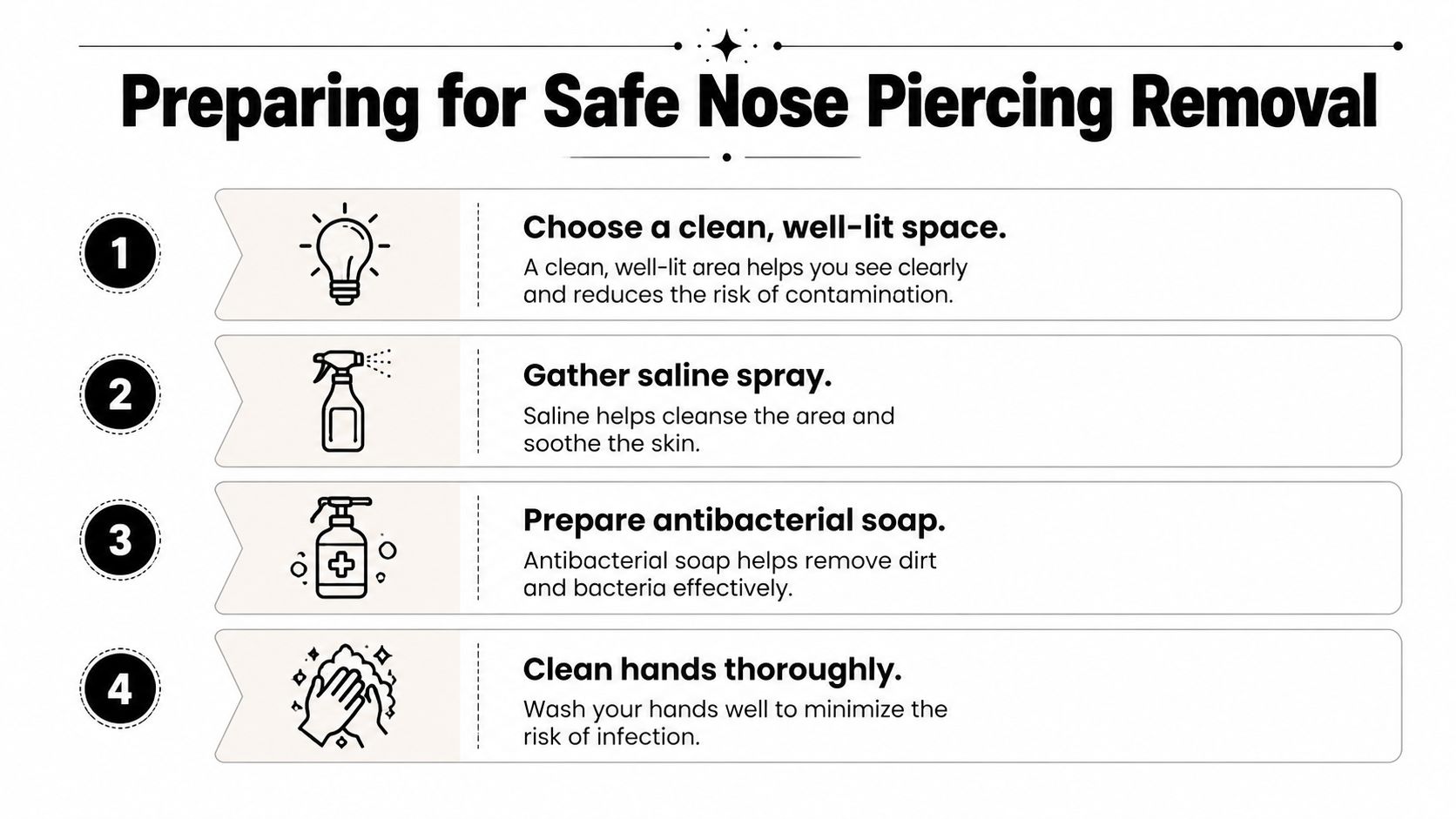
Good removal starts before you touch the jewellery. Set yourself up properly first, because half the problems people run into come from bad lighting, dirty hands, or trying to work too fast in a bathroom mirror.
Gather the right supplies
Keep the tools simple and UK-available. You don't need anything fancy, just a clean surface, a mirror at eye level, saline spray, antibacterial soap, and sterile cotton swabs or cotton pads for softening crusting. If the area is hard to see, use bright light from the front rather than overhead shadows, since you need to spot the angle of the post or ring clearly.
Wash your hands thoroughly before you start, then clean the area around the piercing with saline. Healthline notes that a nose piercing may take up to 8 months or more to fully heal, and only after that stage can jewellery be swapped without increased risk of tearing or infection (Healthline). That matters because an early removal is not just a cosmetic change, it's a mechanical risk.
Know when home removal makes sense
At-home removal works best when the jewellery is healed, visible, and moving normally. If the skin is hot, sharply painful, or swollen around the post, wait and reassess rather than pushing through it.
Clean hands, softened crusting, and good light solve more removal problems than pressure ever will.
Avoid oils you haven't vetted, random “piercing hacks,” and any product that leaves residue in the channel. The safest home approach is friction reduction, not experimentation. If you're at the stage where the jewellery needs to come out for a short time, treat the skin as delicate tissue, because that's exactly what it is.
Removing nostril and septum jewellery safely
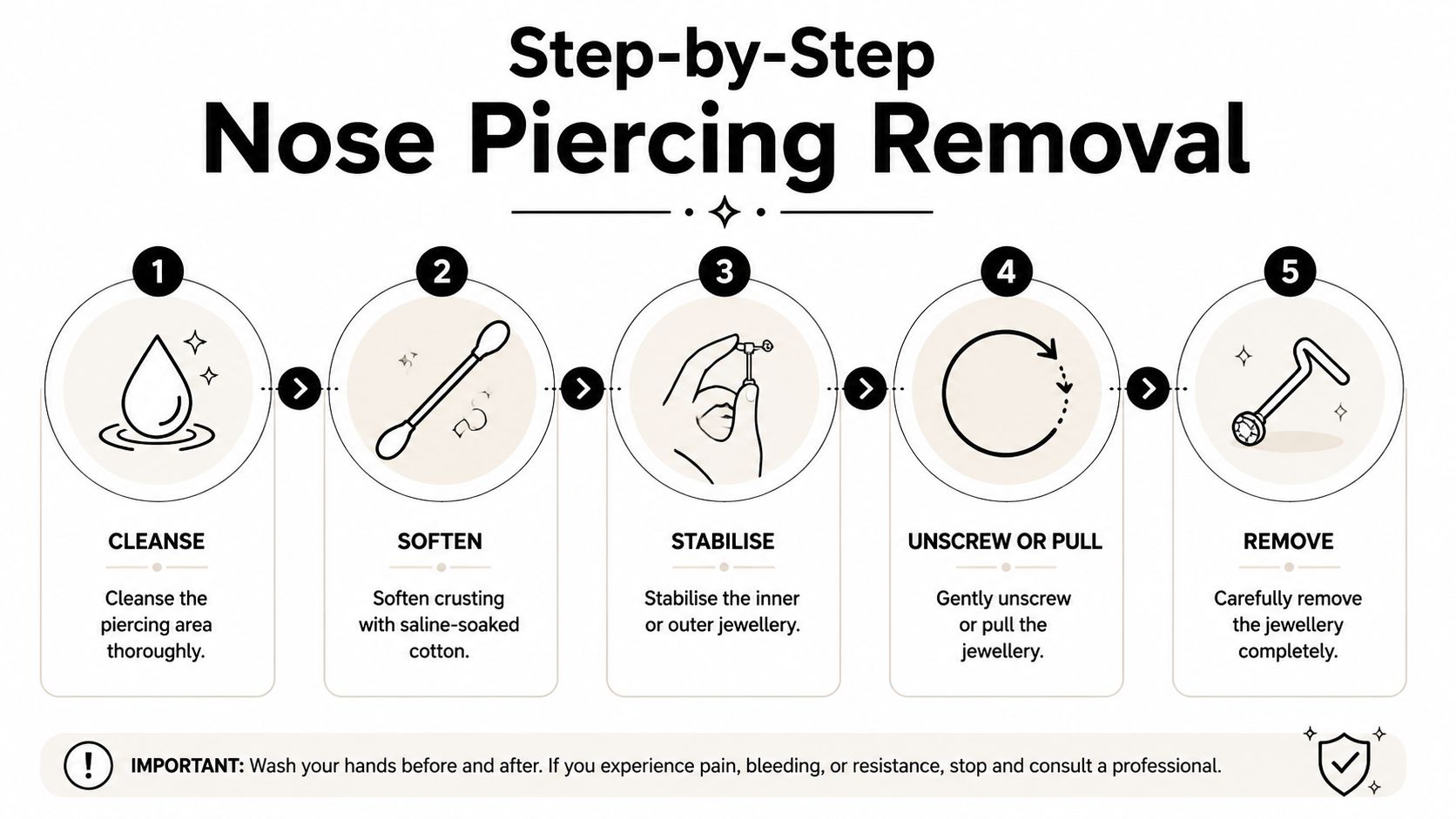
Clean removals stay calm. The jewellery should move under light, controlled pressure, and the method should match the piece in front of you, not the amount of force you can apply.
Nostril studs
Wash your hands first, then hold saline-soaked cotton against the piercing for 30 to 60 seconds to soften any crusting. UK aftercare guidance also recommends gentle traction or rotation depending on the jewellery style, and stopping at once if you feel resistance, so you do not tear the channel (Carl Oliver).
For a nostril stud, steady the inner post or backing with one hand and guide the front end out with the other in a slow, straight movement. If the post is screw-style and the angle feels off, do not yank it straight out. A controlled turn and slide is safer than a sudden pull, especially if the tissue is still tender.
Septum rings
Septum jewellery needs a different approach because the shape and closure matter. If the ring opens by rotation, support the channel and ease it open without twisting against the skin. If it is a captive style, keep the pressure light and work the join, rather than trying to drag the whole ring through in one go.
What to stop doing immediately
If the jewellery catches, stop and soften the area again with saline. Consumer guidance also recommends washing your hands for 20 seconds with antibacterial soap before removal to reduce friction and infection risk, then using saline-soaked cotton for the same 30 to 60 seconds before trying again (Bluestone).
If it does not move with gentle pressure, do not force it.
A stud that refuses to release is often showing you that swelling, crusting, or angle has changed. Pause, let the tissue settle, and come back only when the movement feels free. If the jewellery still will not budge, or the area is hot, painful, or increasingly swollen, that is the point to book a piercer rather than keep twisting at home.
Troubleshooting removal challenges
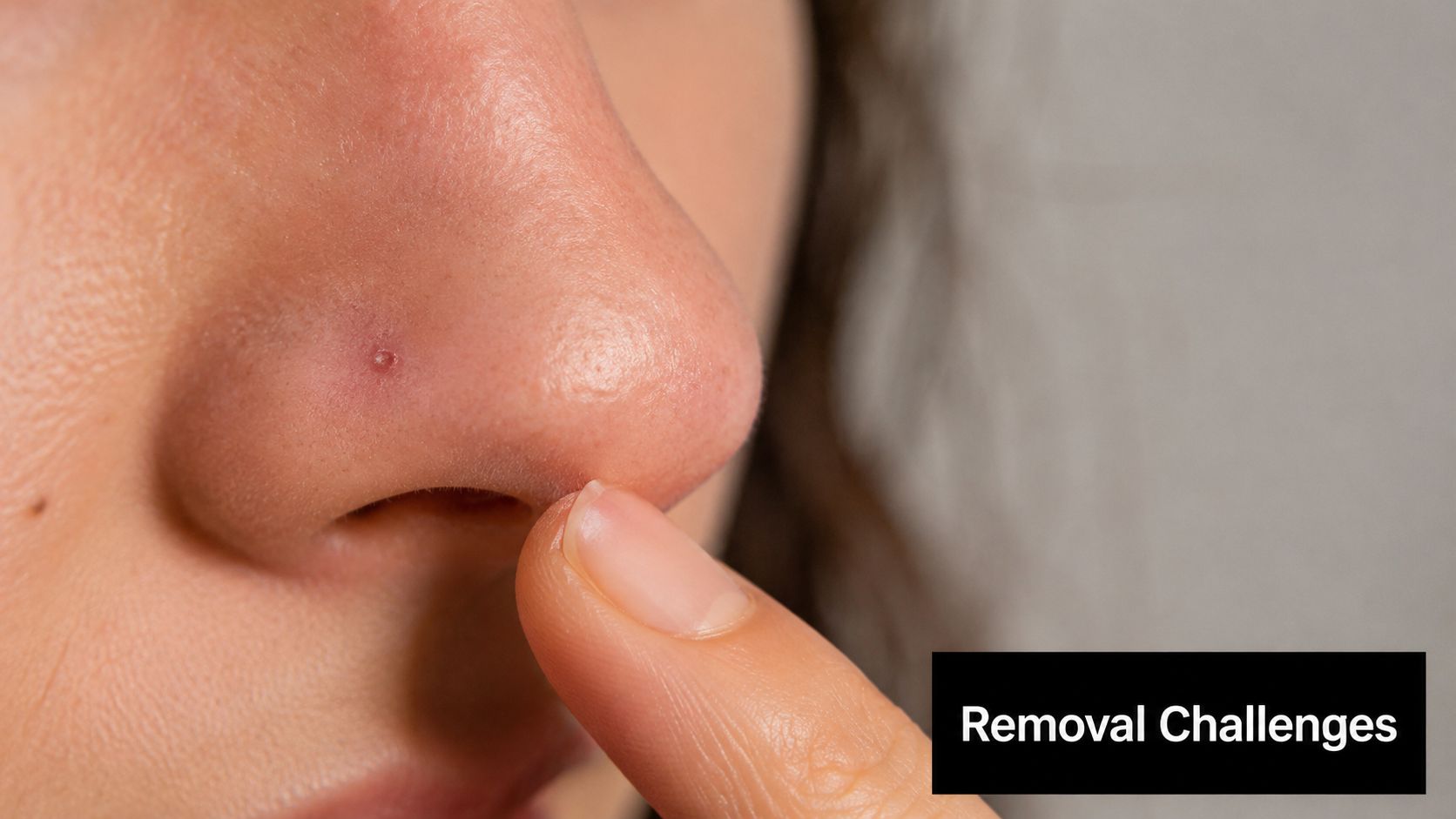
Most removal problems are minor, but they can still stall the process. A stud may feel stuck, a ring may only move part way, or the tissue around the piercing may look puffy enough that you do not want to keep forcing it.
Stuck studs
Dried fluid is the usual cause. Soak the area, do not scrape it. Saline softens crusts and helps them release naturally, while scraping with a fingernail or pin can drag bacteria into the channel.
If the stud still does not move after a fresh soak, leave it alone for a while and return once the skin has settled. A stubborn post is not something to wrestle with, it usually means swelling, crusting, or the angle has changed and the tissue needs more time.
Swelling and minor bumps
Swelling can shift the angle of the jewellery, which makes removal feel tighter than it really is. Gentle cleaning and patience usually do more than repeated attempts, because every extra tug can inflame the skin further.
As noted earlier, minor problems can become much more serious if the area is handled roughly, especially with younger clients. Parents should treat a tight or inflamed piercing carefully and avoid trying to force it.
Small tears and scarring
A small snag or pressure mark often settles once the jewellery is left alone. Keep the area clean, avoid picking, and let the skin calm down before deciding whether the piercing should stay out permanently.
If the bump is getting larger, the channel looks misshapen, or the jewellery seems to be sinking into the tissue, stop trying at home. Those signs mean the fit or the tissue needs professional eyes on it, not more force.
For anything that starts to look more like infection than irritation, use a clear guide such as how to tell if a nose piercing is infected so you can judge whether home care is still reasonable or whether it is time to book in.
Aftercare and infection signs to watch
Once the jewellery is out, the job is not quite finished. The skin still needs a low-friction approach, especially if you want the channel to settle cleanly or stay open for reinsertion later.
Simple aftercare routine
Keep the area clean and leave it alone as much as possible. Use saline if the skin feels sticky or crusted, then avoid makeup, heavy creams, and casual touching for the rest of the day so the channel is not constantly disturbed. If you want a clear reference point for what counts as infection rather than ordinary irritation, this guide on infected nose piercings is a useful place to check the warning signs.
What matters most is the trend. Mild tenderness and a little crusting can be normal after removal, but the site should start to calm down, not become redder, hotter, or more painful as the hours pass.
Red flags that need attention
Look for symptoms that show the tissue is reacting badly rather than settling. Persistent pain, spreading redness, swelling that keeps increasing, and unusual discharge are the main signs to take seriously.
- Redness that spreads: If the colour moves beyond the piercing site, treat it as a warning.
- Increasing pain: Soreness should ease, not build.
- Unusual discharge: Thick, coloured, or foul-smelling fluid needs assessment.
- General illness: Feeling unwell alongside local symptoms deserves prompt attention.
After removal, the same low-friction approach still applies. Keep the area clean, dry, and undisturbed, because the skin is trying to recover and every extra poke slows that down.
If the piercing was removed for a medical reason, do not keep checking the hole or handling it to see whether it is closing. That adds irritation and can make future reinsertion harder if you need the channel again.
Choosing professional help and booking local studios
Some removals cross the line from awkward to unsafe. Embedded jewellery, deep tears, severe swelling, or a backing you can't reach cleanly are all good reasons to stop and let a professional handle it.
When to book instead of pushing ahead
A piercer has the angle, tools, and visibility to remove jewellery without turning the channel into a tear. That matters most when the jewellery is partially embedded, the nostril has swollen around the post, or you've already made one or two careful attempts and the area is more irritated than before.
If you're in Croydon or Bournemouth and want a quick in-person assessment, use the local piercing studio finder to check availability and get the right studio details before you travel. For Timebomb Tattoo & Piercing, you can call 01202 900050 (Bournemouth) / 020 8686 7730 (Croydon) or WhatsApp 07752 913846 (Bournemouth) / 07902 490584 (Croydon) to ask about removal support, booking times, and what to bring.
A short studio visit is better than a long recovery from a torn channel.
If you're unsure whether to try again at home, book the visit. A professional removal is often the fastest way to protect the piercing site, avoid extra swelling, and decide whether the jewellery can go back in or should be left out.
Piercing Near Me helps you find trusted UK piercing support when removal gets tricky, whether you're checking aftercare, comparing local options, or deciding if it's time to book a studio visit. If you want practical help from people who understand the difference between a simple stud swap and a problem that needs a piercer's hands, visit Piercing Near Me and take the next step with confidence.
Trackbacks/Pingbacks