
16g (1.2mm) and 14g (1.6mm) are the standard small septum starting sizes in the UK, with typical inner diameters of 6mm, 8mm or 10mm. The right choice depends on your septum anatomy, not how small you want the ring to look.
You're probably looking at a booking screen with several jewellery sizes open, trying to decide whether “small” means a thinner bar, a tighter ring, or both. At the chair, I treat it as a fit decision first and a style decision second. The jewellery needs to sit comfortably in the soft tissue, leave enough clearance for normal movement, and suit the shape of your nose.
That care matters. An England household survey of 10,503 people found that 10% of adults had at least one non-earlobe piercing, while health problems were reported in about one-third of piercings, with some requiring further help or hospital admission, as documented in the national piercing survey. A well-chosen small septum and professional placement won't remove every healing variable, but they give the piercing a sound starting point.
What a Small Septum Piercing Actually Means
In studio language, a small septum piercing usually combines a modest jewellery thickness with a compact inner diameter. The starting gauge is commonly 16g, or 1.2mm, or 14g, or 1.6mm, while the ring's inner diameter is often 6mm, 8mm or 10mm. Those measurements work together, but they describe different things.
Gauge tells us the thickness of the jewellery passing through the tissue. Inner diameter tells us how much room the ring has inside its circle. A 16g ring can therefore look very different in 6mm and 10mm, even though the bar thickness is identical.
The placement matters just as much. A septum should generally be marked through the soft membrane behind the firm front cartilage, often called the sweet spot, rather than through hard cartilage. A compact ring placed correctly can look neat and balanced. A tiny ring placed too high, too low or at the wrong angle can pinch, pull or sit visibly unevenly.
Practical rule: “Small” describes the jewellery footprint, not a separate piercing site.
Small doesn't mean a surface piercing, a micro-piercing or a different version of the septum. It's the same anatomical placement, fitted with jewellery that has less visible drop or a slimmer overall profile. The shape of the ring, the size of its bead or hinge and how far it hangs beneath the nostrils will influence the final look.
Before booking, use this septum piercing placement guide to understand why anatomy comes before a jewellery catalogue. A piercer can assess the tissue directly and decide whether a 6mm ring will sit comfortably or whether 8mm gives better clearance.
The most useful question isn't “What is the smallest ring available?” Ask instead, “What is the smallest stable size for my anatomy?” That shift prevents a discreet look from becoming an uncomfortable fit.
Gauge, Diameter and the Sweet Spot in Your Septum
A piercer is balancing three variables: gauge, inner diameter and placement. None should be chosen in isolation, especially when a client has a narrow nose or wants jewellery that sits close to the nostrils.
Gauge controls thickness
Gauge is the thickness of the bar. 16g is 1.2mm, while 14g is 1.6mm, and both are commonly used for starter septum jewellery in the UK, as outlined in this UK septum jewellery sizing guide.
A 16g starter gives a clean, versatile profile and suits many first-time clients. A 14g bar has more visual weight and may make sense where the anatomy supports it or where the wearer already knows they want thicker jewellery later. Starting thinner can make a later move to a thicker gauge more gradual, but stretching still requires a fully healed piercing and professional assessment.
Inner diameter controls the drop
Inner diameter is measured across the inside of the ring. A 6mm ring sits close to the underside of the nose, an 8mm ring allows more breathing and movement for many faces, and a 10mm ring creates a more obvious drop. Nose height, nostril flare, columella shape and the jewellery's decorative ends all affect the result.
A 6mm ring may look beautifully discreet on one narrow nose and feel restrictive on another. An 8mm ring often offers a useful middle ground, while 10mm may be appropriate when the wearer wants visible movement or a statement silhouette.
Placement determines whether the measurements work
The sweet spot is the thin membrane just behind the firm front cartilage. Piercing through that tissue generally gives the piercer a cleaner route than placing the channel through dense cartilage. The exact position isn't identical on every person, so a piercer should mark and check the angle before proceeding.
| Measurement | Small option | Typical fit |
|---|---|---|
| Gauge | 16g, 1.2mm | Slim, versatile starter profile |
| Gauge | 14g, 1.6mm | Thicker, stronger visual presence |
| Inner diameter | 6mm | Close and discreet, only where anatomy allows |
| Inner diameter | 8mm | Compact with useful clearance |
| Inner diameter | 10mm | More visible drop and room for larger ends |
A useful rule for a narrow nose is to begin with the smallest gauge and diameter that clear the tissue without pressure. That may be 16g with 6mm, but it might be 16g with 8mm if the smaller ring presses against the columella.
For a broader explanation of the measurement terms, use this millimetre to gauge conversion guide. The numbers become much easier to choose once you separate thickness from ring height.
Discreet vs Statement Styles for a Small Septum
Once the fit is confirmed, the style choice becomes straightforward. A small septum can disappear into the face, or it can use the same compact footprint to frame the mouth with a deliberate feature.
| Choice | Hide-ability | Early healing comfort | Everyday practicality |
|---|---|---|---|
| Titanium clicker | High | High | Smooth and easy around masks |
| Seam ring | High | High when correctly fitted | Minimal snag points |
| Hinged segment ring | Medium to high | Depends on the front detail | Practical once the hinge is secure |
| Circular barbell | Lower | Depends on end size and movement | More visible around clothing and glasses |
| Spiked or charm ring | Low | Lower during active healing | More likely to catch or pull |
For a discreet result, I favour a smooth titanium clicker, a clean seam ring or a simple hinged segment ring in titanium or 14k gold. The closure can sit at the back or be tucked up into the sweet spot, leaving very little visible. These options are easier to live with around masks, jumpers, glasses and changing clothes.
Statement jewellery takes the same piercing in another direction. Captive bead rings, circular barbells, spiked clickers, ornate seam rings and dangling charms create more movement and draw the eye towards the lips. They can look excellent, but extra weight, protruding ends and decorative edges give clothing and fingers more opportunities to snag the jewellery.
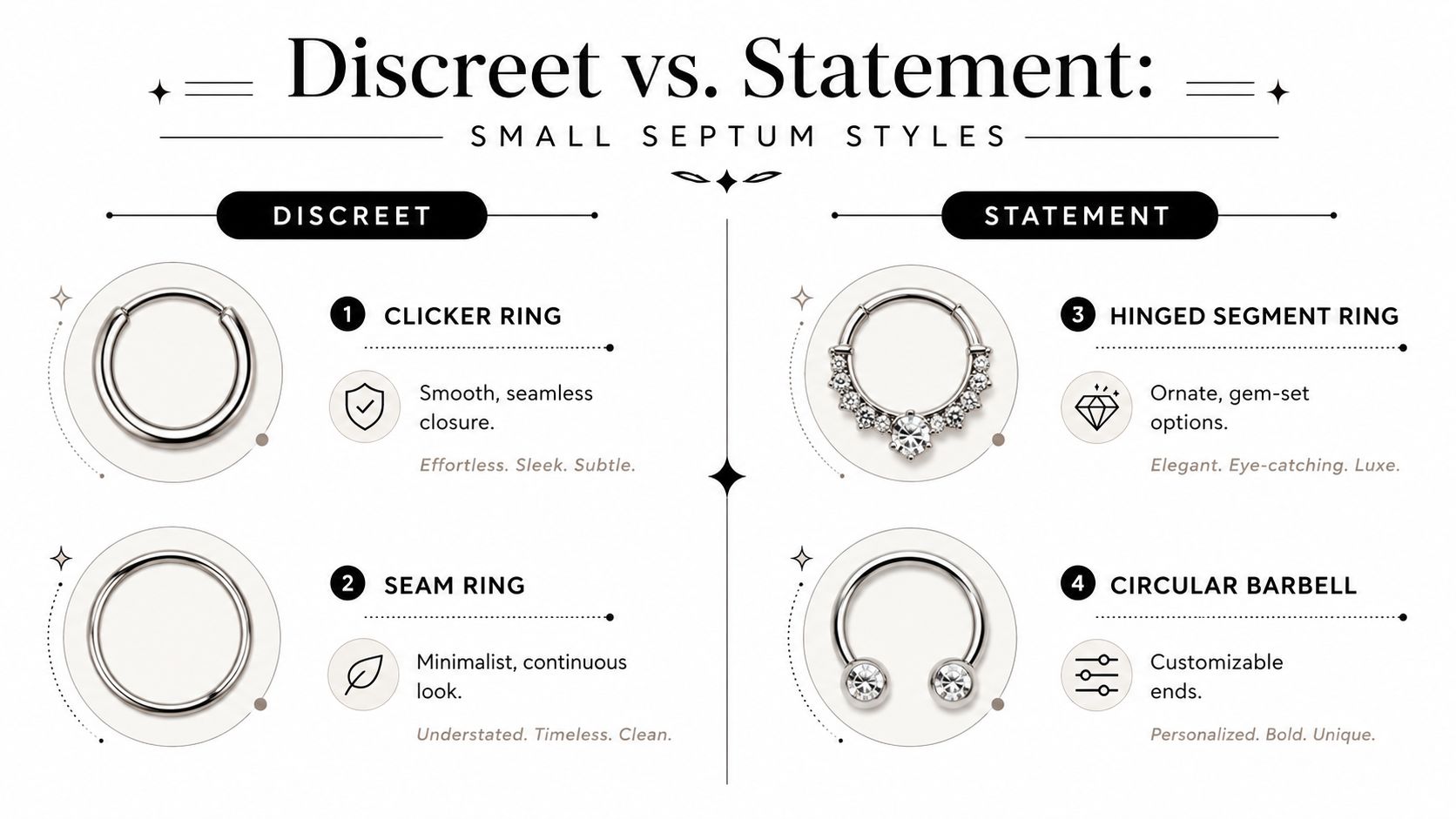
My usual sequence is simple: heal with discreet, smooth jewellery first, then introduce the statement piece after the fistula has matured and a piercer has checked the fit. A small footprint remains useful long-term, even when the front becomes more decorative.
Don't choose a dramatic ring merely because the smaller option looks plain online. Jewellery photographs don't show your nostril flare, columella or daily routine. A style that looks impressive in a product image may be awkward with glasses or catch on a wool collar.
Healing Timeline and Aftercare the NHS Way
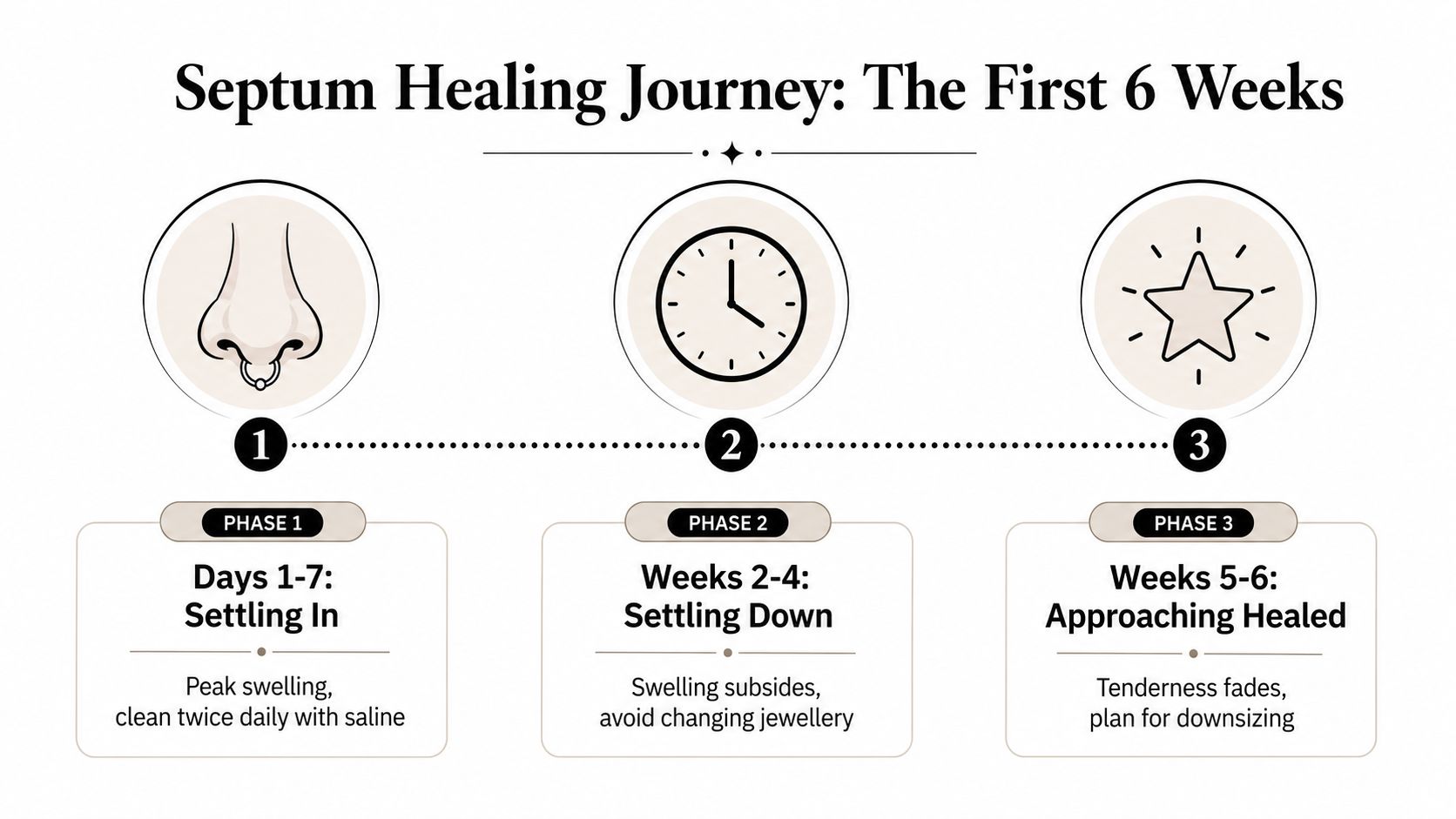
A small ring doesn't make the tissue heal instantly. UK clinical guidance places nasal septum healing at about 8 weeks, while the nostril region can take up to 12 months, as explained in the British Orthodontic Society facial piercing guidance. Piercers may discuss a longer maturation period before changing jewellery for comfort, stability and fit.
Your daily routine
For the first phase, wash your hands before touching the area. Use sterile saline once or twice daily, allow softened discharge to loosen, and dry with a clean paper towel. The NHS advises cleaning twice daily with warm salty water, keeping jewellery in place if infection is suspected unless a doctor tells you to remove it, and avoiding twisting or turning the jewellery when the piercing is dry, as set out in NHS advice on infected piercings.
Public Health England specifically warns that antibacterial wash isn't suitable for nostril or septum tissue because the area is delicate. Its guidance describes a saline mix of 1/4 level teaspoon of preferably sea salt in an egg cup or shot glass of warm water, or a warm compress using clean cloth or gauze, as detailed in this UK aftercare warning.
Avoid alcohol, harsh antiseptics, antiseptic creams and cotton wool. Fibres can catch around the channel, and strong products can irritate rather than support healing.
What the early weeks feel like
The first days can bring tenderness, mild swelling and dried discharge. During the following weeks, crusting should gradually become easier to manage, but the absence of soreness doesn't prove the inside is fully mature.
Keep make-up, hair products and dirty phone screens away from the piercing. Avoid unnecessary flipping, snagging and water exposure, and take care around swimming pools and hot tubs during the early healing stage. A clean pillowcase helps reduce contact with residue and hair products overnight.
Healing rule: Leave the jewellery alone unless cleaning or a piercer has a specific reason to adjust it.
The septum piercing healing time guide gives further context for planning a jewellery change. Don't swap the ring just because the outside looks calm. A follow-up appointment lets the piercer check the channel and confirm whether downsizing or a style change is sensible.
Sizing a Septum for Narrower Noses and Downsizing Later
Narrower noses need clearance, not just the tiniest ring. A 16g ring with a 6mm inner diameter can be a sensible starting point when the septum window is compact and the ring clears the cartilage without pressing into the columella. If 6mm pinches, 8mm may be the better small choice.
I don't recommend choosing a 5mm ring by guesswork. It can press into the tissue and leave no room for natural swelling or everyday movement. At the other extreme, a 10mm ring may flare visibly beneath the tip when the wearer wanted a close-fitting look.
| Gauge | Inner diameter | Best for |
|---|---|---|
| 16g, 1.2mm | 6mm | Narrow anatomy with comfortable clearance |
| 16g, 1.2mm | 8mm | Compact look with more breathing room |
| 14g, 1.6mm | 8mm | Thicker jewellery with a controlled drop |
| 14g, 1.6mm | 10mm | Statement ends or a more visible profile |
Initial jewellery often needs room for swelling. Once that swelling has resolved and the channel is stable, your piercer may recommend a smaller or more suitable ring. The decision belongs at a follow-up, not in front of an online size chart.
If you want to move from 16g to 14g, wait until the piercing is fully healed and proceed one gauge at a time. A piercer should check the tissue before stretching, select appropriate jewellery and stop if resistance or pain appears.
Decision rule: For a narrow nose, book an anatomy check, ask whether 16g is appropriate, and compare 6mm with 8mm only after the sweet spot and clearance have been confirmed.
That approach avoids the common mistake of treating diameter as a beauty filter. The ring should look small because it fits well, not because it compresses the tissue.
Booking Your Small Septum in Croydon or Bournemouth
If you're undecided between 16g and 14g, or between 6mm and 8mm, book a consultation before committing to the piercing. A piercer needs to inspect the septum in person, identify the sweet spot and check how much clearance each diameter gives you.
Both the Croydon and Bournemouth studios offer consultations, walk-ins and appointments. Availability can vary, so contact the team before travelling if you need a particular piercer, jewellery material or time. A consultation also gives you space to discuss whether you want a ring that can be hidden, a more visible horseshoe or a later statement upgrade.
Prepare before the appointment
Bring valid photo ID and a list of medications. Tell the piercer about allergies, skin conditions, previous piercing problems and any metal sensitivity before jewellery is selected.
A clear preference for implant-grade titanium or 14k solid gold helps the team narrow down suitable options, but the piercer will still need to confirm the jewellery's shape, finish and dimensions. Arrive with a clean nose and postpone the appointment if you're unwell or have an active skin flare-up around the area.
Ask about the studio's deposit terms and cancellation window when you book. Those details can differ by appointment type, so confirm them directly rather than assuming a consultation and a piercing follow the same policy.
Know what happens on the day
The appointment should include an anatomy assessment, jewellery discussion, marking and a chance to check the proposed position in the mirror. Once you approve the mark, the piercer prepares the area, uses sterile single-use equipment and fits the selected starter jewellery.
You can reach the Croydon and Bournemouth teams by phone on 01202 900050 (Bournemouth) / 020 8686 7730 (Croydon) or by WhatsApp on 07752 913846 (Bournemouth) / 07902 490584 (Croydon). You can also use email or Instagram direct message to ask about current walk-in availability, jewellery stock, deposits and travel details.
Plan your route before leaving home. Check nearby parking and public transport for the relevant studio, allow extra time for delays and avoid booking immediately before an event where you'll need to wear tight clothing or handle the nose repeatedly.
The booking process should leave you with three clear answers: which gauge suits your anatomy, which inner diameter gives comfortable clearance and which jewellery style fits your routine. If those answers aren't clear, use the consultation to resolve them before the needle is involved.
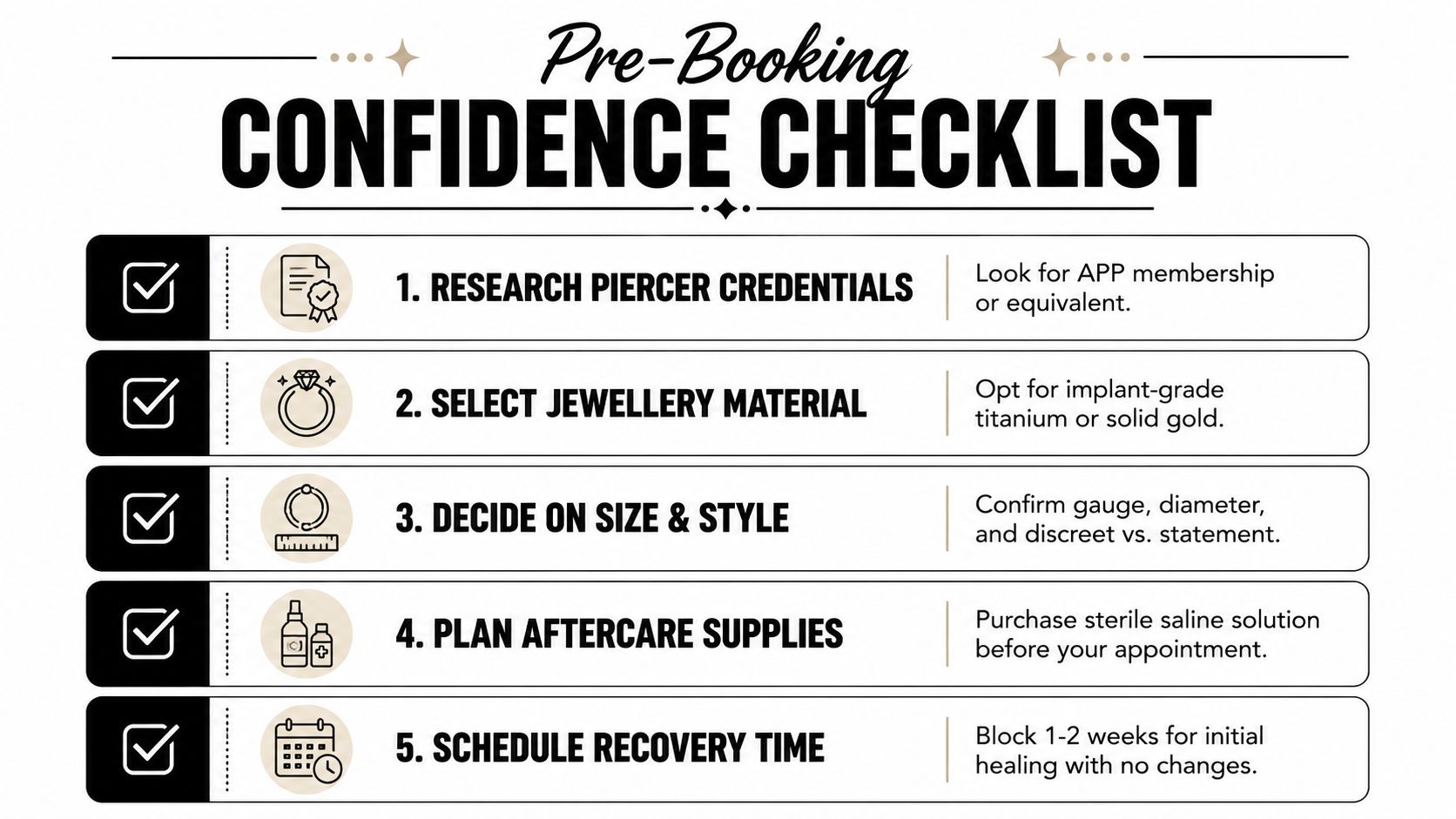
Quick Confidence Checklist Before You Book
Use this list at home before contacting the studio:
- Choose a starting gauge: Keep 16g, or consider 14g if your anatomy and long-term plans support it. Your piercer makes the final call.
- Shortlist the inner diameter: Compare 6mm, 8mm and 10mm, but treat them as options to assess, not guarantees of fit.
- Check the placement goal: Ask for the soft sweet spot behind the firm front cartilage, with enough room that the jewellery won't pinch.
- Pick the first style: A smooth titanium clicker or simple horseshoe is easier to manage than a heavy charm or spiked ring during healing.
- Plan the later change: Expect the starter jewellery to remain in place until a follow-up confirms that downsizing or a style change is appropriate.
- Prepare saline: Have sterile saline ready before the appointment and know that harsh cleansers, dry twisting and cotton wool aren't part of a sensible routine.
- Prepare your visit: Bring photo ID, medication information and your metal preference, then confirm deposits, cancellation terms and travel arrangements.
The right small septum isn't necessarily the smallest ring in the display. It's the combination of stable gauge, comfortable diameter, accurate placement and patient healing, followed by a jewellery change only when the tissue is ready.
At Piercing Near Me, you can arrange a consultation, walk-in or appointment at our Croydon or Bournemouth studios and discuss small septum sizing with a professional piercer. Contact us on 01202 900050 (Bournemouth) / 020 8686 7730 (Croydon) or WhatsApp 07752 913846 (Bournemouth) / 07902 490584 (Croydon), then visit Piercing Near Me to plan your placement, jewellery and aftercare with the team.