
You've probably seen silver huggie earrings everywhere lately. They're on high-street sites, marketplace listings, social feeds, and curated ear inspiration boards. Then you try to buy a pair and run into the usual problems. One listing gives a size but not the inner diameter, another says “silver” without telling you whether it's sterling or plated, and almost none explain whether that pair is suitable for a piercing that's still healing.
That's where people get caught out.
A good huggie should look simple, feel secure, and sit comfortably for long wear. A bad one pinches, flips forward, irritates the piercing, or turns out to be the wrong metal for your skin. When people search for silver huggie earrings uk, they're often looking for style first. In practice, fit and material matter just as much.
From a piercer's point of view, huggies are one of the most useful earring styles when they're chosen properly. They work on healed lobes, some cartilage placements, and stacked ear projects. They also create confusion because fashion retailers usually sell them as a look, while studios deal with the part that determines whether they'll wear well.
Your Introduction to Huggie Earrings
You order a pair of silver huggies online because the photos look right, then they arrive too tight for your lobe, too thick for your piercing, or made from a metal that your ears do not tolerate well. I see that problem often in studio. The style is simple. Choosing a pair that wears well is not.
A huggie earring is a small hoop that sits close to the ear rather than hanging away from it. That close fit is the whole point. It gives a cleaner profile, keeps the jewellery compact, and makes huggies a common choice for healed lobes, curated ear styling, and some cartilage placements.
Most huggies use a hinged clicker-style closure. The hoop opens on a hinge, passes through the piercing, and clicks shut. That design is easy to wear day to day, but the mechanism still needs to be well made. A poor hinge can misalign, pinch, or loosen over time, which is one reason studio-sourced jewellery tends to outperform cheap fashion pairs.
What makes them different from regular hoops
The main difference is fit. A regular hoop usually leaves more visible space between the jewellery and the ear. A huggie sits closer and looks more controlled.
That changes how it behaves in daily wear:
- Closer to the ear: Less movement means fewer snags on hair, knitwear, towels, and phones.
- Compact shape: They work well for understated styling and for ears with multiple piercings.
- Practical closure: A good hinged clasp is usually easier to handle than thin wire hoops or separate backs.
From a piercer's point of view, the close fit is both the benefit and the risk. If the diameter is wrong, the hoop can press into the lobe or sit awkwardly forward. If the post thickness is wrong, insertion can be uncomfortable or damaging. Buyers often get caught out by exactly that, choosing a style that looks polished online but does not suit their anatomy or piercing stage.
Why people like them for everyday wear
Huggies stay popular because they are easy to live in. A plain silver pair can look smart at work, understated on casual days, and neat enough to leave in without much thought. For healed piercings, that makes them a useful staple rather than a trend purchase.
The gap between fashion retail and piercing safety matters here. Many UK product listings focus on finish, price, and styling photos, but leave out the details that determine whether the jewellery is wearable. For anyone with reactive skin, healed but temperamental piercings, or a history of irritation, it helps to start with advice on hypoallergenic earrings for sensitive ears before choosing a silver huggie.
Studios approach huggies differently from retailers. The first question is not whether the pair looks good in the tray. It is whether the metal, diameter, gauge, and closure are suitable for your ear. That is the standard worth using if you want silver huggie earrings in the UK that feel as good as they look.
Understanding Silver Quality Sterling vs Plated
Material decides whether a pair of huggies will stay comfortable or become a problem after a week of wear. Many UK listings use the word "silver" loosely, and that is where buyers get caught out. In a studio, the first check is always the full material description, not the finish photo.
What sterling silver means
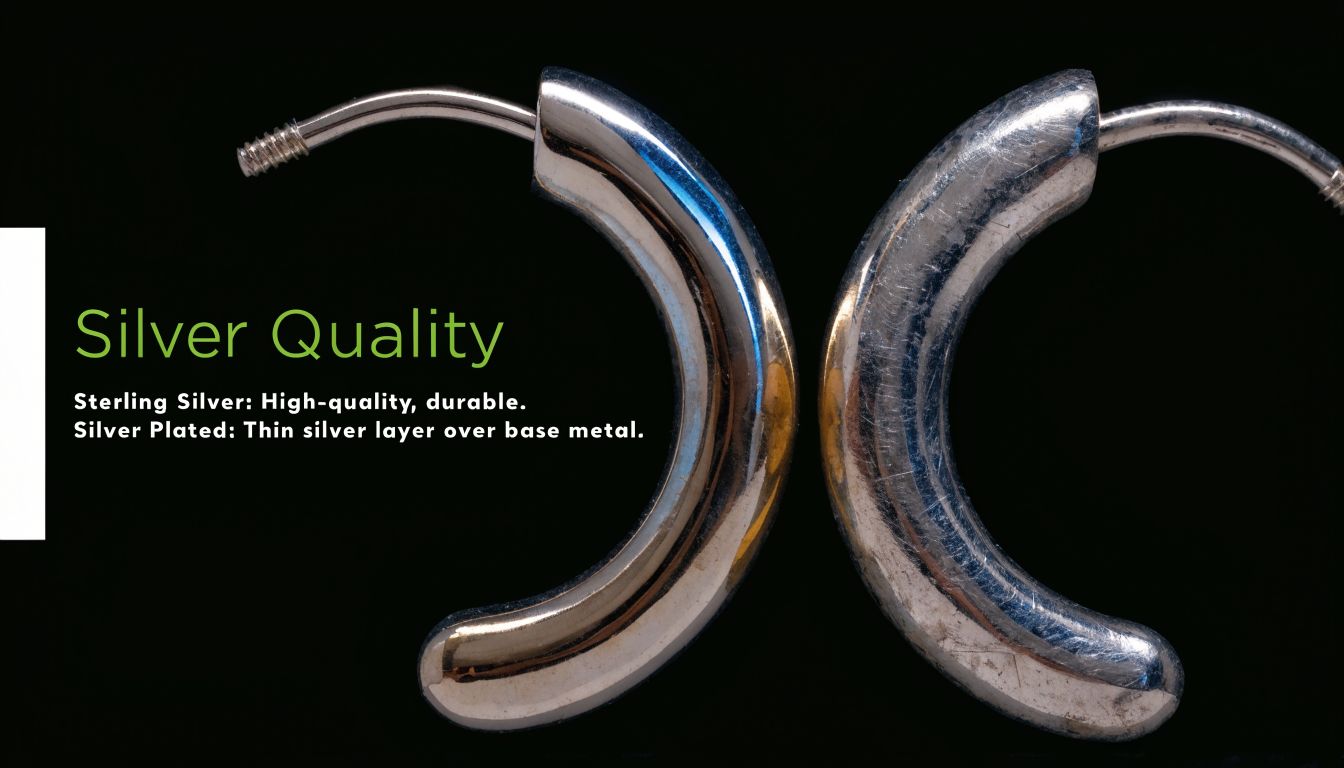
Sterling silver is a silver alloy made to the 925 standard. That means the piece contains 92.5% silver, with the rest added for strength, usually copper. Fine silver is softer, so sterling is the more practical choice for everyday earrings that need to keep their shape and hold up at the hinge.
That said, 925 on its own does not answer every safety question. It tells you the alloy standard. It does not tell you whether the post finish is smooth, whether the hinge lines up cleanly, or whether the jewellery is suitable for a healing piercing.
For healed lobes, sterling silver can be a sensible middle ground. It looks like precious metal, wears better than plated fashion jewellery, and usually sits at a price point that makes everyday use realistic.
Sterling silver vs plated silver
The difference matters most where the jewellery touches skin.
- Sterling silver: The full piece is made from the alloy, so light surface wear does not expose a different base metal underneath.
- Silver-plated: A thin silver layer sits over another metal. Once plating wears through, the post or inner curve can expose the base material.
- Fine silver: Softer and less common in huggies because it marks and bends more easily.
Plated huggies often look convincing in photos. The weak point is daily friction. The post passes through the piercing channel, the clicker rubs during opening and closing, and the inner edge sits against warm skin for hours. On cheap plated pairs, that is usually where wear shows first.
A cautious rule helps here. If a listing says "silver tone", "silver finish", or "plated" without naming the base metal, treat it as fashion jewellery rather than piercing jewellery.
Where sensitive ears change the decision
This is the part fashion retailers rarely explain well. Sterling silver may suit a healed piercing, but it is still not the material I would choose for a fresh piercing or an ear with a long history of flare-ups. In those cases, implant-grade materials are usually the safer option because they are made for long contact with the body, not just for appearance.
If your ears react easily, read a proper guide to hypoallergenic earrings for sensitive ears before ordering silver huggies based on style alone.
The practical trade-off is simple. Sterling silver can work well for healed everyday wear. Plated silver is best treated as occasional fashion jewellery. New or irritated piercings need a higher standard than either. That is one reason professional studios are a better place to ask. A good studio can tell you whether a pair is only attractive in the box, or suitable for your ear.
The Complete Huggie Sizing and Fit Guide
A pair can look perfect on a product page and still pinch, hang awkwardly, or refuse to close once it reaches your ear. Fit is the part online shops often reduce to one neat number. Real ears are less tidy than that.
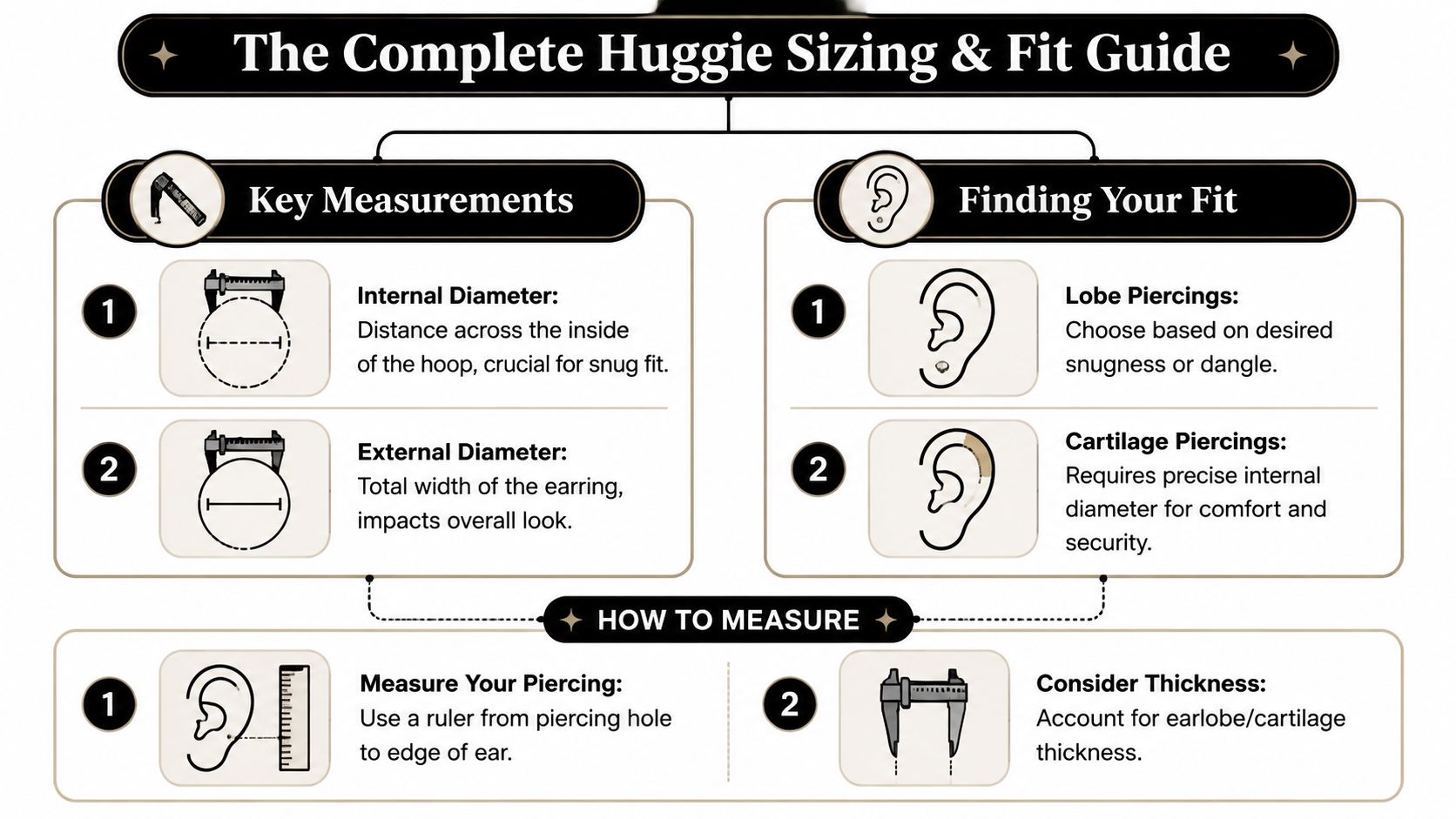
Huggies only make sense when you check two measurements together: inner diameter and gauge. Inner diameter decides how much space the ear tissue has inside the hoop. Gauge tells you how thick the wearable part is, which affects both comfort and how securely the jewellery sits in the channel.
The two measurements that matter
Inner diameter is the usable space inside the hoop. On a lobe, that determines whether the ring hugs neatly or presses into the tissue. On cartilage, a millimetre can decide whether the jewellery sits cleanly or causes constant pressure.
Gauge is the thickness of the post or ring that passes through the piercing. Very fine hoops can look refined, but they are not always the best option for long wear. A slightly thicker gauge often feels more stable, especially in cartilage, because it is less likely to tilt or cut in.
Retail sizing guides for huggies commonly show diameters from very small cartilage sizes up to roomier lobe options. In practice, many healed lobe piercings suit a mid-range inner diameter, while cartilage placements need anatomy-led sizing rather than guesswork. That is why studio fitting matters. A piercer can check whether the ring clears the tissue, whether the hinge lines up comfortably, and whether the gauge matches the piercing channel you already have.
How to measure before you buy
Start with the actual ear, not the product title. Use a mirror and a millimetre ruler, or ask a studio to measure it properly.
For a standard lobe, measure from the centre of the piercing hole to the bottom edge of the lobe, then allow enough extra room for the thickness of the tissue. If you want the earring to sit close, keep that allowance tight. If you prefer some visible space under the lobe, go up a size.
Cartilage takes more care. Helix, tragus, and conch placements do not have the same give as soft lobe tissue, so a ring that looks "small and neat" online can end up pressing on both sides of the piercing. That pressure is uncomfortable in a healed piercing and a bad idea in one that is still settling.
A close fit should still leave clearance. Huggies are meant to hug, not squeeze.
Size guide by placement
| Piercing Location | Common Inner Diameter | Best For |
|---|---|---|
| Lobe | 10mm to 14mm | Everyday close fit or a slightly roomier classic look |
| Upper lobe | Smaller close-fitting options | Stacked ears and neat second or third lobe styling |
| Helix | Small precise fit | A close cartilage hoop once fully healed |
| Tragus | Very small close fit | Minimal styling where the hoop sits tight to the ear |
| Daith | Placement-specific fit | Only with proper professional assessment |
| Conch | Larger or anatomy-led fit | A hoop look once the piercing is fully stable |
These ranges are starting points, not guarantees. Ear thickness, piercing angle, scar tissue, and placement height all change the result. Two people can both wear a "10mm huggie" and get completely different fits.
What works in practice
Good fit usually comes from three checks. Measure the ear. Confirm the inner diameter. Make sure the gauge matches what your piercing can comfortably wear.
Problems usually start with assumptions. Buyers often use the first lobe size for every placement, choose the smallest hoop available because they want a very snug look, or rely on model photos that do not show the wearer's actual anatomy. Product shots also hide another detail. Some hoops lose usable space because of a thick hinge or curved inner edge, so the listed diameter does not always tell the whole story.
Closure style matters too. Hinged huggies are usually easier for daily wear than butterfly-back "hoop look" earrings because the ring sits as one piece and is less likely to shift around during the day. The catch is quality. A weak hinge can misalign, and a badly finished clicker can scrape the piercing channel during insertion.
If you're trying to judge fit for cartilage placements specifically, it helps to see examples of ear cartilage piercing ring styles and sizing before ordering blindly.
The practical rule is simple. Buy fashion huggies by appearance if the piercing is well healed and not reactive. Buy piercing jewellery by measurements, material, and wearability. For anything new, irritated, or anatomy-specific, get sized in a professional studio instead of guessing from a retail listing.
How to Style Silver Huggies on Lobes and Cartilage
Styling starts after the fit is right. Once you've got the correct size and a material your ears tolerate well, huggies become one of the easiest pieces to build around.
The clean everyday look
For a simple ear, a single polished silver huggie in the main lobe is often enough. It reads neat rather than plain. If you want jewellery you can wear to work, leave in for dinner, and not think about all day, this is the strongest option.
The 14mm size has become a popular standard across many UK retailers, suggesting it hits a sweet spot for average ear anatomy and everyday wear, according to this UK marketplace overview of sterling silver huggies.
Stacked styling that still looks balanced
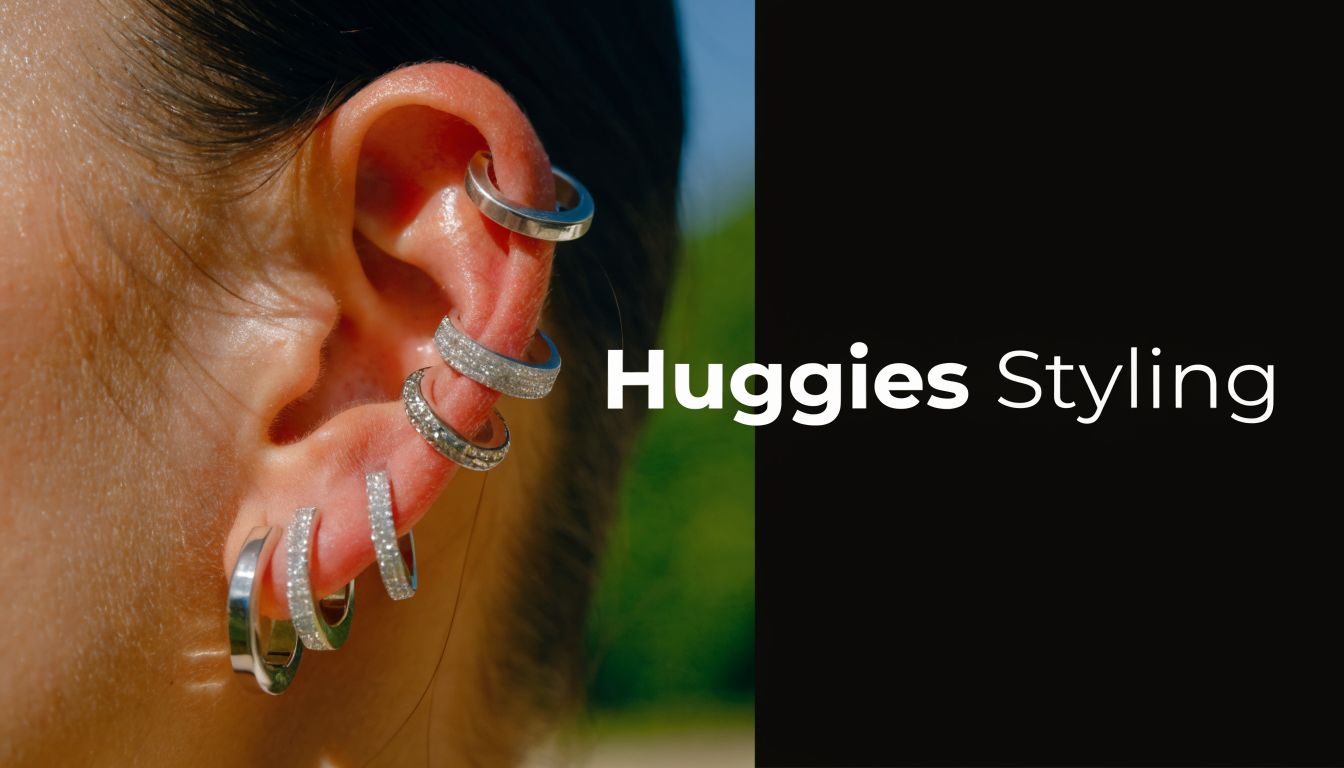
A curated ear works best when the sizes step down naturally. If every hoop is the same diameter, the ear can look crowded. If they graduate, the arrangement feels intentional.
A few combinations that tend to work well:
- Main lobe plus upper lobe: Use a classic huggie in the first piercing and a smaller plain hoop above it.
- Minimal cartilage stack: Pair one smooth lobe huggie with a tiny helix hoop for a sharper silhouette.
- Mixed texture: Keep one hoop plain and add a stone-set or patterned huggie in another healed piercing so the ear has a focal point.
The best styled ear usually isn't the one with the most jewellery. It's the one where each piece has enough room to make sense.
Matching style to the placement
Lobes can carry slightly more visual weight. Cartilage usually looks better with slimmer, tighter pieces. A chunkier huggie in a small helix can feel heavy fast, even if it looked good in the box.
Online shopping often falls short; listings show a beautiful product, but not how that same hoop behaves on a thicker lobe, a high lobe, or a narrow helix rim. Styling isn't only aesthetic. It's anatomical.
Huggies in New Piercings A Safety and Aftercare Guide
This is the part fashion listings rarely explain properly. A standard silver huggie is not the right starting jewellery for a fresh piercing.
Many UK retailers market huggies as fashion pieces, but they don't usually address the needs of new piercings. During the 6 to 12 week initial healing period, material choice matters far more, and an estimated 8 to 12% of the UK population has a nickel sensitivity, according to this overview of the safety gap in huggie retail content.
Why fresh piercings need different jewellery
A new piercing is a wound. It needs stable, biocompatible jewellery that leaves room for swelling and doesn't introduce avoidable irritation. That's different from healed-piercing jewellery, where style can play a much bigger role.
What usually goes wrong when someone swaps too early:
- The hoop is too tight: swelling or pressure makes the piercing angry fast.
- The metal isn't ideal for healing: the ear reacts, dries out, or stays sore.
- The hinge passes through a fragile channel: that can irritate tissue that hasn't matured yet.
Sterling silver can be excellent for healed wear. It's not my first recommendation for initial healing.
What to wear first instead
For a fresh piercing, studios generally favour implant-grade jewellery because it's selected for healing, not just appearance. That gives the piercing the best chance to settle before you start experimenting with hoops and decorative styles.
If you're unsure whether your piercing is ready for a jewellery change, check a realistic guide to ear piercing healing times before doing anything at home.
Healing doesn't run on the timeline of an online order. A piercing decides when it's ready.
Aftercare for the piercing and the jewellery
These are two different jobs and they shouldn't be mixed up.
For the piercing, keep aftercare simple, consistent, and gentle. Don't rotate the jewellery for the sake of it, don't sleep on it if you can avoid it, and don't switch to a hoop because the outfit would look better that weekend.
For the silver huggie itself, clean away product build-up and dry it properly after washing. Silver benefits from sensible maintenance. Skin, shampoo, and styling product residue can all build up around the hinge and post.
A healed piercing can tolerate much more than a new one. That doesn't mean every earring is suitable the moment tenderness fades.
Where to Find Safe and Stylish Huggies in the UK
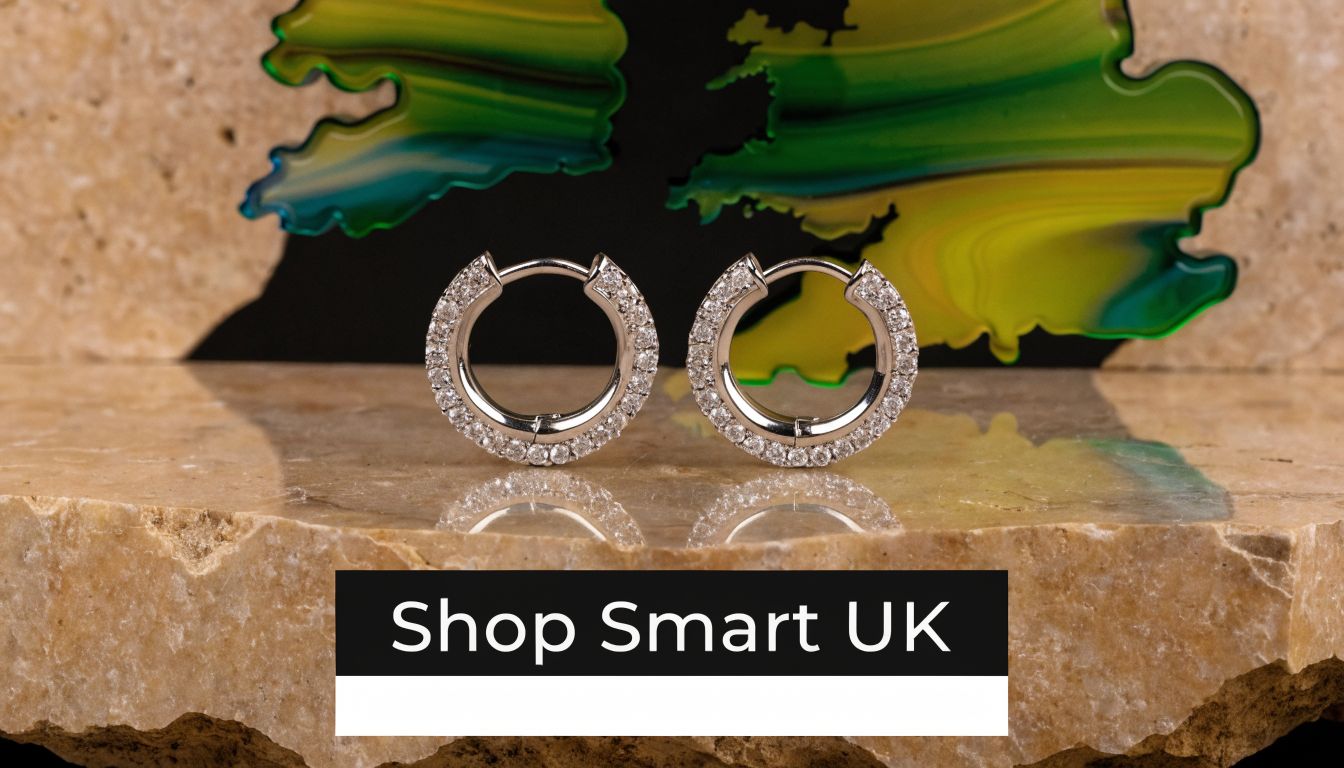
The UK has plenty of places selling silver huggies. That isn't the hard part. The hard part is knowing whether the pair you're looking at is well made, correctly sized, and appropriate for your piercing.
Retailer convenience vs studio advice
Retail sites are good at showing trend, finish, and price. They're usually much weaker on anatomy, material verification, and timing for jewellery changes. That's the gap that catches first-time buyers and people with sensitive ears.
According to this UK retail comparison gap analysis, professional piercing studios are the ones best placed to give price-to-quality guidance, check whether jewellery meets implant-grade standards when needed, and advise on safe swap timing under UK health protocols.
That studio role matters because good jewellery choice isn't one decision. It's several:
- Is the piercing healed enough for a hoop?
- Is sterling silver suitable for this person's skin?
- Will this diameter clear the tissue properly?
- Will the clasp sit comfortably in this placement?
What a good buying process looks like
A sensible purchase usually involves a brief fitting mindset, even if you're buying for style:
- Check whether the piercing is fully healed.
- Confirm the actual material, not just the colour description.
- Measure the placement or have it assessed.
- Choose a hinge style that closes cleanly and sits securely.
- If there's any doubt, ask a piercer before wearing it.
That's especially relevant for cartilage. A hoop that looks perfect in a tray can be entirely wrong once it meets a real ear.
Why studio guidance saves hassle
You don't just get a product. You get context.
A studio can tell you whether you need a smaller inner diameter, whether a chunkier gauge will feel better in your placement, and whether your “silver huggie” choice should wait until the piercing is calmer or more mature. That beats guessing from cropped product photos and vague material labels every time.
Frequently Asked Questions About Silver Huggies
Are sterling silver huggies good for sensitive ears
They can be for healed piercings, especially if you tolerate sterling silver well. But “sensitive ears” covers a lot of different reactions. If you're newly pierced or react easily to metals, get advice from a professional before buying on looks alone.
Can I sleep and shower in huggies
Many people do because the shape sits close to the ear and doesn't have a separate back to press into the skin. The catch is maintenance. Any earring worn for long stretches needs regular cleaning, especially around the hinge.
Why won't my huggie click shut properly
Usually one of three things is happening. The hoop is the wrong size for the tissue, the hinge has picked up residue, or the alignment has been bent slightly through handling. Don't force it through a piercing if it isn't closing cleanly outside the ear.
Why did my silver earrings leave a dark mark
Silver can tarnish, and product build-up on the jewellery or skin can make that more noticeable. That doesn't automatically mean the piece is fake. It does mean the earring needs cleaning, and you should stop wearing it if the skin itself feels irritated rather than marked.
If you want clear advice before you buy or swap jewellery, Piercing Near Me can help you find safe, professional guidance through Timebomb Tattoo & Piercing's Croydon and Bournemouth studios. For personalised advice, give us a call on 01202 900050 (Bournemouth) / 020 8686 7730 (Croydon) or send a message to our WhatsApp on 07752 913846 (Bournemouth) / 07902 490584 (Croydon).