
You're standing in a piercing studio, tray open, skin already half-deciding whether to say yes or no, and the labels all start to blur together. Surgical steel, implant-grade titanium, polished shine, small price difference, and one quiet question sits underneath all of it, what's in the metal that's going into your body?
That's the part most first-timers don't get told clearly. “Surgical steel” is not one single, guaranteed medical material, it's a loose label that can hide significant differences in alloy, nickel content, and the standard the jewellery was made to. In the UK, that matters because jewellery for pierced ears and prolonged skin contact sits under the UK REACH nickel-release framework, and 316L surgical steel is not nickel-free. It typically contains about 10 to 15% nickel by weight, so the core issue isn't whether the tray looks clean, it's whether the piece is the right standard for your skin and your healing stage. UK implant-grade material guidance on nickel release and 316L composition
If you're booking in Croydon or Bournemouth and want a calmer, safer conversation at the counter, this guide will help you ask better questions before the needle comes out. It also fits the practical reality of UK piercing studios, where clients want jewellery that's affordable, durable, and honest about what it is. That's the difference between choosing by label and choosing by standard.
Walking Into the Studio With More Questions Than Answers
The most common moment of confusion happens fast. You're looking at two jewellery trays in a studio, both shiny, both neat, both apparently “safe”, and one says surgical steel while the other says titanium. To a first-timer, they can feel interchangeable. To a piercer, they're not.
Why the label feels reassuring, but isn't enough
A studio can say “surgical steel” and still leave out the part that matters most, which exact alloy it is and whether it was made to a recognised piercing standard. That's why the word can mislead. It sounds medical, but in practice it's often a marketing label, not a full technical specification.
Practical rule: if the material isn't named beyond “surgical steel”, ask what standard it meets before you let anyone fit it.
For a fresh piercing, that question matters even more than the look of the jewellery. The skin is open, swelling is normal, and anything that carries extra nickel or has a rough finish can make healing harder than it needs to be. In other words, the right question isn't “Does it say surgical?”, it's “What exactly am I being pierced with?”
That's why this topic comes up so often at the counter. Clients want something that looks clean, costs less than premium metals, and won't cause trouble later. Those are fair goals. The trick is matching them to the right material instead of assuming one shiny word covers everything.
A good studio will welcome that conversation, not brush past it. If you're in the UK, especially around busy walk-in areas like Croydon or Bournemouth, asking about the standard, the finish, and your own sensitivity history is normal, not fussy. It's the fastest way to turn a confusing tray into a clear choice.
What Surgical Steel Really Means in Body Jewellery
Surgical steel is a broad term, and that's exactly where people get tripped up. It doesn't name one single alloy, and it doesn't automatically tell you how the metal was made or tested. It's like asking for “bread” without saying whether you want white, wholemeal, or sourdough. You get a category, not a guarantee.
The standards that actually matter
The piercing world leans on specific grades such as 316L, 316LVM, ASTM F-138, and ISO 5832-1. Those names matter because they're traceable, so they tell you more than a generic label does. ASTM F-138 and ISO 5832-1 are commonly treated as implant-grade references, which is why many piercers view them as the safer starting point for initial piercings. If a studio only says “surgical steel” and can't name the grade, you're missing the useful part.
A mill certificate is the paperwork that shows what the metal batch contains. That matters because the jewellery can look identical on the outside while being made from very different stock inside. If a seller or studio can't explain the certificate, the batch number, or the named standard, you're being asked to trust a label that hasn't proved anything.
The UK side of this is important too. UK and EU-style nickel rules restrict jewellery intended for pierced ears and prolonged skin contact, but a legal limit doesn't turn every alloy into the best choice for every person. It just means the material has to stay within the release threshold. That's a very different thing from being nickel-free.
Straight answer: the safest starting point for a fresh piercing depends less on the phrase “surgical steel” and more on the exact standard behind it.
How to read the jargon without getting lost
Use this shortcut. “Surgical steel” is the family name, while 316L, 316LVM, ASTM F-138, and ISO 5832-1 are the named members of that family. If a piercer can tell you which one you're buying, you're having a real materials conversation. If they can't, you're still in branding territory.
For a deeper look at how this is discussed in piercing retail, see the material tag at 316L surgical steel jewellery guidance. The useful habit is simple, ask for the standard, not the slogan.
Inside 316L and Why the L Matters
316L is the most familiar stainless-steel grade in piercing jewellery, and the reason it keeps coming up is straightforward. It balances durability, polish, and corrosion resistance in a way that suits everyday wear. The trade-off is just as straightforward, it still contains nickel, so you need to understand how the alloy behaves rather than assuming it's harmless by default.
What the alloy is doing
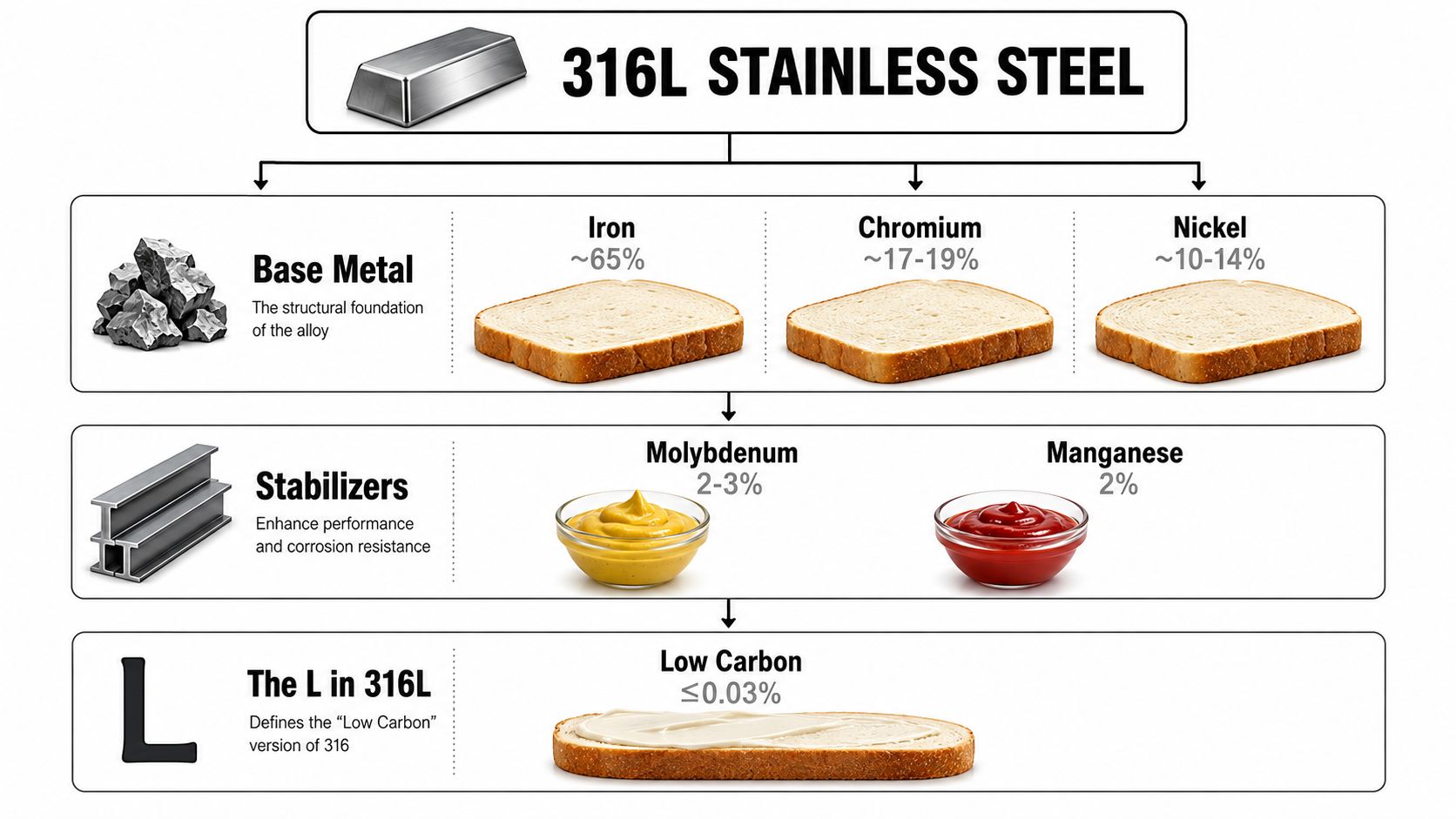
The easiest way to think about 316L is as a layered recipe. Iron is the base, chromium helps form a protective surface layer, nickel helps with strength and workability, and molybdenum improves resistance to corrosion. That's why 316L is so often sold for body jewellery, it's built to cope with moisture, sweat, and repeated wear.
The L stands for low carbon. That small detail matters because lower carbon helps the alloy stay stable during manufacturing and supports better corrosion resistance in use. In plain English, it's one of the reasons 316L holds up better than generic stainless steel in a piercing environment.
Why the surface matters as much as the alloy
The surface of the metal is part of the safety story too. A well-finished piece relies on a passive chromium-oxide layer, which acts like an invisible shield on the outside of the jewellery. That layer helps keep nickel locked inside the alloy and is one reason 316L can stay under the UK REACH nickel-release threshold for prolonged skin contact, even though the metal itself is not nickel-free.
The catch is obvious once you say it out loud. If a material depends on a protective surface layer to control release, then scratches, poor polishing, or a cheap finish can undermine the very feature that makes it workable for skin contact. That's why quality control matters as much as the alloy name.
316L also explains why steel jewellery feels familiar to so many clients. It's sturdy, widely available, and commonly stocked for mainstream ear and body piercings. But “common” doesn't mean “best for everyone”, especially not during the first weeks of healing.
Nickel, Allergies and the Question of Fresh Piercings
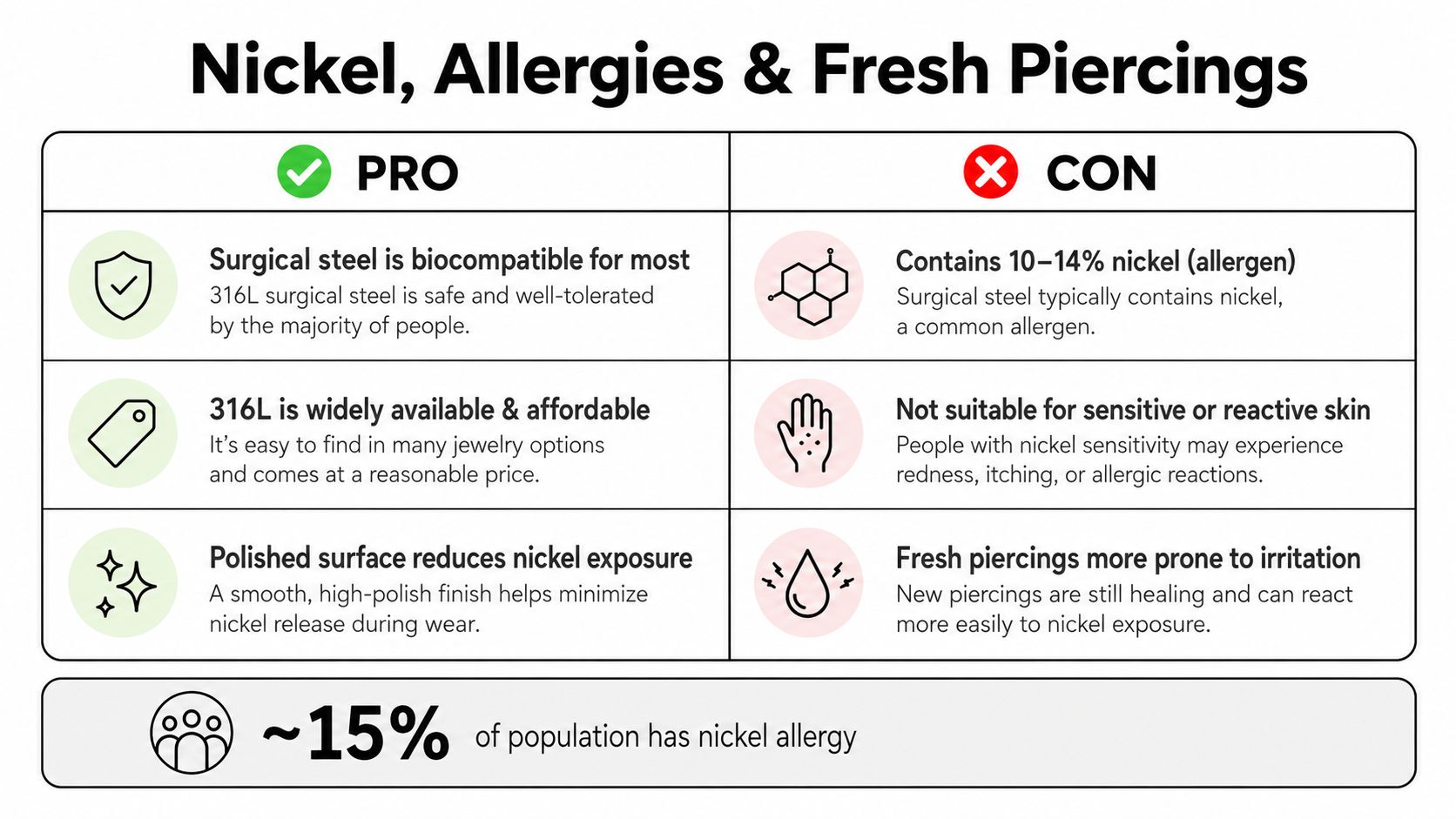
Here's the part many need to hear. 316L surgical steel is not nickel-free, and the nickel content is exactly why some people react to it while others don't. The issue isn't theory, it's skin history. If you've had itchy earrings, red earlobes, or jewellery that seems fine for a day and then starts to sting, nickel may already be on your radar.
Who should be cautious
Anyone with a known nickel sensitivity should treat surgical steel carefully, even when it's legal and well-made. The same caution applies to first ear piercings for teenagers, where a reaction can turn a simple booking into a miserable healing process. Cartilage and navel piercings also deserve extra care because swelling can trap moisture and slow down recovery.
A healed piercing and a fresh piercing are not the same situation. A healed lobe or helix can often tolerate steel if the jewellery is properly made, but a new piercing is building a fistula and needs the least irritating material you can reasonably choose. That's why many experienced piercers reach for implant-grade titanium first when skin history is uncertain.
What to ask before you book
The clearest question is also the one people forget to ask. What exact standard is the jewellery meeting, and do you disclose it before the appointment? If the answer is vague, that's useful information. You're not being difficult, you're deciding what will sit in an open wound for weeks.
Some clients hear “hypoallergenic” and assume that ends the conversation. It doesn't. Metal reactions are personal, and the same piece can feel fine for one person and irritating for another. That's why material choice should be tied to the wearer, not just the display case.
For readers comparing options for sensitive ears, the practical discussion around hypoallergenic earrings for sensitive ears is worth a look, especially if you're booking a first piercing for a child or teen.
Use this rule of thumb: if your skin has ever reacted to cheap earrings, ask for titanium first and treat steel as a later option, not the default.
Surgical Steel Compared With Implant-Grade Titanium
Steel and titanium often sit side by side in UK studios, but they solve different problems. The comparison is less about which metal is “better” in the abstract and more about which one fits the piercing stage, your budget, and your skin's history. That's the decision.
| Property | Surgical Steel (316L) | Implant-Grade Titanium |
|---|---|---|
| Weight | Heavier | Lighter |
| Cost | Usually cheaper | Usually more expensive |
| Nickel exposure | Contains nickel | Virtually nickel-free |
| Best fit | Often used for healed piercings | Often preferred for fresh piercings |
When steel makes sense
Steel can be a sensible option for healed piercings, especially when you want durability, a polished finish, and a lower price point. It's also a familiar choice for clients who don't have a nickel history and want jewellery that holds its shape well over time. In that setting, the material's weight and strength aren't problems, they're part of why people like it.
When titanium is the cleaner choice
Titanium is the safer conversation for fresh work, especially if the piercing is new, swollen, or placed where movement and moisture are hard to avoid. It's also the first thing to ask for if you already know your skin is reactive. A lighter piece can feel more comfortable in cartilage, and the lack of meaningful nickel exposure removes one variable from the healing process.
Practical rule: fresh piercing, reactive skin, or unknown allergy history, start with titanium. Healed piercing, no known sensitivity, and a budget-conscious choice, steel can be reasonable.
If you're comparing the two at the point of booking, this steel-versus-titanium guide is a useful companion. It helps turn a vague “which one is better?” question into a simple fit-for-purpose decision.
How to Spot Quality Surgical Steel Jewellery
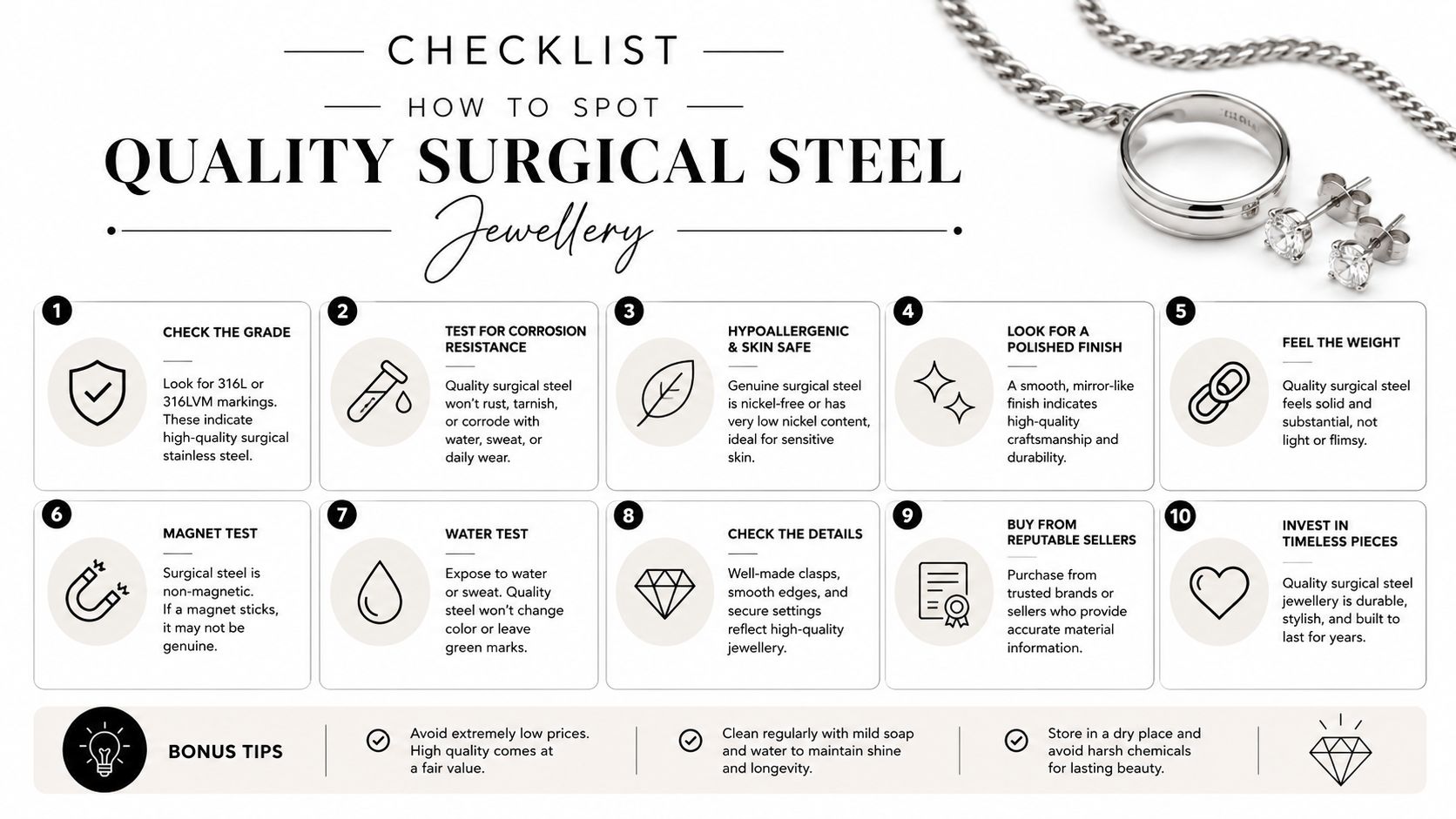
A good piece of steel gives itself away once you know what to look for. The shine should be even, the edges should be smooth, and the seller should be able to tell you exactly what it's made from. If the jewellery feels like a mystery product, treat that as a warning sign.
What good steel looks and feels like
Start with the surface. Mirror polish matters because pits and scratches can trap debris and irritate healing skin. Then look at the threading or attachment points. Rough seams, badly cut threads, or cheap-feeling ends are all signs that the jewellery was finished too quickly.
The label matters just as much as the shine. A reputable piece should name 316L, 316LVM, ASTM F-138, or ISO 5832-1 rather than hiding behind “surgical” alone. If the studio can show a mill certificate or batch information, that's a strong sign they're working with traceable stock.
Questions to ask before you hand over the payment card
- What standard is this piece made to? If the answer is only “surgical steel”, keep asking.
- Is the finish polished all the way through? A smooth surface reduces irritation from the start.
- Is this internally threaded or threadless? Those styles are usually easier on healing tissue than rough external threads.
- Can you show me the grade or batch details? Clear paperwork is what separates a serious material choice from guesswork.
One practical detail gets overlooked a lot, price. Suspiciously cheap lots often come with vague labelling, poor finishing, or plating over a less suitable base metal. None of that belongs in a fresh piercing.
You can also use the shop floor itself as a clue. Good studios don't get defensive when you ask what the jewellery is. They answer in specific terms, because they know the exact standard is part of the service.
Caring for Surgical Steel Piercing Jewellery
Steel is easy to live with, but it still needs sensible care. The aim is to keep the surface clean without stripping it, scratching it, or putting unnecessary chemicals near a healing piercing. If you treat the jewellery gently, it usually stays tidy and comfortable for a long time.
Daily cleaning that makes sense
For a healing piercing, stick with sterile saline or a mild, fragrance-free soap if your piercer has approved it. Alcohol, bleach, and harsh cleaners are the wrong tools here because they can irritate skin and damage the finish. Clean hands matter as much as the product you use.
Once a piercing is fully healed, you can remove the jewellery occasionally for a deeper clean, but don't overdo it if the hole still closes quickly or feels tender. If the piece is still part of an active healing process, leave the swapping to your piercer rather than forcing it at home.
Signs the jewellery isn't behaving well
Greenish skin staining, persistent itchiness, or visible pitting on the metal are all reasons to stop and reassess. A bad fit, a rough finish, or a reaction to the alloy can all look similar at first. If you're unsure, keep the jewellery in place and book a studio check rather than making the area angry by removing it in a rush.
Swimming and sport need common sense too. Fresh piercings and unchlorinated water are a poor mix, and hot tubs are especially risky because heat and water exposure can irritate a wound that hasn't sealed properly. If you've got to train, sleep, or shower, protect the piercing according to the aftercare advice you were given.
Good care doesn't mean fussing over the jewellery all day, it means avoiding the few mistakes that create most problems.
Booking a Safe Piercing in Croydon or Bournemouth
A safe studio makes the jewellery conversation easy. You should see single-use sterile needles, autoclaved equipment, and openly displayed jewellery options with clear material information. A piercer who talks through material choice before the appointment is already doing the right thing.
At Timebomb Tattoo & Piercing in Croydon and Bournemouth, clients can ask about consultations, walk-ins, appointments, and aftercare before they commit. If you want to ask a material-specific question first, call 01202 900050 (Bournemouth) / 020 8686 7730 (Croydon) or message 07752 913846 (Bournemouth) / 07902 490584 (Croydon) on WhatsApp.
Quick FAQ for the counter
- Do you stock titanium if I'm nickel-sensitive?
- Can you confirm the grade on the day?
- Is this jewellery suitable for a fresh piercing, or only for healed wear?
If a studio answers those plainly, you're in the right conversation.
If you want help choosing piercing jewellery with fewer guesses and more clarity, Piercing Near Me gives you a practical route into safe studios, clear material choices, and straightforward aftercare in the UK. Visit Piercing Near Me to compare options, check studio details, and book with more confidence.