
You've probably seen it already. A neat row of tiny studs climbing the outer rim of the ear, sitting perfectly inside a “curated ear” and making the whole ear look more polished with almost no effort. It looks simple in a photo. Then you start thinking about getting one yourself, and the questions arrive quickly.
Can you really get all three at once? Will your ear suit it? Is it just three helix piercings, or is there more to it than that? And how hard is it to heal when those piercings are all so close together?
A tri helix piercing is one of those styles that looks delicate but needs solid planning. It isn't just a quick add-on. It's a coordinated cartilage project that depends on anatomy, spacing, jewellery choice, and patient healing. If any one of those parts is rushed, the result can feel crowded, irritated, or frustrating long after the appointment.
That's why it helps to think of a tri helix less like buying three earrings and more like designing a small ear composition. Each placement affects the next one. Each piece of jewellery needs room. And each piercing has to heal while sharing the same bit of cartilage.
Practical rule: If a tri helix is planned well, it can look effortless. If it's planned badly, the ear usually tells you.
This guide is written the way I'd explain it in the studio. Plain language. No fluff. Just what you need to know before you commit, from placement and consultation to healing, jewellery, cost, and when to hold off.
Introduction
A tri helix piercing is usually what people mean when they point to those stacked upper-ear piercings they've saved online. It's a grouping of three piercings along the outer cartilage rim, arranged to create a balanced look rather than three random dots.
That styling is a big part of the appeal. A single helix can look subtle. A tri helix looks intentional. It gives the ear shape, draws the eye upward, and works well whether you like a minimal all-stud look or a more decorative setup later on.
What catches people out is that the style looks light, but the commitment isn't. Cartilage behaves differently from lobe tissue. It's firmer, slower to settle, and less forgiving when it gets knocked, slept on, or squeezed by poor jewellery. Add three fresh piercings close together and you've got more pressure, more swelling to manage, and more reason to get the basics right.
Why this piercing needs planning
The mistake I see most often is treating it like “a helix piercing times three”. That sounds logical, but in practice it doesn't work that way. Once you place one cartilage piercing, you change the space available for the next two. The angle matters. The spacing matters. The jewellery size matters.
Here's what usually shapes the final result:
- Your ear rim shape decides whether a neat line, a softer curve, or a spaced cluster will suit you.
- Your healing habits matter more than your inspiration photo. If you sleep on that side every night, that needs discussing before the needle comes out.
- Your jewellery choice has to support healing first and styling second.
A beautiful healed tri helix starts with boring, sensible decisions. That's a good thing.
What Exactly Is a Tri Helix Piercing
A tri helix piercing is a set of three separate helix piercings placed along the outer cartilage rim of the ear, forming a tiny earring constellation. Each point is individual, but the look only works because the three placements relate to one another.
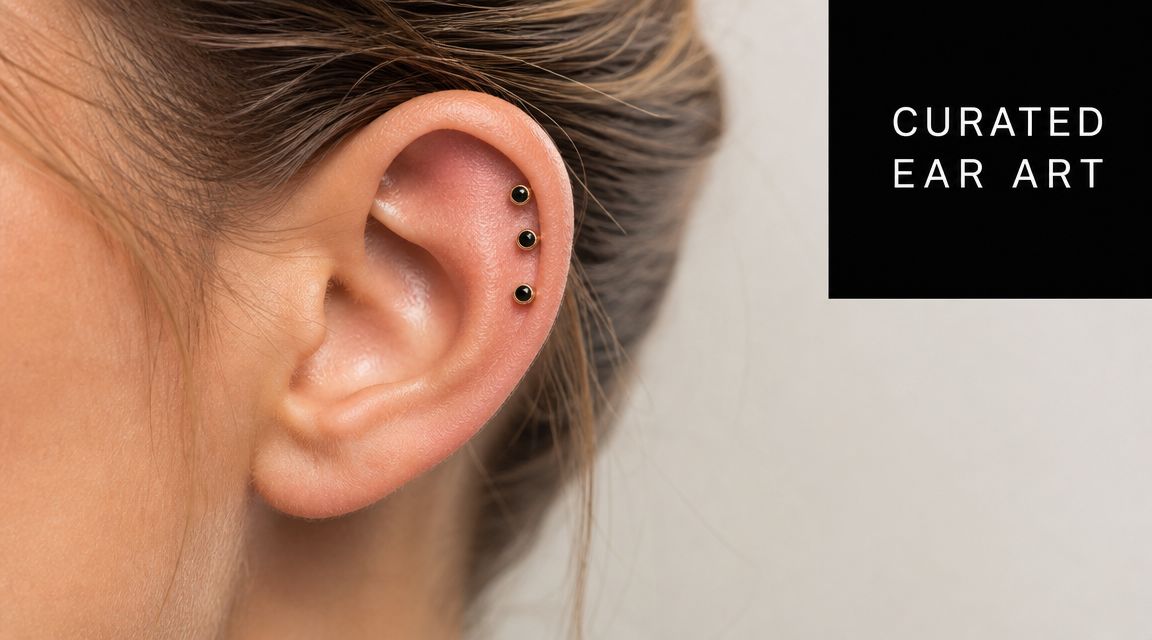
It's not a separate anatomical piercing in the way a tragus or conch is. It's a styling concept built from three helix placements. That distinction matters because it changes how you should think about the appointment. You're not just asking, “Can I get pierced here?” You're asking, “Can my ear support three well-spaced placements that will still look good once they heal?”
How it differs from similar ear piercings
A lot of first-time clients mix up these terms, which is completely normal.
| Piercing style | What it means |
|---|---|
| Single helix | One piercing on the outer cartilage rim |
| Double helix | Two piercings grouped on that rim |
| Tri helix | Three piercings grouped on that rim |
| Forward helix | A piercing placed on the front upper cartilage, nearer the face |
So if your piercings sit along the outside curve of the ear, you're in helix territory. If they sit at the front fold near the temple, that's forward helix territory.
Why it's more than a fashion add-on
In the UK, helix cartilage is widely described as a slower-healing area. One UK guide notes that helix cartilage typically takes around 3 to 6 months to heal, with some taking up to 9 months, while more conservative UK guidance gives a full healing window of 6 to 12 months. The same guide also notes that double or triple helix placements are multiple holes along the outer rim, and that adding more placements increases stress on the ear, making careful placement and healing more important (UK helix healing guidance from Pierced).
That's the part many photos don't show. The ear may look calm far earlier than it is strong. A tri helix can appear “fine” on the surface while the tissue inside is still doing repair work.
A tri helix is jewellery design on the outside and wound healing on the inside. You have to respect both.
The consultation shapes the result
The nicest tri helix setups always look natural on the person wearing them. That isn't luck. It comes from a consultation where the piercer studies the curve of the ear and works with the available cartilage rather than forcing a copied layout.
Some ears suit a tight stacked line. Others need a little more breathing room. Some can take all three in one go. Others are better started in stages. That's not bad news. It's good piercing.
Anatomy Placement and Your Piercing Consultation
The first question isn't “How many can I fit?” It's “What does my ear allow?”
That might sound less exciting than choosing jewellery, but it's the part that protects the whole project. A tri helix only works when the placements sit well in your anatomy, heal without rubbing into one another, and still leave room for future jewellery changes.
What a piercer is checking
When you sit down for a proper consultation, a skilled piercer isn't just looking for a blank patch of cartilage. They're checking the curve of the helix rim, the thickness of the tissue, the natural rise of the ear, and whether three placements can sit perpendicular to the tissue without becoming cramped over time. Professional guidance for helix placement stresses exactly that point. These piercings need to be planned around anatomy, and that's why consultation is so important for a tri helix (professional anatomy and placement advice from Lynn Loheide).
In simple terms, your ear is not a flat noticeboard. It's curved. If the angle is off, jewellery can sit awkwardly, press into the rim, or heal under tension.
Common placement patterns
A piercer might map a tri helix in a few different ways depending on your ear:
- Straight rising line for a clean, modern look
- Soft curve that follows the ear rim more naturally
- Slightly staggered cluster when equal spacing would feel too rigid
Each option changes both the look and the healing behaviour. A layout that seems tiny on paper can feel crowded once swelling starts.
Studio insight: Good spacing isn't about squeezing in three holes. It's about leaving enough room for the ear to stay calm while the jewellery sits comfortably.
Questions worth asking at the appointment
You don't need expert language to have a good consultation. Ask practical questions:
- Can my ear support all three in one session?
- Will these placements leave room for downsizing and future jewellery choices?
- Are you marking them with swelling and spacing in mind?
- Would staging them be smarter for my anatomy or lifestyle?
If a piercer welcomes those questions, that's a good sign. If they rush straight to a template look without discussing your ear shape, that's a reason to pause.
What confusion usually sounds like
Many clients worry they'll be turned away if their ear can't support the exact layout they saved. A good consultation isn't about saying no for the sake of it. It's about translating inspiration into something your ear can wear well.
Sometimes the safest answer is still yes, but with adjusted spacing. Sometimes it's two now and one later. Sometimes a slightly different arrangement gives a cleaner end result.
That's not compromising the style. It's protecting it.
The Tri Helix Healing Process and Aftercare
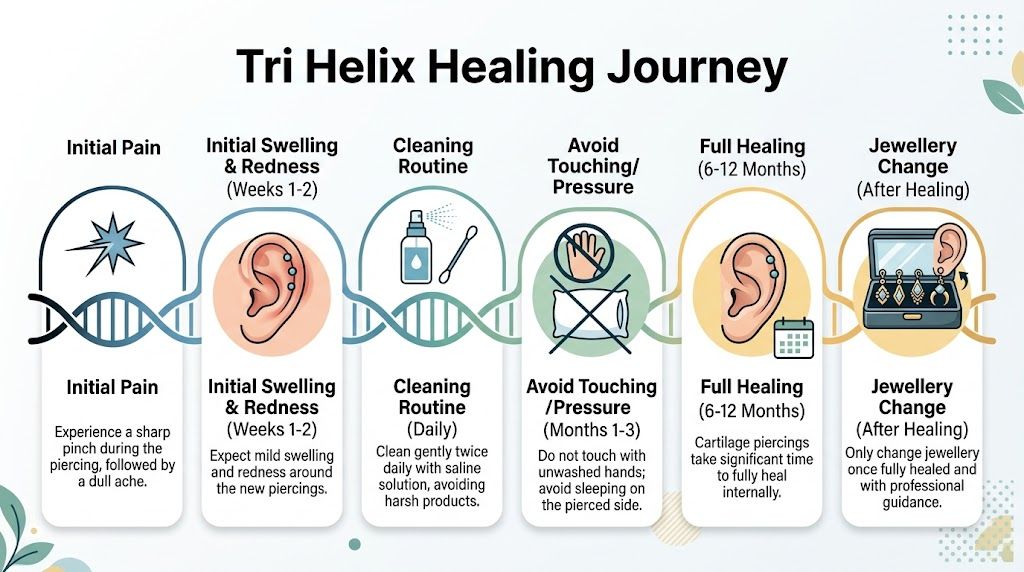
Three fresh helix piercings can look neat and balanced on day one, then feel surprisingly awkward by day three. Your ear is not healing one tidy little spot. It is managing three wounds in the same strip of cartilage, with shared swelling, shared pressure, and very little room for mistakes.
That is the part online inspiration often skips.
What healing actually feels like
The piercing appointment is brief. The project that follows is much longer.
In the first few days, warmth, redness, puffiness, and a dull throb are all common. With a tri helix, those reactions can stack up because each piercing irritates tissue close to the next one. One snag from a brush, a hoodie, or your pillow can make the whole row feel grumpy for hours.
That can be confusing. The outside may look settled before the inside is ready. Cartilage often heals from the surface inward, a bit like paint that feels dry on top while the layer underneath is still soft. If you want a clear refresher on helix piercing aftercare steps, use that as your baseline, then be even more careful because you are healing three at once.
Why tri helix healing is harder than a single helix
A single helix can often calm down with a bit of patience and fewer knocks. A tri helix needs planning during healing too.
Pressure spreads across the area. Swelling in one piercing can make the others feel tighter. If one angle gets bumped often, the whole line can look uneven or irritated even when the original placement was good. That is why piercers treat a tri helix as a coordinated healing job, not just one helix repeated three times.
Small problems add up fast here. Sleeping on that side for one night might not ruin anything, but repeated pressure can keep all three piercings stuck in the irritated stage.
A routine that gives the ear the best chance
Keep your aftercare simple and consistent.
- Clean with sterile saline as your piercer advised. Let it soften any crust, then leave it alone.
- Do not twist or test the jewellery. Movement delays healing, even if you are only checking whether it still feels sore.
- Protect the ear from pressure while sleeping, on the phone, or under headphones and helmets.
- Be careful with hair and clothing. Towels, jumpers, hoods, and hairbrushes are common troublemakers.
- Return for your downsize appointment when your piercer recommends it. Posts that are too long after swelling drops can catch and shift.
A good rule is this: calm ears heal. Busy ears do not.
What usually causes setbacks
People often assume infection is the main risk. More often, the problem is irritation.
Cartilage dislikes repeated friction, moisture trapped against the ear, harsh cleaning products, and jewellery that moves too much. With three piercings close together, you have three chances to knock something and one shared area that reacts. That is why over-cleaning can be just as unhelpful as under-cleaning. If the tissue is already irritated, extra fuss usually adds to the problem.
Be cautious with advice that tells you to use alcohol, tea tree oil, homemade salt mixes, or ointments not recommended by your piercer. Fresh cartilage usually does better with a cleaner, quieter routine.
What normal healing looks like, and when to get help
Some day-to-day variation is normal. One piercing may feel more tender than the other two. The top or middle one may swell a bit more. Mild crusting can come and go.
Get your piercer to check it if swelling keeps increasing, the jewellery starts to feel tight, the area becomes very hot, or discharge turns thick and dark. Those changes need a proper look, especially in a grouped project like this where one problem can affect the spacing and comfort of the full set.
Patience matters here. A tri helix asks more of you than a single helix because the healing has to stay stable across all three placements at the same time. If you treat it that way from the start, you give the final look a much better chance of healing cleanly and sitting well.
Choosing Your Jewellery Gauge Size and Material
Jewellery choice shapes whether a tri helix heals as a tidy set or turns into three separate problems. Online photos often focus on the final look. Your piercer has to plan for the first phase instead: swelling, spacing, pressure, and how three piercings will sit next to each other for months.
Why piercers usually start with studs
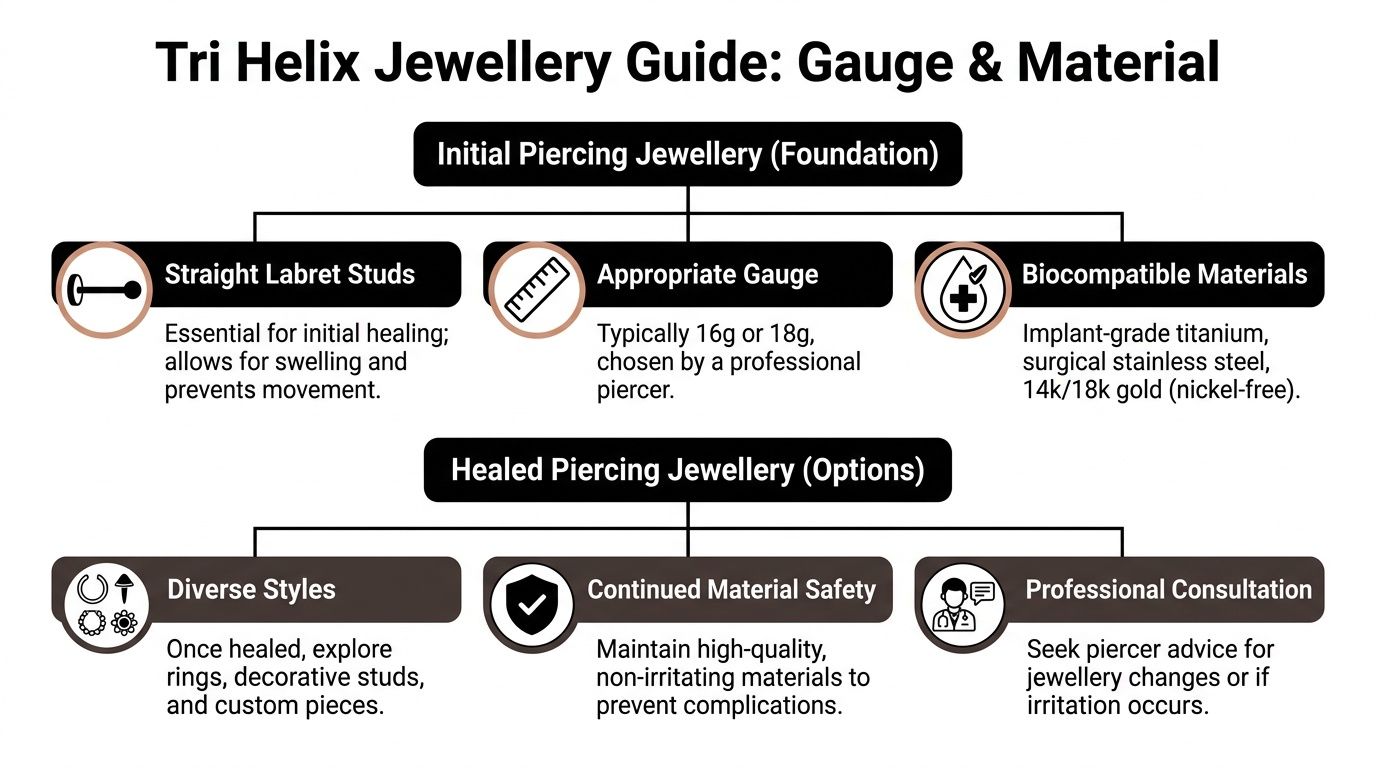
For a fresh tri helix, piercers commonly choose 16G labret studs with enough post length to leave room for early swelling. The exact length depends on your ear anatomy and how tightly the three placements need to sit as a set. It is a fitting decision, not a fashion one.
Studs work well here because they keep the project more stable.
| Jewellery feature | Why it matters for tri helix healing |
|---|---|
| Flatback labret | Sits securely and reduces rubbing behind the ear |
| 16G thickness | Gives cartilage steady support without feeling overly bulky |
| Slightly longer initial post | Leaves room for swelling in the early stage |
| High-quality implant-grade material | Lowers the chance of avoidable irritation |
Hoops usually come later. A ring has more freedom to move, and movement in one piercing can tug on the spacing of the others nearby. In a single helix, that may be manageable. In a tri helix, it can disturb the whole layout.
Material matters more in a grouped piercing project
Three healing channels in one area ask more from the tissue, so jewellery quality matters from day one. Implant-grade titanium is a common first choice because it is stable, lightweight, and well tolerated by many clients. If you want a clearer explanation of why piercers recommend it so often, this guide to implant-grade titanium piercing jewellery breaks down the practical differences.
Solid implant-grade gold can also work in the right piece, but only if the alloy and finish are suitable for fresh piercings. The key point is verification. “Titanium coloured” or “surgical steel” on a product page does not tell you enough. Your piercer should be able to tell you exactly what the jewellery is made from and why it is being used for initial fitting.
Top size matters as much as gauge
This is one of the details clients often miss during planning.
On a tri helix, the decorative ends need their own spacing plan. If the tops are too large, they can crowd each other, press into swelling tissue, and make cleaning awkward. Small, simple ends usually heal better because they leave each piercing enough personal space. Three parked cars fit neatly only when each one has room to open the door.
That is why a fresh tri helix can look plainer than the inspiration photo you saved. The goal is to build a stable foundation first, then style it once the ear has settled.
Matching jewellery to real life
Your jewellery should also match how you live. If you wear helmets, use over-ear headphones, answer the phone against that side, or have long hair that catches easily, your piercer may suggest a more compact setup. A tri helix is not just three holes. It is three healing points sharing one high-traffic part of the ear.
If irritation starts, check the mechanics before assuming something more serious is wrong. Common causes include pressure during sleep, posts that are now too long or too short, decorative ends that crowd the space, and poor-quality metal. In practice, good tri helix jewellery does two jobs at once. It protects healing tissue and preserves the final arrangement you wanted in the first place.
Understanding Costs and Managing Complications
A tri helix often looks simple online. In the chair, it is closer to a small coordinated project. You are paying for three placements that have to line up well, leave room for swelling, and heal without competing with each other.
That is why the cheapest quote can become the costly option later. If a studio rushes the consultation, uses poor jewellery, or offers no review appointment, you may end up paying again for longer bars, troubleshooting, or even retiring one of the piercings.
What the price usually covers
Studios may price a tri helix as three separate cartilage piercings or as one grouped service. Either way, the total is usually built from the same parts:
- Placement planning, because each piercing affects the spacing and angle of the other two
- Three pieces of appropriate initial jewellery, not one
- Sterile single-use equipment and clinical setup
- Time to check swelling room and fit
- Aftercare advice and follow-up support, especially if downsizing is needed later
It helps to read a studio's prices for piercings with that in mind. A tri helix quote is not only about making three holes. It is about setting up three healing piercings so they can succeed together.
Why tri helix problems can be harder to manage
With one helix piercing, an irritation bump or pressure issue is usually isolated. With three close together, one problem can affect the rest of the set. Swelling in the middle piercing can make the top and bottom feel tighter. A snag on one bar can shift the angle of healing around it. It works a bit like three tent pegs placed in the same patch of ground. If one loosens, the structure around it can start pulling unevenly.
That does not mean complications are inevitable. It means they need to be handled early and practically.
Normal healing versus a complication
Some tenderness, light crusting, and occasional swelling are common with cartilage piercings, especially in the first part of healing. What deserves a review is a pattern that keeps repeating or gets worse instead of settling.
Ask your piercer to check things if you notice:
- Pressure that does not improve, especially after sleeping on that side
- Jewellery that looks embedded, too tight, or excessively long
- Persistent redness and irritation around one piercing that starts affecting the others
- Frequent snagging from hair, headphones, helmets, or clothing
- Heat, throbbing, or discharge that looks more concerning than normal dried lymph
A good studio will first look at the mechanics. Angle, spacing, bar length, and external pressure cause many tri helix setbacks. People often assume the piercing itself has "gone wrong" when the actual issue is that the ear is being bumped, compressed, or crowded every day.
Budget for the full healing period, not just the appointment
This is the part many guides skip.
Your first payment is only the start of the project. You may also need a check-up, a downsize once initial swelling reduces, and a jewellery change much later when the piercings are fully stable. If one of the three becomes irritated, solving it quickly can save the rest of the arrangement.
That is why studio choice matters so much here. A tri helix needs a piercer who can plan the whole set, then help you adjust it as the ear changes during healing.
Book Your Tri Helix Piercing in Croydon or Bournemouth
If you've read this far, you already know the main truth about a tri helix. It can look delicate, but it needs serious planning. The right studio won't just ask which side you want. They'll check your anatomy, mark the placement carefully, fit suitable jewellery, and explain healing in a way that helps when you get home.
That matters even more if this is your first cartilage project. You want a piercer who's comfortable saying, “Yes, that will work,” or “Not quite like that, but here's a safer version.” Good advice saves you time, discomfort, and disappointment later.
What to look for before you book
Choose a studio that offers:
- Single-use sterile needles
- Verified implant-grade jewellery
- A proper consultation before marking
- Clear aftercare instructions
- Follow-up support for downsizing or concerns
If you're booking in Croydon or Bournemouth, Timebomb Tattoo & Piercing is the kind of studio setup you should be looking for. The focus should always be on safe technique, correct jewellery, and realistic placement rather than copying an online photo without considering your ear.
Questions to ask before your appointment
A short message before booking can save a lot of uncertainty. Ask:
- Can you assess whether my ear can support a tri helix in one session?
- Do you stock implant-grade titanium for initial jewellery?
- Will you mark the placements and discuss spacing before piercing?
- Do you offer follow-up checks and downsizing advice?
Those aren't awkward questions. They're exactly the right ones.
If you want to speak to the studio directly, call 01202 900050 (Bournemouth) / 020 8686 7730 (Croydon) or message on WhatsApp at 07752 913846 (Bournemouth) / 07902 490584 (Croydon). That's the easiest way to ask about availability, consultation, jewellery options, or whether your ear is likely to suit the look you want.
Frequently Asked Questions About Tri Helix Piercings
A tri helix raises different questions than a single cartilage piercing because you are healing a set of three that need to behave well together. Good planning matters just as much as the piercing itself.
Can all three piercings be done in one session
Often, yes. The primary question is whether your ear has enough usable space for clean spacing and whether you are prepared for the extra healing work that comes with three fresh piercings in one area.
A good piercer will assess the curve of your ear, mark the placement, and tell you if all three should be done at once or split into stages. That is one of the biggest gaps between online inspiration and real life. A photo can show the look. It cannot show whether your ear can support it safely.
Is a tri helix much more painful than a single helix
Usually, it feels more intense overall because the ear becomes more sensitive with each piercing. Many clients describe the first one as sharp, the second as more noticeable, and the third as the one they feel most.
The bigger difference is often after the appointment. One helix can be annoying. Three close together can leave the whole area feeling warm, sore, and a bit grumpy for a while.
How do I sleep with a fresh tri helix
Keep all pressure off that side.
A travel pillow or piercing pillow works like a donut cushion for your ear. Your head rests on the pillow while the ear sits in the centre gap instead of being folded and pressed. That simple change can make a big difference because pressure can irritate all three piercings at once, not just one.
When can I change the jewellery to hoops
Wait until they are fully healed and your piercer has checked the tissue. With a tri helix, patience matters even more because changing one piece too early can upset the whole cluster.
Starter studs are usually the calmest option during healing because they stay more stable. Hoops are better treated as the finishing look once the project has settled properly.
What's the best material for starter jewellery
Implant-grade titanium is a strong choice for initial jewellery because it is well tolerated and less likely to cause irritation. That matters even more when three piercings are healing side by side. If one becomes irritated, the surrounding piercings often become harder to settle too.
What's the difference between a helix and a forward helix
A standard helix sits along the outer upper rim of the ear. A forward helix sits further toward the face, on the front part of that upper cartilage fold.
They are easy to mix up in photos. Placement changes the jewellery angle, the available space, and sometimes whether a triple arrangement is even possible.
If you're comparing studios, planning your first cartilage project, or ready to book a tri helix in Croydon or Bournemouth, Piercing Near Me helps you find practical guidance, studio information, and safe booking options with a focus on professional piercing standards.