
You might spot a compact barbell across someone's inner ear and assume a snug piercing would suit you too. The placement is more selective than its neat appearance suggests. A snug piercing passes horizontally through the inner anti-helix ridge, usually with a small curved barbell, and healing can take 6 to 12 months.
Its appeal comes from the contrast: subtle from the front, more noticeable from the side, and less familiar than a standard helix. The deciding factor, however, is your ear's structure. Your anti-helix shape, jewellery choice, sleeping habits, and aftercare routine all affect whether it settles comfortably.
A piercer must check whether your anti-helix forms a tall, substantial ridge with enough tissue for the channel. If that fold is shallow or narrow, the jewellery may sit under pressure, making comfortable healing difficult. A consultation should therefore come before choosing the style.
What a Snug Piercing Is
You may notice a compact barbell crossing the inner ear and wonder whether the same placement would suit you. A snug piercing runs horizontally through the anti-helix, the firm inner ridge that roughly parallels the outer rim. Guidance for UK cartilage piercings places this area among the slower-healing ear cartilage placements. UK cartilage piercing guidance
The name describes the way the jewellery follows a defined cartilage fold. Its position distinguishes it from nearby options:
- A helix sits on the upper outer rim of the ear.
- A conch passes through the broad, bowl-shaped cartilage in the centre.
A piercer will usually start with a small curved barbell. Its shape follows the anti-helix more naturally than a straight bar, much like a rail following the curve of a track. This helps the jewellery rest against the ear without pulling the entry and exit points into an awkward angle. A ring may be suitable later, after the channel has settled, but it is not usually the first choice for a fresh snug.
Why the anatomy decision comes first
Your ear needs a tall, substantial anti-helix fold for a traditional snug. If the ridge is shallow, soft, sharply folded, or close to neighbouring structures, it may not provide enough cartilage to support the barbell comfortably. An experienced piercer should examine your ear in person, rather than approve the placement from a photograph.
That assessment matches the jewellery and channel to your actual structure. If your fold cannot support a true horizontal piercing, the piercer may suggest a faux snug made from separate placements. It can create a similar visual effect without forcing a channel through unsuitable anatomy.
The style is selective by nature. A snug can look distinctive, but your ridge determines whether it is a sensible choice.
The Ear Anatomy Behind the Placement
Start with the outer edge of your ear. The helix is the curved rim that outlines it. Inside that rim is the anti-helix, an inner ridge with a branching, Y-like shape. The snug generally uses the lower, more vertical part of this ridge, above the earlobe and towards the anti-tragus.
The conch occupies the central bowl of the ear, while the daith sits deeper inside, in the cartilage fold above the ear canal. These placements may appear close together in a curated ear, but they use different cartilage surfaces and create different jewellery angles. A snug travels horizontally through the anti-helix fold, which is why its suitability depends so heavily on the fold's height and thickness.
What your piercer is checking
Cartilage ridges vary naturally from person to person. One ear may have a prominent fold, while the other may be flatter or shaped differently. That difference affects whether the piercer can create a channel with enough tissue around it, place jewellery at a stable angle, and leave room for normal swelling.
The ridge also determines how easily the jewellery will catch on daily pressure. A snug may sit directly where an over-ear headphone cushion, hat band, helmet strap, or pillow presses. If the bar is too long, it can snag and move. If it's too short, swelling can put pressure on the ends and make the jewellery feel embedded.
Practical rule: A good anatomy check should happen while you're sitting upright, because your ear's shape and the jewellery angle need to be assessed in its natural position.
Ask your piercer to mark the proposed entry and exit points before the procedure. Look at the marks from the front, side, and mirror angles. If the ridge doesn't look defined enough, or the marked line feels forced, postponing the piercing is safer than hoping the tissue will adapt.
Snug Piercing Compared with Other Cartilage Piercings
Choosing between cartilage placements becomes easier when you compare how each one fits your ear and your routine. A standard helix is more exposed on the outer rim, while a snug sits deeper along the inner ridge. A forward helix is near the front upper ear, a conch uses the central bowl, and a daith sits in the inner fold above the canal.
Pain varies with anatomy and personal sensitivity, so the scale below is only a rough expectation, not a promise. The snug is commonly placed higher than a helix or conch because the anti-helix is a dense cartilage ridge. You can read a more focused explanation of the location in this anti-helix piercing guide.
Snug vs Other Cartilage Piercings
| Piercing | Location | Typical Jewellery | Visibility | Pain (1-10) |
|---|---|---|---|---|
| Snug | Horizontal through the inner anti-helix ridge | Curved barbell | Moderate, strongest in profile and side views | Around 6 to 7 |
| Standard helix | Upper outer ear rim | Labret stud, later a ring | High from side and front angles | Usually lower than a snug |
| Forward helix | Front section of the upper helix, near the face | Small labret stud | Subtle from the front | Usually lower than a snug |
| Conch | Central bowl of the ear | Labret stud, later a ring | Moderate, depending on jewellery size | Often lower than a snug |
| Daith | Inner cartilage fold above the ear canal | Curved barbell or ring suited to the fold | Low from straight-on views | Varies with the fold and piercer's assessment |
Jewellery follows the location. A snug normally needs a curved barbell to match the ridge. A conch or forward helix commonly starts with a flat-back labret, while a healed helix or conch may be styled with a ring. Visibility also differs: the snug often disappears from a straight-on view but becomes a clear feature when someone sees your ear in profile.
The right choice depends on more than appearance. If you regularly wear over-ear headphones or sleep on one particular side, an outer-rim placement may create different problems from a snug. If you want a discreet first cartilage piercing, a forward helix may feel less prominent. If you want a central focal point and have a suitable ridge, the snug offers a distinctive result, provided you're comfortable with the longer commitment.
Pain and Healing Expectations
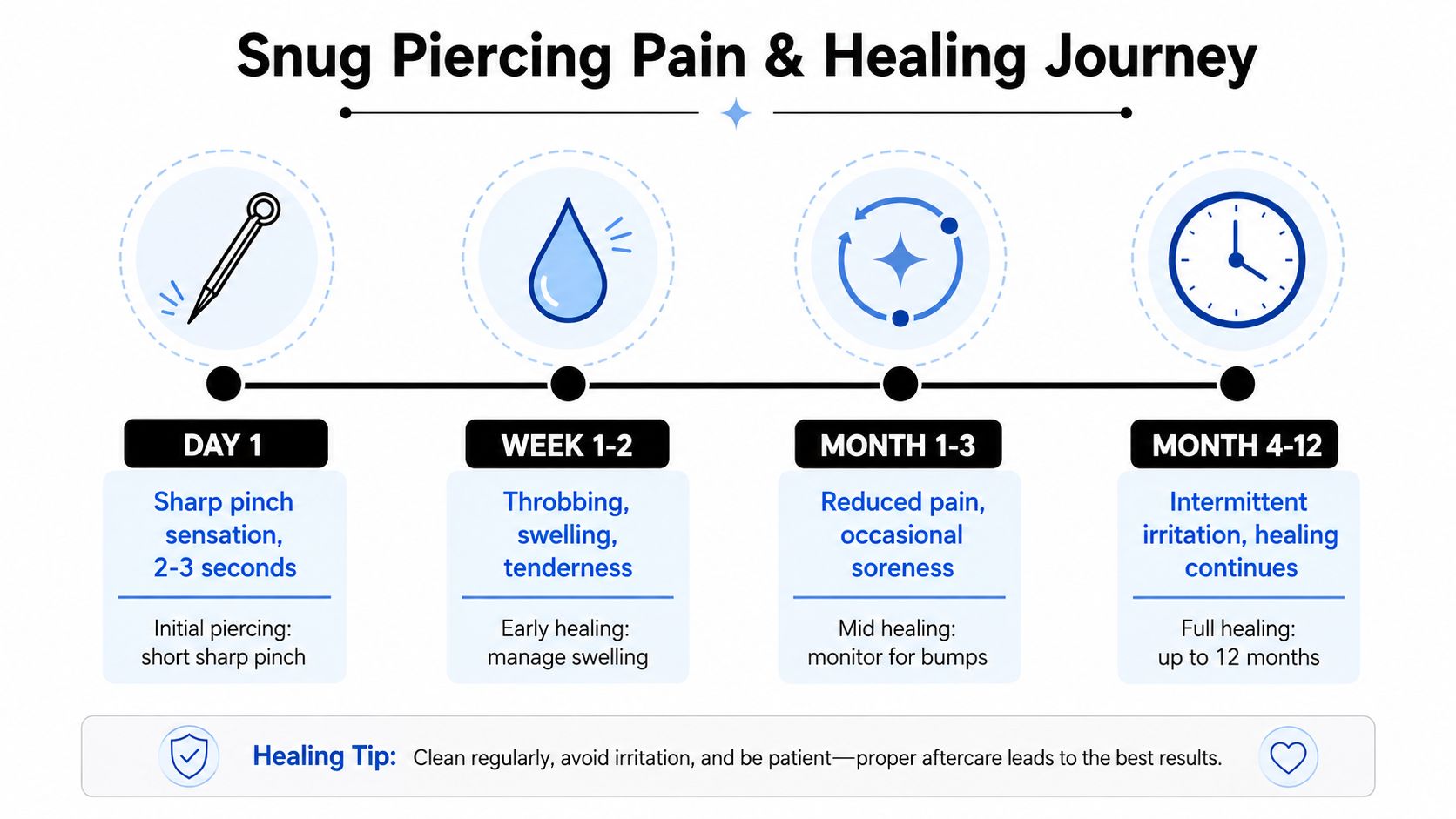
A snug usually feels like a short, sharp pinch, followed by pressure as the needle passes through the anti-helix ridge. A reasonable personal estimate is around 6 to 7 out of 10, but your anatomy, stress level, and previous piercing experience can change that. The intense sensation is brief. The longer test is how well your ear copes with pressure while the channel settles.
Cartilage generally repairs more slowly than a lobe because it receives less blood flow. UK guidance places cartilage piercings in a healing range of 3 to 6 months, sometimes longer, while other UK beauty guidance gives a 6 to 12 month window for a snug. UK health guidance on infected piercings recommends avoiding twisting, picking, and dry friction, alongside careful cleaning.
Your anatomy determines how manageable that period feels. A well-defined anti-helix ridge gives the jewellery a stable path, while a shallow or tightly folded ridge may leave the barbell more exposed to pressure. Talking, chewing, using a phone, brushing your hair, or resting your head can all move or press the ear.
What daily healing can feel like
During the first few days, warmth, swelling, and tenderness are common. Leave room around the jewellery for that response, while ensuring the barbell is not so loose that it catches.
In the early weeks, symptoms can change from day to day. A commute may press the ear against a phone or headphone, and a gym session may bring sweat, hair, or a towel into contact with the piercing. Keep contact light, avoid rubbing, and check that helmets, headphones, and hair do not press directly on the ridge.
Over the following months, the piercing may tolerate ordinary movement better, yet react after sleeping on it or catching it with clothing. A calm outer surface does not prove that the inner channel has matured, so judge progress by consistent comfort rather than appearance alone.
Your piercer may recommend a downsize once the initial swelling has reduced. This replaces the longer starter bar with one suited to the settled ear. Have a professional make the change, and do not treat it as proof that healing is complete.
Jewellery Choices That Work for a Snug
A snug only works with jewellery that suits the ear's anti-helix. If the ridge is too shallow, tightly folded, or uneven, a barbell may sit under pressure no matter how appealing the reference photo looks. Your piercer should assess the available tissue first, then select the curve, thickness, and length that follow your anatomy.
A curved barbell is usually the most practical starter piece. Its arc follows the ridge and helps keep pressure balanced at both openings. The correct fit leaves space for early swelling without making the jewellery so loose that it catches on hair, clothing, or headphones.
Rings can look striking after the channel has settled. They move more freely, however, so a captive bead ring or fixed ring may irritate a snug that is still healing. A small labret stud suits other cartilage placements and can create a faux snug effect, but it generally does not follow the snug's horizontal route through the ridge.
Jewellery options for a snug piercing
| Jewellery Type | Best For | Healing Friendliness | Typical Diameter |
|---|---|---|---|
| Curved barbell | Initial snug placement and controlled healing | High when correctly sized to the ridge | Piercer-selected length and curve |
| Captive bead ring | A later style change after the channel settles | Moderate, because movement can increase | Piercer-selected inner diameter |
| Fixed ring | Minimal, polished styling after healing | Moderate, depending on fit and movement | Piercer-selected inner diameter |
| Small labret stud | Alternative anatomy plans or faux snug styling | Can be suitable for separate placements | Piercer-selected post length |
Ask for implant-grade titanium or solid 14k gold from a reputable supplier. Titanium can suit clients concerned about metal sensitivity, while solid gold provides a warmer colour when it meets appropriate quality standards. Traceable material and a smooth finish matter because flaking or rough surfaces can disturb the healing channel.
Avoid plated jewellery, mystery alloys, and low-cost “surgical steel” without clear material information. Nickel-containing metals may irritate healing tissue, and plating can wear away as the piece moves. A professional studio should identify the material before it touches your ear, and the choice should follow the ridge's shape rather than a trend.
Getting Pierced Safely at a UK Studio
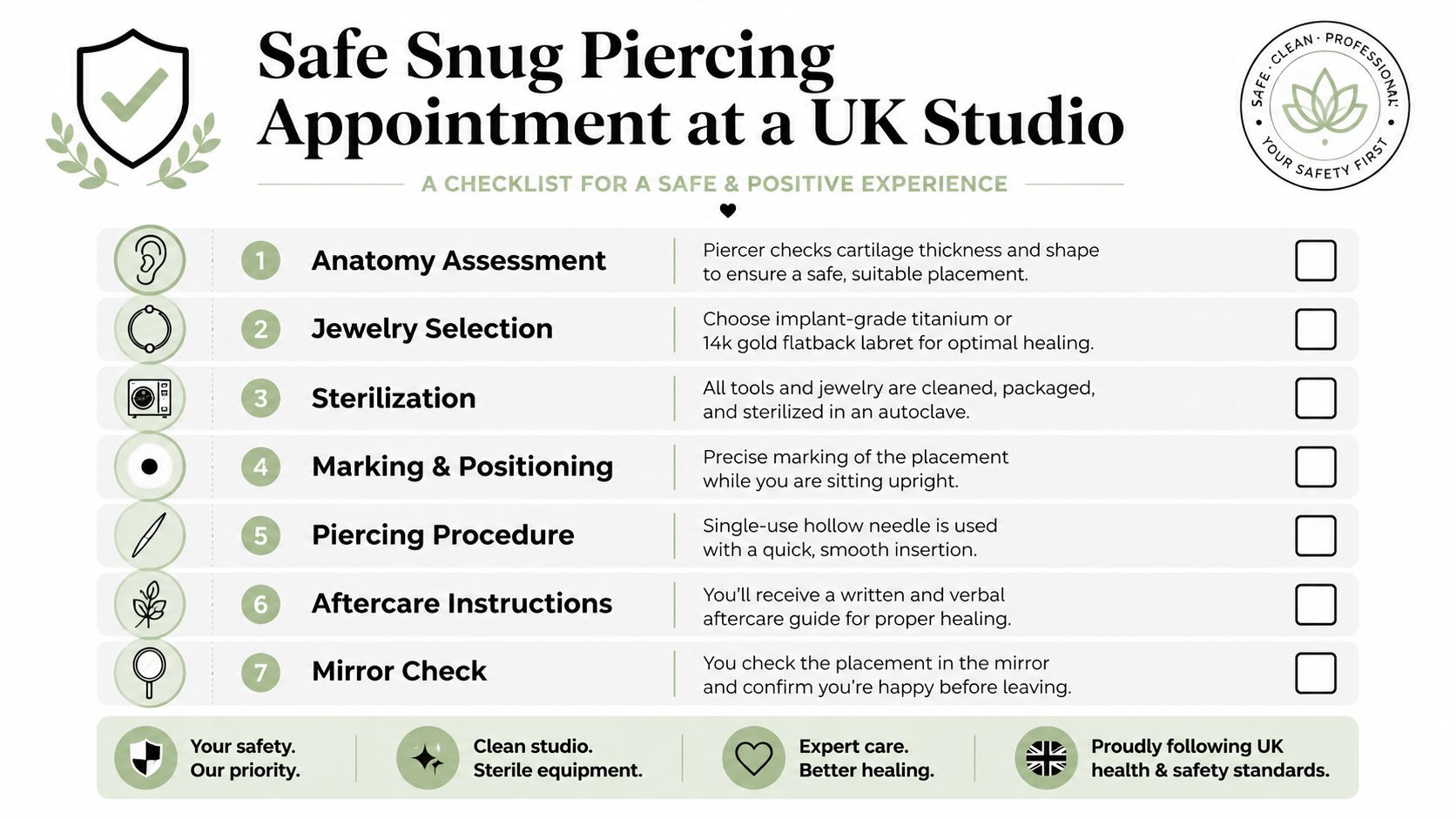
You arrive with a snug reference photo, but the piercer first studies your ear rather than copying the image. While you sit upright, they should assess whether your anti-helix forms a thick, stable ridge and explain how the jewellery would rest within it. If the ridge is too shallow, refusal or a different placement shows professional judgement. A snug is anatomy-dependent, not a style every ear can support.
Before booking, check the studio's working standards. Ask whether reusable tools are sterilised in an autoclave, how sterilisation records are maintained, and how sharps are disposed of. Ask to see healed snug work, not only fresh photographs. Healed examples reveal whether the piercer consistently chooses suitable angles, spacing, and jewellery fit after swelling has settled.
The appointment should also include clear checks that protect your decision:
- Review the proposed placement while you are upright, then inspect the marks in a mirror from several angles.
- Ask what single-use hollow needle and jewellery specifications will be used. The studio should identify the material and manufacturer before the piece touches your ear.
- Confirm that the curved barbell suits the ridge, with enough room for expected swelling without leaving an unnecessarily long bar.
- Ask what follow-up support is available if the placement becomes irritated or the jewellery needs adjustment.
- Before leaving, look at the final angle and position, and make sure the written aftercare instructions are understandable.
A piercing gun should never be used on cartilage. It drives a pre-loaded stud through tissue with blunt force, whereas a sterile hollow needle creates a controlled channel. This piercing gun versus needle guide explains the difference and why it matters for a dense, anatomy-sensitive placement such as a snug.
Aftercare and Long-Term Healing
A fresh snug needs consistent care, and the first few months influence how the channel settles over time. Wash your hands before touching it, use sterile saline spray twice daily, and let clean shower water rinse the area gently. Pat around the piercing with a clean disposable product or let it air dry. Twisting the barbell, picking at crust, and scrubbing the cartilage can all prolong irritation.
Keep pillowcases clean and sleep on the opposite side. Over-ear headphones, tight hat bands, helmet straps, hair, and phone pressure may bump the ridge. If something repeatedly touches the jewellery, change that object or routine instead of allowing ongoing pressure on an anatomy-sensitive placement.
Small habits protect the channel
- Sleeping: Use the opposite side or a pillow designed to keep pressure away from the ear.
- Headphones: Avoid over-ear models while the snug heals. Earbuds also need care if they touch the area.
- Sport: For contact training, ask your piercer whether a breathable protective covering suits your activity.
- Water: Avoid swimming until the piercing channel has fully formed, since submerged water can introduce contamination.
- Hair and clothing: Tie hair back while styling it, and pull jumpers or tops over the ear carefully.
Warm water compresses may help an irritated or infected piercing, while mechanical trauma can make symptoms worse. The cartilage aftercare guide explains saline cleaning and how pressure affects a piercing during its longer healing period.
When to ask for help
Some early swelling and tenderness can be normal. Contact your piercer for an assessment if the jewellery begins embedding, the bar appears to migrate, or irritation continues to worsen after obvious pressure has been removed. A snug can be especially sensitive when its ridge is narrow or the jewellery fit no longer allows for swelling.
Seek medical advice for increasing redness, heat, throbbing pain, or discharge beyond clear lymph. Cartilage infections can progress to perichondritis, an infection affecting the covering around the cartilage. UK public-health guidance notes that these cases may require antibiotic treatment, and The UK government guidance on Pseudomonas-related perichondritis explains why suspected cartilage infection deserves prompt attention.
Age Rules, Studio Policy, and Common Questions
UK piercing rules and studio policies don't always match. One London borough code states that body piercing isn't permitted under 16, while clients aged 16 to 17 need a parent or legal guardian present and written consent for ear cartilage piercings. The Redbridge body piercing code is a useful example of how local requirements can work in practice.
A studio may set a stricter policy than the local legal minimum. Some reputable studios require clients to be 18 or older for higher-risk cartilage work, even where a younger client could legally attend with consent. Studios may also ask for photo identification, proof of guardianship, and a parent or guardian to remain present. A professional piercer can decline the procedure if the anatomy, maturity, jewellery plan, or aftercare circumstances aren't appropriate.
Common questions
Can you wear AirPods with a snug?
Only if they don't touch or press on the jewellery. During healing, avoid any earbud that rubs the anti-helix.
Can you hide it for work?
The snug is partly concealed from straight-on views, but the jewellery can show in profile. Don't remove fresh jewellery to hide it, because the channel may narrow or close.
Does it close if you remove it?
A healing piercing can tighten quickly after jewellery removal. Ask your piercer before taking it out, especially if you suspect infection.
Can it be combined with a conch?
It may be possible, but the available space and jewellery angles need an in-person assessment. Your piercer should plan the placements together rather than treating them as independent choices.
When can you change the jewellery?
Wait until your piercer confirms that the channel is mature enough. The outside can look healed while the inner tissue remains vulnerable.
Before booking, check four points: your anti-helix has suitable depth, neighbouring piercings have settled, your metal sensitivities are understood, and you have saline and a realistic pressure-free routine ready.
Piercing Near Me offers consultations and booking information for professional piercing services in Croydon and Bournemouth, including guidance on snug placement, jewellery selection, and personalised aftercare. Visit Piercing Near Me to explore your options, contact the team on 01202 900050 (Bournemouth) / 020 8686 7730 (Croydon) or WhatsApp 07752 913846 (Bournemouth) / 07902 490584 (Croydon), and arrange an anatomy check before committing.