
A tragus piercing is a piercing through the small cartilage flap that sits just in front of the ear canal, and it can take up to 12 months to heal fully. It isn't just another lobe piercing with a different piece of jewellery.
You may be looking at your phone right now, scrolling through photos of neat little studs and wondering whether your ear has the right shape. The jewellery is the visible part, but the outcome depends just as much on what happens around it every day: earbuds pressing against the channel, a phone held to the same ear, or sleep putting steady pressure on the tragus.
A calm decision starts with anatomy. You need to know what the needle passes through, how cartilage behaves while it heals, which jewellery gives the channel room to settle, and which symptoms mean you should speak to a healthcare professional rather than just clean the piercing more often.
Meeting the Tragus for the First Time
You're in the studio chair with your phone in your lap, comparing old lobe-piercing stories and trying to decide whether a tiny silver or gold stud would suit you. The piercer asks you to relax your jaw and turns your attention to the small, firm flap immediately in front of the ear canal. That flap is the tragus.
A tragus piercing is made with one needle passing through that cartilage. It differs from a lobe piercing because the lobe contains softer tissue with a stronger blood supply, while the tragus is dense cartilage. It also isn't the same as an anti-tragus, which sits opposite the tragus, or a rook and daith, which are placed higher within the folds around the inner ear.
The exact result depends on your ear. A tragus may be thick, flat, narrow, or very small, and the piercer must assess whether there's enough tissue for a stable channel. Placement and angle matter because jewellery that sits too close to the canal, presses against the surrounding fold, or enters at an unsuitable angle can be difficult to heal.
A good consultation is an anatomy check, not a formality. Your piercer should examine the ear before choosing the mark, jewellery length, and angle.
The needle creates a controlled channel through skin and cartilage. After that, the channel needs protection from pressure, dirt, movement, and snagging while the body builds new tissue around the jewellery. That's why this guide focuses not only on the piercing itself, but also on jewellery, healing, phones, headphones, sleep, warning signs, and booking.
For a first-person account of what the procedure can feel like, read this practical guide to whether a tragus piercing hurts. Pain varies from person to person, so a professional explanation of the process is more useful than a fixed rating.
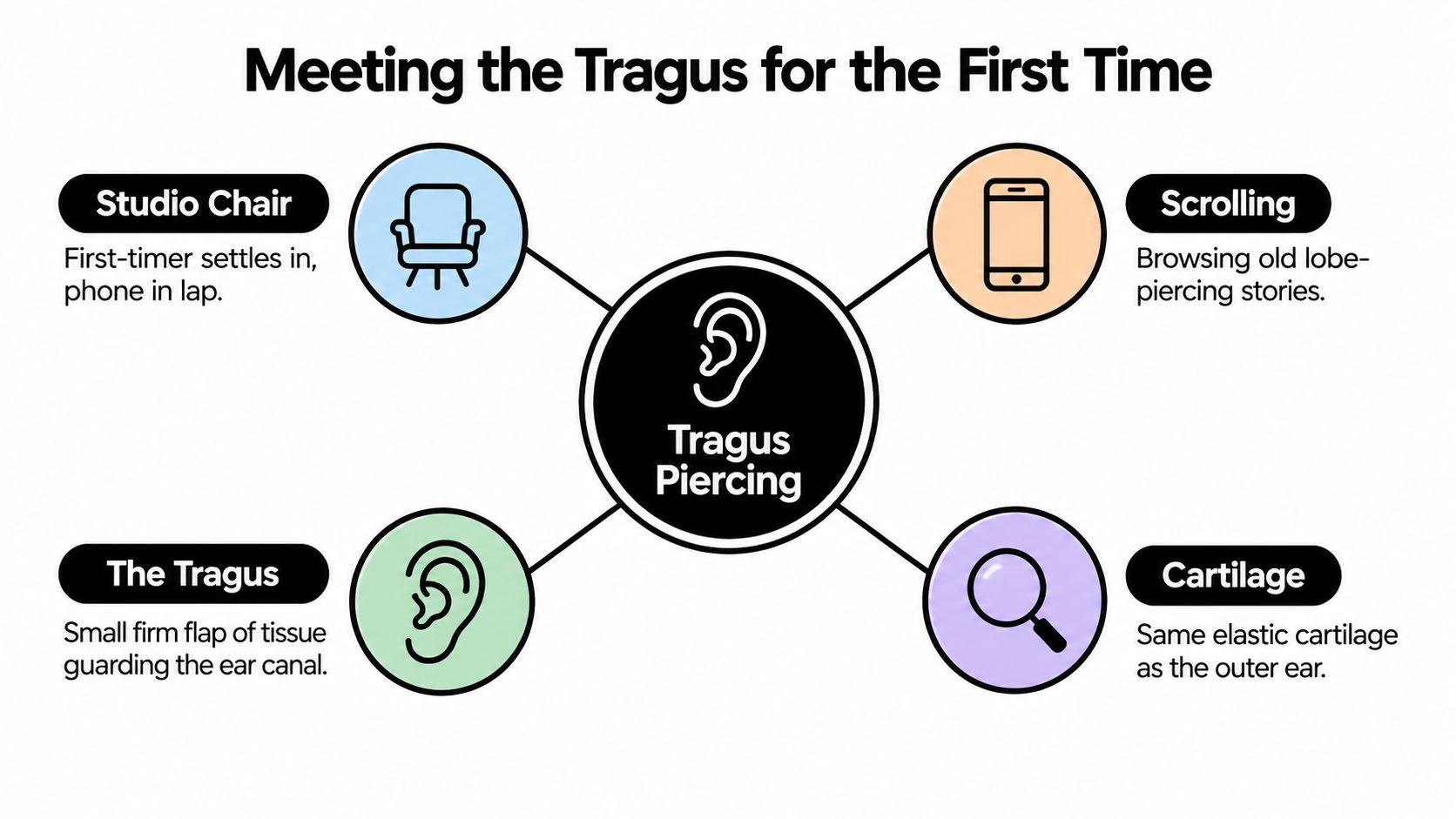
In short, a tragus piercing is a piercing through the small cartilage flap that sits just in front of the ear canal.
The Anatomy Behind the Piercing
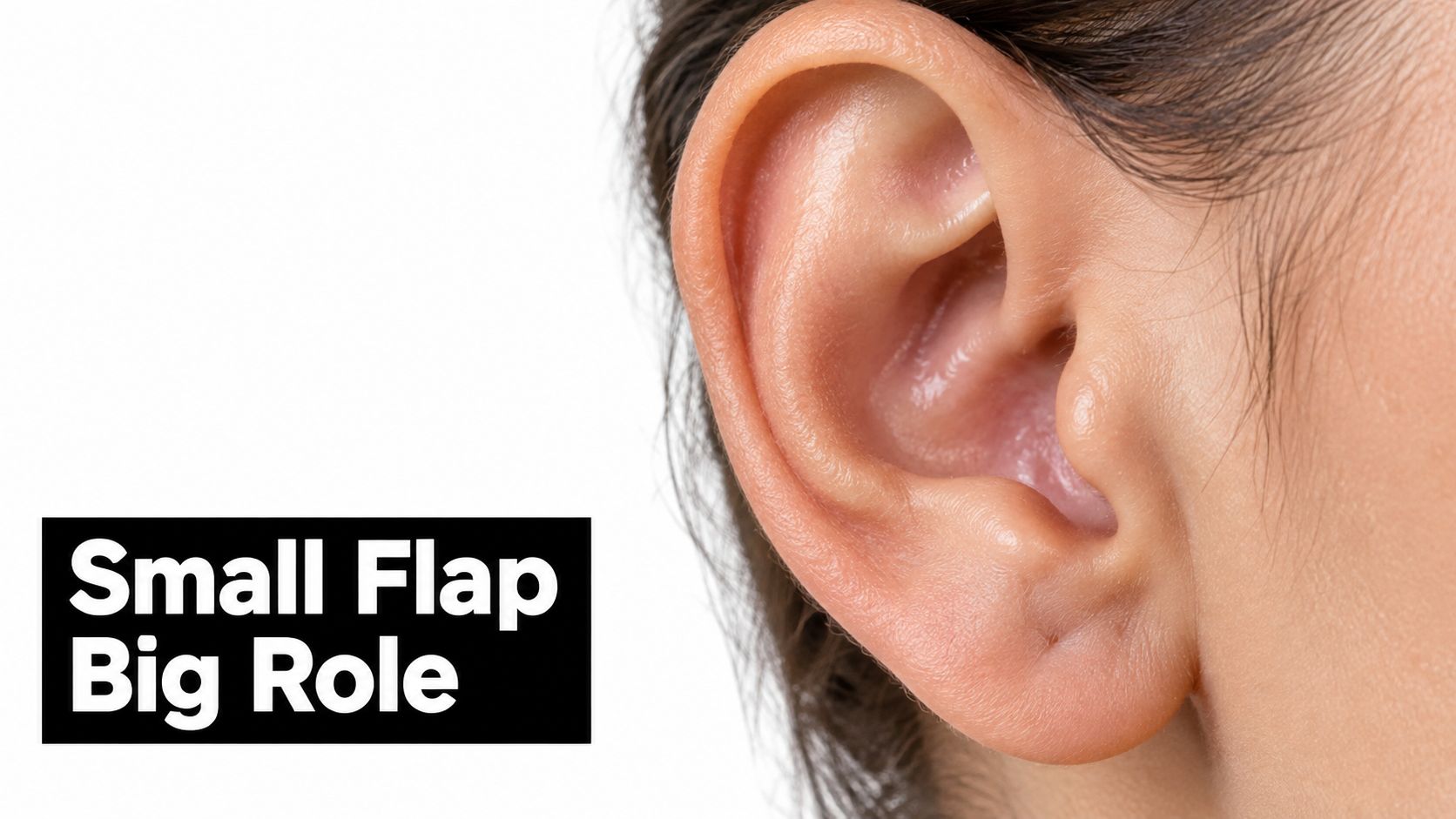
The tragus is the rounded piece of cartilage that partly covers the opening of the ear canal. Run a clean finger gently along the front of your ear and you'll feel it move slightly over the canal. It's made from the same type of elastic cartilage found in much of the outer ear, but it doesn't have the soft, fatty structure of the earlobe.
That difference changes the healing experience. Cartilage has a more limited blood supply than the lobe, so the body has less direct circulation delivering nutrients and immune support to the area. UK clinical guidance warns that cartilage piercings can lead to infection and deformity, with severe infections carrying wider health risks. Public-health guidance on piercing risks also identifies problems such as swelling, embedded jewellery, migration, allergic reactions, scarring, and blood-borne infections.
What the needle passes through
A professional needle travels through the skin, a thin layer of tissue beneath it, and the dense cartilage of the tragus. Jewellery then sits inside that narrow channel, known as a fistula, with the front decorative end visible and the back fitting resting behind the flap.
That snug arrangement explains why a tragus can react to seemingly minor pressure. A lobe may tolerate a brief knock without much consequence, but cartilage beside the ear canal can become irritated by repeated contact from an earbud, a telephone, a pillow, or a helmet strap.
Why a consultation protects the result
A very small tragus may not have enough usable tissue for the jewellery style you first imagined. A flat or asymmetrical tragus may need a different entry point on each ear. The piercer also needs to consider the angle of the canal, the shape of the surrounding folds, and whether your preferred headphones will repeatedly press on the site.
This anatomy is why a tragus behaves differently from a lobe. It heals more slowly, dislikes pressure, and needs more careful jewellery selection. Treating it like a simple accessory can turn manageable irritation into persistent inflammation.
Choosing Jewellery That Heals With You
For most fresh tragus piercings, a flat-back labret stud offers a stable starting point. A piercer may select a 1.2 mm or 1.6 mm gauge and an 8 to 10 mm post, depending on your anatomy and expected swelling. A small bezel-set stone or simple flat top usually creates fewer snagging points than a large, raised design.
A ring or curved barbell may look appealing, but it generally moves more through a fresh cartilage channel. Many piercers reserve those shapes for a later change or downsize, after the tissue has become more stable. Threadless and internally threaded systems can also reduce trauma during jewellery changes because the inserted post doesn't need to be repeatedly forced through the healing channel.
Read the material, not just the label
“Hypoallergenic” and “sensitive” are marketing descriptions, not complete material specifications. Ask what the entire inserted assembly is made from, including the post and the fitting behind the ear. A decorative end can look like titanium while the part inside the piercing is made from something else or covered by a coating that may wear.
Suitable choices commonly include ASTM F136 implant-grade titanium, niobium, or solid 14k or higher nickel-free gold. UK product-safety guidance sets a nickel-release limit of 0.2 micrograms per square centimetre per week for post assemblies intended for piercings, while jewellery in prolonged skin contact has a 0.5-microgram limit. Check the UK jewellery safety guidance on nickel release when you want to understand what those limits mean.
| Metal or Material | Healing Suitability | UK REACH Nickel-Compliant | Typical Starter Use |
|---|---|---|---|
| ASTM F136 implant-grade titanium | Strong option when the specification is documented | Confirm product documentation | Flat-back labret |
| Niobium | Suitable when supplied by a reputable body-jewellery maker | Confirm product documentation | Flat-back labret or simple end |
| Solid 14k+ nickel-free gold | Suitable when solid and nickel-free | Confirm product documentation | Small decorative top |
| Mystery steel | Avoid for a fresh piercing because the alloy may be unclear | Not reliably verifiable | Not recommended |
| Plated jewellery | Avoid because the surface can wear | Not reliably verifiable | Not recommended |
| Acrylic or cheap costume alloy | Avoid during healing | Not reliably verifiable | Not recommended |
A piercer should check the post after swelling settles and discuss a professional downsize, often around 4 to 8 weeks. Don't change it yourself just because the outside looks calmer. A titanium piercing jewellery guide can help you compare options before your appointment, but your piercer still needs to select the size for your ear.
Healing Timeline From Day One to One Year
A standard lobe piercing may heal in approximately two to four months, while UK-facing health information says a tragus can take up to 12 months. This comparison of tragus piercing healing time reflects the central difference: cartilage has limited circulation, so the visible surface can appear settled before the deeper channel has finished rebuilding.
The most useful expectation is a gradual six-to-twelve-month cartilage curve, not a promise that the piercing will be ready for frequent jewellery changes after a few weeks.
What each stage can feel like
Month 1: Tenderness, local swelling, and mild sensitivity are common. Leave the starter jewellery in place, keep handling to a minimum, and avoid testing the piercing by turning or pushing the post.
Months 2 to 3: The outside may look much better, but the tissue inside can still be fragile. A snag, dirty earbud, or night spent sleeping on the piercing may cause a flare-up even when there had been no recent discomfort.
Months 4 to 6: This is a sensible period to ask the piercer to assess the fit. If swelling has settled, a longer initial post may be replaced with a closer-fitting one. A professional, rather than an at-home jewellery change, helps protect the channel from unnecessary trauma.
Months 7 to 12: The tragus may still become sore after a knock or a new earring. Full stabilisation can take the longer end of the expected range, particularly if pressure and friction have repeatedly interrupted healing.
A quiet-looking piercing isn't automatically a fully healed piercing. The deeper channel can remain vulnerable after tenderness has faded.
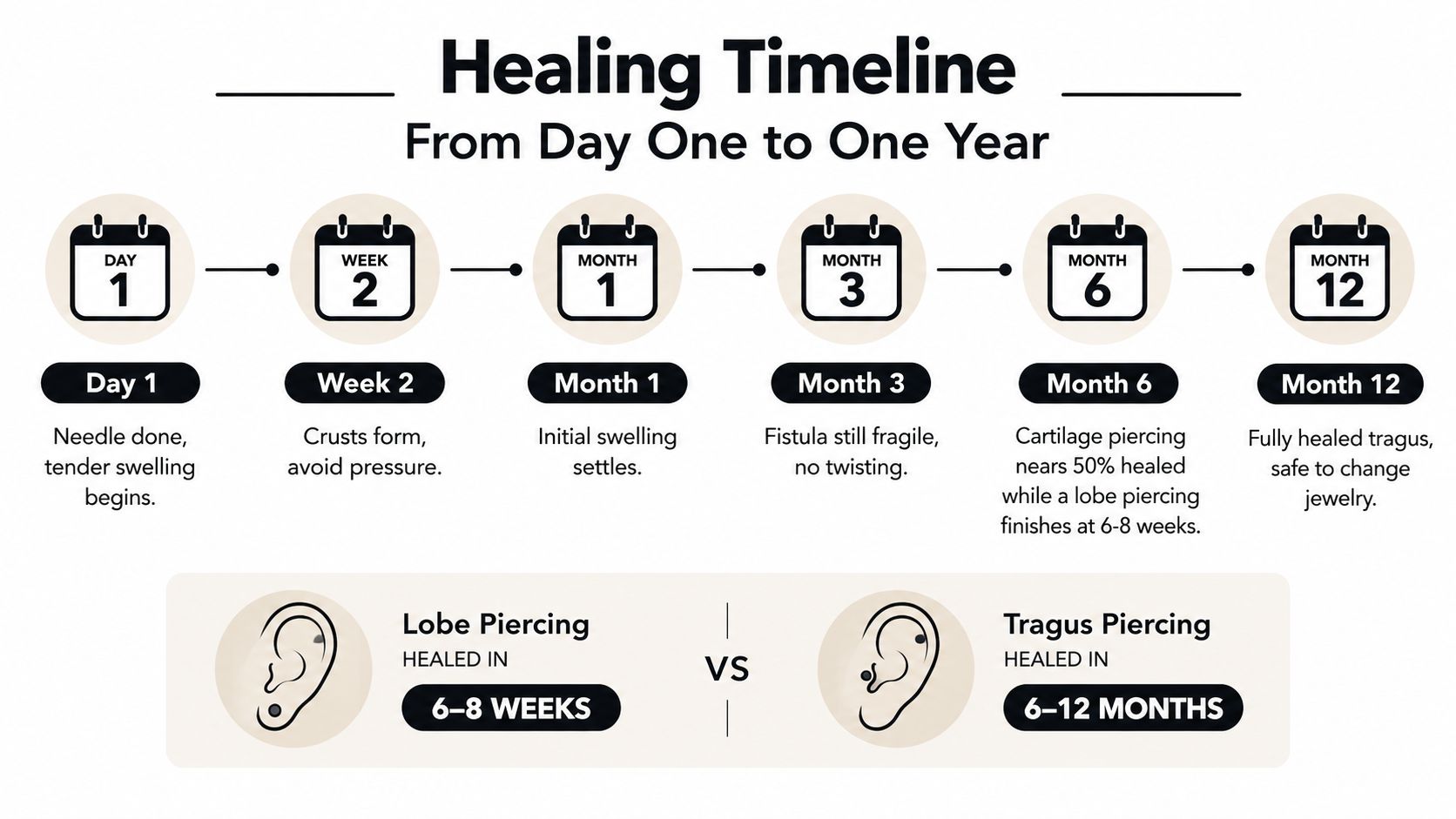
Don't use the calendar as the only test. A professional piercer can assess whether the channel, skin, and jewellery are ready for a change. More practical detail is available in this guide to tragus piercing healing time.
Living With a Healing Tragus Every Day
A new tragus is a working piercing. It sits in the path of objects you use repeatedly, so small changes to your routine often matter more than an elaborate cleaning schedule.
Earbuds: In-ear buds sit directly beside the canal and may press on the front or back of the jewellery. Use the opposite ear, switch temporarily to speakerphone, or choose a listening method that leaves the tragus untouched.
Over-ear headphones: A tight ear cup can compress the cartilage and trap warmth. If you need headphones, choose a softer, roomier design that doesn't touch the piercing, take regular breaks, and stop using them if the jewellery is being pushed sideways.
Mobile phones: Holding a phone against the healing ear transfers pressure and surface bacteria to the area. Alternate ears, use speakerphone, or use a clean hands-free option that doesn't pass across the jewellery.
Sleep and clothing need planning
Side-sleeping places direct pressure on the tragus for much longer than a brief phone call. Sleep on the opposite side, or use a travel pillow arranged so the ear sits in the central opening rather than against the fabric. Change pillowcases regularly and avoid allowing loose hair or fibres to catch the top.
Beanies, hood toggles, helmet straps, and high collars can all snag the jewellery as you dress. Put clothing on slowly, keep drawstrings away from the ear, and check that a helmet or hat doesn't press on the piercing.
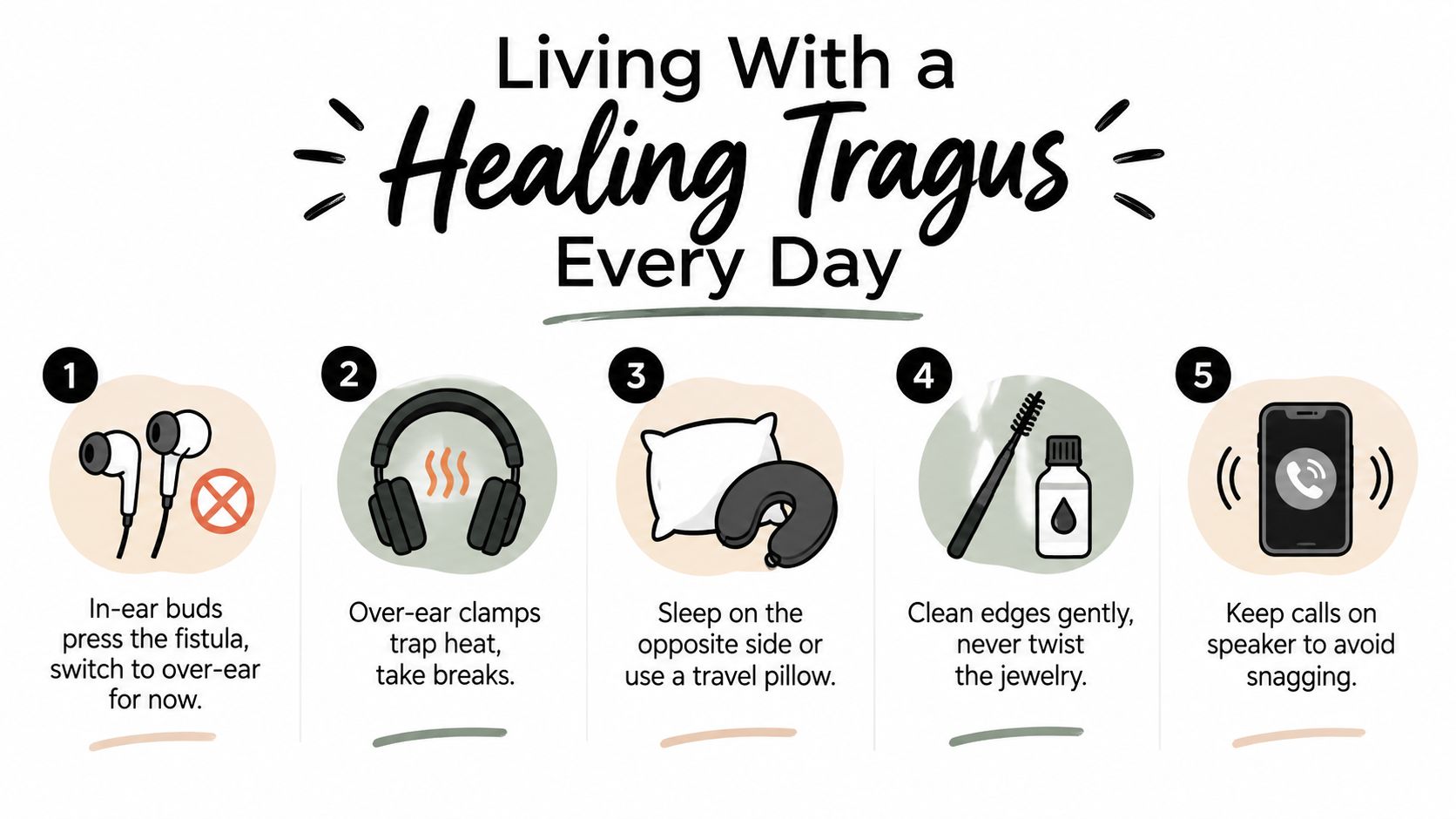
UK local-authority guidance describes body piercing as a procedure that breaks the skin, which is why hygiene and friction control matter together. Advice on ear and face piercing supports the practical basics: wash your hands before contact, don't twist the jewellery, and avoid repeatedly disturbing the channel.
If an object touches the piercing every day, treat that object as part of your aftercare plan. Clean contact surfaces where appropriate, change the habit if it causes pressure, and don't wait for a bump before making the adjustment.
Reading the Signs When Something Is Wrong
A healing tragus doesn't need to look perfectly calm every day. During the early weeks, mild tenderness, localised warmth, slight redness, and a small amount of clear lymph fluid or light crusting can occur as the channel settles.
The important question is whether the overall pattern is easing or worsening. A brief flare after a snag may settle when the pressure stops. Increasing heat, swelling, pain, or redness deserves more attention, particularly because cartilage infections can damage the structure of the ear.
A practical comparison
| Symptom | Usually Normal | See Your GP or Piercer |
|---|---|---|
| Tenderness | Mild and gradually easing | Pain that intensifies or throbs |
| Redness | Localised near the channel | Spreading redness or hot skin |
| Discharge | Clear lymph fluid that dries as crust | Thick, offensive, yellow-green discharge |
| Jewellery | Sitting comfortably with room for swelling | Back or front becoming embedded |
| Bump | Small irritation bump after pressure or snagging | Persistent, expanding, or unexplained swelling |
| General health | You feel otherwise well | Fever, feeling unwell, or rapidly worsening symptoms |
A small bump is not automatically a keloid or an infection. Irritation bumps often remain close to the channel and may follow pressure, jewellery movement, an unsuitable fit, or over-cleaning. A raised scar that extends beyond the original wound needs professional medical assessment, especially if you're prone to keloid formation.
Don't respond by adding harsh products or repeatedly soaking the area. Alcohol, hydrogen peroxide, tea tree oil, abrasive scrubs, and unapproved ointments can create more irritation. A piercer can assess the angle, jewellery fit, and likely mechanical trigger, but a GP or NHS service should assess suspected infection.
The NHS guidance on infected piercings advises seeking medical help when symptoms suggest infection. In the UK, contact NHS 111 or your GP promptly if the tragus becomes increasingly hot, swollen, painful, markedly red, or produces concerning discharge. Leave the jewellery in unless a doctor tells you to remove it, because premature removal can allow the channel to close and may interfere with drainage and assessment.
Booking Your Tragus in Croydon or Bournemouth
A good booking process starts before you sit in the chair. Timebomb Tattoo & Piercing has studios in Croydon on Surrey Street and Bournemouth on Old Christchurch Road, where you can ask about anatomy, jewellery, preparation, and aftercare before committing to the piercing.
For booking and pre-piercing questions, use the studio phone number 01202 900050 (Bournemouth) / 020 8686 7730 (Croydon) or WhatsApp 07752 913846 (Bournemouth) / 07902 490584 (Croydon). Keep those details available if you're comparing jewellery choices or need to check whether a particular diary slot suits your schedule.
What happens during a consultation
A consultation should give the piercer enough time to look at the tragus rather than relying on a photograph. Expect a discussion covering:
- Anatomy: The piercer checks thickness, available tissue, symmetry, the planned angle, and how close the jewellery will sit to the canal.
- Sizing: You can discuss gauge and post length, with measurements selected in millimetres rather than guessed from a product photograph.
- Material: Ask whether the inserted post and fitting are implant-grade titanium, niobium, or another documented option suitable for fresh piercings.
- Sensitivity: If you've reacted to costume jewellery or believe you may have a nickel allergy, mention it before marking. A patch test may be considered where appropriate, although it doesn't replace proper jewellery documentation or medical advice.
- Aftercare: Ask for written guidance covering cleaning, pressure, headphones, jewellery changes, and what to do if symptoms worsen.
Prepare before you arrive
Bring photo ID and tell the piercer about any medication that thins the blood or any health condition that may affect healing. Have a clear idea of your preferred initial jewellery, but stay open to a smaller or flatter top if your anatomy needs it.
Walk-ins may be accepted when diary slots allow. Advance booking gives the studio time to match you with the right piercer and can help you avoid busy weekend queues.
Before the needle is opened, ask these three questions:
- Can you confirm that the entire inserted assembly is implant-grade titanium?
- Will you give me a written aftercare sheet?
- Can we schedule or discuss a professional downsizing check at around six weeks?
A Welsh investigation involving a premises with poor hygiene recorded infection among 36.3% of people who answered the infection question, and seven of nine severe infections followed ear-cartilage piercings. That investigation doesn't represent the normal risk of every tragus piercing, but it demonstrates why sterile technique and competent aftercare guidance matter. The published investigation into unsafe piercing practice is a useful reminder to treat cartilage piercing as a health decision as well as a style choice.
A tragus piercing needs careful placement, suitable jewellery, and a plan for phones, earbuds and sleep. Piercing Near Me connects clients with consultation and booking options for the Croydon and Bournemouth studios, so you can ask your questions and arrange a professional appointment.