
10% of adults in a large English sample had ever had a non-earlobe body piercing, and 33% of all piercings were at the navel. A navel piercing is a surface-adjacent piercing through the upper rim of the navel, usually fitted with a 14-gauge, 1.6 mm curved barbell, and whether it heals well depends on your anatomy from the start.
If you're standing in front of the mirror and wondering whether your belly button can take this piercing, that's the right question to ask first. A navel piercing looks simple from the outside, but the way the skin folds, moves, and rubs against clothing decides almost everything about the result.
What a Navel Piercing Is
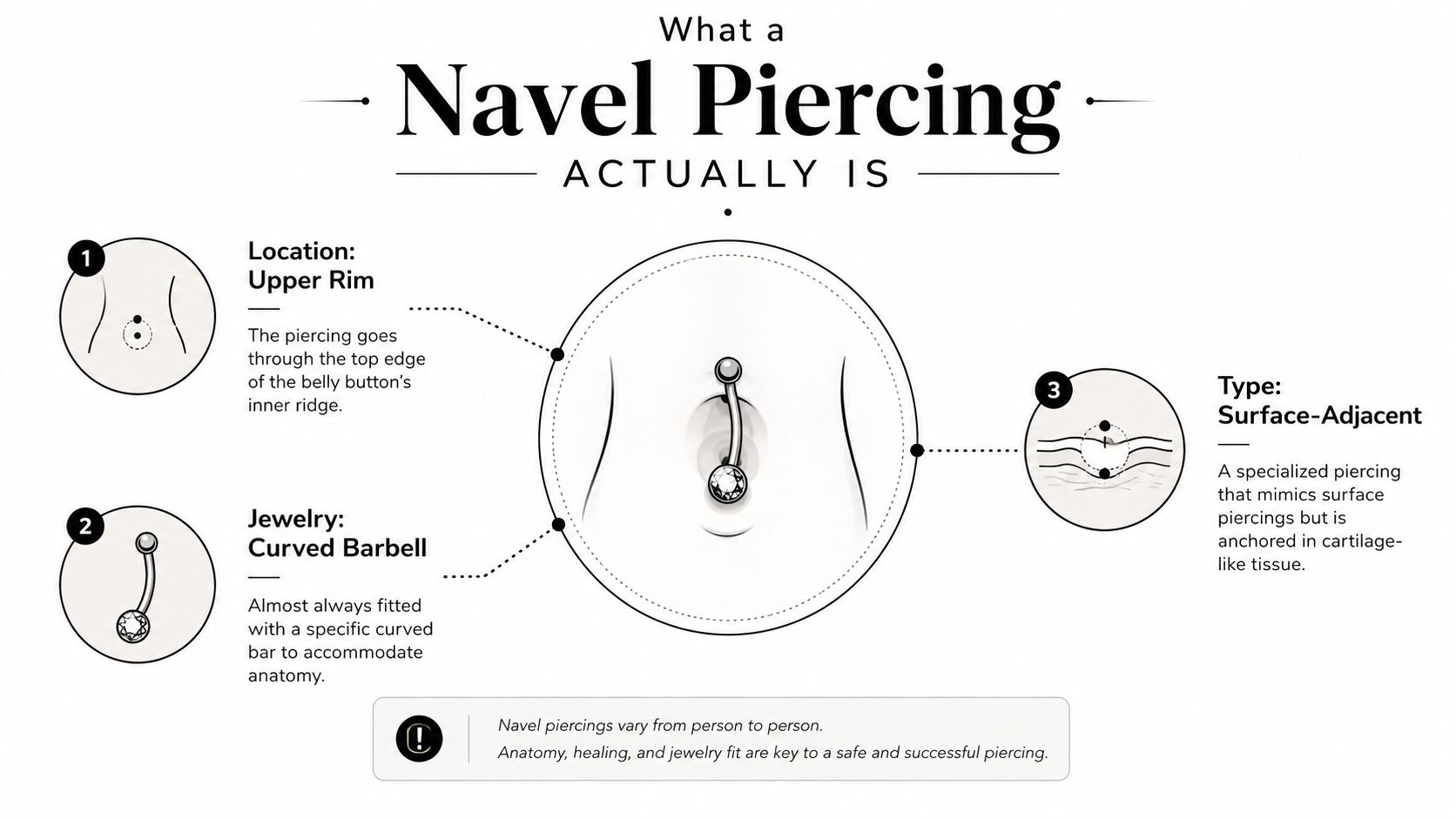
A navel piercing is a body piercing placed through the skin at the top edge of the belly button, not through the belly button cavity itself. In most cases, the starter jewellery is a curved barbell in 14-gauge, 1.6 mm size, because that shape follows the natural curve of the area and gives the tissue a better chance to settle comfortably.
That detail matters because the navel is not treated like a casual accessory piercing. In a large UK survey published in Clinical Epidemiology, 33% of all reported piercings were at the navel, making it the single most common site in that English sample, and about 80% of all piercings were done in specialist tattoo and piercing shops (Clinical Epidemiology survey). So when someone asks what is navel piercing, the answer is more specific than “a bit of jewellery in your stomach area”. It is a professional body-modification placement that is chosen, assessed, and fitted by a trained piercer.
Why the piercing became so familiar in Britain
The style did not stay niche for long. Historical accounts note a mainstream UK breakthrough in the early 1990s, when Christy Turlington and Naomi Campbell wore pierced navels at a London fashion show in 1993, which pushed the look into public view. That same year, the “Cryin’” video from Aerosmith helped amplify demand internationally, and that is part of why the navel piercing still feels both familiar and fashion-led.
A UK reader often sees it as a standard choice now, but that visibility has a specific history behind it. By the time the English survey was published years later, the navel had already become the most common reported piercing site in that sample, so the style's popularity is not just a trend cycle, it is part of modern body-modification culture in Britain (historical summary).
Anatomy of a Navel Piercing and How It Sits on the Body
The needle doesn't go through the belly button hole itself. It passes through the skin at the upper rim of the navel, where there's enough tissue to hold the jewellery steady without the ends pressing hard into the hollow. That's why the top edge, not the centre of the belly button, is the critical part of the anatomy.
The curved barbell is matched to that shape. A straight bar tends to sit awkwardly in this area, while a curved one follows the body's contour and gives the jewellery a better line of movement when you bend, sit, or twist. The goal is simple, keep pressure off the piercing channel and reduce unnecessary dragging from clothing.
What the upper skin shelf actually does
If you can gently pinch a defined fold above the navel, that fold is doing a lot of the work. It gives the jewellery a place to anchor, helps the lower end sit away from the belly button well, and lowers the chance of constant rubbing from waistbands.
That's also why placement isn't identical for everyone. Some navels have a strong upper lip, some are shallow, and some flatten out when you sit down. A good piercer looks at the way the tissue moves in real life, not just how it looks when you're standing still.
The best-looking navel piercing is the one your body can actually support without fighting the jewellery every day.
There's also a difference between a standard top navel placement and a lower one. A lower piercing sits beneath the belly button and behaves differently enough that many clients and piercers treat it as a separate decision, not just a mirrored version of the top placement.
For a simple age and studio-readiness check before you book, this guide is useful: navel piercing age guidance in the UK.
Suitable Anatomy and Candidacy for First-Time Clients
The first check is shape, not style. A piercer looks at how your navel is built, how the skin moves, and how much room the jewellery would have once you sit, twist, or pull on clothing. In practice, that often means looking at four broad profiles, a defined outie, a deep innie, a shallow navel, and a tight or folded navel. Each one changes the amount of support the piercing has, where rubbing is most likely, and whether the channel can settle without constant stress.
A defined outie with a clear upper fold can sometimes work if the tissue gives the jewellery enough support and the area does not keep catching on waistbands. A deep innie may also suit this piercing, although the jewellery sometimes needs to sit a little differently so it does not press into the fold or hold moisture against the skin. A shallow navel usually calls for a more cautious conversation, because there may not be enough of a shelf for the piercing to rest in a stable way.
A tight or folded navel can be the hardest to judge at first glance. The shape may look fine while standing still, then collapse or pinch when you sit, which changes the angle the jewellery has to work with. That is why a first consultation should focus on movement, not only appearance. If you want to check studio readiness as well as age rules before booking, this UK navel piercing age guide is a useful place to start.
How a piercer makes the call
A reputable piercer usually thinks in terms of support, movement, and friction. If the navel closes hard when you sit, folds over a lot, or presses against itself under clothing, the piercing may be more likely to migrate or stay irritated. If the tissue holds its shape and the upper rim remains defined, the chances are better.
Medical guidance also notes that the navel is one of the more reaction-prone body piercing sites because of its shape, moisture, and friction from clothing (HealthyChildren). That is why this decision is not only about whether the piercing looks good in a photo. It is about whether your anatomy can keep the channel calm enough to heal.
If a piercer pauses and says your navel needs a closer look, that is a sign of care, not hesitation.
Some clients will be told they suit a standard curved barbell, some may need a different bar length or a more specialised option, and some may be advised to leave this placement alone. That honesty protects both your skin and your expectations.
The Standard Piercing Procedure From Consultation to Finish
A proper navel appointment starts with a conversation, not a needle. The piercer checks your anatomy, asks about medical history, and makes sure the piercing is a sensible choice for your body and lifestyle. At Timebomb Tattoo & Piercing, that usually includes talking through pregnancy, keloid history, and any recent tattoos or changes in the area before anything is marked.
Then comes placement. You'll usually be asked to stand, sit, and move a little while the piercer uses a surgical pen to mark the entry and exit points, because a mark that looks perfect in one position can shift once you bend or relax. That small check matters more than people expect, since the navel moves all day.
What happens once the placement is agreed
After that, the studio process should feel calm and controlled. Hands are cleaned, tools are set up single-use, and the jewellery is prepared sterile and ready to go. The actual piercing itself is quick, then the barbell is fitted straight away so the tissue doesn't have to be re-opened later.
A good first-time client also gets told what to wear. A loose cotton top makes sense, and anything that presses hard on the waist, like a tight belt or stubborn waistband, is asking for irritation later.
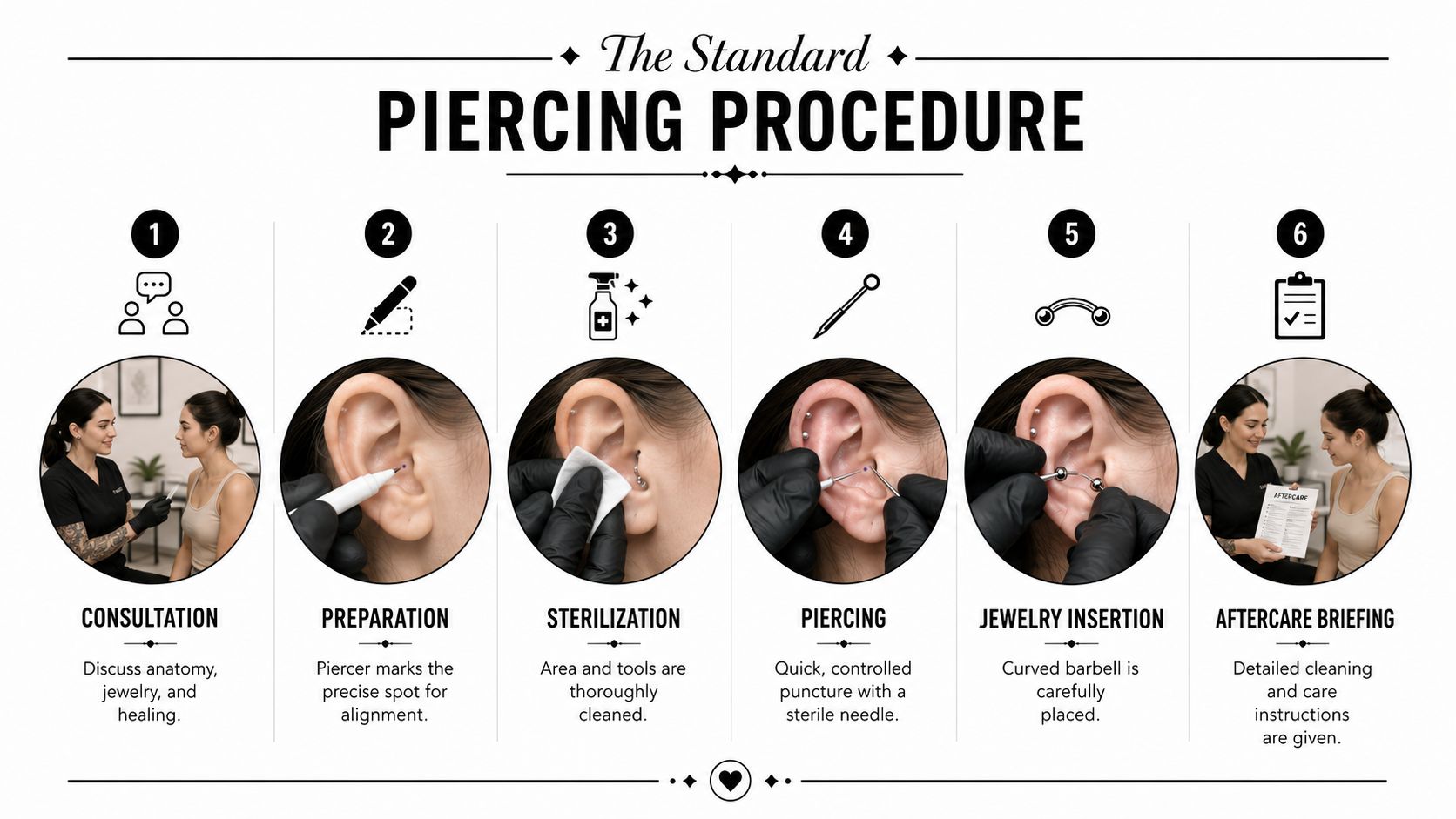
By the time you leave, you should know exactly how the jewellery sits, what it's made from, and how to clean it without overdoing anything. If those points weren't explained clearly, the appointment wasn't finished properly.
Jewellery Options and Materials That Heal Safely
For a fresh navel piercing, the safest starting point is usually a curved barbell. It gives the tissue room to settle, keeps the ends sitting neatly, and avoids the pressure a straight or circular shape can create while the piercing is still new. Some people call it a banana bar, but the curve is what matters, not the nickname.
The gauge is almost always 14 gauge, 1.6 mm, and the first bar is usually chosen with swelling in mind so the tissue has space to breathe. Once the piercing settles, that bar can often be shortened if needed. The first fit is a healing fit, not the final fit.
Materials that make sense for healing
For a fresh piercing, implant-grade titanium is a strong choice. Solid 14k or 18k gold with nickel-safe alloy content can also work well when it is made properly for body jewellery. Both are chosen because they are more likely to stay calm in a healing wound than cheaper finishes that can irritate the skin.
Plated fashion jewellery is a poor choice for a healing navel, and acrylic pieces belong in the same category. Surgical steel can be fine in some cases, but if the alloy content is unclear, I would not want it on a fresh piercing.
| Style | Best For | Typical Material | Notes |
|---|---|---|---|
| Curved barbell | Fresh healing | Titanium, 14k or 18k gold | Standard choice for a new navel piercing |
| Banana bar | Fresh or healed, depending on design | Titanium or gold | A curved option with different decorative ends |
| Circular barbell or ring | Healed piercings | Gold or titanium | Usually better once healing is complete |
A fresh navel piercing should be chosen for healing first, style second. The jewellery can look better later, but it has to heal well now.
A first appointment should also cover what sits comfortably against the waist. Loose cotton tops make life easier, and loose jeans or trousers with soft waistbands are usually kinder than tight leggings, belts, or anything that presses hard across the navel. If the jewellery is going to live in a moving part of the body, the clothing around it should not keep rubbing it.
For general cost planning before you book, this navel piercing cost information may help.
Healing Timeline and Day-to-Day Aftercare
A navel piercing often takes 6 to 12 months to heal, and the tissue inside can keep changing for even longer. The outside can look settled while the channel underneath is still building strength, which is why a piercing that seems fine too early can still be easy to irritate.
That slow pace is normal for this area. If you want a clear guide to how healing tends to unfold, see this navel piercing healing time guide. For long-term perspective, one peer-reviewed study of people with navel piercings found that 59.8% had kept theirs for 5 years or more, and the longest reported duration was 24 years (study on duration). A navel piercing can be a long-term body modification, not just a piece of jewellery you wear for a season.
What to do in the routine
Keep the aftercare plain and steady. Sterile saline rinses once or twice a day are usually enough, and the jewellery should be left still rather than twisted, turned, or tested to see whether it moves. Clean hands matter, loose clothing matters, and sleep position matters more than many first-time clients expect.
Avoid swimming pools, hot tubs, and the sea until the piercing is fully healed. In the early months, anything that traps moisture or rubs hard against the site can slow healing, including tight leggings, high-waisted waistbands, and pressure from a seatbelt on long drives.
A little bump is one thing. Repeated squeezing or soaking can leave the area sore the next day, and that irritation adds up if it keeps happening.
The routine works best when it stays boring. Keep the area dry, clean, and unbothered, and you give the piercing a much better chance to settle without constant setbacks.
Common Risks Complications and When to Seek Help
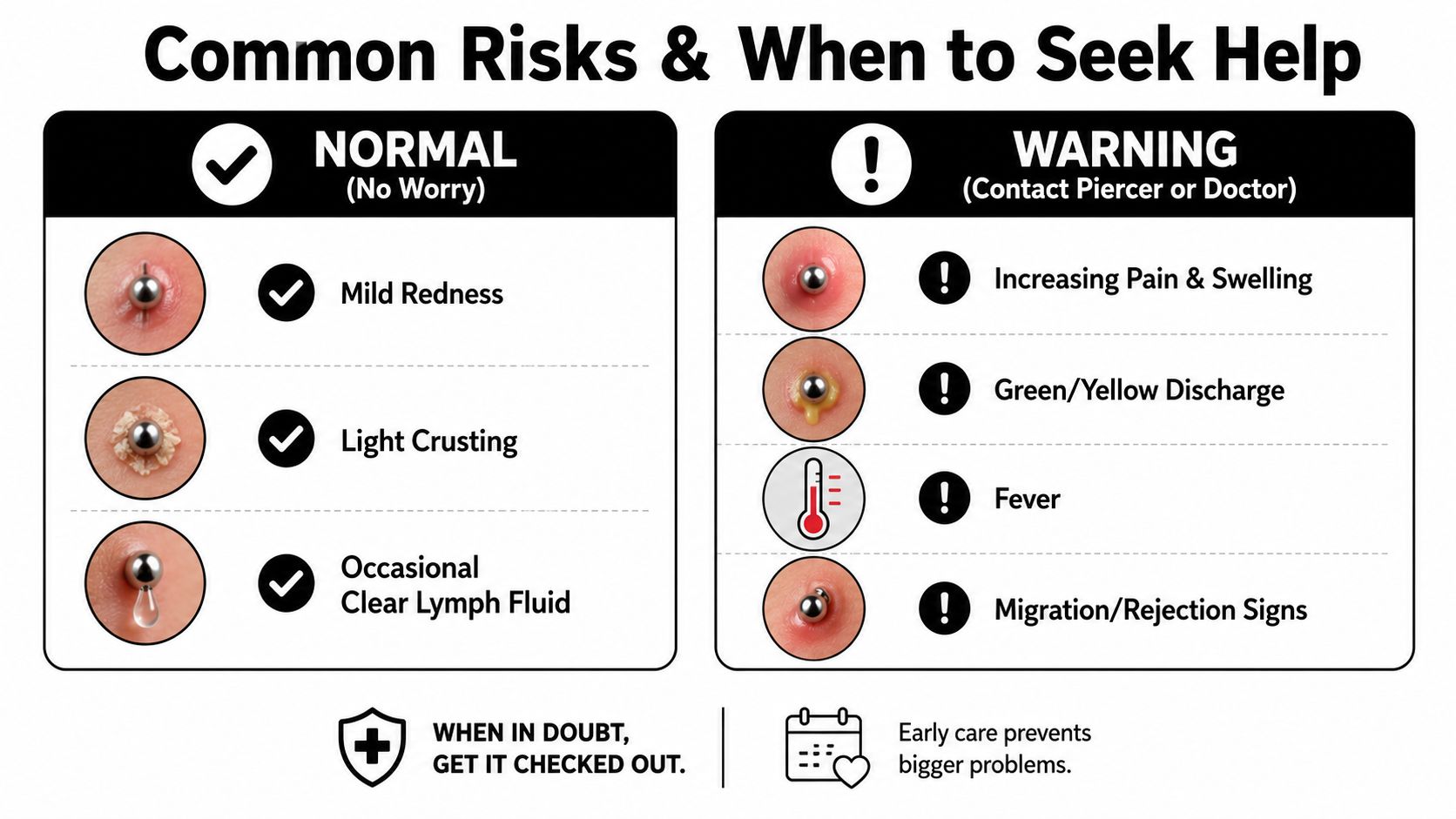
A new navel piercing will usually be a little red, a little tender, and prone to light crusting as it settles. Occasional clear lymph fluid is part of normal healing, and mild itchiness can happen as the tissue matures. Those signs are annoying, but they're not automatically a problem.
The warning signs are different. Hot redness spreading outward, thick yellow or green discharge, persistent swelling that doesn't settle, or a barbell that starts to look like it's moving towards the surface all need attention. If the top of the bar starts becoming visible through thinning skin, that can point to migration or rejection.
Why the navel needs extra attention
The navel is especially prone to trouble because of its shape and the way clothing sits on it. Moisture gets trapped easily, waistbands press on it, and movement from bending or exercise can keep the channel irritated. Tight clothes and sweat-heavy training make that worse.
If anything changes within the first six months and it doesn't feel right to you, book a check with your piercer. If you get spreading redness, fever, or foul discharge, speak to a GP promptly. That's the line between normal aftercare and a problem that needs medical help.
Booking Your Navel Piercing Safely at Timebomb
If you want a navel piercing in Croydon or Bournemouth, book somewhere that treats anatomy as the deciding factor, not an afterthought. Timebomb Tattoo & Piercing works with single-use sterile needles, implant-grade jewellery, experienced piercers, and personalised aftercare so the appointment feels measured rather than rushed.
That matters most for first-time clients, because the best outcome starts before the needle goes in. A proper consultation, a clear look at your navel shape, and an honest jewellery choice can save you months of irritation later.
For practical planning, call 01202 900050 (Bournemouth) / 020 8686 7730 (Croydon) or message 07752 913846 (Bournemouth) / 07902 490584 (Croydon) on WhatsApp, and read more about navel piercing cost guidance before you visit. Whether you book in Croydon or Bournemouth, you should expect placement, jewellery selection, preparation, piercing, and aftercare to be explained clearly from the start.
If you're ready to make a confident booking, start with Piercing Near Me. It's a simple way to find safe, professional body piercing support, compare your options, and move forward with a navel piercing that suits your anatomy instead of fighting it.
Trackbacks/Pingbacks