
You've just left the studio, you're in the car or on the train, and the first thing you're doing is checking the mirror and wondering if you should twist the jewellery, rinse it, or leave it alone. That's the normal first reaction, especially with a cartilage piercing, because it feels more delicate than a lobe piercing and the aftercare advice online is often messy or contradictory.
The sensible starting point is simple. Cartilage piercing aftercare is a long game, not a quick tidy-up, and the healing window is usually measured in months rather than days. UK clinical evidence shows cartilage piercings have more complications than lobule piercings, with 40.2% versus 25.4% complications and 30.3% versus 23.8% infections in a recent study, while body piercing infections overall are often localised and cartilage is especially vulnerable because of its poor blood supply and slower healing study summary. If you want a follow-up check at the Croydon or Bournemouth studio, the direct contact details are 01202 9000 50 and 07752913846 on WhatsApp.
Why Cartilage Piercing Aftercare Is Different
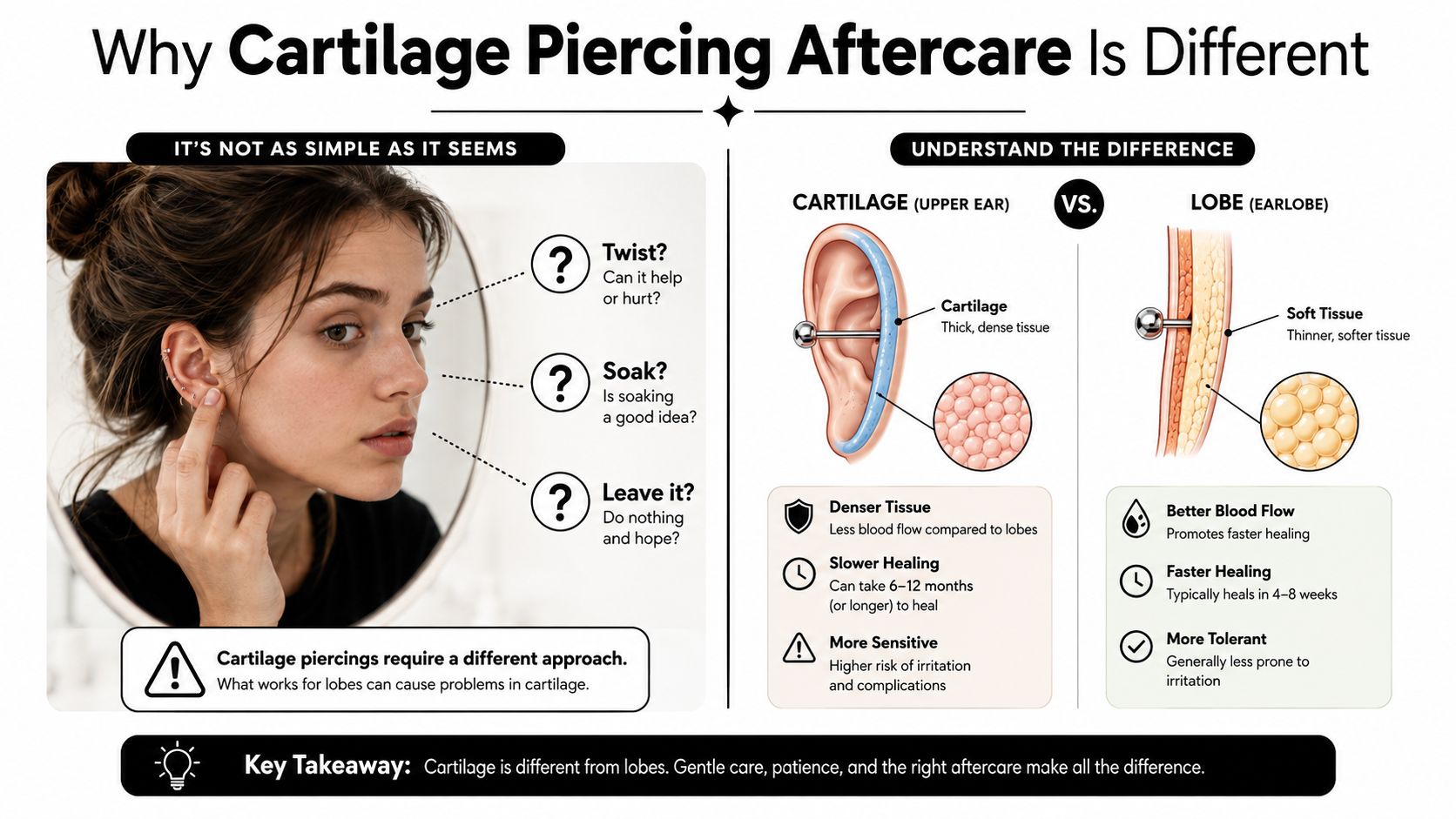
If you've just had a cartilage piercing done, it can look fine on the surface and still react for weeks. That catches people out. Cartilage is denser than a lobe, gets less blood flow, and is far less forgiving when it's knocked, slept on, twisted, or cleaned with harsh products. A little redness, tenderness, or swelling can hang around longer than you expect, and I'd rather a client treat it as a slow heal than try to force it into behaving like a lobe piercing. A recent clinical study backed that up, with complications seen more often in cartilage than in lobule piercings.
What the numbers say
The point of the study is simple. Cartilage piercings give you less room for error because the tissue heals more slowly and complains more loudly when it is irritated. That does not make them a bad choice. It means the aftercare has to suit the tissue, not the other way round.
A fresh helix or conch often gets treated too aggressively because it seems settled once the initial sting has passed. Clients twist it to check it, over-clean it because they are worried, or switch products too early because they want quick progress. Those habits usually create the exact irritation they are trying to avoid.
The moment clients need to hear the truth
The first days after a cartilage piercing are the wrong time to keep testing whether it is “fine”. Leave it alone unless you are cleaning it properly, keep pressure off it, and accept that calm-looking jewellery can still be healing underneath. A piercing that has stopped throbbing is not necessarily healed, it is just quieter for the moment.
That is why I treat cartilage aftercare as a staged process, not a one-off routine. In studio, I would rather give someone a clear plan for the first 24 hours, the first few weeks, and the longer healing stretch than let them improvise based on how it looks on a given morning. If you are not sure whether what you are seeing is normal, it is better to book a quick aftercare check through the Croydon or Bournemouth studio than to guess and make the area angrier. Keep 01202 9000 50 and 07752913846 handy.
For a clear step-by-step refresher, see how to clean a new piercing.
Practical rule: if a cartilage piercing looks calm but still feels “new”, it probably still is.
The Daily Cleaning Routine That Holds Up in Studio Practice
The routine that holds up in studio practice is boring in the best way. It is hands, saline, dry, repeated without drama. The safest approach is a twice-daily sterile saline routine, which matches authoritative piercing guidance. Wash your hands first, apply sterile saline to the front and back, let it sit briefly, then dry with disposable paper towel or non-woven gauze safe piercing aftercare.
Use the right products
For the solution itself, use sterile saline 0.9% sodium chloride. A fragrance-free antimicrobial soap can be a secondary option in some routines, but it should not replace saline for day-to-day care. Keep the process gentle. You are supporting healing, not scrubbing a worktop.
Do not reach for alcohol, hydrogen peroxide, tea tree oil, cotton buds, or cloth towels. Those products dry the tissue out, irritate it, leave fibres behind, or trap bacteria. Rotating the jewellery is another common mistake, and it is not needed. The piercing channel does not need to be opened up every day, it needs to be left undisturbed.
The routine in practice
Use the same sequence every time.
- Wash your hands properly.
- Spray or apply saline to the front and back.
- Let it sit for a moment, then dry carefully.
That is enough for many people to get through the healing period well. Over-cleaning is just as unhelpful as neglect, because cartilage can get angry if you keep stripping away the skin barrier. If you want a plain-language refresher while you are setting up your routine, this guide to how to clean a new piercing is a useful reference point.
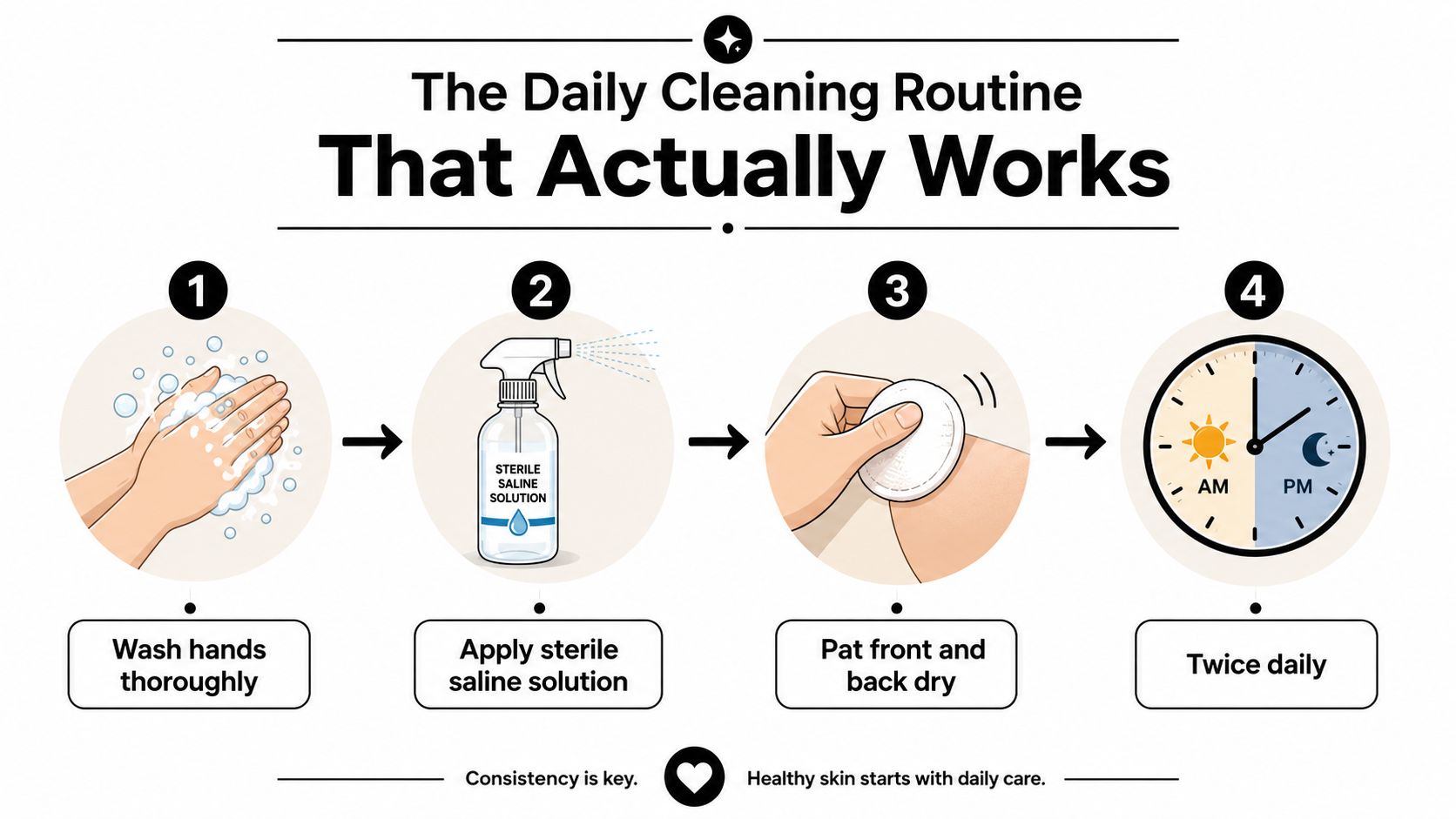
Three-step routine: wash hands, apply sterile saline, dry with disposable paper towel or non-woven gauze.
Your Aftercare Timeline From Day One to Month Twelve
A cartilage piercing doesn't follow a single neat checklist. It moves through different phases, and what matters most changes as the swelling drops and the channel starts to stabilise. WebMD describes cartilage piercings as usually taking 4 to 12 months to fully heal, with cleaning once or twice a day using sterile saline solution or fragrance-free antimicrobial soap, and avoiding open water while healing WebMD cartilage guidance.
First 24 hours
Leave the area alone unless you're doing the first gentle clean. Mild tenderness, a little heat, and some pinkness are normal. If there's a dressing or protective covering from the studio, don't peel at it because you're curious. If the jewellery feels snug, that doesn't automatically mean something's wrong, it often just means the body is reacting to a new channel.
Week 1 to Week 4
This is the stage where people get overconfident. The piercing may look much better after a few days, but it's still raw inside, which is why the routine stays the same. Stick to saline twice daily, avoid swimming, and don't sleep on it. The first month is also when a commute on the London Overground, a crowded gym session, or a careless hoodie zip can easily undo a quiet day of progress.
Month 2 to Month 6
This is the longest stretch for most clients. Keep cleaning until your piercer confirms healing is complete, and don't mistake a good week for a finished piercing. Irritation bumps often show up here, especially after pressure, hair snagging, or a rough weekend away in Dorset with saltwater and sun.
Month 6 to Month 12
By this stage, many cartilage piercings are much calmer, but they can still be sensitive when hit or slept on. If the bar was fitted slightly longer at the start, a downsizing check may be needed once swelling has settled. For healing windows, the broad evidence still supports a patient approach, not an early jewellery swap ear piercing healing times.
Useful marker: if you're still having to think about it every day, it probably isn't ready to be treated like finished jewellery yet.
Cartilage Versus Lobe What Changes About Healing
Someone who had their lobes pierced as a child can easily assume a helix or conch will settle in the same way. It won't. Lobe tissue is softer and better supplied with blood, while cartilage sits over a firmer, less well supplied structure, so it heals more slowly, holds onto swelling longer, and reacts badly to pressure. A bump that fades quickly on a lobe can linger on cartilage for weeks or longer.
What the UK evidence shows
The UK paediatric evidence is a useful reminder that ear-piercing problems are not unusual or new. In one Scottish study of 52 children with ear-piercing complications, 65% had local infection and 79% had embedded earrings paediatric review evidence. The same review notes that the first piercing ages in the studies it cites ranged from 6 months to 10 years, which shows these problems have been part of UK practice across younger age groups for a long time.
For cartilage, the pattern is less forgiving. In a study of females aged 18 to 28, infection after ear cartilage piercing was more frequent than after earlobe piercing, at 41.4% versus 29.6%. That is why I tell clients to treat cartilage with a slower, cleaner aftercare plan, and why I push patience rather than chasing a quick fix.
What that means in day-to-day care
The practical difference is simple. Cartilage asks for light touch, steady saline care, and jewellery that does not press or twist. Leave it alone, keep the area clean, and expect a longer healing window than you would with a lobe. It also means reading the site properly, because a little crust, a bit of fluid, or some on-and-off tenderness is part of the process, while repeated swelling after knocks or sleeping on it is a sign to ease off and reassess.
If a client tells me their lobe healed fine with a gun years ago, I usually remind them that cartilage is a different job entirely. The tissue is tighter where it matters, the healing period is longer, and pressure management counts far more than people expect. As cited above, the evidence points in the same direction, cartilage gives less margin for error, so the aftercare has to be calmer and more consistent.
Daily Life Do's and Don'ts While You Heal
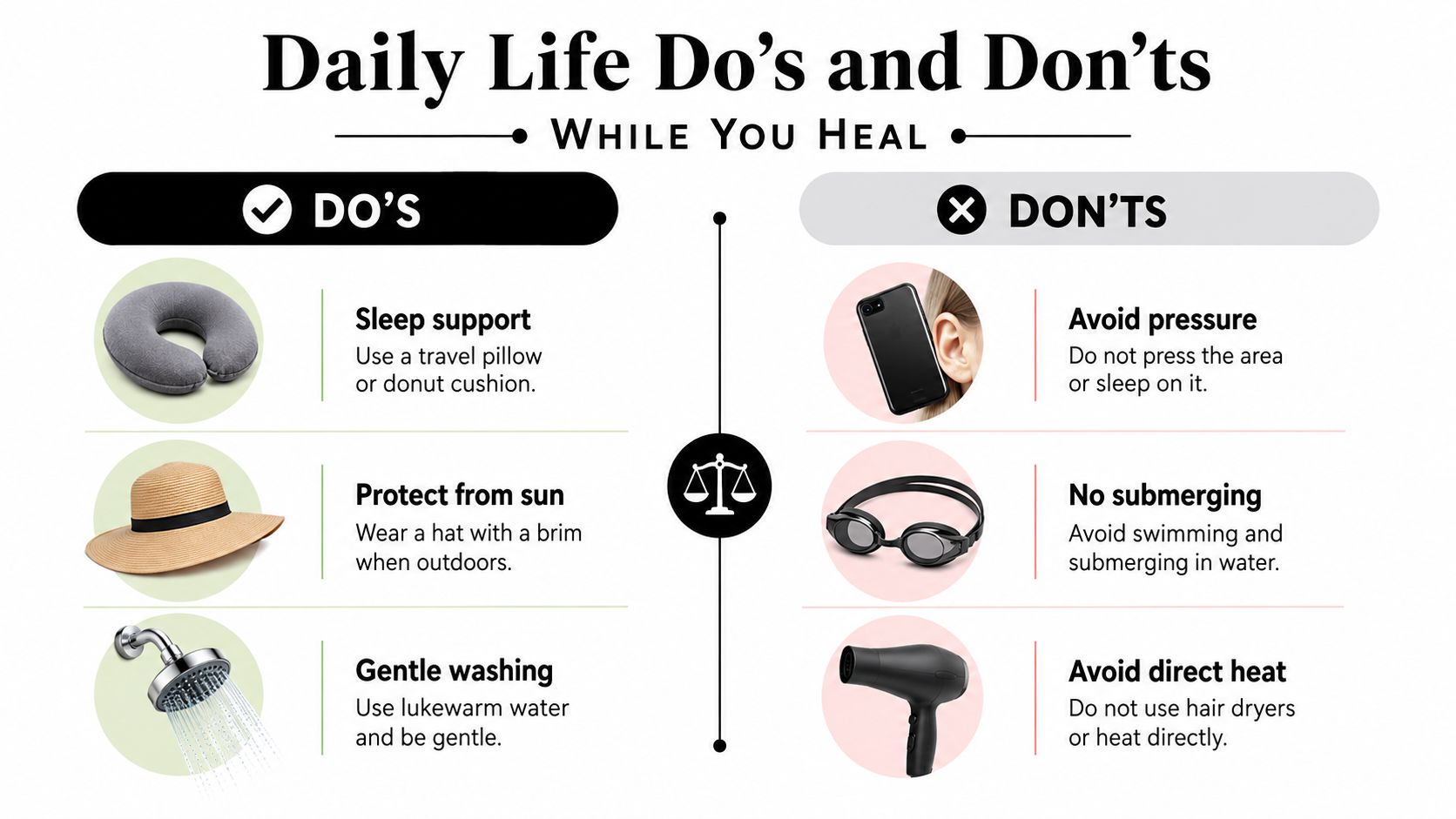
Healing gets messy in ordinary life, not in the sterile little box of an aftercare leaflet. Sleep, work, makeup, commuting, headphones, the gym, and a last-minute plan at the seaside all test a cartilage piercing in ways a sink-side clean never will. The rule is to remove pressure and contamination wherever you can, then keep the routine simple.
Sleep, sound, and pressure
Use a travel pillow or donut cushion so the ear sits in the hole rather than under your body weight. Sleeping on the piercing is a classic reason a calm helix suddenly becomes swollen again. Over-ear headphones are usually kinder than in-ear buds, and if you do wear earbuds, keep them on the unaffected side.
Practical rule: if it presses, rubs, or catches, it's too much for the piercing right now.
Hair, makeup, and skin care
On day one, dry shampoo can be a useful workaround if you don't want wet hair near the area. When you do wash, tilt your head back and keep conditioner away from the piercing so residue doesn't sit on the fistula. Foundation and SPF too close to the piercing for the first month tends to clog and irritate, so keep your skincare routine clear of the site.
Water, heat, and sport
No pools for at least the first month, and no lakes, sea, or hot tubs for the full healing window. That includes a relaxed beach weekend, because open water is still open water. Saunas and sunbeds are poor choices in the first month too, since heat and sweat can add irritation. Boxers, rugby players, and anyone wearing helmets need to pause or protect the ear carefully, because one good knock can set you back a lot.
Life changes and healing mood
Pregnancy and hormonal changes can make healing feel fussier, and that's worth expecting rather than fighting. The piercing isn't being dramatic, the body's response is just less predictable. Keep your routine steady and give it more time, not more products.
If you're unsure whether your normal routine is too rough for the piercing, the studio can talk it through with you in plain language. That's one reason clients keep the contact details saved, 01202 9000 50 and 07752913846.
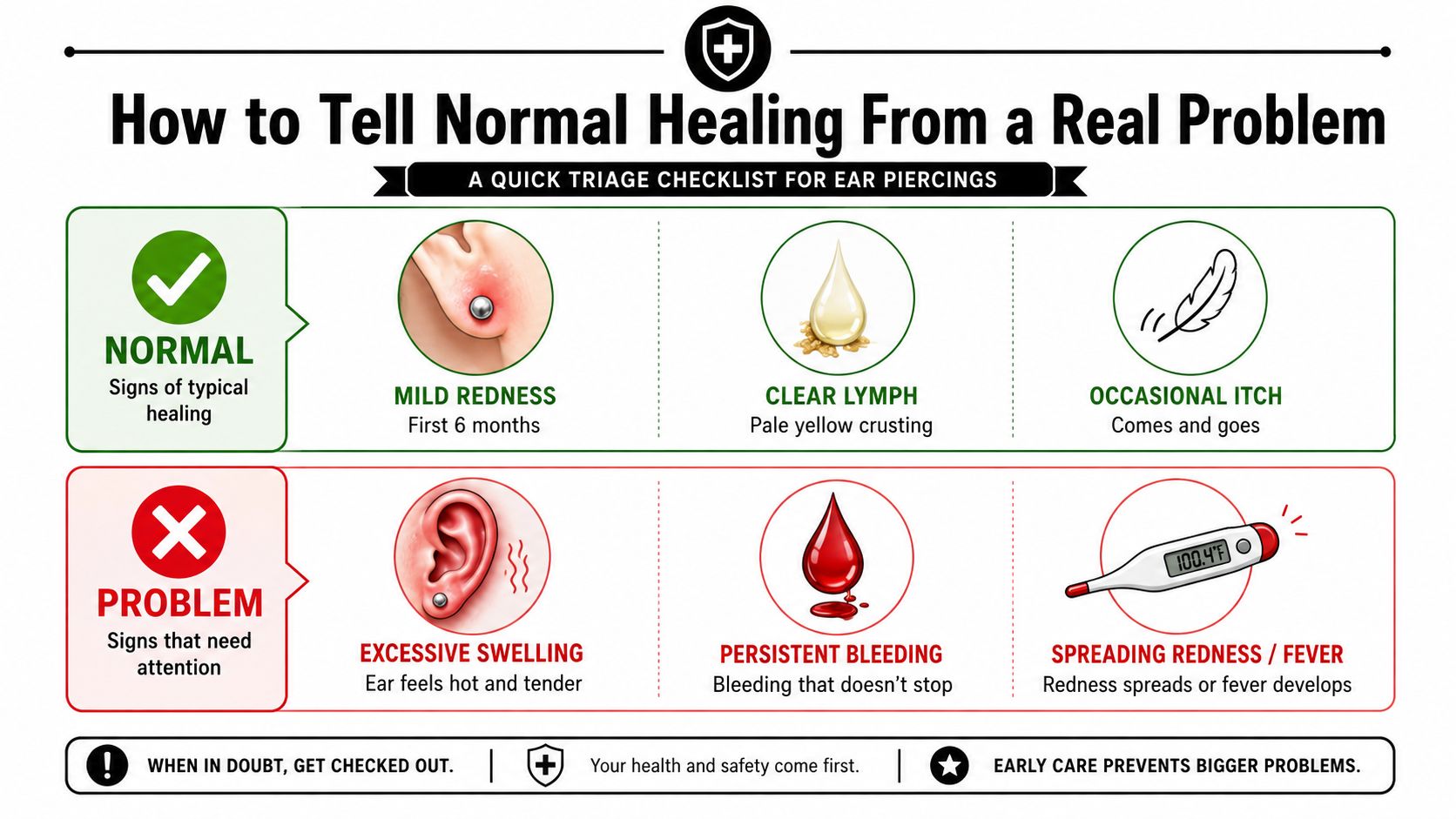
How To Tell Normal Healing From a Real Problem
This is the part people usually need most, because cartilage can look alarming while still behaving normally. Mild redness, clear or pale yellow lymph crusting, occasional itch, and low-grade tenderness when bumped are all common in the early and middle healing period. What matters is whether symptoms are stable and local, or whether they're getting worse and spreading.
What still fits normal healing
A piercing can stay a bit pink for a long time, especially if you keep knocking it with hair, headphones, or a pillow. Crusting is usually dried lymph, not pus. A small, movable irritation bump can also happen when the jewellery is too long, the area is too dry, or the ear has been slept on.
What needs attention
Warning signs are different. Spreading redness, increasing heat, yellow-green discharge, throbbing pain, fever, or jewellery embedding under the skin need medical assessment. If the ear starts feeling hot rather than just tender, or the swelling is pushing the jewellery into the skin, don't wait it out.
The three confusing middle-ground problems
An irritation bump is often pressure or friction. An allergic reaction usually comes from poor-quality metal and can look red, itchy, and persistently unhappy. A granuloma-like lump is often trapped fluid rather than a true infection, and the Chartered Institute of Environmental Health advises a warm water compress once a day in that situation, with ear cartilage healing placed at 6 to 8 weeks in its guidance CIEH aftercare guidance.
If a lump is growing, hot, or painful, that's not a moment for alcohol, peroxide, or removing the jewellery. Those are the wrong responses because they irritate the channel and can trap the problem inside. If you're uncertain, call the piercer first for a check, and call your GP if the symptoms are spreading, severe, or systemic.
Jewellery Materials and When It Is Safe to Change
Jewellery choice is part of aftercare, not separate from it. If the metal irritates the skin, the piercing spends its whole healing phase fighting the jewellery instead of settling around it. The safest starter pieces are implant-grade titanium ASTM F136, solid 14k or higher gold, or niobium, and the first bar should be slightly longer to allow for swelling. If you want a deeper materials breakdown, this guide on titanium piercing jewellery is worth keeping nearby.
What should be in the piercing
Avoid plated brass, silver, mystery metal, and anything that looks polished but doesn't clearly state its material. Cartilage is unforgiving when the finish flakes or the alloy is unpredictable. A professional studio should fit jewellery that's suitable for healing, not just attractive in the tray.
When to downsize
Once the swelling settles, the bar usually needs a downsizing appointment. In practice, that's commonly around 4 to 8 weeks, but the exact timing depends on how the tissue is behaving. If the bar is still long enough to catch on hair and sleeves, that's useful in the beginning. If it's now snagging constantly, it may need shortening.
When to change the style
Do not swap to a hoop until the piercing is fully healed. Even then, a large-diameter ring is kinder than a tight one, and many people sleep better with a flat-back labret in place. Tight hoops push and roll, which is the last thing you want in cartilage that's still finishing its work.
A few hard rules
Piercing guns are a hard no for cartilage. They can cause blunt trauma that a sterile needle avoids, and they're not the tool for this tissue. A single-use needle and good jewellery choice from the start make the rest of aftercare much easier.
Daily and Weekly Aftercare Checklist
| Daily | Weekly |
|---|---|
| Wash hands before touching the area | Look at the piercing honestly in good light |
| Clean with sterile saline morning and evening | Book a check-up if anything feels off |
| Dry with disposable paper towel or non-woven gauze | Avoid sleeping on it, swimming, and harsh products |
| Keep hair, makeup, and pressure away | Check the jewellery isn't too tight or snagging |
FAQs
What if the stud falls out in week two? Get in touch with your piercer straight away, because the channel can tighten fast and the jewellery may need to be put back in before it closes too much.
Do cartilage piercings close up like lobe piercings? They can close quickly if they aren't fully healed or if jewellery is left out for too long, so don't assume a cartilage hole will stay open.
How do I book a free aftercare review? Call 01202 9000 50 or WhatsApp 07752913846 for the Croydon or Bournemouth studio, and bring a clear photo if you can.
If you want help with placement, materials, or a healing concern, Piercing Near Me helps clients find professional piercing support and clear aftercare guidance, and you can visit Piercing Near Me to take the next step.
Trackbacks/Pingbacks