
You've just left a piercing studio in Bournemouth or Croydon, checked your new jewellery in the mirror, and decided the conch looks exactly as planned. By the time you reach home, the sharp moment has faded. A few weeks later, it may look calm enough to sleep on, wear headphones, or change the jewellery. That's where many healing journeys become difficult.
A conch piercing can feel settled on the surface while the cartilage channel underneath is still repairing. Conch piercing healing commonly takes about 6 to 12 months, and pressure, snagging, moisture, and repeated touching can extend that process. The safest approach is steady and uncomplicated: understand the timeline, protect the ear from everyday friction, and know which changes need a piercer or medical professional.
Your First Conch Piercing and the Months Ahead
At a Bournemouth studio, a first-time client may sit up after the needle has passed, breathe out, and turn towards the mirror. The jewellery is in place. The ear looks balanced. The difficult part seems to be over.
Then comes the quieter part. The client goes home, showers, sleeps, commutes, and carries on with normal life while the cartilage begins a slow repair process. A conch piercing sits in firm ear cartilage, not the soft tissue of the lobe, and UK guidance places cartilage healing in a much longer window than lobe healing. One UK aftercare guide gives cartilage piercings a 4 to 12 month healing window, while UK-facing conch advice commonly uses 6 to 12 months (UK cartilage aftercare guidance).
Why the early calm can mislead you
Around the first few weeks, swelling and tenderness may ease. The outer skin can look neat, and the jewellery may stop feeling noticeable. That visual improvement doesn't mean the internal channel has finished repairing. Cartilage has a lower blood supply than soft tissue, so the body takes longer to manage irritation and rebuild the area around the jewellery.
A client who feels fine after a few weeks isn't doing anything wrong. They're at an early point in a long process. The piercing can react again after an accidental knock, a night spent on that side, or repeated headphone pressure, even if it had seemed completely quiet beforehand.
A useful mindset: Treat the first year as a relationship with your ear, not as a wound that should close quickly.
That mindset changes the decisions you make. You won't interpret every small fluctuation as failure, but you also won't mistake a calm surface for permission to ignore pressure or change jewellery prematurely. Consistency matters more than trying to accelerate healing with stronger products or frequent cleaning.
If your routine changes, such as a new job requiring a headset or a holiday involving swimming, think about how that change will affect the ear before the irritation starts. A conch piercing usually rewards patience. It doesn't reward urgency.
How Conch Piercing Healing Actually Works
Cartilage healing is easier to understand if you stop thinking of it as a scab disappearing. Think of it as a narrow bridge being built through a busy area. The body first stabilises the area, then gradually strengthens the tissue around the jewellery. The bridge may look usable before its foundations are strong.
The first stage is a settling response
Immediately after piercing, the ear responds to a controlled injury. Warmth, local swelling, mild redness, and tenderness can occur as the body begins repair. The jewellery needs room while the tissue reacts, which is why an experienced piercer assesses swelling rather than treating the initial fit as permanent.
Cartilage doesn't receive blood as freely as soft tissue. That lower blood supply helps explain why a conch piercing may remain sensitive for longer and why pressure can keep restarting irritation. A sleeping position, a helmet, or a headphone cup can apply force to the same small area repeatedly.
The second stage is internal repair
The visible opening isn't the whole piercing. The channel through the cartilage must develop stronger tissue around its length, and that happens gradually. A conch piercing can appear healthy while the inside remains vulnerable to movement, friction, and sudden jewellery changes.
UK-facing guidance commonly places full conch healing at 6 to 12 months, with repeated mechanical stress capable of slowing recovery (UK conch healing guidance). This is why week six is a checkpoint, not a finish line. A piercing that feels comfortable at that point may still need careful handling for many more months.
The final stage is resilience
Later healing isn't about looking normal. The tissue needs to tolerate ordinary movement without becoming sore, swollen, or crusty after every disturbance. Some intermittent tenderness can still occur during this longer period, particularly after pressure or an accidental snag.
The practical lesson is simple. A quiet piercing is a healing piercing, not necessarily a healed piercing. Protecting the developing bridge from repeated stress gives the body a better chance to complete the work without constant setbacks.
Daily Conch Aftercare That Prevents Problems
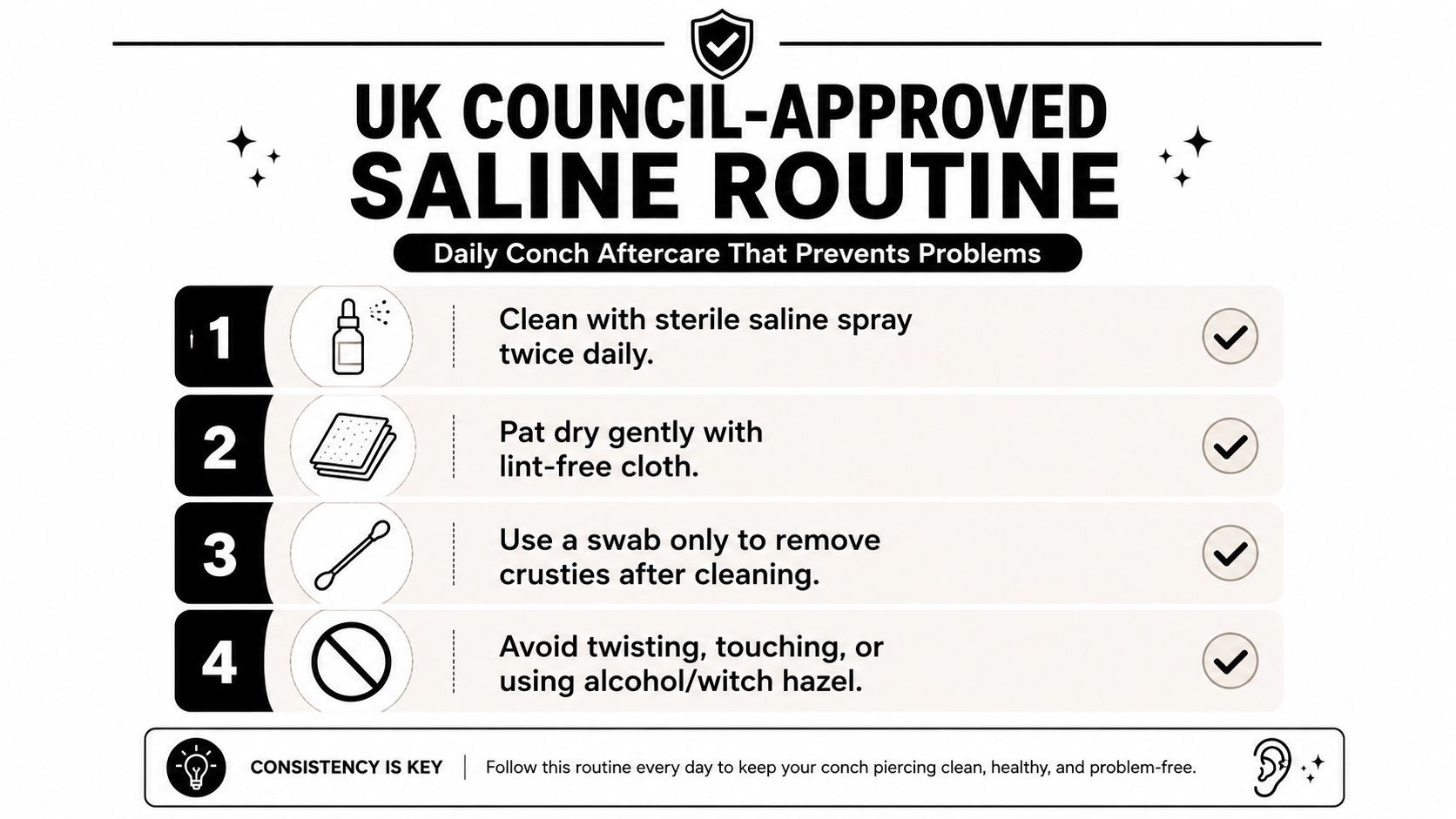
Good aftercare should be easy enough to repeat and gentle enough not to become another source of irritation. UK local-authority guidance supports a low-intervention routine for ear cartilage, including saline care, avoiding manipulation, and keeping fibres away from the wound. A sterile saline spray designed for piercings can make that routine more consistent, and you can compare suitable options in this guide to saline spray for piercings.
A calm daily routine
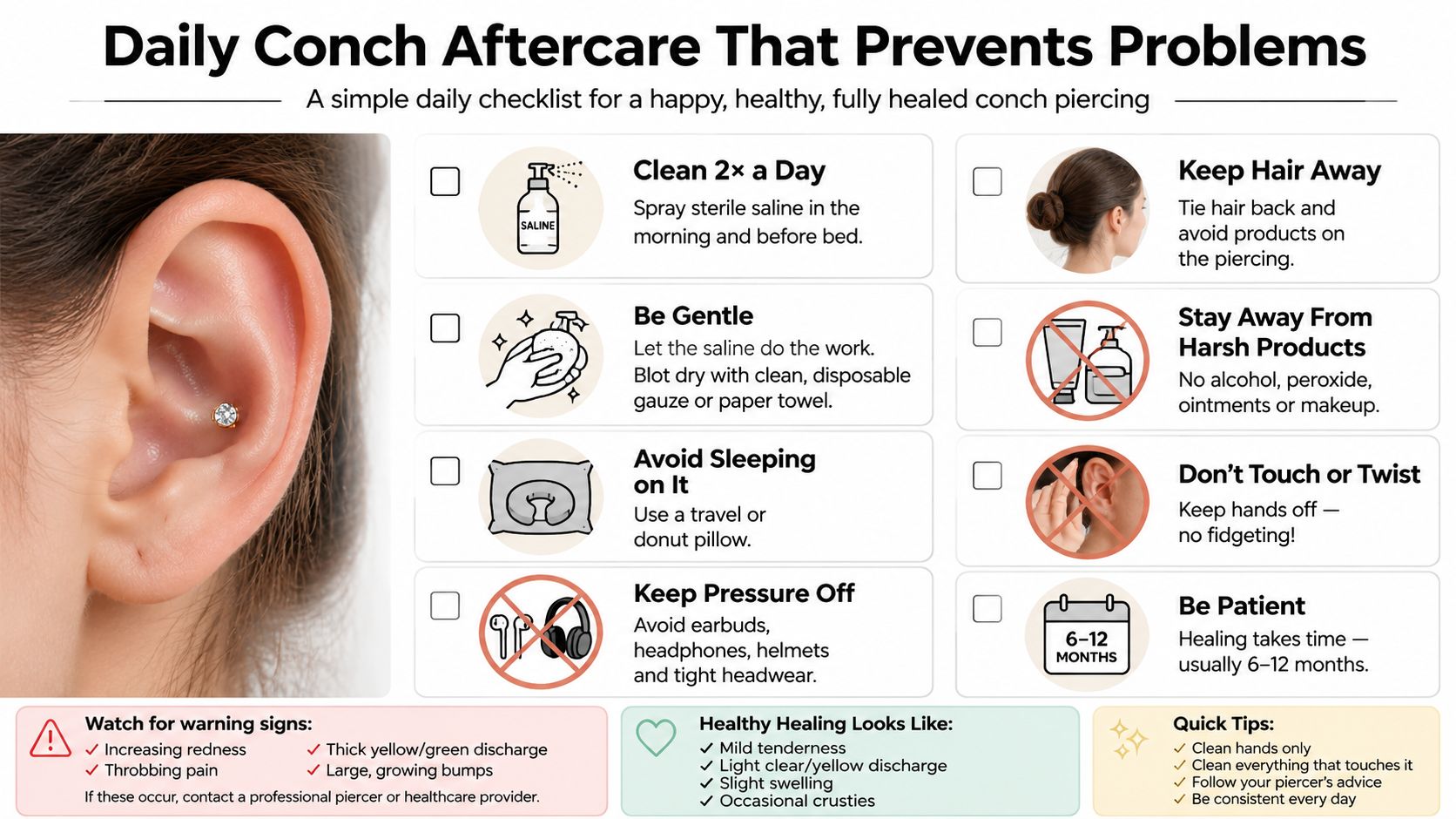
Use sterile saline once or twice daily, as advised by your piercer or the product directions. Let the saline reach the area without scrubbing the jewellery or forcing fluid through the channel. Cleaning more often doesn't necessarily make healing faster. Excess cleaning can dry and irritate the surrounding skin, while friction can disturb the delicate tissue trying to close around the jewellery.
After cleaning, dry the area gently with disposable paper. UK guidance from Torbay Council specifically warns against cotton-wool fibres and recommends avoiding manipulation of the jewellery (Torbay Council ear and face piercing aftercare). Paper helps reduce the risk of loose fibres catching around the post.
Less is more: Saline, gentle drying, and clean hands are usually more helpful than a cupboard full of harsh products.
What to leave out
Don't twist, rotate, pick, or test the jewellery. Each movement can scrape the healing channel and prolong inflammation. Avoid alcohol, witch hazel, strong antiseptics, perfumed products, creams, oils, and hair products around the piercing unless a healthcare professional specifically tells you otherwise.
Cotton buds can leave fibres behind, and cloth towels may catch on the jewellery. If a small amount of dried crust is present, saline can soften it. Don't pull at it while it's attached.
A simple routine also makes changes easier to spot. You can notice whether the ear is gradually settling or whether redness, pain, and swelling are becoming more intense. That observation is more useful than repeatedly cleaning in response to anxiety.
Normal Healing Versus Infection Warning Signs
The hardest question for many first-time clients is whether an unpleasant-looking change is part of healing or a complication. Mild tenderness, occasional redness, and light crusting can occur as the channel settles. A pattern of increasing heat, swelling, pain, or discharge needs a different response.
UK public-health guidance tells piercing businesses to provide written and verbal aftercare advice and to direct clients to a doctor when infection signs appear. Local-authority guidance identifies unusual yellow or green discharge with an offensive smell, alongside redness, swelling, and pain, as reasons to seek medical attention promptly (UK government guidance on piercing-related cartilage infection).
Normal healing vs complication signs
| Sign | Normal or Warning | Action |
|---|---|---|
| Mild tenderness that comes and goes | Usually normal healing | Reduce pressure and monitor the trend. Contact your piercer if it keeps worsening. |
| Small amounts of light crusting | Often part of normal healing | Leave it alone or allow saline to soften it. Don't pick. |
| Redness that gradually settles | Usually normal healing | Continue gentle care and avoid friction. |
| Redness that spreads or becomes more intense | Warning sign | Seek medical advice promptly. |
| Increasing swelling, heat, or throbbing pain | Warning sign | Contact NHS services or a doctor, particularly if symptoms are progressing. |
| Yellow or green discharge with an offensive smell | Strong warning sign | Seek medical attention immediately. |
| A local lump with trapped fluid | Needs assessment | NHS guidance describes granulomas as trapped fluid and recommends a warm-water compress once daily for those lumps (NHS infected piercings guidance). |
| Jewellery pressing tightly into swollen tissue | Pressure complication | Contact your piercer urgently for an assessment. Don't force or remove it yourself. |
The distinction isn't about diagnosing yourself from a photograph. It's about recognising direction and severity. If the ear is becoming hotter, more painful, more swollen, or increasingly wet with offensive-smelling discharge, don't wait for the piercing to “see how it goes”.
For a plain-language checklist before contacting a professional, use this guide to telling whether a piercing is infected. A piercer can assess jewellery fit and irritation, but suspected infection belongs with a healthcare professional.
Sleeping Headphones and Swimming Around Healing
Most conch irritation doesn't come from one dramatic event. It comes from ordinary contact repeated often enough to keep the ear unsettled. A headphone cup presses during a commute, hair catches while changing clothes, and a favourite sleeping position puts weight on the piercing for several hours.
Make sleep less mechanical
Sleeping directly on the conch places pressure against cartilage and can push the jewellery sideways. A donut pillow or a travel pillow with a central opening can let the ear sit in the gap rather than against the fabric. The pillow itself should stay clean, and the opening needs to position your ear without forcing it against the edge.
Keep hair away from the jewellery where possible. Loose strands, styling products, and repeated brushing can create small snags that you might barely notice at the time. If you wake with fresh tenderness after sleeping, treat that as feedback about pressure, not as a reason to clean aggressively.
Be realistic about headphones
In-ear earbuds sit close to the conch and can rub during insertion and removal. Over-ear headphones may avoid the canal but still press directly on the outer ear, depending on the cup shape and your anatomy. A headband-style audio device can still touch the area, so test its position carefully rather than assuming it is safe.
If you need headphones for work or commuting, use the least-contact option available, keep the ear clean and dry, and take breaks from pressure. Stop using any device that leaves the piercing sore or visibly swollen.

Swimming advice needs context
UK-facing advice varies, with some guidance suggesting avoiding swimming for 2 to 3 weeks and other advice suggesting 4 weeks. Those shorter periods shouldn't be confused with full healing, which remains about 6 to 12 months for a conch piercing (UK conch healing overview).
Pools, hot tubs, and open water create wet-environment risks while the channel is still vulnerable. If swimming is unavoidable, ask your piercer or healthcare professional for advice based on the piercing's current condition, and dry the ear carefully afterwards. Irritation can prolong recovery even when there is no infection.
Jewellery Downsize and Booking Your Studio Check
Initial conch jewellery needs space for early swelling. Once that swelling has reduced, an overly long post can move, catch on hair, and collect knocks. A professional check around six weeks can determine whether the jewellery is ready to be downsized, rather than relying on a calendar alone.
Downsizing means replacing the initial longer post with a shorter one that fits the ear more closely. It isn't the same as changing jewellery for style. The purpose is to reduce unnecessary movement and pressure trauma while keeping enough room for the tissue to remain comfortable.
Choose fit over impatience
A piercer should assess the ear before shortening the post. If swelling, tenderness, or irritation remains, changing too soon may create pressure. If the post is moving excessively or catching repeatedly, waiting without an assessment may also be unhelpful.
For new cartilage piercings, ask about implant-grade jewellery, such as suitable titanium, and make sure the finish and fit are appropriate for your anatomy. A flat-back stud is often easier to protect during healing than a ring because it presents fewer moving parts to hair, pillows, and headphones. You can explore the considerations involved in choosing a conch piercing stud, then discuss the final size with your piercer.
Timebomb Tattoo & Piercing supports clients in Bournemouth and Croydon with placement, jewellery selection, checks, and aftercare guidance. To arrange a studio conversation, call 01202 900050 (Bournemouth) / 020 8686 7730 (Croydon) or send a WhatsApp message to 07752 913846 (Bournemouth) / 07902 490584 (Croydon).
When to Return and How Timebomb Supports You
Conch piercing healing becomes easier to manage when you know who to contact for each type of concern. A piercer is the right person to assess jewellery length, angle, pressure points, snagging, and whether a downsizing appointment is appropriate. They can also help identify irritation caused by sleep, headphones, hair, or unsuitable jewellery.
Medical concerns follow a different route. If you notice worsening pain, spreading redness, significant swelling, heat, or yellow or green discharge with an offensive smell, seek medical advice promptly rather than waiting for a studio appointment. UK public-health guidance makes that escalation part of responsible piercing aftercare because cartilage infections can become serious quickly.
A straightforward decision path
- The jewellery feels too long or keeps catching: Book a professional studio check.
- The area is irritated after sleeping or headphone use: Remove the source of pressure and contact your piercer if it doesn't settle.
- A lump is present but there are no escalating infection signs: Ask a piercer or healthcare professional to assess it.
- Pain, heat, swelling, or discharge is worsening: Contact NHS services or a doctor.
- The jewellery appears embedded or tightly compressed: Seek urgent professional assessment and don't force it out yourself.
Timebomb Tattoo & Piercing can support the practical side of the process in Bournemouth and Croydon, from the initial fit to later checks. You don't need to wait until a manageable concern becomes a crisis. A quick conversation can clarify whether the issue is pressure, jewellery fit, normal fluctuation, or something requiring medical care.
Call 01202 900050 (Bournemouth) / 020 8686 7730 (Croydon) or WhatsApp 07752 913846 (Bournemouth) / 07902 490584 (Croydon) if you're uncertain about your conch piercing healing or need help deciding your next step.
If you're planning a conch piercing or need help with healing, visit Piercing Near Me to explore professional piercing services, jewellery guidance, and aftercare support in Bournemouth and Croydon. Book a consultation or contact the studio team before changing jewellery, returning to pressure, or ignoring symptoms that are getting worse.
Trackbacks/Pingbacks