
You've found a piece of jewellery you love. The photos look right, the metal sounds right, and then the size menu stops you in your tracks. Is 1.2 mm the same as 16g? Is 18g always 1.0 mm? Why does one site list a different conversion from another?
That confusion is normal. We hear it all the time at Timebomb Tattoo and Piercing, especially from first-time clients who are trying to buy jewellery online without risking irritation, swelling, or a bad fit. A lot of size guides make it sound simple, but piercing sizes in the UK have a few important quirks that generic charts skip over.
This guide is here to make mm to gauge conversion clear, practical, and safe. I'll keep it straightforward, explain where people get caught out, and show you when it's best to stop thinking in gauge altogether and stick to millimetres.
Why Your Piercing Size Matters More Than You Think
Jewellery size isn't just a style detail. It affects how your piercing sits, how it heals, and whether changing jewellery feels smooth or uncomfortable.
If the bar or ring is too thin, it can put pressure on the tissue in the wrong way. If it's too thick, you should never force it through. Even a small difference can be the reason a piercing feels sore, tight, or unsettled after what should've been a simple jewellery change.
Why professionals use mm first
In UK piercing practice, millimetres are the clearest way to describe jewellery thickness. That's because mm gives you an exact measurement, while gauge can mean different things depending on the system behind it. For safety and accurate fit, UK practice leans on mm so there's less room for misunderstanding.
That matters even more when jewellery is manufactured to metric tolerances. A piercer checking a helix post, a septum clicker, or a nostril stud wants a direct size they can verify with proper measuring tools, not a label that might vary by brand.
Practical rule: If you know your size in mm, you're less likely to buy the wrong jewellery.
Where online charts can mislead
A lot of online conversion charts treat gauge as if it's universal. It isn't. One useful reminder comes from recent UK industry data noted by Tribu, which says 38% of new piercers in the South Coast region report clients bringing in jewellery labelled “16g” that measures 1.3 mm instead of 1.2 mm. That's the sort of mismatch that can lead to poor fit or delayed healing if nobody checks the actual thickness.
For a first-time client, that's frustrating because you think you followed the chart correctly.
At Timebomb, we'd always rather a client ask before ordering than guess and hope for the best. A well-fitting piece of jewellery should support healing, sit comfortably, and go in without drama.
The Ultimate MM to Gauge Conversion Chart
Here's the quick reference commonly sought. In everyday UK piercing use, these are the size pairings clients most often come across when shopping for jewellery or checking an existing piercing.
Piercing jewellery mm to gauge conversion
| Gauge (g) | Millimetres (mm) | Common piercings |
|---|---|---|
| 20g | 0.8 mm | Fine nostril jewellery, some healed lobe jewellery |
| 18g | 1.0 mm | Earlobe, nostril |
| 16g | 1.2 mm | Helix, tragus, conch, septum, many cartilage piercings |
| 14g | 1.6 mm | Navel, tongue, some industrial and larger cartilage jewellery |
| 12g | 2.0 mm | Larger body jewellery, some stretched piercings |
| 10g | 2.5 mm | Stretching and larger gauge jewellery |
| 8g | 3.0 mm | Stretched piercings |
| 6g | 4.0 mm | Stretched piercings |
| 4g | 5.0 mm | Stretched piercings |
| 2g | 6.0 mm | Stretched piercings |
| 0g | 8.0 mm | Stretched piercings |
| 00g | 10.0 mm | Stretched piercings |
How to use the chart properly
Use the chart as a starting point, not as proof that every seller is using the same standard in the same way. If your current jewellery is comfortable, the safest move is to measure that exact piece and then buy a replacement in the same thickness and wearable length or diameter.
A good example is a healed cartilage piercing. You might know it as 16g, but when you shop, it's better to look for 1.2 mm jewellery and then check the post length or ring diameter separately.
A conversion chart helps you translate sizes. It doesn't replace measuring the jewellery you already know fits.
One more thing about stretching sizes
Once jewellery gets into larger sizes, gauge labels become less useful in everyday conversation. If you're dealing with plugs, tunnels, or stretched lobes, most UK studios and jewellery sellers will talk in mm because it's simpler and more accurate.
Understanding Different Gauge Systems
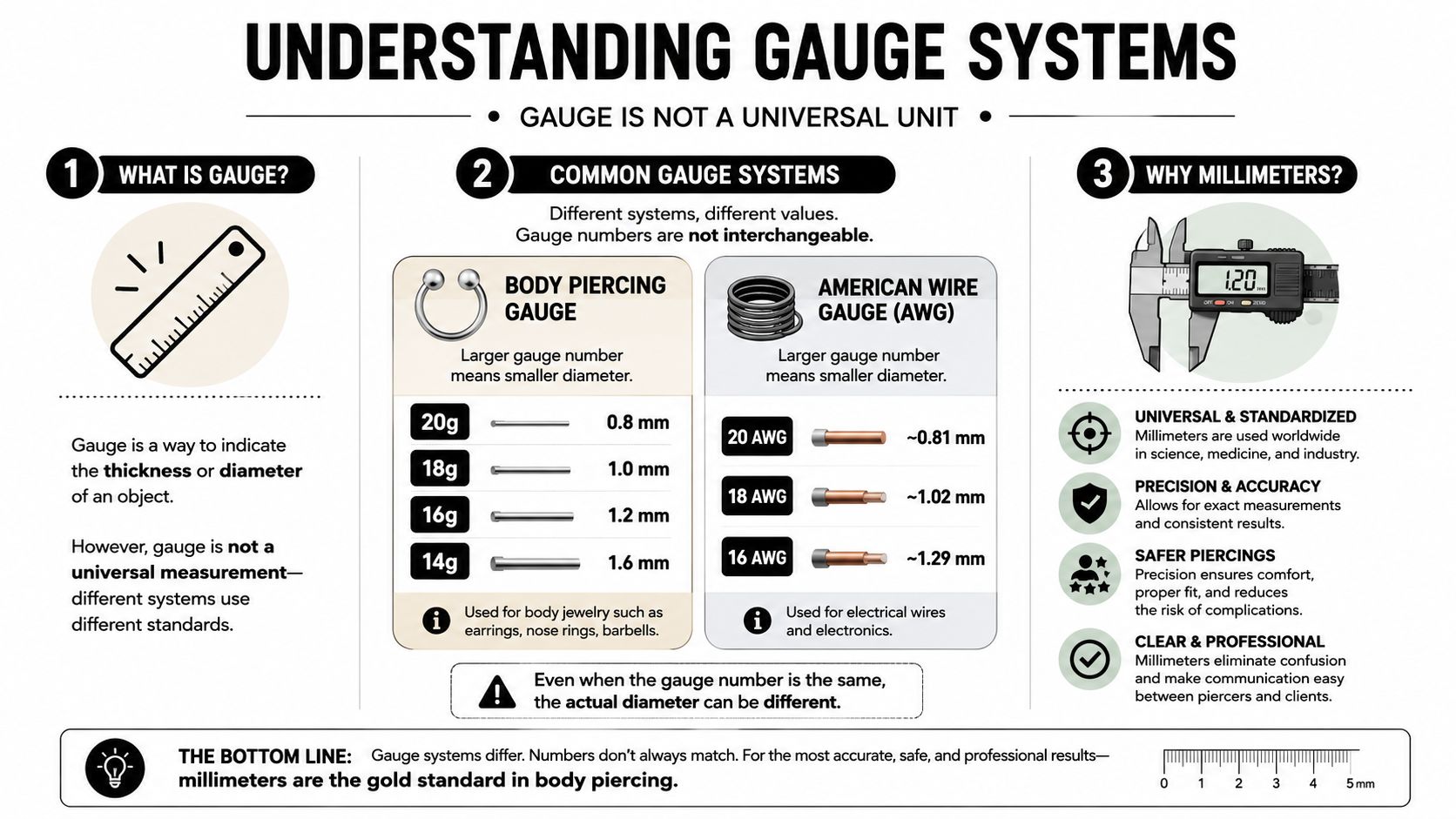
The biggest source of confusion in mm to gauge conversion is this. Gauge is not one universal measurement system. The same number can mean different thicknesses depending on whether you're looking at British or American standards.
That's why two charts can both look official and still show different numbers.
SWG and AWG are not the same
In the United Kingdom, the historic wire standard is Standard Wire Gauge (SWG). According to this UK explanation of metric and imperial sizing, 16 SWG is exactly 1.626 mm and 18 SWG is 1.219 mm. The same source also notes that 18 SWG is thicker than 18 AWG, which is 1.024 mm, creating a 0.195 mm discrepancy.
In piercing terms, that difference is not trivial. A ring or post that's off by that amount can change how securely jewellery fits, whether insertion is comfortable, and whether tissue gets irritated.
Why clients get mixed messages
Many jewellery websites borrow terminology from different systems. Some use gauge labels casually. Some round to the nearest familiar body jewellery size. Some list the gauge but not the actual mm thickness.
That's how a client ends up thinking every “18g” item should be interchangeable, when one piece may be noticeably thicker than another.
A simple way to think about it is this:
- SWG is part of British imperial history
- AWG is an American wire gauge system
- Body jewellery shops often use simplified piercing sizes that don't always match strict engineering conversions exactly
The safest way to read a listing
Ignore the gauge label first. Find the actual millimetre measurement.
If the listing clearly states the jewellery is 1.0 mm, 1.2 mm, or 1.6 mm, you've got something concrete to work with. If it only says “16g” and gives no measured thickness, you're relying on the seller to mean the same thing your piercer means.
When a client asks, “What gauge am I?”, the better question is usually, “What mm thickness are you wearing now?”
That one habit clears up most sizing confusion before it becomes a problem.
Standard Piercing Sizes for Popular Placements
You're standing at the mirror with a new piece of jewellery, certain it should fit because the listing says the “usual” size for your piercing. Then it either feels loose, refuses to go in, or irritates the channel straight away. That happens all the time with first-time clients, especially when online shops blur together UK and US sizing terms.
In the studio, we treat standard sizes as a starting point, not a promise. Certain placements usually heal best within a familiar range, but anatomy, swelling, jewellery style, and the way a brand machines its pieces all affect what fits well.
Ear and face placements
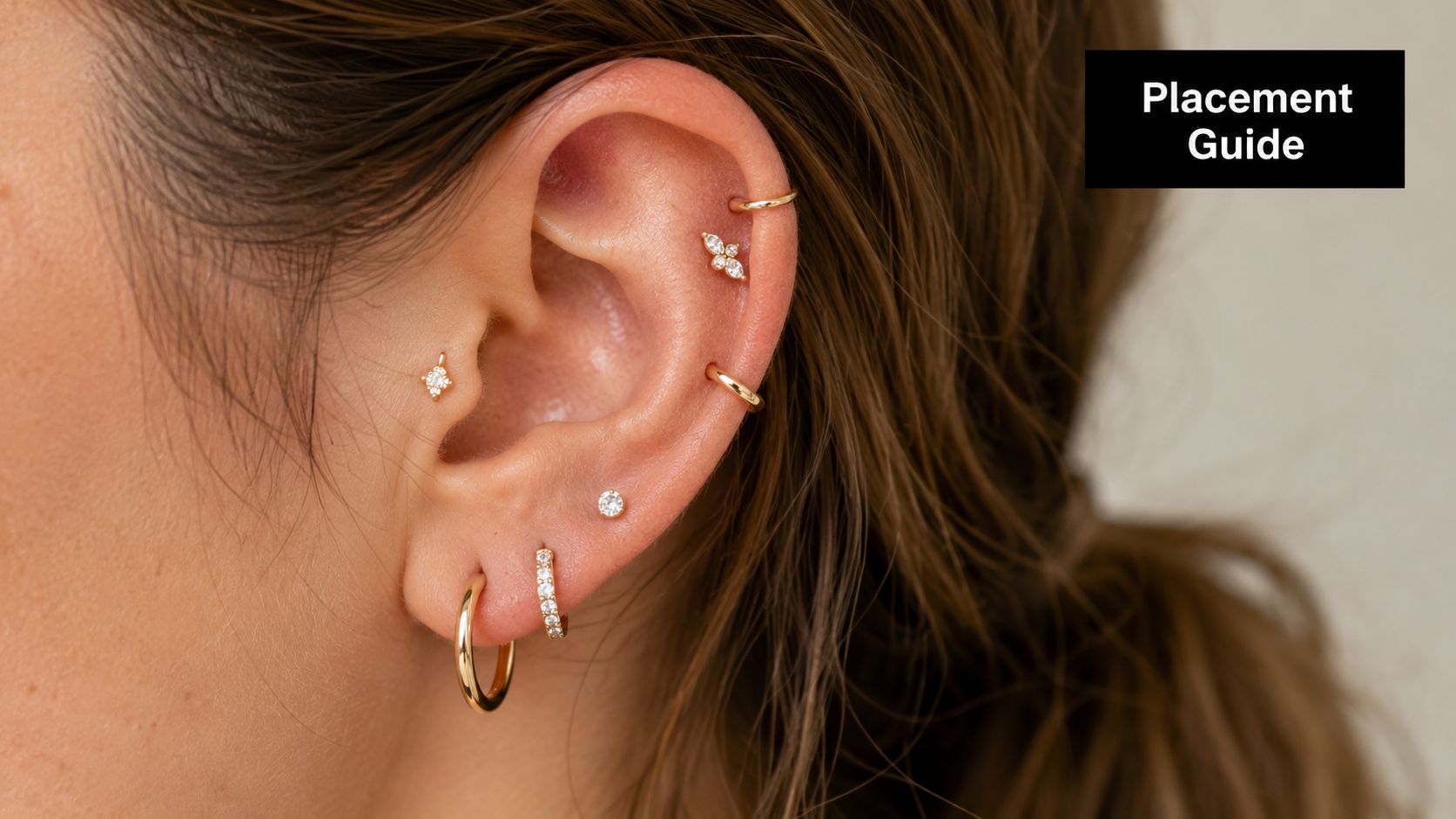
For most UK clients, these are the sizes they'll see most often:
- Earlobe usually starts at 1.0 mm
- Nostril is commonly 1.0 mm
- Helix is commonly 1.2 mm
- Tragus is often 1.2 mm
- Conch commonly starts at 1.2 mm
- Septum commonly starts at 1.2 mm
Those numbers are useful because they reflect how different tissue behaves. Softer tissue, like the lobe or nostril, often suits a finer post. Cartilage usually benefits from a slightly thicker piece because it offers more stability during healing, much like a sturdier tent pole holds its shape better under pressure.
If you want a closer look at nose jewellery options, our guide to nostril piercing gauge sizes breaks down the common choices in more detail.
Body placements and larger sizes
For body piercings such as navel or tongue, studios often start with thicker jewellery than they would use for lobes or nostrils. That choice is based on support and healing room, not just appearance. A fresh tongue or navel piercing needs jewellery that can cope with movement and early swelling.
Stretched piercings are another area where clients get caught out. Once jewellery gets into larger diameters, people usually stop speaking in gauge and switch to millimetres instead. In practice, that is far clearer. Asking for 8 mm or 10 mm leaves less room for confusion than relying on a gauge label alone.
A safer way to use “standard sizes”
Use standard size guides the way you'd use a shoe size chart. They point you in the right direction, but they do not replace a proper fitting.
At Timebomb Tattoo, we also warn clients about manufacturing tolerances because two pieces sold as the same size may not be identical in real life. One brand's “1.2 mm” can feel slightly tighter than another's, and that small difference matters far more in a fresh or temperamental piercing than people expect.
If you come in asking for the thinnest possible look in a new cartilage piercing, we'll explain why a slightly sturdier starting size is often the better call. It usually sits more securely, heals more calmly, and gives you better jewellery options once the piercing has settled.
How to Measure Your Piercing and Jewellery
If you're buying replacement jewellery, measuring your current piece is one of the smartest things you can do. It takes the guesswork out of mm to gauge conversion and helps you order a piece that fits properly.
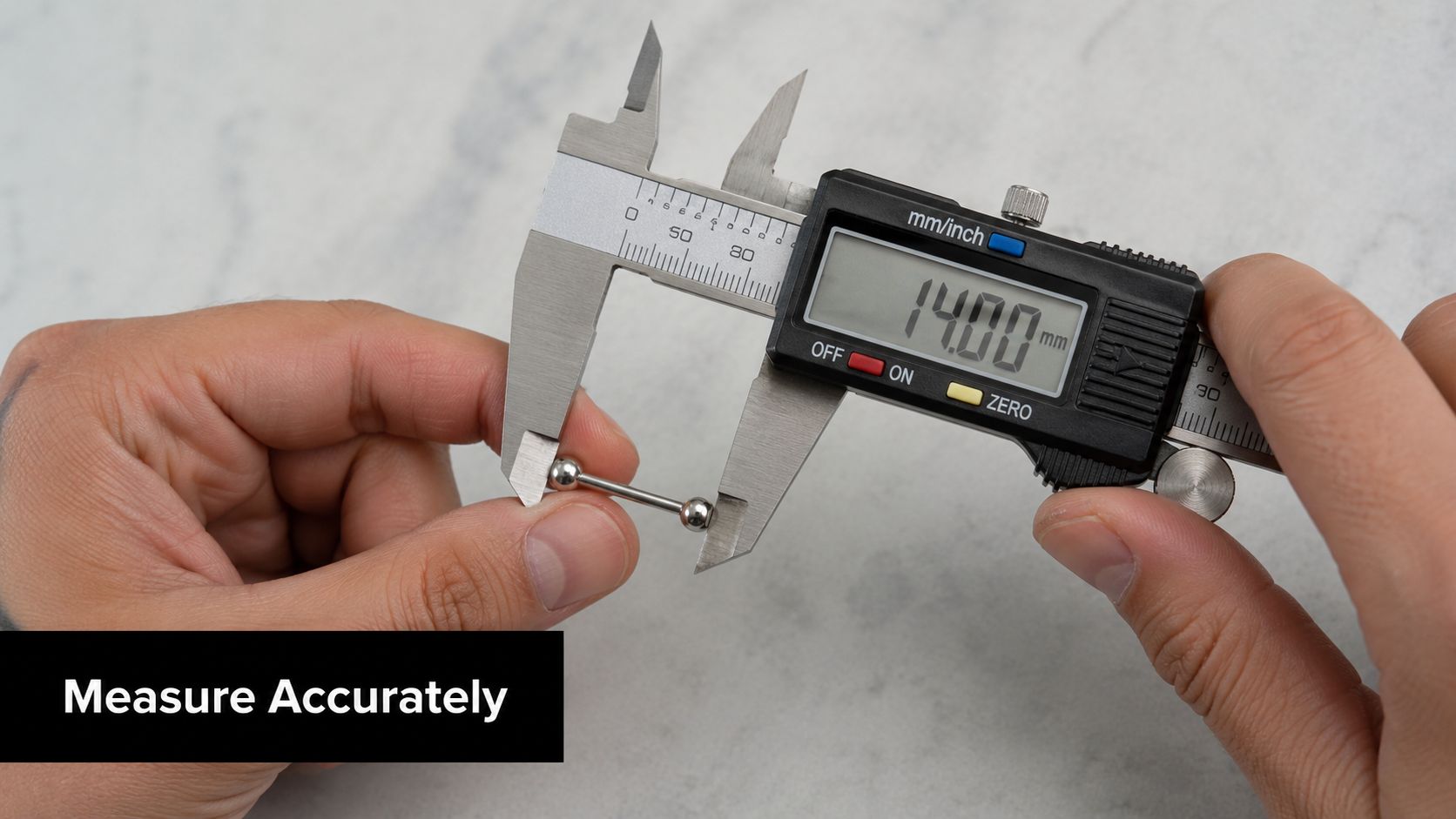
The best tool for this is a digital caliper. It gives you a direct reading in millimetres and is much more reliable than holding jewellery against a ruler.
What to measure
You're usually checking three different things:
Thickness
This is the gauge in mm. Measure the straight part of the bar or ring, not the decorative end.Wearable length
On a barbell or labret, this means the length of the post that sits through the piercing.Internal diameter
On a ring or clicker, this means the space inside the ring, not the outer edge-to-edge size.
How to measure at home
Here's the simplest method:
- Clean the jewellery first so you're handling a piece that's free from build-up.
- Set the caliper to mm before you begin.
- Measure the bar thickness gently without squeezing hard. You want contact, not pressure.
- Check a straight section of the jewellery, especially on curved pieces.
- Write the measurement down exactly as it appears.
If you're measuring a ring, close the caliper across the inside of the ring to get the internal diameter. If you're measuring a labret post, measure only the section that passes through the piercing.
When not to measure by yourself
If the jewellery is still in a healing piercing and you're not confident removing it, don't struggle with it at home. It's better to have a piercer check it properly than to irritate the channel trying to get a reading.
For a broader guide to jewellery styles and fit, have a look at UK body jewellery basics.
Worth remembering: Thickness, length, and diameter are separate measurements. Knowing only the gauge still isn't enough to buy the right piece.
Common Sizing Mistakes and How to Avoid Them
The biggest mistake people make is trusting the label more than the jewellery itself. A listing says 1.2 mm or 16g, so it must be right. In practice, that isn't always how it works.
Labels can be close, not exact
As noted in this body jewellery sizing chart discussion, implant-grade jewellery is often manufactured with tolerances of ±0.05 to 0.1 mm, and that can create mismatches when clients buy online. The same source warns that a 1.2 mm cartilage stud may technically be 16g or 14g depending on the brand.
That explains why one piece slides in smoothly and another piece with the “same” label suddenly feels wrong.
Mistakes that cause trouble fast
A few problems come up again and again:
Forcing jewellery through
If it doesn't go in easily, stop. Pressure can tear tissue or inflame a settled piercing.Buying only by gauge name
“16g” without a stated mm measurement leaves too much open to interpretation.Ignoring length or diameter
A post can be the correct thickness and still be too short for swelling or too long for comfortable healing.Assuming all brands round the same way
They don't. That's where many online ordering mistakes begin.
How to make safer choices
Buy from sellers who state the size in mm clearly. Keep a note on your phone with the exact thickness, length, and diameter of jewellery that fits you well. If you're changing jewellery in a piercing that's still fairly new, ask a professional before downsizing or switching styles.
Jewellery should never need force. If you have to push, twist, or “make it work”, the size or fit is probably wrong.
That one decision, stopping instead of forcing it, prevents a lot of avoidable irritation.
Our Sizing Philosophy at Timebomb Tattoo and Piercing
At Timebomb Tattoo and Piercing, we work from a simple principle. We size jewellery in millimetres first, because that gives clients the clearest and safest information.
That approach lines up with UK best practice. According to Ouch Body Jewellery's explanation of correct sizing, professional standards in the UK treat millimetres as the primary metric for defining gauge, and that practical rounding approach supports proper fit for implant-grade titanium and surgical steel jewellery.
What that means in the studio
When we pierce someone, we're not picking a size because it sounds standard on paper. We're looking at the placement, the tissue, the jewellery design, and how that piece needs to behave during healing.
That's why we favour implant-grade options and measured sizing. If a client asks about material choices, our page on titanium piercing jewellery explains why titanium is such a dependable option for fresh and sensitive piercings.
Why this helps first-time clients
First-time clients often worry that they need to memorise every gauge before they book. You don't. Our job is to measure properly, explain your options clearly, and fit jewellery that works for your anatomy.
We'll also tell you what size you're wearing in plain terms so you can replace it confidently later. That's much better than leaving with a vague “it's just standard”.
If you want us to check your size
If you're unsure what fits your piercing now, bring the jewellery in and we'll assess it properly. If you're booking a new piercing and want guidance before choosing jewellery, get in touch.
Phone: 01202 9000 50
WhatsApp: 07752913846
A quick check before you buy usually saves a lot of hassle later.
Frequently Asked Questions About Piercing Sizes
What happens if I put smaller gauge jewellery in my piercing
The piercing may shrink around the thinner jewellery. Sometimes that happens quickly, especially in newer piercings. If you then try to put the original thicker jewellery back in, it may feel tight or not go back in cleanly.
Can I use jewellery from America in my UK piercing
Sometimes yes, but only if you verify the actual mm measurement and not just the gauge label. That's the safest way to avoid confusion between different sizing systems and different brand conventions.
Is 16g always 1.2 mm
In everyday UK piercing conversation, people often use 16g to mean 1.2 mm. But as covered earlier, strict gauge systems and brand rounding don't always line up perfectly, so checking the listed mm size is still the better habit.
Why does one 1.2 mm piece feel tighter than another
Because thickness isn't the only factor. Surface finish, threading style, manufacturing tolerance, shape, and how healed the piercing is all affect insertion. A ring can also feel different from a straight post even when the thickness matches.
How do I know when it's safe to change jewellery
That depends on the placement, how well it's healed, and whether the new jewellery matches the existing fit. If there's any tenderness, crusting, tightness, or uncertainty, it's better to let a piercer assess it first.
Should I buy by gauge or by millimetre
Buy by millimetre whenever possible. Gauge is useful as shorthand, but mm is the clearer measurement when you want a dependable fit.
What if I don't know my current size at all
Don't guess. Bring your current jewellery to a professional studio and have it measured with calipers. That's the quickest way to avoid buying something you can't safely wear.
If you're comparing studios, jewellery, or healing advice, Piercing Near Me is a helpful place to start. It connects you with trusted UK piercing information and makes it easier to book with experienced professionals at Timebomb Tattoo and Piercing in Croydon and Bournemouth. If you'd rather get a direct answer on sizing before you buy, call 01202 9000 50 or message 07752913846 on WhatsApp.