
You've just had your lip pierced, the initial excitement is wearing off, and you're now wondering whether the swelling, tenderness, or small amount of dried fluid is normal. Good aftercare for lip piercings is less about buying a cupboard full of products and more about following a calm, consistent routine while avoiding the habits that irritate fresh tissue.
Lip piercings heal through both the skin and the mouth, so external cleaning alone isn't enough. UK public-health advice combines gentle cleaning, careful drying, jewellery stability, and restrictions on oral contact during the early healing period. That practical combination gives you a much safer framework than repeatedly touching the jewellery or applying harsh products.
Your First Cleaning Routine
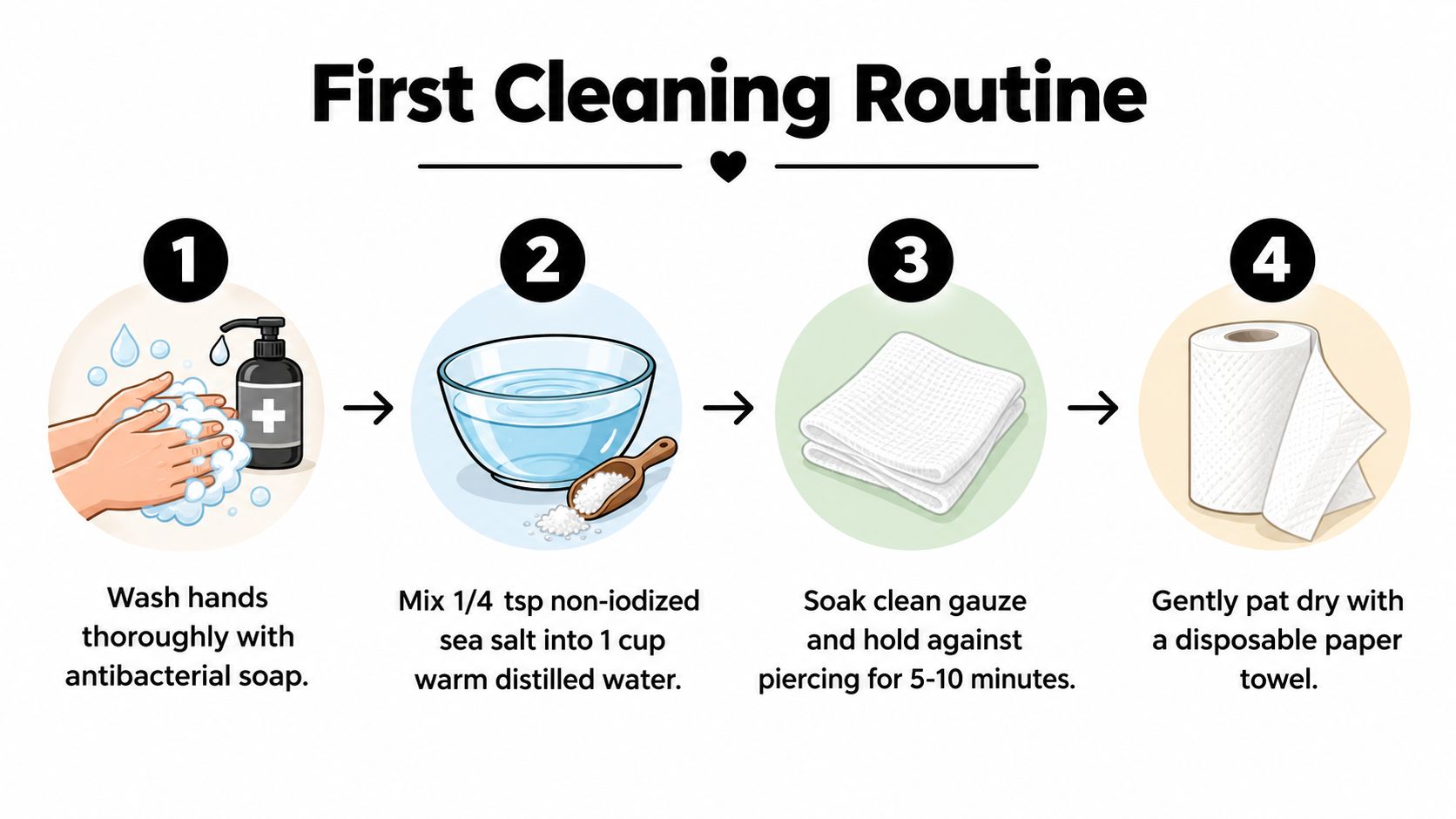
Begin with a saline compress twice a day. UK public-health guidance recommends about one quarter of a level teaspoon of sea salt mixed into an egg cup or shot glass of warm water. Keep the solution mild. Too much salt can dry and irritate the surrounding skin rather than clean it. (UK oral piercing aftercare guidance)
Wash your hands before preparing the solution or touching the jewellery. Stir the salt into warm water until it dissolves, then soak clean gauze or a fresh compress and hold it gently against the outside of the piercing. Do not twist the bar, move it back and forth, or scrape away crusts before they have softened. Warmth loosens dried discharge, while the compress cleans without the friction of rubbing.
Drying matters as much as cleaning
If your skin feels salty after the compress, rinse away the residue. Dry the area with fresh disposable paper towel or kitchen roll, patting rather than dragging the paper across the jewellery. UK guidance recommends disposable paper products because shared or reused towels can carry bacteria and catch on the bar.
Leave the piercing alone once it is clean and dry. Repeated soaking, prodding, or drying throughout the day can keep the channel irritated, even when your hands and products are clean.
For a visual walkthrough of the external routine, follow this guide to cleaning a new piercing. Maintain gentle oral hygiene inside your mouth, but do not use the external compress as a reason to manipulate the jewellery.
Understanding the Healing Timeline
A client may leave the studio feeling fine, then wake up with a tighter, more tender lip the next morning. That change doesn't automatically mean something has gone wrong. Fresh tissue can fluctuate as swelling settles, and the jewellery needs enough room to accommodate that early response without being pushed, pressed, or repeatedly adjusted.
UK local-authority guidance gives lips and cheeks a typical healing window of six to twelve weeks. The same guidance advises leaving new jewellery in place for at least six weeks before attempting any change. (Gloucester local-authority body-piercing guidance)
What normal progress can look like
During the earlier part of healing, tenderness and swelling should gradually become easier to manage. The outside may look settled before the deeper channel has finished strengthening, which is why a piercing that appears healed can still become sore after catching, biting, or changing jewellery too soon.
| Healing phase | Practical expectation |
|---|---|
| Early healing | Swelling and tenderness may be noticeable and can vary from day to day. |
| Middle healing | The outside often looks calmer, but the channel can remain sensitive. |
| Later healing | Comfort improves as the tissue matures, provided the jewellery stays stable. |
Jewellery movement creates unnecessary trauma inside a channel that's trying to close around the bar. It can also make the fit feel inconsistent, especially if swelling returns after pressure or accidental catching. A longer initial bar may look less neat than the final fit, but it gives swelling space and should only be downsized or changed by a qualified piercer at the appropriate stage.
Practical rule: A calm-looking surface doesn't prove that the entire piercing has healed.
Don't remove the jewellery because the piercing feels tight for a short period, and don't change it just because the visible swelling has reduced. If the bar appears to be embedding, pressing firmly into the tissue, or becoming increasingly difficult to clean around, contact your studio promptly rather than trying to force it out.
Products to Use and Habits to Avoid
The safest approach is selective. Use products that clean without stripping or burning the tissue, and remove behaviours that introduce avoidable friction, saliva exposure, or contamination.
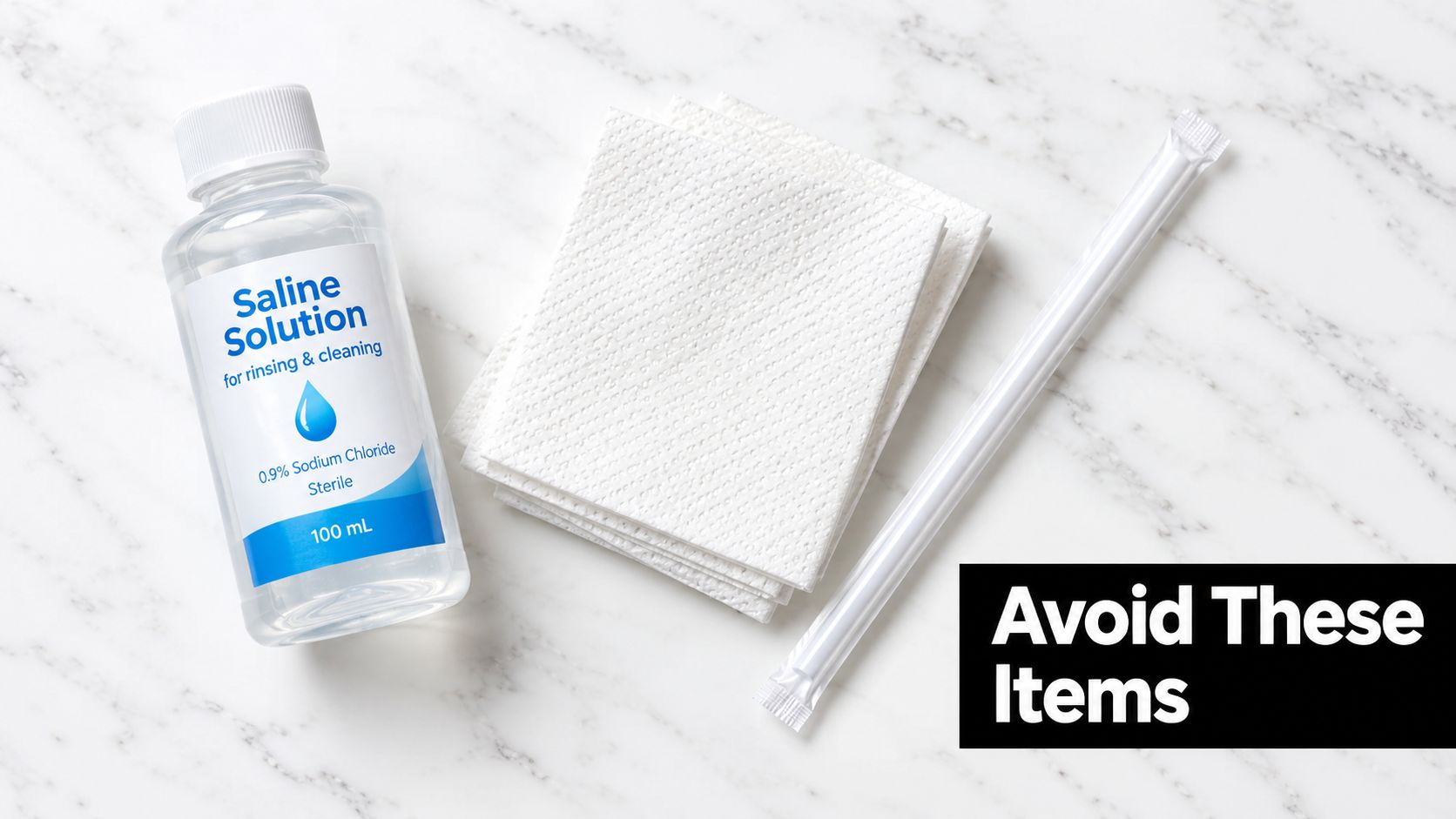
For the outside, use the warm salt-water compress described above or a suitable sterile saline product. Inside the mouth, an alcohol-free mouthwash or gentle saline rinse is preferable to a harsh alcohol-based formula. Alcohol can sting and dry fresh tissue, while vigorous swishing can disturb the piercing. Follow your piercer's advice for the product and frequency rather than layering several different solutions together.
Choose gentle care
- Sterile saline: Use it for straightforward external cleaning when you want a ready-made option with a consistent formulation. You can learn more about saline spray for piercings.
- Warm salt water: Use the measured UK guidance ratio rather than making an excessively salty solution.
- Alcohol-free mouthwash: Choose this for oral hygiene if your piercer recommends it, particularly after food or drinks.
- Disposable paper towel: Pat the site dry and discard the material after use.
- Clean hands: Wash them every time before touching the area, even if you're only checking the jewellery.
Remove avoidable irritation
UK clinical guidance advises avoiding smoking, chewing gum, swimming, and alcohol for at least twenty-four hours after placement. It also recommends avoiding close oral contact such as kissing for four weeks and avoiding oral sex until the mouth piercing has healed. (UK guidance on piercings and tattoos)
These restrictions address different problems. Smoking and alcohol can irritate fresh tissue, chewing gum encourages repeated movement around the jewellery, and swimming exposes an open piercing to water that may contain microorganisms. Kissing and other close oral contact introduce saliva and bacteria directly to a healing channel, so saline cleaning alone can't cancel out that exposure.
Don't apply hydrogen peroxide, strong antiseptics, or cosmetic creams unless a medical professional specifically tells you to. Don't use make-up over the external opening, pick at dried material, or spin the bar to “keep it from sticking”. Those actions usually create more irritation than benefit.
Identifying Signs of Infection
A fresh lip piercing can feel tender, look mildly swollen, and produce a small amount of pale or dried fluid during normal healing. The direction of change matters. Infection is the more likely concern when symptoms intensify or spread rather than gradually settling.
Warning signs include increasing soreness, inflammation, and yellowish discharge. These symptoms warrant medical advice, particularly when they persist or appear alongside worsening swelling. A piercer can check jewellery fit and identify irritation, but suspected infection requires medical assessment. Use this guide to telling if a piercing is infected for additional reference, not as a substitute for professional care.
Compare the direction of change
A piercing that was settling before becoming increasingly hot, swollen, painful, or inflamed needs attention. Discharge that becomes persistent and yellowish is also more concerning than a small amount that reduces as the site calms. Fever, feeling generally unwell, rapidly spreading redness, or marked swelling around the mouth should be treated as an urgent medical concern.
A Wales look-back investigation reported that approximately thirty-six percent of respondents experienced a subsequent skin infection after piercing. The investigation involved premises with poor hygiene practices, so its finding should not be treated as the expected result of every professionally performed piercing. It does, however, show why hygiene during placement, careful aftercare, and early monitoring matter. (Wales piercing and tattooing look-back investigation)
Don't confuse irritation with infection
Irritation often follows a clear trigger, such as catching the jewellery, sleeping against it, or repeatedly touching the site. It may improve after the trigger stops while the jewellery remains stable. Infection is more likely when symptoms continue to worsen, spread, or affect your general health.
Do not remove jewellery without professional guidance. Closing the channel can interfere with drainage if infection is present, so seek advice before making that decision.
When to Contact Your Studio
Contact your studio when the jewellery fit changes, swelling appears to trap the bar, the disc presses into the inner lip, or the piercing keeps becoming irritated despite a consistent routine. These problems can come from jewellery length, placement, movement, pressure, or an unsuitable material. A professional can inspect the site and decide whether an adjustment is appropriate.
Seek medical advice when you have worsening soreness, significant inflammation, yellowish discharge, or symptoms that make you feel unwell. Don't attempt to treat a suspected infection with alcohol, peroxide, essential oils, or leftover antibiotics. Don't remove the jewellery on your own unless a clinician or qualified piercer advises you to do so.
Send useful information
When you call or message, explain when the piercing was placed, what jewellery it contains, when the symptoms began, and what products you've used. Clear photographs in good natural light can help a piercer assess swelling or jewellery pressure, although they can't replace an in-person or medical assessment.
A reputable studio should ask about your routine rather than just selling you another product. It should also tell you plainly when the issue sits outside a piercer's role and needs a GP, NHS service, or urgent medical assessment.
Timebomb Tattoo & Piercing's studios in Croydon and Bournemouth can provide piercing-related guidance, jewellery checks, and aftercare support. For appointments or questions, the phone number is 01202 900050 (Bournemouth) / 020 8686 7730 (Croydon) and the WhatsApp number is 07752 913846 (Bournemouth) / 07902 490584 (Croydon). If you're contacting the studio, include the location you visited and whether the concern is external, internal, or both.
A good escalation plan is part of aftercare. You're not being difficult by asking for a fit check or medical direction.
Don't wait for a routine appointment if swelling is rapidly increasing or you're struggling with breathing, swallowing, or opening your mouth. Those symptoms need urgent medical attention.
Final Aftercare Checklist
Successful aftercare for lip piercings comes from reducing variables. Clean the outside twice daily with the measured warm salt-water compress, pat it dry with fresh disposable paper towel, and leave the jewellery alone between cleaning sessions.
Keep oral hygiene gentle and consistent. Use an alcohol-free mouthwash or suitable saline rinse when advised, particularly to keep food residue away from the inside of the piercing. Avoid smoking, alcohol, chewing gum, and swimming during the initial restriction period, and observe the longer limits on kissing and sexual oral contact while the piercing heals.
Your daily check
- Wash first: Clean your hands before approaching the jewellery.
- Clean gently: Use the warm compress without twisting or pushing the bar.
- Dry carefully: Pat the outside with fresh disposable paper towel.
- Observe objectively: Note worsening soreness, inflammation, or yellowish discharge.
- Protect the channel: Keep the initial jewellery in place for at least six weeks and arrange changes through a qualified piercer.
- Escalate early: Contact your studio about fit or irritation concerns, and seek medical advice for suspected infection.
Aftercare isn't passive waiting. Each calm cleaning, avoided trigger, and early decision to ask for help gives the healing tissue a better chance to settle without unnecessary trauma.
For practical guidance on lip-piercing aftercare and access to professional piercing services, visit Piercing Near Me. You can explore support for Timebomb Tattoo & Piercing's Croydon and Bournemouth studios, including consultations, appointments, jewellery selection, and aftercare advice.