
You've probably got a tab open with piercing ideas, another with aftercare horror stories, and a final one asking whether the studio you found is safe. That's a normal place to start. Many clients come in excited about the look, then realise the key decision isn't just what to get pierced. It's who's doing it, what jewellery they're using, and whether they'll still help when the piercing needs checking later.
That matters even more in the UK, where the quality gap between studios can be wide. A clean-looking room and a confident social media page don't tell you enough on their own. Good piercing is built on sterile technique, anatomy, suitable jewellery, and honest advice about what your body can heal well.
This body piercing guide is written the way I'd talk to a client before an appointment. Calmly, clearly, and without the vague nonsense. If you're in Croydon or Bournemouth and want to ask something specific before booking, call 01202 900050 (Bournemouth) / 020 8686 7730 (Croydon) or message 07752 913846 (Bournemouth) / 07902 490584 (Croydon) on WhatsApp.
Your First Step into the World of Piercing
A first piercing appointment usually starts long before you walk into a studio. It starts when you save a helix photo, spot a nostril stud you like, or decide you're finally ready to get the navel piercing you've thought about for ages. Then the questions arrive quickly. Will it suit me? How much will it hurt? How long will it take to heal? What if I choose the wrong jewellery?
Those are the right questions.
People often assume the hardest part is the needle. In practice, the biggest difference between a good experience and a bad one is everything around it. The consultation, the marking, the jewellery fit, the sterile setup, and the aftercare advice all matter more than bravado.
Good piercing work should feel organised before it feels dramatic.
Some clients come in for their first lobe or nostril. Others already have several piercings and want something more technical, like a conch, daith, or navel with anatomy-specific placement. The approach should still be the same. Start with your anatomy, choose jewellery that supports healing, and only pierce what can sit safely and comfortably on your body.
What clients usually need most
- Clear answers: You need someone to explain the trade-offs, not just say yes to every idea.
- A sterile environment: Professional standards aren't optional.
- Jewellery that heals well: The first piece has a job to do. It isn't just decorative.
- Support after the appointment: Healing doesn't end when you leave the studio.
A proper body piercing guide should make you feel more informed, not more overwhelmed. By the time you finish reading, you should know what piercing names to ask for, how to judge a studio properly, what happens during the procedure, and how to heal your piercing without irritating it into a problem.
Exploring Popular Body Piercing Types
The easiest way to narrow your choice is to group piercings by area and think about lifestyle as much as style. Some placements are subtle and straightforward. Others are more visible, more technical, or slower to heal.
A useful bit of UK context comes from a 2005 survey in England covering over 10,000 people, which found that 10% had a piercing somewhere other than the earlobe. Among those placements, the navel was most common at 33%, followed by the nose at 19% and ear cartilage piercings at 13%. The same survey linked that popularity strongly with women aged 16 to 24.
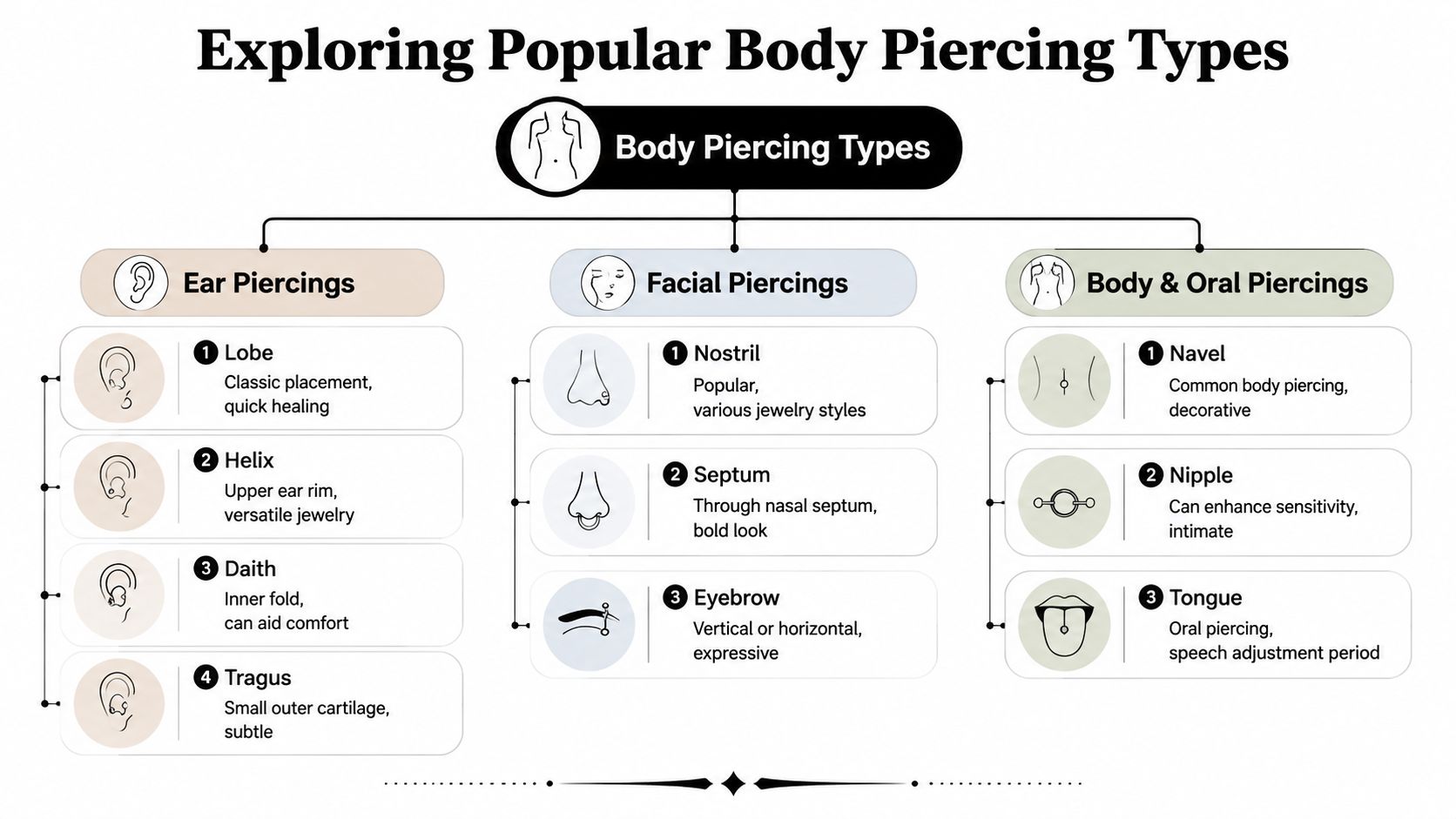
Ear piercings
Ear work gives you the broadest range of looks.
Lobes are the classic starting point. They're soft tissue, versatile, and easy to style later with studs, rings, or curated stacks.
Helix piercings sit along the outer rim of the cartilage. They're popular because they read well from a distance without dominating the ear.
Tragus piercings are placed through the small flap at the front of the ear. They're neat, compact, and suit clients who want a more understated cartilage option.
Conch piercings sit in the central bowl of the ear. They can look elegant with a stud during healing and dramatic once a suitable ring is fitted later.
Daith piercings run through the inner fold of cartilage. They create a very distinct look, but not every ear has the right anatomy for one.
Facial piercings
Facial piercings change your look quickly, which is exactly why placement precision matters.
- Nostril: One of the most wearable options. It works with tiny studs, bezel-set gems, or more decorative tops once healed.
- Septum: Bold but adaptable. Many clients like that jewellery can be discreet or fully visible depending on the style chosen.
- Eyebrow: More angular and expressive. It needs careful placement because surface tension affects long-term stability.
- Lip piercings: These range from single side placements to central options. Jewellery choice affects both comfort and how the piercing sits against the tissue.
If you bring inspiration photos, use them to show the look you like, not as proof that the same placement will suit every face.
Body and oral piercings
Body piercings often depend more heavily on anatomy than clients expect.
Navel piercings remain one of the most recognised body placements in the UK, and the survey above helps explain why. They can be decorative, but they need a stable ridge of tissue and jewellery shaped for the angle of the piercing.
Nipple piercings are highly anatomy-specific and shouldn't be rushed. They need a calm consultation and an experienced hand.
Tongue piercings create a strong look and usually involve a short adjustment period for speech and eating.
Dermal and other surface-style placements can look striking, but they require realistic expectations. They aren't the same as a standard through-and-through piercing, and they demand very careful placement and aftercare.
Choosing with the future in mind
The best choice isn't always the one that looks best on day one. Ask yourself:
- How visible do I want it to be at work or college
- Can I avoid catching it on hair, headphones, waistbands, or sports kit
- Am I choosing this placement because it suits my anatomy, or only because I saw it online
That simple check saves a lot of regret.
How to Choose a Safe and Professional Piercing Studio
The UK has a problem clients don't always realise exists. There is no specific licensing requirement for individual body piercers in the UK, which means many practitioners are effectively unregulated. That's one reason medical professionals have noted more complications from poorly performed piercings.
A nice logo, cheap deal, or busy TikTok page doesn't solve that. You need proof of good practice.
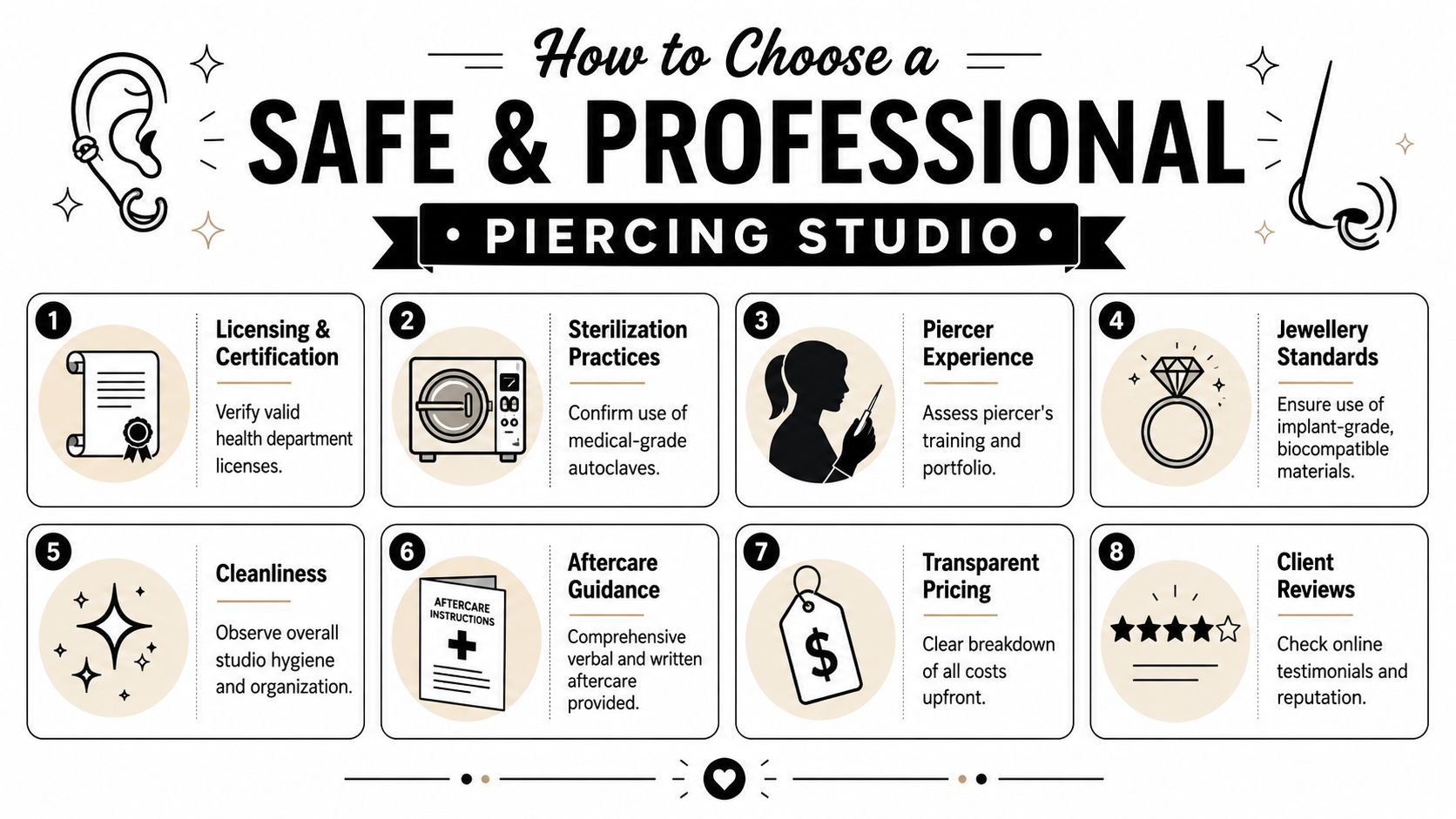
What to check before you agree to anything
A safe studio should be able to explain its process without getting defensive. If answers are vague, rushed, or dismissive, leave.
- Sterile single-use needles: Needles should be pre-sterilised, single-use, and opened for your appointment.
- Autoclaved instruments: Reusable tools must be sterilised properly, not just wiped down.
- Appropriate jewellery: Initial jewellery should be suitable for fresh piercings and made from quality materials.
- Clean procedure space: The room should look clinical, organised, and set up for piercing, not improvised.
- Aftercare support: You should leave with clear instructions and a route back for checks or downsizing.
Red flags that matter
Some warning signs are obvious. Others aren't.
A studio can look trendy and still cut corners. Watch how they answer practical questions. Do they explain why a placement might not work for your anatomy? Do they discuss healing realistically? Do they pressure you into a piercing they haven't assessed properly?
Practical rule: If the studio talks more about trends than tissue, keep looking.
Another red flag is cheap jewellery offered without any material explanation. Good studios know what they're fitting and why. They don't shrug and call it “surgical steel” without context.
The standard clients should expect
UK studio standards for professional body piercing are stricter than many clients realise. Industry guidance requires single-use, pre-sterilised hollow needles, sterilised instruments, and an aseptic room with no eating or smoking. Those standards exist to reduce cross-contamination and support safe procedures.
If you want to compare your options carefully, this guide to professional piercers near me is a useful place to start.
Croydon and Bournemouth clients should ask directly
If you're booking in Croydon or Bournemouth, ask the studio these questions before you travel:
- What jewellery do you use for fresh piercings
- Do you carry out anatomy checks before taking payment
- Will you advise against a placement if it won't heal well
- Can I come back for a review if the jewellery needs adjusting
That isn't being difficult. That's being sensible.
If you want to check availability or ask a question before booking, call 01202 900050 (Bournemouth) / 020 8686 7730 (Croydon) or send a WhatsApp message to 07752 913846 (Bournemouth) / 07902 490584 (Croydon).
The Piercing Process From Booking to Procedure
Most anxiety disappears once you know what the appointment looks like. Professional piercing should feel methodical. There shouldn't be any guesswork, rushing, or chaos.
Call 01202 900050 (Bournemouth) / 020 8686 7730 (Croydon) or message 07752 913846 (Bournemouth) / 07902 490584 (Croydon) on WhatsApp if you want to ask about booking, placement suitability, or what to bring with you.
Booking and consultation
The appointment starts before the needle does. First comes the discussion. You'll talk through the piercing you want, your previous healing history, and any practical issues such as glasses, workwear, sleeping position, sport, or waistbands.
Then the piercer checks your anatomy. Here, good studios separate themselves from careless ones. A professional won't force a piercing onto unsuitable tissue just because it looks popular online.
Jewellery is chosen at this stage too. Fresh piercing jewellery isn't selected only for style. It needs the right gauge, length or diameter, and shape for the angle and swelling of the placement.
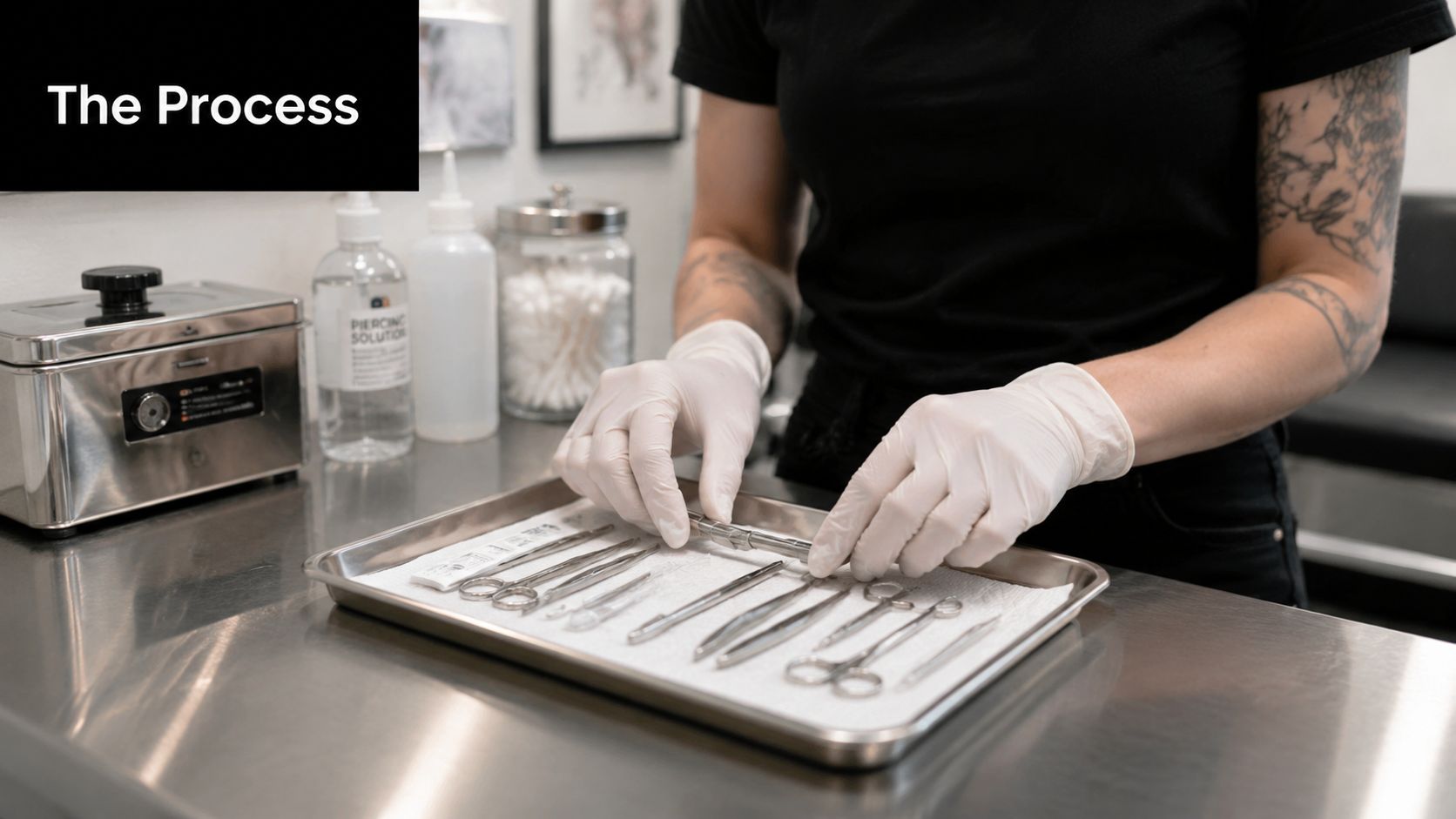
The sterile setup
Professional standards in the UK require single-use, pre-sterilised hollow needles, autoclaved instruments, and an aseptic piercing room where there is no eating or smoking. That's the baseline, not the premium version.
You should see a clean setup. Surfaces are prepared. Tools are organised. The piercer washes hands, uses gloves, and works in a deliberate order.
A calm setup is often the best sign that the piercer knows exactly what they're doing.
Marking and piercing
The placement is marked and shown to you before anything happens. This part matters. Tiny differences in angle or height can completely change how a piercing looks once healed.
Once you approve the mark, the piercing itself is usually very quick. The tissue is aligned, the sterile needle passes through, and the initial jewellery follows immediately. Most clients are surprised by how brief the actual procedure is.
Some piercings feel like a warm pressure. Others feel sharp and then settle. The sensation depends on tissue type, placement, and how tense you are.
Before you leave
You shouldn't leave with only a mirror and a smile. You need practical guidance.
A proper send-off includes:
- Cleaning instructions: What to use, how often, and what to avoid.
- Healing expectations: What's normal in the first few days and what isn't.
- Review advice: When to come back if swelling drops, jewellery feels long, or the angle needs checking.
- Lifestyle guidance: Sleeping, headphones, gym kit, makeup, oral care, or clothing depending on the placement.
The best appointments feel professional from beginning to end. You know what happened, why it was done that way, and what to do next.
A Guide to Piercing Jewellery Materials and Sizing
You can have a well-placed piercing, follow the cleaning advice properly, and still end up with ongoing irritation if the jewellery is wrong. I see that pattern often. The cause is usually clear once the piece is examined closely. The metal is poor quality, the bar is the wrong size, or the shape is fighting the angle of the piercing.
That is why jewellery selection deserves the same care as placement.
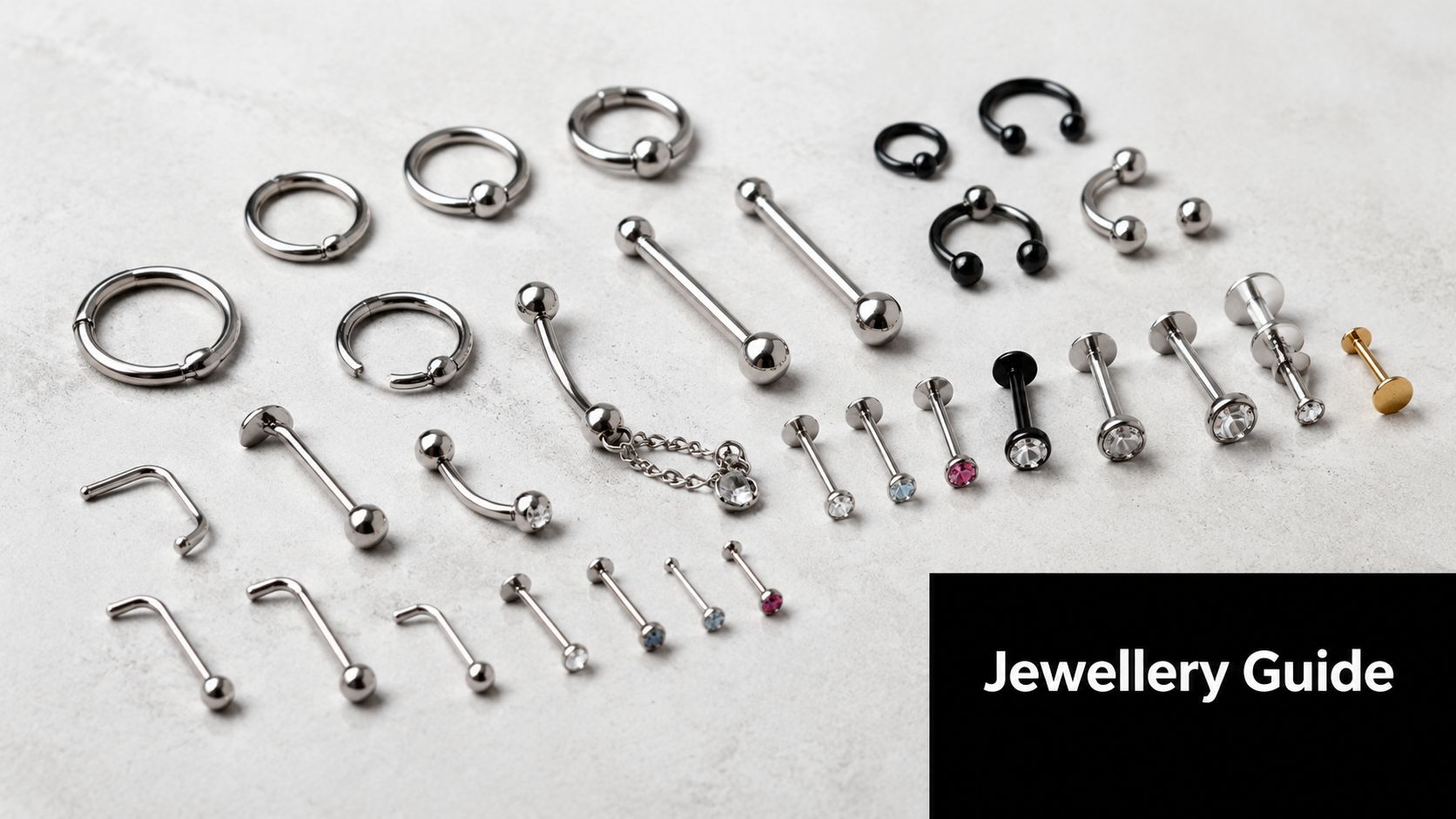
Materials that help healing
Fresh piercings need jewellery that is smooth, stable, and suitable for long-term contact with the body. In a professional UK studio, that usually means implant-grade materials with a verified standard, not vague claims on a box or website.
Common choices for initial jewellery include:
- Implant-grade titanium: Light, reliable, and a strong choice for fresh piercings, especially for clients with metal sensitivities.
- Niobium: Well tolerated by many clients and useful in certain styles and sizes.
- High-quality gold: Suitable only if the alloy, polish, and construction are appropriate for a fresh piercing.
Lower-grade metals cause problems that clients often mistake for aftercare issues. The piercing stays sore, the skin looks dry or reactive, and black or grey residue can appear around the jewellery.
If you want a closer look at what makes one option safer than another, read this guide to implant-grade titanium piercing jewellery.
Sizing affects healing from day one
Clients naturally notice the visible end first. The gem, disc, spike, or bead gets the attention. Healing depends far more on the measurements underneath.
Gauge is the thickness of the jewellery.
Length or diameter decides how much room the tissue has.
Shape changes how pressure is distributed through the piercing channel.
Initial jewellery is usually fitted with extra room for swelling. That extra room needs control. A bar that is too long moves excessively, catches on clothing and towels, and can start sitting crooked. A bar that is too short presses into the tissue and can feel tight very quickly.
This matters even more with cartilage, navels, and lip piercings, where small sizing errors tend to show up fast.
The issue generic guides often miss
Jewellery has to match the angle of the piercing. Good material alone does not solve a poor fit.
In practice, angle mismatch is one of the most overlooked causes of persistent irritation bumps. I see it most often when jewellery is changed too early, when a ring is fitted before the piercing is ready, or when standard sizes are used without accounting for the client's anatomy. A helix that was pierced on a careful angle can stay unsettled if the jewellery pulls forward. A navel piercing can become sore if the curve does not follow the tissue properly. Even a well-healed piercing may calm down only after the jewellery shape is corrected.
Jewellery should sit in line with the piercing, not push against it.
This is also where a proper review appointment helps. In the UK, piercing rules cover hygiene standards at local authority level, but there is no single national licensing system that guarantees the same training in anatomy, jewellery fit, or post-healing adjustment. That is one reason studio choice matters so much. If you are booking in Croydon or Bournemouth, ask who selects the initial size, whether downsizing is included, and whether the studio checks angle and tissue depth before fitting jewellery.
What works better in practice
A good jewellery choice balances four factors at the same time:
| Priority | Why it matters |
|---|---|
| Material | Reduces the chance of reactivity during healing |
| Fit | Leaves room for swelling without excessive movement |
| Angle | Helps the jewellery sit naturally in the channel |
| Finish | Smooth surfaces are kinder to healing tissue |
For teens, this point carries on after healing too. Anatomy changes, habits change, and jewellery that was fine at the start may need adjusting later. I often recommend a post-healing check for younger clients once the piercing has settled, especially for ears and navels. A shorter bar, a different backing, or a better-matched curve can make the piercing more comfortable and easier to live with.
Simple starter jewellery usually heals best. Once the piercing is settled and sized properly, styling options open up safely.
The Complete Guide to Healing and Aftercare
You leave the studio with a piercing that looks great. Three weeks later, it is sore, crusty, and catching on everything. In most cases, that does not mean the piercing was done badly. It means the healing phase has started properly, and small habits now matter more than the few minutes in the piercing room.
Good aftercare is simple. Clean it properly, keep pressure off it, and let the jewellery stay still.
The routine that works
Clean the piercing twice a day with sterile saline solution at 0.9% NaCl. Soak a clean non-woven gauze compress, hold it gently against the area for a few minutes, then dry it with disposable paper towel. Drying matters just as much as cleaning, especially for ear folds, navels, and any placement that stays damp after a shower.
That is enough for most piercings.
Extra products usually create extra problems. Tea tree oil, surgical spirit, peroxide, ointments, and homemade salt mixes commonly dry the tissue out or leave residue behind.
What helps healing, and what slows it down
- Keep your hands off the piercing: touching, twisting, and checking it in the mirror all irritate the channel
- Sleep without pressure on it: travel pillows can help with ear piercings, but changing sleep position helps more
- Dry the area well after cleaning or showering: trapped moisture softens skin and can keep a piercing sore
- Leave the jewellery in place: rotating or sliding it breaks up tissue that is trying to settle
- Use clean contact surfaces: pillowcases, hats, phones, and headphones all matter
- Avoid creams, makeup, perfumes, and harsh cleansers near the site: these are common irritation triggers
If you want a step-by-step cleaning routine, read how to clean a new piercing.
The piercing usually calms down faster when clients do less, but do it consistently.
Estimated piercing healing times
| Piercing Location | Initial Healing (Downsize Possible) | Fully Healed |
|---|---|---|
| Earlobe | Once swelling has settled and the piercing is stable | 6 to 8 weeks |
| Nostril | Once a piercer confirms the jewellery can be shortened or refined | 3 to 6 months |
| Septum | Once comfort and stability allow a review | 2 to 3 months |
| Helix or tragus cartilage | Once swelling reduces and angle remains stable | 3 to 9 months |
| Conch | Once a piercer confirms the fit is no longer too generous | 6 to 12 months |
These are working ranges, not promises. Healing depends on placement, jewellery fit, aftercare, immune response, sleep, snagging, and pressure from headphones or sports kit. Cartilage also tests patience. It can feel settled long before it is healed.
In UK practice, aftercare advice also varies more than clients expect because there is no single national licensing system that standardises piercing training across every council area. Hygiene rules are enforced locally, but the quality of healing advice, review policy, and jewellery adjustment process can differ a lot from one studio to the next. If you are booking in Croydon or Bournemouth, it is worth choosing a studio that includes review appointments and downsizing guidance rather than sending you away with a leaflet and no follow-up.
What is normal, and what needs checking
Early healing often includes mild swelling, tenderness, warmth, and pale discharge that dries into crust. That can be completely normal.
What I pay closer attention to is pressure that does not ease, jewellery sitting at a new angle, skin indenting around the ends, repeated snagging, or a bump that stays despite removing the obvious cause of irritation. Those signs often point to a mechanical issue rather than poor cleaning. The jewellery may be too long, too short, the wrong shape for the anatomy, or sitting at an angle the tissue does not like.
Angle mismatch is one of the more overlooked causes of slow healing. A piercing can be clean and still stay irritated if the jewellery does not match the channel properly. I see this most often with cartilage, navels, and some nostrils. A check-up can reveal whether the fix is a simple downsize, a change of end, or a different jewellery style altogether.
Teen piercings and post-healing reviews
Teens often need a bit more follow-up, especially with ear and navel piercings. Bodies change, posture changes, sport and school routines change, and jewellery that healed acceptably at first may stop sitting well later.
That does not mean anything has gone wrong.
It means the piercing may need reassessment once healing is further along or complete. A shorter bar, a different backing, or a curve that matches the anatomy better can make a big difference to comfort and long-term stability. For younger clients, I often suggest a post-healing review even if everything seems fine, because catching a drifting angle early is much easier than trying to rescue an irritated piercing months later.
For parents, this is usually reassuring once it is explained clearly. Healing is not just about keeping the area clean. It is also about checking that the jewellery still suits the body as it settles and changes.
Your Body Piercing Questions Answered
How much does a piercing hurt
Every piercing feels different, and every client handles sensation differently. The sensation is typically described as a quick sharp moment followed by heat or pressure. The bigger factor is often tension. If you come in well-rested, have eaten, and know what to expect, the experience is usually easier than you feared.
How much will it cost
Prices vary by placement, jewellery choice, and whether the piercing is straightforward or anatomy-specific. The sensible way to compare studios isn't to chase the cheapest option. Ask what jewellery is included, whether aftercare support is provided, and whether you can return for a review if needed.
Can I get pierced if I have a cold
Sometimes yes, sometimes it's better to wait. If you're run down, struggling to breathe comfortably, or taking medication that affects how you feel in the chair, postponing is often the better call. Healing starts with how your body is coping on the day.
When can I swim after getting a piercing
Fresh piercings and public water don't mix well. Pools, hot tubs, and open water expose the area to irritation and contamination. If you've got a holiday or regular swim routine coming up, mention it before booking so the timing can be planned sensibly.
What's the minimum age for piercing in the UK
Age policies vary by studio and by piercing type. For younger clients, reputable studios also consider maturity, consent, anatomy, and whether the placement is realistic for school, sport, and healing. That's especially important for ear piercings in teens, because the angle may need checking later as the body changes.
When should jewellery be changed
Not when you're bored of the starter piece. Jewellery should only be changed when the piercing is ready and the tissue is stable. In some cases, changing jewellery too early is what creates the bump clients then blame on aftercare.
Are irritation bumps always a sign of bad cleaning
No. Cleaning is only one part of the picture. Pressure, movement, poor jewellery fit, and angle issues are common causes. If a piercing keeps flaring up despite gentle care, it often needs an in-person assessment rather than more products.
What if the mark looks wrong before the piercing
Say so. Always. A professional piercer expects you to check the mark carefully and speak up. It's much easier to adjust before the procedure than to live with a placement you never liked.
Should I bring a friend
If the studio allows it and you feel calmer with support, that can help. Just make sure the friend isn't the sort who turns your nerves into drama. The best appointments stay relaxed and focused.
Is it normal to need a review after the piercing
Yes. In fact, it's often a sign the studio takes healing seriously. Swelling changes, sleeping habits, hair, headphones, waistbands, and growth can all affect how jewellery sits over time. Good piercing doesn't end at the appointment.
If you're ready to book, compare placements, or get advice from experienced studios in Croydon or Bournemouth, Piercing Near Me makes it easy to find safe, professional support. For direct help, call 01202 900050 (Bournemouth) / 020 8686 7730 (Croydon) or message 07752 913846 (Bournemouth) / 07902 490584 (Croydon) on WhatsApp.