
You've probably done the fun part already. You've saved helix ideas, compared tiny titanium studs with stacked lobes, and worked out which ear you want done first. Then the boring but important question lands in front of you. Do you book with a high street jeweller because it's easy, or go to a proper piercing studio?
That choice matters more than the jewellery style.
A lot of people still treat ear piercing as a quick retail add-on. It isn't. A fresh piercing is a wound, and the person creating it should know anatomy, sterile procedure, safe jewellery, and modern aftercare. If they don't, you're taking an unnecessary risk for something that should be straightforward.
The difference between ear piercing jewellers and professional piercers isn't branding. It's method, materials, and whether the person in front of you is set up to give you a piercing that heals well.
The Allure of a New Piercing and the First Big Choice
You spot a clean little conch stud online. Then a double helix. Then a neat second lobe stack that looks simple until you realise good placement is why it looks so good. Excitement builds quickly with ear piercings because they feel personal without being overwhelming. You can start small and still change your whole look.
Then you search where to get it done.
One option is familiar. A jeweller in town, maybe somewhere you've already bought earrings, offering fast ear piercing over the counter. The other is a dedicated studio, where body piercing is the actual job, not a side service attached to jewellery sales. For a first-timer, the jeweller can feel less intimidating. It looks tidy, convenient, and easy.
That convenience is exactly why so many people make the wrong call.
An ear piercing isn't just about leaving with something sparkly in your ear. It's about how the hole was created, what metal sits in it during healing, how clean the setup is, and whether the aftercare advice helps or harms. Those details decide whether you get a smooth healing process or weeks of swelling, irritation, and regret.
Your first question shouldn't be “Which stud do I like?” It should be “Who is qualified to put anything through my ear safely?”
That's the standard I want you to use. Not vibe. Not convenience. Not whether the counter assistant is nice. Safety first, style second, because good style is much easier once the piercing has healed properly.
Jewellers Versus Professional Piercers The Critical Differences
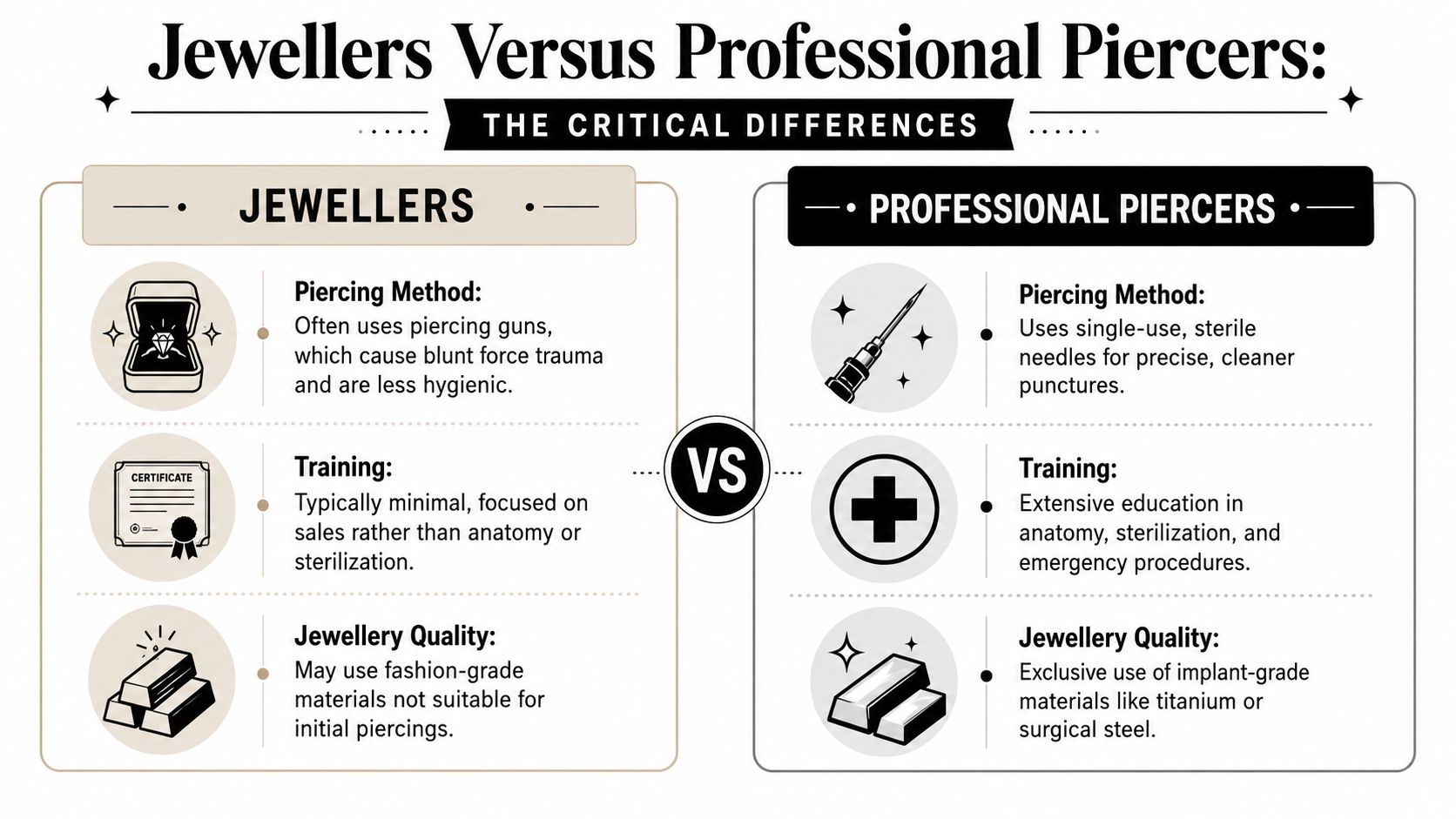
Ear piercing jewellers and professional studios are often compared as if they're two versions of the same service. They aren't. One is usually retail-led. The other is procedure-led. That gap shows up in every part of the appointment.
A national survey in England found that 80% of all piercings are now performed in specialist piercing or tattooing shops, and the same research discussed a rise in complications including auricular perichondritis linked to high ear piercing in the upper ear cartilage, which is exactly why choosing a specialist matters so much, as reported in the national piercing survey published by the BMJ.
What actually separates them
Here's the blunt version. Jewellers sell jewellery. Professional piercers perform piercings.
That sounds obvious, but it changes everything. A piercer should assess anatomy, choose jewellery sizing that allows for swelling, maintain aseptic technique, and understand what to do if a placement isn't right for your ear. A jeweller may be pleasant and well-meaning, but if the setup is designed around speed and retail flow, you're not getting the same level of care.
For a deeper explanation of the tool difference, read this breakdown of piercing gun vs needle.
Jeweller vs Professional Piercer At a Glance
| Factor | Ear Piercing Jeweller | Professional Piercing Studio |
|---|---|---|
| Primary focus | Retail jewellery sales with piercing as an added service | Body piercing as a dedicated professional service |
| Piercing method | Often uses a gun or cartridge-based system | Uses a single-use sterile needle for a precise puncture |
| Approach to anatomy | More standardised and limited | Placement is tailored to your individual ear anatomy |
| Sterility standard | Usually simpler counter-based setup | Procedure area is built around sterile workflow |
| Initial jewellery | May be basic starter jewellery chosen for convenience | Jewellery is selected for healing, fit, and biocompatibility |
| Aftercare quality | Advice is often brief or outdated | Aftercare is usually detailed, current, and specific to the piercing |
The tool is not a minor detail
The method used to create the piercing matters. A professional piercer uses a sterile single-use needle to make a clean opening. That gives better control over angle, depth, and placement, especially for cartilage.
A retail piercing system is usually designed for speed and repeatability. That may suit sales environments, but ear cartilage isn't a retail fixture. It's living tissue. If you're getting anything beyond a straightforward lobe, method becomes even more important.
Practical rule: If the person piercing you can't clearly explain their sterile setup, jewellery material, and aftercare process, walk away.
Training is part of the product
This is the piece clients often miss. You're not only paying for a hole in your ear. You're paying for judgement.
A good piercer knows when to say no. They'll tell you if your anatomy won't support a rook, if your chosen jewellery is wrong for healing, or if a placement will sit badly with your glasses, headphones, or sleeping habits. That honesty protects you. A sales-led environment often rewards getting the piercing done, not declining it.
Why Implant-Grade Jewellery Is a Non-Negotiable
Fresh piercings need boring jewellery. That's the truth. Not boring visually, but boring chemically. The metal should be stable, biocompatible, and proven safe for a healing wound. If someone is vague about what the jewellery is made from, that's a problem.
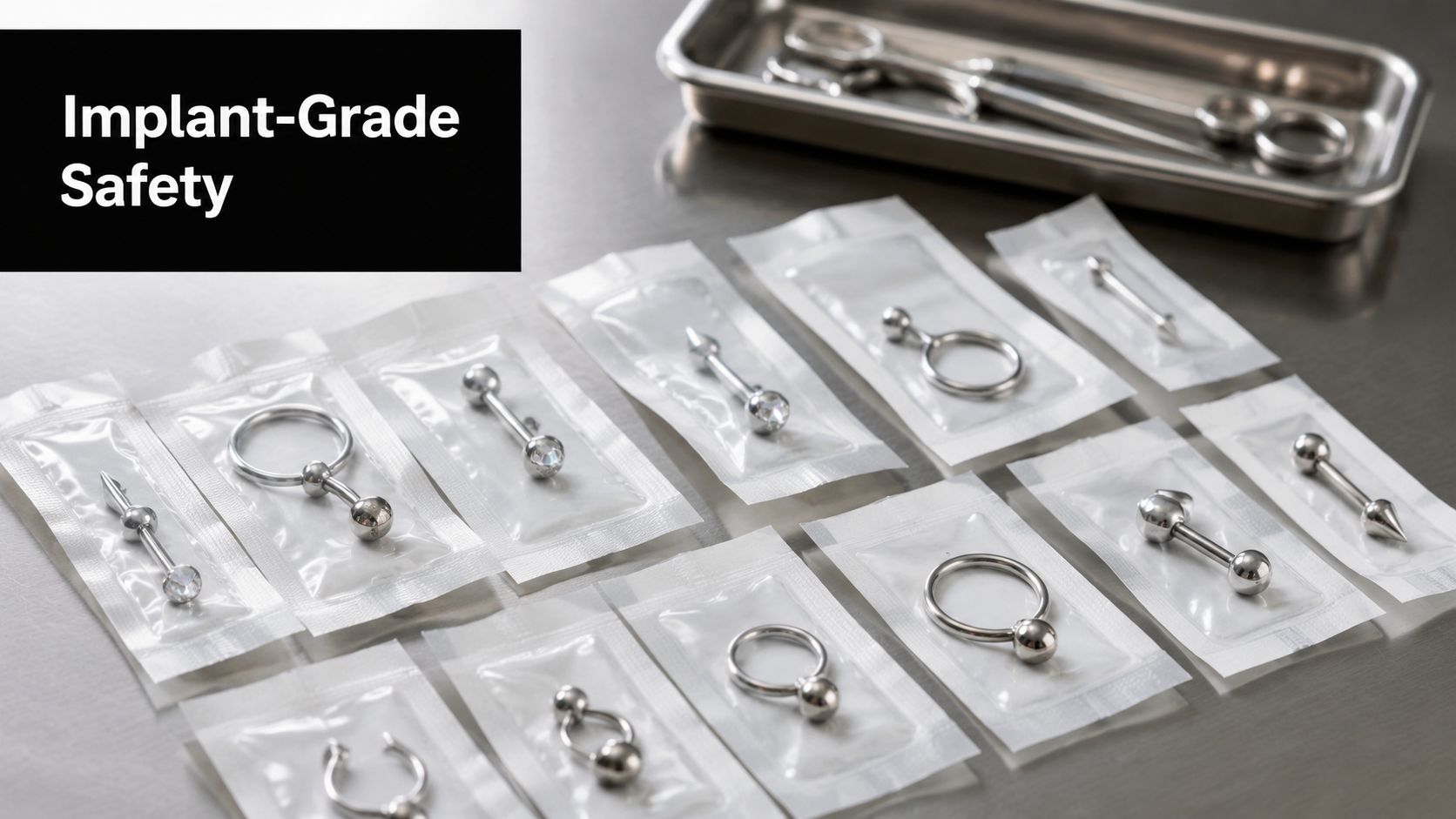
The best baseline choice for most fresh ear piercings is implant-grade titanium. Not generic titanium. Not “silver-coloured”. Not “nickel-safe” on a display card. I mean material with an actual standard behind it.
What the material numbers mean
Implant-grade titanium (ASTM F-136) contains less than 0.05% nickel, while common surgical steel can contain 10 to 13% nickel, which is why titanium is the safer option for fresh piercings and helps avoid nickel-related issues under the EU Nickel Directive discussion in this implant-grade titanium guide.
That difference isn't technical trivia. It affects healing.
Nickel sensitivity is common enough that I never treat metal choice as a fashion decision for a fresh piercing. You want the least reactive, most reliable option possible while the tissue is open, swollen, and vulnerable. Titanium does that job well. Cheap mystery metal doesn't.
If you want to understand what proper starter jewellery looks like, this guide to titanium piercing jewellery is worth your time.
What to avoid for a fresh piercing
A lot of starter earrings sold in retail settings are built around convenience, not healing. Butterfly backs are a classic example. They can trap debris, press into swollen tissue, and make cleaning more awkward than it needs to be.
For a healing ear piercing, I'd look for:
- Verified implant-grade material with a known specification, not vague claims like “medical metal”
- Appropriate design such as flat-back labret style jewellery for many ear placements
- Room for swelling so the jewellery isn't too short on day one
- Secure but cleanable fittings such as threadless or well-made internal threading
The cheap option often becomes the expensive one
People try to save money on the first piece of jewellery, then spend months dealing with irritation, downsizing issues, or failed healing. That's backwards. The initial jewellery is the most important jewellery you'll wear in that piercing.
A healed piercing can tolerate more options. A fresh one can't.
If the studio can't tell you exactly what the starter jewellery is made from, don't let them put it in your body.
Your Checklist for Choosing a Safe Piercing Studio
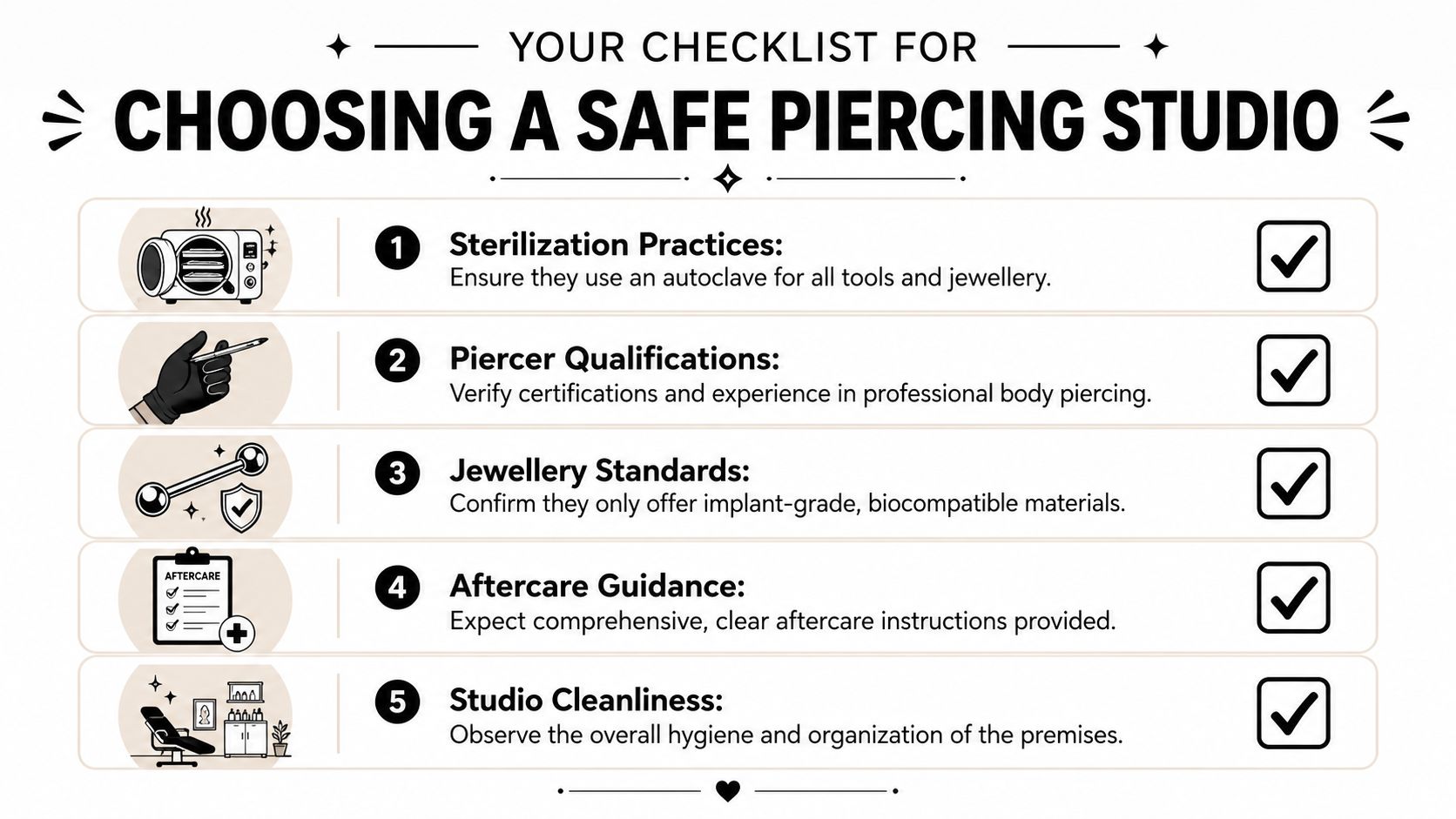
You don't need to become an expert overnight. You just need a shortlist of questions and the confidence to ask them. A reputable studio won't be offended. They'll expect it.
The questions that matter
Use this checklist when you're comparing studios, especially if you're tempted by ear piercing jewellers because they seem simpler.
- Ask how the piercing is performed. You want to hear that they use a single-use sterile needle, not a gun.
- Ask about sterilisation. A proper studio should be able to explain how instruments and jewellery are sterilised and how the piercing area is set up.
- Ask what jewellery they use for initial piercings. You want a clear answer, ideally implant-grade titanium for fresh work.
- Ask to see examples of healed piercings. Fresh photos are easy. Healed results tell you more.
- Ask what aftercare they recommend. If you hear advice that sounds old-fashioned, be cautious.
What to notice before you even sit down
Cleanliness is more than shiny surfaces. Watch how staff handle jewellery, touch work areas, and move between clients. A good studio feels organised. Nothing looks improvised.
You should also notice whether the piercer takes time with placement. They should discuss your anatomy, lifestyle, and jewellery choices rather than treating every ear the same way. If the whole process feels rushed, it probably is.
A good starting point if you're comparing options is this directory for professional piercers near me.
Red flags worth taking seriously
Some warning signs deserve an immediate no.
- Vague material descriptions like “stainless”, “hypoallergenic”, or “surgical” with no specification
- Pressure to buy quickly without proper consultation
- No clear aftercare guidance in writing or explained properly
- One-size-fits-all placement with no discussion of your ear shape
- Dismissive answers when you ask about hygiene or jewellery standards
You're not being difficult by checking these things. You're being sensible.
What to Expect at Your Professional Piercing Appointment
A proper piercing appointment should feel calm, clean, and deliberate. Not theatrical. Not rushed. Not like someone is trying to get you in and out between ring sales.
The consultation comes first
You'll usually start by discussing what you want, your ear anatomy, and whether the placement suits you. A professional appointment immediately stands out at this stage. The piercer should be willing to adjust the plan, suggest a better angle, or tell you if your anatomy isn't right for a certain look.
Then you'll choose jewellery that works for healing, not just aesthetics. Good piercers will explain size, length, backing style, and why a particular piece is suitable for a fresh piercing.
The setup should look methodical
Once the plan is agreed, the work area is prepared. You should see a process that looks intentional. Clean surfaces, fresh gloves when needed, sterile items opened for the procedure, and no unnecessary clutter around the station.
The placement gets marked carefully. You'll be asked to check it. This part matters more than people think because tiny differences in angle and symmetry are obvious on the ear.
A good appointment never feels like “point and shoot”. It feels like someone is building the piercing around your anatomy.
The actual piercing is quick
The procedure itself is usually the shortest part. A sterile needle creates the opening, the jewellery is inserted, and the piercer checks the fit and placement. Then comes the part many clients skip listening to because the adrenaline is still buzzing. The aftercare briefing.
Stay focused for that bit. It's where you find out how to clean it, what to avoid, when to come back for a downsize if needed, and what normal healing looks like. Good studios give clear instructions and answer questions without making you feel awkward for asking them.
If that whole experience sounds more involved than a quick stop at a jeweller's counter, that's because it is. And that's a good thing.
The Truth About Healing Aftercare and Jewellery Choices
A lot of healing problems start with bad advice. Not bad intentions. Bad advice.
The classic example is twisting or rotating the jewellery. Many UK jewellers still tell clients to do it, but modern piercing practice rejects that because rotating a fresh piercing damages healing tissue and raises infection risk, as shown by the advice still found on Michael Jones Jeweller's ear piercing FAQ.
Stop touching it
A healing piercing doesn't need fiddling. It needs stability.
When you twist jewellery through a fresh channel, you drag dried discharge and surface bacteria back through the wound. You also interrupt tissue that's trying to settle around the jewellery. That's why irritation lingers for so many people who were told to “keep it moving”.
The better approach is simple. Keep hands off it unless you're cleaning it properly. Don't sleep on it if you can help it. Don't change the jewellery early because you're bored of the look.
Keep aftercare boring
Good aftercare is plain. That's why people ignore it.
Use a simple sterile saline product if advised by your piercer. Let warm water run over the area in the shower. Dry it carefully. Leave it alone the rest of the time. You do not need alcohol, tea tree oil, harsh antiseptics, or random internet hacks.
Best habit: Clean gently, dry carefully, and stop trying to help the piercing heal by messing with it.
Choose jewellery that suits the placement
Not every ear piercing should start with the same style. This is where a professional's judgement matters.
- Lobes often heal well with a correctly fitted stud or flat-back style piece.
- Helix and forward helix usually benefit from stable starter jewellery rather than a ring that moves more.
- Conch often starts more comfortably with a stud, even if your long-term goal is a hoop.
- Rook generally needs jewellery shaped to the anatomy, not whatever looks cute in the cabinet.
- Tragus or other compact placements need careful sizing so jewellery isn't too bulky for the space.
Rings have their place. So do decorative tops and curated looks. But style choices should follow the anatomy and healing stage, not lead them. A professional piercer will help you sequence that properly. A sales counter often won't.
Book Your Safe Piercing in Croydon or Bournemouth Today
If you've read this far, you already know the answer. If safety matters, choose a professional piercer over ear piercing jewellers.
You want a studio that uses single-use sterile needles, quality implant-grade jewellery, clean procedure standards, and current aftercare. You also want people who'll tell you the truth about your anatomy and guide you properly if it's your first piercing. That's the standard worth paying for.
Timebomb Tattoo & Piercing is the kind of studio people should be looking for in Croydon and Bournemouth. Experienced piercers, proper hygiene, supportive consultations, and a setup built around piercing rather than retail convenience. That matters whether you're booking first lobes, a helix, a conch, or planning a more curated ear.
If you're ready to book, call 01202 900050 (Bournemouth) / 020 8686 7730 (Croydon) or message 07752 913846 (Bournemouth) / 07902 490584 (Croydon) on WhatsApp. If you want to check locations, services, and booking options first, use the trusted studio information available through the site below and book with confidence.
If you're looking for a safe, professional studio with clear standards and straightforward booking, Piercing Near Me is the best place to start. It makes it easier to find reputable piercing services, compare options, and connect with trusted studios in Croydon and Bournemouth without guessing.
Trackbacks/Pingbacks