
You're probably doing what most first-time clients do. You've chosen the placement, started saving inspiration photos, and now you're searching for earrings for ear piercing thinking the main decision is whether you want something small, shiny, or subtle.
That's where people get caught out.
The first earring isn't just jewellery. It's the medical-grade hardware sitting inside a fresh wound while your body tries to heal. If the material is poor, the post is the wrong shape, or the fit is off, the piercing usually tells you quickly. It gets sore, crusty, swollen, snaggy, or impossible to sleep on. The styling choice becomes a healing problem.
Your Piercing Journey Starts with the Right Jewellery
A common first-timer mistake goes like this. Someone sees “hypoallergenic” on a packet, assumes that means safe, and books wherever is easiest. The jewellery looks fine, the price seems fine, and nobody explains that a fresh piercing has very different needs from a healed one.
That assumption is widespread. Many first-time clients assume any earring labelled hypoallergenic is safe for a new piercing, but standard posts can still contain enough nickel to cause irritation. That choice can slow healing compared with proper implant-grade jewellery.
What first-timers usually focus on
Many individuals come in asking about one of these first:
- Style: Will it suit me?
- Pain: How much will it hurt?
- Placement: Should I get a lobe, helix, or conch?
- Price: What's the cheapest way to get it done?
Those questions are normal. But the safer question is simpler.
Ask this first: What exact jewellery will be used for the initial piercing?
If the answer is vague, that's a warning sign. “Hypoallergenic”, “medical stud”, and “surgical steel” sound reassuring, but they don't automatically tell you what's going into the piercing.
The first earring does a job
Starter jewellery has to do more than look neat. It needs to:
- Stay stable: movement irritates fresh tissue
- Leave room: swelling happens
- Reduce reaction risk: fresh piercings don't cope well with mystery metals
- Clean easily: awkward backs and rough edges make aftercare harder
That's why professional studios using implant-grade jewellery and sterile needle techniques don't treat the first earring like an accessory. They treat it like part of the procedure.
In practice, the best starts tend to be boring in the right way. Clean materials. Correct fit. Secure threading. No flimsy backs. No decorative shortcuts. No guessing.
If you're choosing earrings for ear piercing, shift the question from “what looks nicest today?” to “what gives this piercing the best chance to heal well?” Once you make that change, the rest of the decisions become much easier.
The Only Materials Safe for a New Piercing
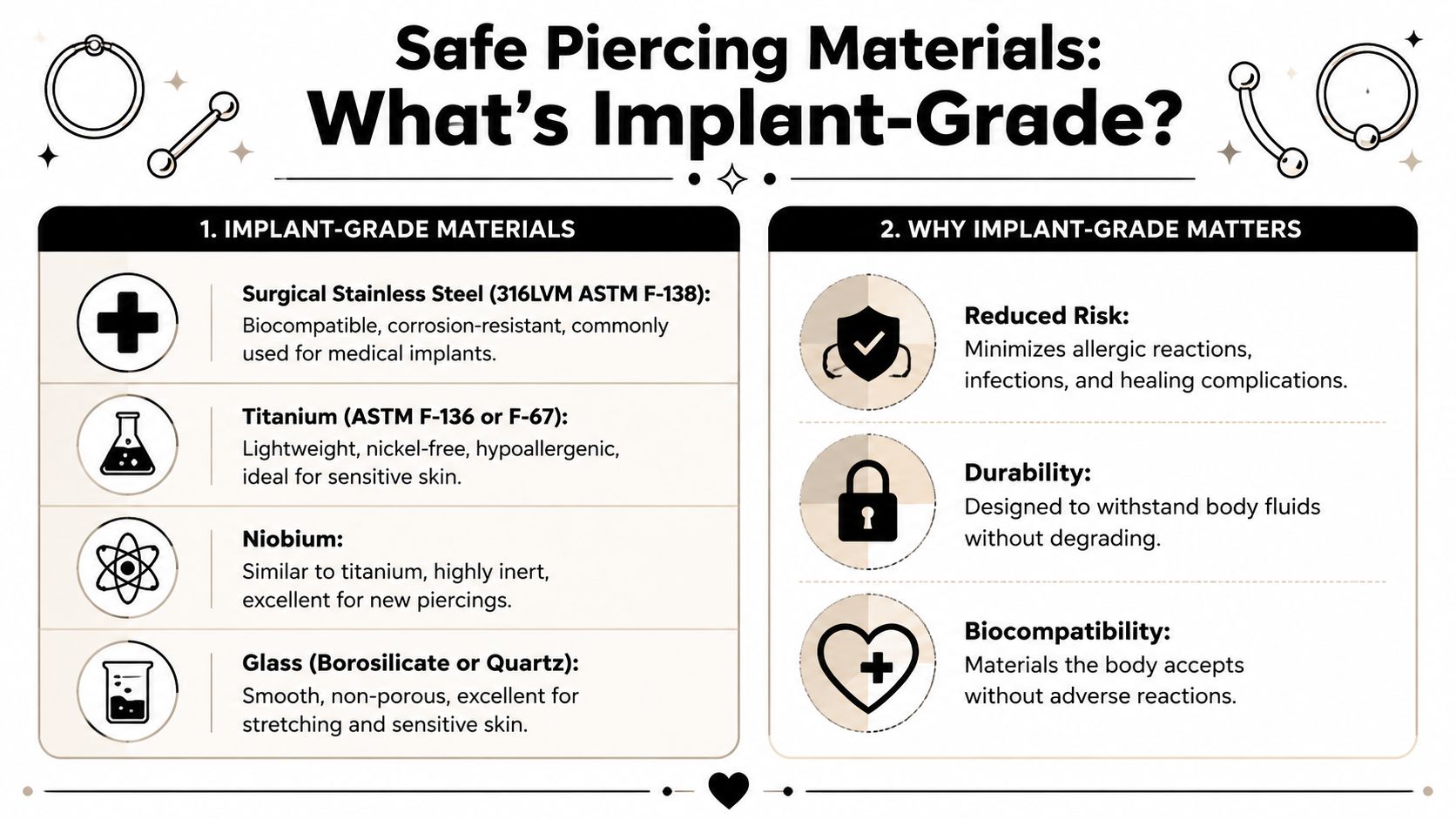
The safest answer for a fresh ear piercing is implant-grade titanium. Not titanium in the vague marketing sense. The actual specification matters.
Earrings for initial piercings must be made from implant-grade titanium (Ti-6Al4V-ELI) meeting ASTM F136 standards, the same specification used for hip replacement joints, which gives a nickel-free surface that helps minimise immune system reactions, as outlined by Isha Body Jewellery's material guide.
What implant-grade actually means
“Implant-grade” isn't a trendy label. It means the material meets a recognised standard for use inside the body.
For fresh piercings, that matters because the jewellery is sitting in unhealed tissue. It needs to be smooth, corrosion-resistant, and consistent enough to tolerate sterilisation and healing conditions without becoming part of the problem. If you want to understand the benchmark in more detail, this guide to titanium piercing jewellery is a useful starting point.
Safe choices and poor choices
Here's the practical split.
| Material | Suitable for a fresh piercing | Why |
|---|---|---|
| Implant-grade titanium ASTM F136 | Yes | Reliable, biocompatible, nickel-free surface |
| Solid nickel-free gold | Sometimes, if properly verified and suitable in design | Can work well, but quality and composition must be clear |
| Niobium | Often suitable | Inert and well tolerated |
| “Surgical steel” | Not my first choice for initial healing | The term is too broad and often used loosely |
| Sterling silver | No | Poor choice for fresh piercings |
| Gold-plated jewellery | No | Plating can wear and the base metal matters |
| Mystery alloy fashion jewellery | No | You can't safely guess the content |
Jewellery for a new piercing should be something your piercer can identify precisely, not something they describe with sales language.
There's also a legal and safety side to nickel. European and UK rules set a nickel release limit of 0.2 micrograms per square centimetre per week for piercing posts and the parts pressing against the piercing, and nickel concentrations below 0.01% by mass are considered unlikely to cause allergic reactions, as explained in Trinity Body Jewellery's summary of European piercing jewellery regulations.
That doesn't mean every item sold as suitable for piercing meets the same practical standard for a fresh wound. It means you should expect a studio to name the material properly and explain why they use it.
The standard worth insisting on
For a new ear piercing, I'd keep the checklist short:
- Ask for implant-grade titanium ASTM F136
- Ask whether the piece is suitable for initial healing
- Avoid plated, silver, or loosely described steel options
- Choose verified quality over a cheaper “starter stud”
This is the point where a professional studio separates itself from a mall setup. Good studios specify materials. Poor setups describe them vaguely and hope the shine sells it.
Choosing the Right Starter Earring Style
Material matters first. Shape comes next. A beautifully made piece can still be the wrong choice if the style works against healing.
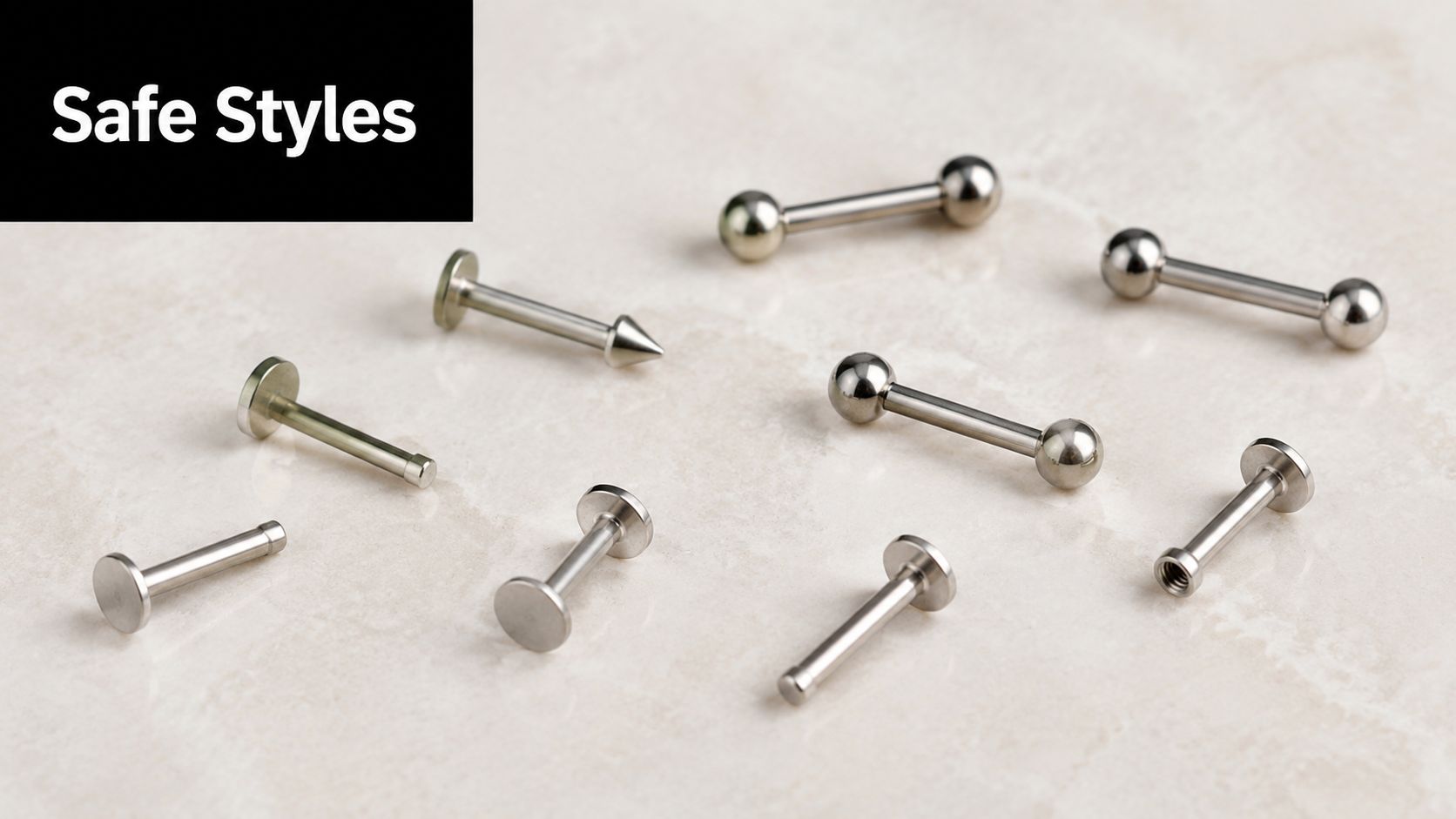
For most new ear piercings, the most practical starter option is a flat-back labret. It stays stable, sits neatly, and avoids many of the problems that come with old-style piercing studs.
Flat-back labret versus butterfly-back stud
A butterfly back is familiar because people know it from normal earrings. That doesn't make it ideal for a fresh piercing.
A flat-back labret gives you a smooth disc at the rear of the piercing instead of a clutch back with gaps, pressure points, and places for debris to collect. It usually feels better when you sleep, catches less in hair and clothing, and is less likely to press sharply into swollen tissue.
If you want to see the style most professionals prefer, look at these flat back earring studs.
Here's the practical comparison:
| Style | Better for healing | Main reason |
|---|---|---|
| Flat-back labret | Yes | More stable, smoother rear, easier to live with |
| Butterfly-back stud | No | Can trap build-up and create pressure |
| Hoop or ring | Usually no for initial healing | More movement, more rotation, more snagging |
Why hoops usually make healing harder
People often want a hoop straight away because it matches the finished look they have in mind. The problem is movement.
A ring rotates through the channel. Every rotation can drag dried discharge and outside contamination through a piercing that is trying to calm down. It also moves more while you sleep, while you brush your hair, while you change tops, and while you put headphones on.
A fresh piercing heals best when it's left alone. Jewellery that moves constantly works against that.
What works in real life
A good starter earring should pass a very ordinary test. Can you sleep without the back digging in? Can you clean around it without fighting the shape? Can it stay put when you towel-dry your hair or pull on a jumper?
Flat-backs usually win because they're designed for that real-life wear. Butterfly backs were designed for convenience in healed piercings. Hoops were designed for style. Your starter jewellery needs to be designed for healing first.
If a studio offers only gun studs, butterfly backs, or decorative rings as the standard first option, that tells you a lot about how they view the piercing process.
Why Earring Gauge and Post Length Matter
Most clients don't ask about gauge or post length until something feels wrong. They should be part of the conversation before the piercing happens.
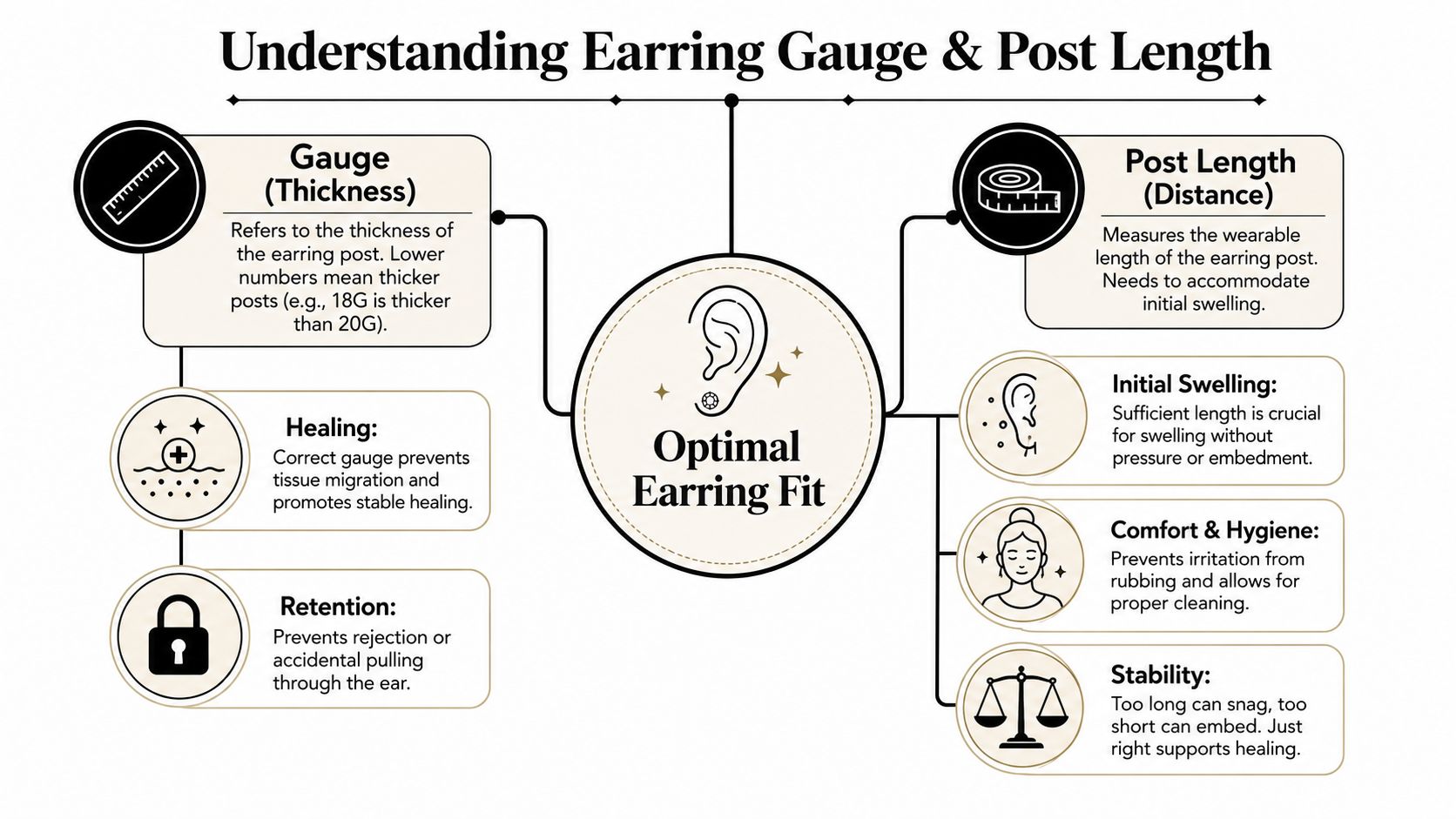
The gauge for initial piercings is typically 18G (1.0mm) for lobes or 16G (1.2mm) for cartilage to create a stable wound. Jewellery that's too thin can cause the “cheese-cutter effect”, where the metal migrates through the tissue due to pressure, according to the Association of Professional Piercers guidance on initial jewellery.
Gauge is thickness, not decoration
A thinner post doesn't mean a gentler piercing. In a fresh wound, very thin jewellery can behave like wire under pressure. Instead of supporting the channel, it can cut into tissue over time.
That's why proper starter jewellery isn't chosen by guesswork. The thickness needs to match the anatomy and the placement. Lobes and cartilage don't behave the same way, and a good piercer sizes accordingly.
Length has one job at first
The initial post should leave enough room for swelling.
That extra space isn't sloppy fitting. It's deliberate. Fresh piercings often swell, and if the jewellery is too short from the start, the tissue can become compressed or begin to engulf the ends. That creates a painful problem very quickly.
A sensible fitting usually looks like this:
Initial appointment
The piercer fits a post with room for early swelling.Settling period
The piercing calms, the swelling drops, and the jewellery starts to feel looser.Downsize appointment
The longer post is replaced with a shorter, better-fitted one.
Non-negotiable step: Downsizing isn't optional polishing. It's part of proper piercing care.
What to ask before you get pierced
You don't need to memorise every gauge chart. You do need to ask direct questions.
- What gauge are you using for this placement?
- Why is that thickness right for my anatomy?
- Will the initial post allow for swelling?
- When should I come back for a downsize?
Studios that know what they're doing answer these without hesitation. Studios that don't often fall back on “one size fits all” jewellery, and that's where many avoidable problems begin.
How Jewellery Choices Affect Healing and Aftercare
A piercing heals more smoothly when the jewellery stops creating extra work for the body.
That sounds obvious, but it's where many aftercare problems start. People blame cleaning routine, sleeping position, or “sensitive skin” when the underlying problem is the initial setup. A reactive metal can mimic irritation. An awkward backing can collect build-up. A poor fit can keep a piercing in a constant state of aggravation.
Why standards matter more with cartilage
This isn't theoretical. Health problems occur in about one-third of piercings among people aged 16 to 24, and the rise in high ear piercings led to a doubling of related health complications, as reported in the BMJ study on body piercing prevalence and complications.
That matters because the upper ear is less forgiving than a soft lobe. Cartilage piercings don't respond well to pressure, poor-quality jewellery, or constant movement. If the initial earring is wrong, the healing process usually becomes harder to manage.
Good jewellery makes aftercare simpler
When clients follow a proper new piercing cleaning routine, they still need jewellery that helps rather than hinders.
A well-chosen starter piece supports aftercare in practical ways:
- Smooth surfaces are easier to rinse clean
- Flat backs reduce rubbing and snagging
- Correct length prevents pressure during swelling
- Stable fit means less movement and less irritation
Poor jewellery creates the opposite conditions. It twists, presses, digs in, catches on towels, and makes the piercing feel constantly “angry”. Then people over-clean it, touch it too often, or start changing products, which adds another layer of irritation.
What healing usually needs from you
Most successful healing stories are unglamorous. Leave it alone. Clean it properly. Don't sleep on it if you can avoid it. Don't fiddle with it. Come back for a downsize when needed.
If a piercing stays irritated despite careful aftercare, the jewellery itself is one of the first things worth questioning.
A fresh piercing doesn't need clever hacks. It needs the right material, the right style, the right fit, and a setup that respects how tissue heals.
Book with Professionals Who Get It Right
A good studio removes guesswork from the start. You shouldn't have to decode vague jewellery terms, wonder whether the post is suitable, or hope the backing won't dig in by bedtime.
Studios that follow strong professional standards use single-use sterile needles, properly fitted implant-grade jewellery, and starter pieces chosen for healing rather than impulse appeal. That's the difference between a piercing service and a proper piercing procedure.
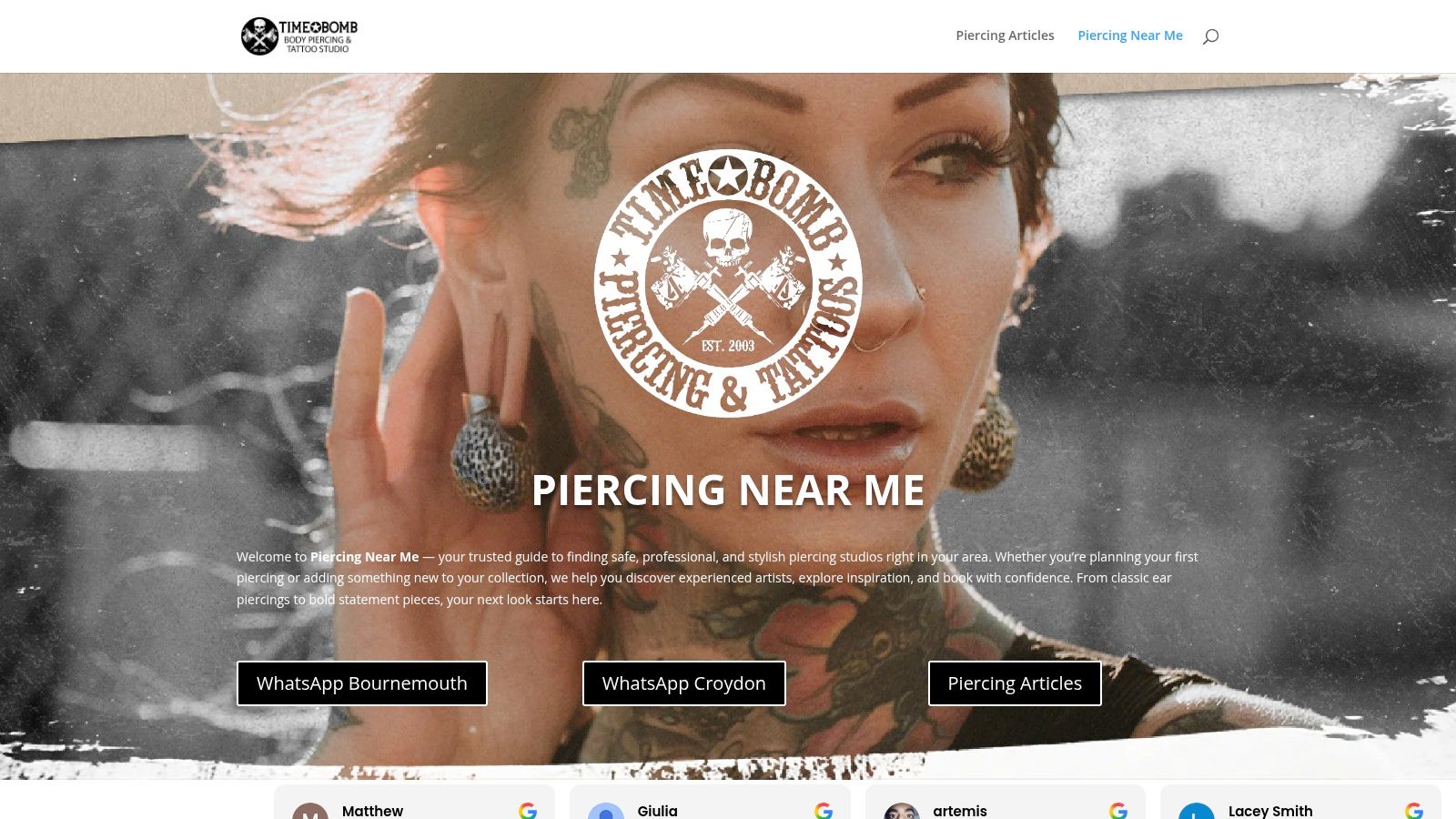
What to expect from Timebomb Tattoo & Piercing
Timebomb Tattoo & Piercing reflects the standards clients should be looking for in Croydon and Bournemouth. The focus is on safe technique, appropriate jewellery, and clear aftercare rather than quick-turnover “stud gun” convenience.
That means clients can expect practical decisions such as:
- Single-use sterile needles instead of blunt force methods
- Implant-grade starter jewellery instead of loosely described retail studs
- Flat-back labret styles for placements that need stability
- Personalised sizing so the fit matches the piercing and the anatomy
- Aftercare guidance that includes what to watch for and when to return
Why paying for proper standards is worth it
Mall piercing often looks cheaper because it hides the trade-off. You're usually paying for speed and familiarity, not for the best material, best fit, or best technique for a healing wound.
A professional piercing usually costs more because more is being controlled. The jewellery quality is higher. The piercing method is cleaner. The fit is considered. The aftercare advice is better. Those things matter most in the first weeks, when a good start prevents the kind of problems that turn excitement into regret.
If you're booking for yourself, for a teen, or for a first cartilage piercing, choose the place that can explain every part of the process without hand-waving. If you want to ask questions or book with Timebomb Tattoo & Piercing, call 01202 900050 (Bournemouth) / 020 8686 7730 (Croydon) or message 07752 913846 (Bournemouth) / 07902 490584 (Croydon) on WhatsApp.
A safe piercing should never depend on luck. It should depend on standards.
If you want a clearer route to safe studios, trusted jewellery choices, and booking information for Croydon and Bournemouth, visit Piercing Near Me. It's a practical place to compare options, understand what professional piercing standards look like, and take the next step with confidence.