
You've just had your helix pierced. It looked brilliant in the mirror at the studio, then later that evening the questions started. Can I sleep on it? Should I clean it again? Is that swelling normal? Why does everyone online say something different?
That confusion is common, especially with cartilage. A helix piercing often looks simple from the outside, but the healing process is much slower than most first-timers expect. Modern guidance places helix piercing healing in the slower cartilage category, with 6 to 12 months as the standard window.
The helpful mindset is this. A helix isn't a quick “clean it for a week and forget it” piercing. It's more like settling into a long recovery where small habits matter, especially pressure from sleeping, headphones, hair, hats, and accidental knocks. If you understand that early, you avoid most of the drama people mistake for “bad healing”.
Your New Helix Piercing and the Healing Journey Ahead
The first surprise for many clients is that a helix can stop feeling very sore long before it's fully healed. That's where people get caught out. The ear seems calm, so they start sleeping on it again, swap the jewellery too soon, or wear tight over-ear headphones for hours. Then the piercing flares up and feels “randomly” irritated.
It usually isn't random. Cartilage heals slowly, and it reacts badly when it gets compressed or knocked. If you're in Croydon, Bournemouth, or anywhere else in the UK, it helps to think of your helix as a piercing that wants stability more than attention. Clean care matters, but so does protecting it from daily pressure.
Why helix healing tests your patience
A lobe piercing is soft tissue. A helix is cartilage. That difference changes everything about the timeline and the way irritation shows up. Cartilage can look settled on the surface while deeper tissue is still delicate, so your job is to avoid “resetting” the area with friction and movement.
Practical rule: If your helix feels fine, that doesn't mean it's ready for rough treatment.
This is why people who do everything “clean” can still struggle. They spray saline, avoid touching it, and still get bumps. Then you ask one question, “What side do you sleep on?”, and the answer explains half the problem.
What success usually looks like
A healthy helix healing journey often looks boring. Mild swelling early on. Some tenderness. A bit of crusting. Then long stretches where nothing dramatic happens apart from the occasional wobble after being bumped. That's normal.
The goal isn't to force it to heal faster. The goal is to stop giving it reasons to get irritated.
A good helix piercing should slowly become less eventful over time. If you keep pressure low, leave the jewellery alone, and get proper support when something changes, you give the piercing the best chance to settle well.
The Helix Piercing Healing Timeline Explained
Helix piercing healing makes more sense when you picture it like repairing a tunnel through firm material. The outside entrance can look neat quite quickly, but the inside walls still need time to strengthen. That's why a calm-looking helix can still react badly if you change the jewellery or sleep on it too soon.
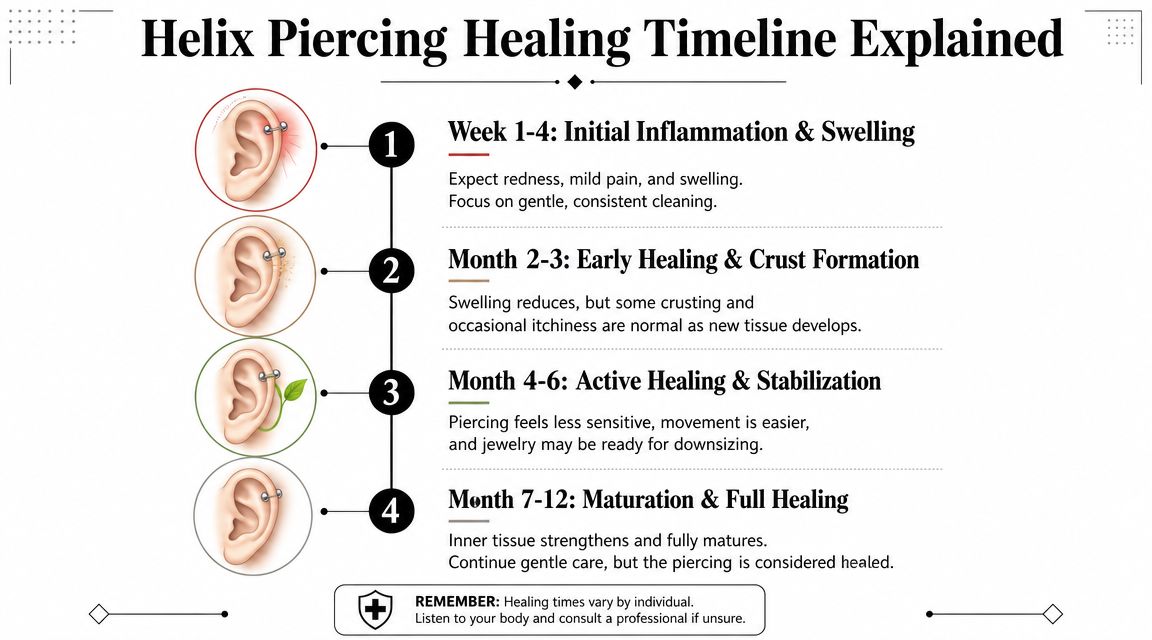
Guidance on helix healing treats it as a 6 to 12 month process because cartilage remodels slowly. It can remain fragile for the first 3 to 4 months, even when the surface looks calm. A professional downsize is often appropriate at 4 to 6 weeks, while a true style change is usually delayed until around 6 months or longer, according to Rhokea's month-by-month helix healing guide.
Week 1 to 4
This is the “fresh wound” stage. Your ear may feel warm, tight, and more swollen by evening than it did in the morning. That doesn't automatically mean something is wrong. It means your body has started the repair process.
Common experiences in this stage include:
- Tenderness: It may sting when hair catches on it or when you pull a top over your head.
- Swelling: The ear can look a bit puffy, especially after sleeping awkwardly or touching it too much.
- Redness: Mild local redness is expected early on.
- Awareness: You'll notice it constantly because it's new and easy to bump.
The main job here is protection. Clean it gently and don't test it.
Month 2 to 3
During this phase, many people get overconfident. The helix often seems quieter. Pain drops. Redness settles. Crusties may come and go. It can look nearly done, but it isn't.
Inside the piercing, new tissue is still delicate. Imagine it as wet plaster that has dried on the surface but not fully hardened underneath. If you start twisting jewellery, swapping to a hoop, or sleeping on that side, the tissue can become inflamed again.
A lot of “why is my helix still angry?” stories begin here.
Month 4 to 6
By this stage, the piercing often feels far easier day to day. This is also the period when a downsize may become important if your initial post is now too long. The original jewellery is usually fitted to allow for swelling. Once that swelling has reduced, extra length can create movement, snagging, and crooked pressure.
That doesn't mean you should change it yourself just because it looks settled. It means a piercer checks whether the fit now needs adjusting.
A downsize is a healing tool, not a fashion change.
Month 6 onward
This is the maturation stage. The piercing channel gets stronger and more stable, but “healed enough to survive daily life” is different from “fully mature and tolerant of jewellery changes”.
If you want a hoop, this is usually the point where patience pays off. Waiting longer often gives you a much calmer switch and far less chance of swelling, bumps, or tenderness returning.
Your Daily and Weekly Aftercare Routine
Most helix aftercare problems come from doing too much, touching too often, or missing the role of pressure. You don't need a complicated routine. You need a simple one you'll follow.
Your basic routine
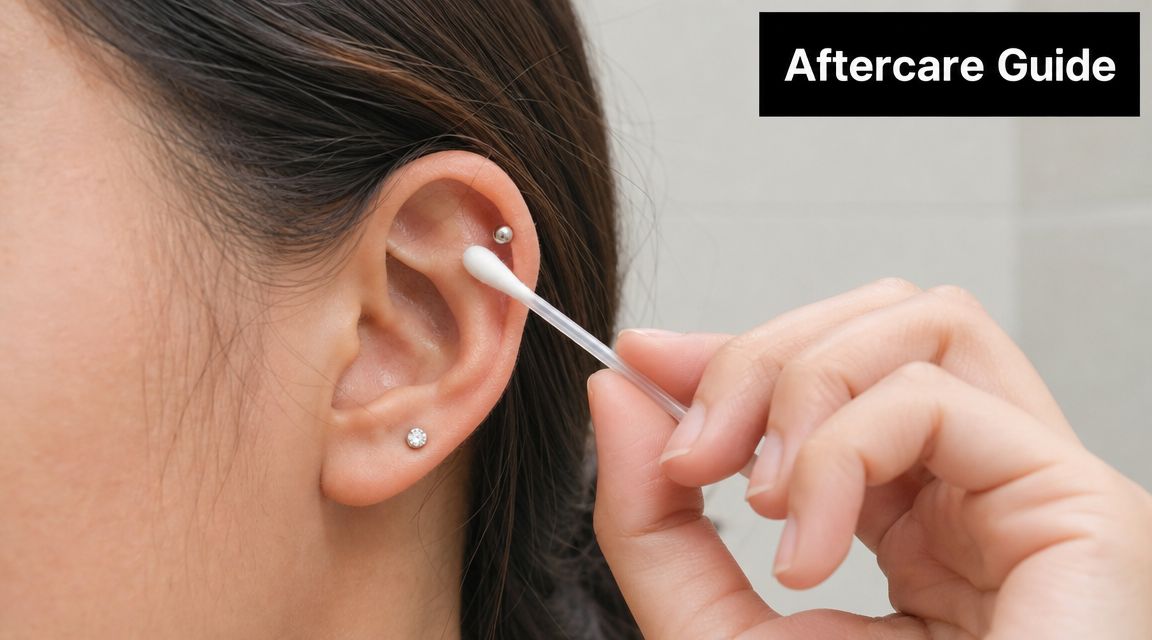
For many individuals, the daily pattern is straightforward:
- Wash your hands first. If your hands aren't clean, don't touch the area.
- Use sterile saline. Spray or rinse the piercing gently.
- Let softened crust lift away naturally. Don't pick at dry build-up.
- Dry carefully. Pat around the area with something clean and disposable, or let it air dry fully.
- Leave it alone. No twisting, spinning, checking, or moving the jewellery for fun.
If you want a more detailed step-by-step version, this guide on aftercare for a helix piercing is a useful reference.
What matters more than cleaning
A lot of people assume aftercare is mostly about what liquid goes on the piercing. In practice, daily behaviour is often the bigger factor.
Focus hard on these habits:
- Sleep protection: Use a travel pillow or donut-style pillow so your ear sits in the hole rather than getting crushed.
- Headphone awareness: Over-ear and on-ear headphones can press directly onto the helix. If they touch the jewellery, that's irritation waiting to happen.
- Hair and clothing care: Wet hair wrapping around the backing, hoodies scraping the ear, and towels catching the post all slow healing.
- Hands off: Curiosity is one of the most common causes of tenderness.
Clean enough to support healing. Don't fuss enough to disturb it.
What to avoid
Some mistakes are so common that they're worth spelling out clearly.
| Habit | Better choice |
|---|---|
| Twisting the jewellery | Leave it still |
| Homemade salt mixes | Use sterile saline |
| Sleeping on the piercing | Offload pressure with a travel pillow |
| Over-cleaning because it looks irritated | Reduce irritation and keep care gentle |
| Changing jewellery when it “seems fine” | Wait for a piercer's advice |
| Wearing anything that presses on the ear | Choose options that leave the helix alone |
A good weekly check
Once a week, do a calm audit of your routine rather than your piercing. Ask yourself:
- Am I sleeping on it without realising?
- Have my headphones been pressing on it?
- Has the jewellery started snagging on hair or jumpers?
- Have I been picking crust or touching it in the mirror?
That sort of check is more useful than staring at the piercing every day looking for reassurance.
Normal Healing Symptoms Versus Warning Signs
A helix can look dramatic while still healing normally. That's why first-time clients often panic over things that are expected, then ignore things that require attention.
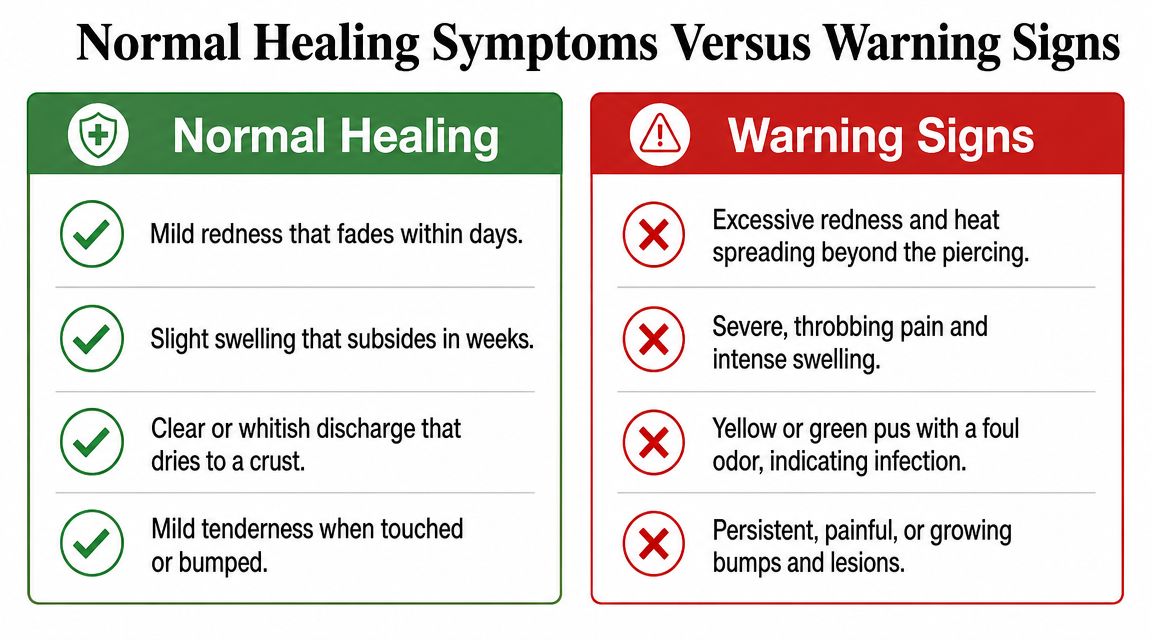
The easiest way to stay calm is to separate irritation from genuine warning signs. Mild swelling, tenderness, and crusting are common. Spreading heat, worsening pain, and thick coloured discharge are a different conversation.
Helix Healing Normal Signs vs. Warning Signs
| Symptom | Normal Healing | Potential Problem (Contact Your Piercer) |
|---|---|---|
| Redness | Mild and local, especially early on | Redness that spreads or looks more intense over time |
| Swelling | Some puffiness, especially after bumps | Swelling that becomes severe or keeps worsening |
| Tenderness | Sore when knocked or cleaned | Throbbing pain, strong heat, or pain that feels out of proportion |
| Discharge | Clear or whitish fluid that dries into crust | Thick yellow or green discharge, especially with odour |
| Bumps | Small irritation bumps after pressure or snagging | Painful, persistent, or growing lesions that need assessment |
Signs that are usually normal
These often worry people, but they can be part of ordinary healing:
- Crusties: Dried lymph can look alarming, but it's often just normal healing fluid drying on the jewellery.
- Occasional itching: Common as the area settles.
- Tenderness after a knock: If your hairbrush hits it, expect a temporary sulk.
- Flare-ups after pressure: One bad night sleeping on it can make it grumpy again.
Signs that deserve prompt attention
These are the ones not to brush off:
- Heat and redness moving outward
- Pain that's escalating instead of easing
- Thick discoloured discharge
- A bad smell coming from the area
- Feeling feverish or generally unwell
If you're unsure whether what you're seeing is irritation or infection, this guide on how to tell if a piercing is infected can help you compare symptoms more clearly.
If the piercing looks mildly annoyed after being slept on, think irritation first. If it looks increasingly angry and you feel unwell, take that more seriously.
Troubleshooting Common Helix Healing Problems
The biggest mindset shift with helix piercing healing is this. Most ongoing problems aren't because your body “can't heal cartilage”. They happen because the piercing keeps getting irritated.
That's good news, because irritation has causes you can often fix.
The bump that keeps coming back
The classic example is the irritation bump. People often call every bump a keloid, which causes a lot of unnecessary panic. In many cases, a helix bump is the ear reacting to repeated stress.
One major cause is mechanical pressure. As noted by Lynn Loheide's helix piercing guide, persistent helix irritation bumps are commonly caused by repeated trauma from sleeping on the piercing, and practical fixes such as a travel pillow and timely jewellery downsizing address the pressure more effectively than just cleaning more.
That last part matters. Cleaning isn't a magic eraser. If the root issue is compression every night, extra saline won't solve it.
Common causes of irritation
A helix usually gets upset for practical reasons:
- Sleeping on it: The most frequent culprit.
- Headphones pressing the area: Especially over-ear styles.
- Snagging: Hair, towels, knit jumpers, and pillowcases all catch helix jewellery.
- Jewellery that's too long once swelling drops: Extra movement creates repeated friction.
- Touching and checking: Tiny disturbances add up.
What to do when your helix is acting up
If your piercing suddenly develops a bump or becomes tender again, strip things back.
Try this approach:
- Remove pressure first. Change how you sleep tonight, not next week.
- Keep care simple. Sterile saline and a hands-off approach.
- Stop unnecessary friction. Switch from over-ear headphones if they touch the area.
- Get jewellery checked. A post that was right on piercing day may now be too long.
- Watch the pattern. If it improves when pressure stops, that tells you a lot.
Most stubborn helix issues are behaviour problems, not cleaning problems.
Not every problem is the same
A small irritation bump isn't the same as obvious infection. A whitehead-like pustule from irritation isn't the same as a severe allergic reaction. That's why guessing based on social media photos goes badly so often.
If the issue follows pressure, snagging, or movement, start by addressing those triggers. If symptoms look more severe or systemic, get proper professional advice quickly.
Jewellery Guidance for a Happy Helix
Jewellery isn't just decoration during healing. It's part of the treatment plan. The shape, fit, and timing of changes all affect how well your helix settles.
A good helix piercing usually heals best with stable jewellery that doesn't twist or swing around. That's why many experienced piercers prefer a flat-back stud style for initial healing rather than a ring.
Why the first piece matters
Initial jewellery needs to give the piercing room for early swelling without being so awkward that it catches on everything. A proper fit is a balancing act. Too tight and it compresses. Too loose and it moves, snags, and shifts the angle.
This is one reason self-changing jewellery early can create chaos. What looks like “just swapping the top” can still disturb the channel.
Downsizing is not optional for many people
Once swelling drops, the extra length that helped in the beginning can become the next problem. The post starts moving back and forth. It catches in hair. It gets knocked while dressing. The piercing then stays mildly irritated, and people blame the cartilage itself.
A professional downsize helps reduce that movement. It often makes the piercing feel calmer and less vulnerable in day-to-day life.
If you want to understand why studs are commonly recommended for the healing stage, this guide on a stud helix piercing gives a solid overview.
When not to change to a hoop
Patience really matters. With helix piercings, visible surface calm does not equal full cartilage remodelling, and changing jewellery too soon can re-traumatise tissue and extend healing time. Following your aftercare properly, including not changing the jewellery too soon, gives a helix the best chance of healing on schedule.
A hoop changes the pressure pattern completely. Instead of a straight post sitting fairly still, a ring can rotate, pull, and put curved pressure on a channel that may not be ready. That's why the “but it looks healed” decision so often backfires.
A simple jewellery rule
Use this rule if you're unsure:
- Healing jewellery is for stability
- Downsized jewellery is for reducing movement
- Styled jewellery is for later, once the piercing has earned it
That order saves a lot of trouble.
When and How to Contact a Professional Piercer
A professional piercer and a doctor do different jobs. Knowing who to contact saves time and prevents the wrong advice from making the piercing worse.
If your helix is irritated, snagging, swelling around the jewellery, or showing signs that the fit is wrong, a piercer is often your first stop. If you have symptoms that suggest significant infection or you feel unwell beyond the piercing site, that moves into medical territory.
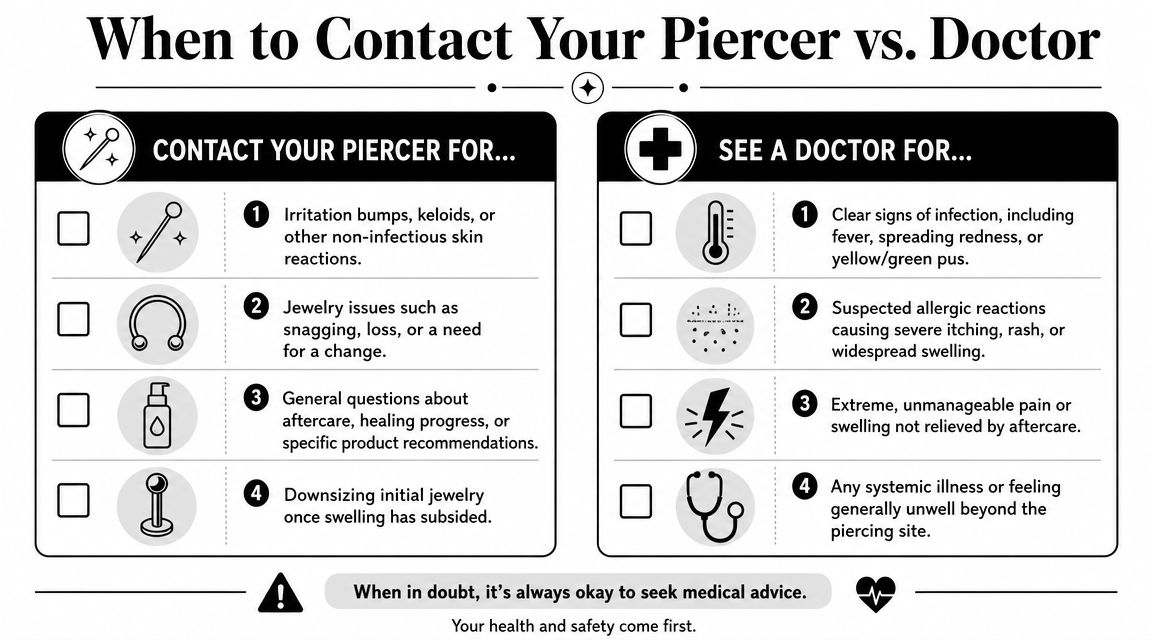
Contact your piercer for
These are common reasons to get in touch:
- Irritation bumps: Especially if they appeared after sleeping on it or catching it.
- Jewellery fit issues: The post feels too long, too tight, or starts embedding.
- Snagging problems: Hair, masks, or clothing keep pulling it.
- Downsize timing: You think swelling has reduced and want the fit checked.
- General healing questions: You want someone experienced to look at the piercing before you make changes.
See a doctor for
These situations need medical assessment:
- Spreading redness and heat
- Thick yellow or green discharge
- Feeling feverish or generally unwell
- Severe swelling or pain that seems out of proportion
- A reaction that extends beyond the local piercing area
Piercers handle jewellery, fit, placement, and irritation. Doctors handle infection and wider health concerns.
Support for Croydon and Bournemouth clients
For clients in London and on the South Coast, the teams at our Timebomb Tattoo & Piercing studios in Croydon and Bournemouth are here to help.
For non-urgent advice or to book a check-up, message us on WhatsApp at 07752 913846 (Bournemouth) / 07902 490584 (Croydon). For immediate concerns or appointments, please call the studio directly on 01202 900050 (Bournemouth) / 020 8686 7730 (Croydon).
What to send when you ask for help
If you're messaging a piercer, make it easy for them to assess the situation.
Send:
- A clear photo in good lighting
- A side angle and a front angle
- A short timeline of what changed
- What jewellery is currently in
- Whether you've slept on it, snagged it, or changed anything recently
That gives far better guidance than “Does this look infected?”
Helix Healing Frequently Asked Questions
Helix aftercare gets clouded by myths very quickly. These are the questions people ask most when they're trying to work out whether their piercing is on track.
Helix Healing FAQ
| Question | Answer |
|---|---|
| Is it normal for my helix to feel fine, then flare up again? | Yes. A calm-looking helix can still be sensitive underneath, and pressure or snagging can irritate it again. |
| Can I sleep on it if it no longer hurts? | It's safer to avoid direct pressure until the piercing is well settled. Pain isn't a reliable sign of full healing. |
| Should I twist the jewellery while cleaning? | No. Twisting disrupts healing tissue and usually causes more irritation, not less. |
| Is a bump always a keloid? | No. Many helix bumps are irritation bumps linked to pressure, movement, or snagging. |
| Can I wear headphones? | Only if they don't press on the piercing. If they touch the helix, they can keep it irritated. |
| Can I change to a hoop because the outside looks healed? | That's a common mistake. Surface calm doesn't mean the inner channel is ready. |
| Should I clean it more if it's irritated? | Not necessarily. If the cause is pressure, more cleaning won't fix the root problem. |
| Can I use oils, creams, or homemade salt water? | It's better to keep aftercare simple and gentle. Adding random products often creates more irritation. |
| Is swimming a good idea with a new helix? | It's best to be cautious with anything that may expose a fresh piercing to unnecessary irritation or contamination. |
| When should I ask a piercer to check it? | If the fit seems wrong, a bump appears, it keeps snagging, or you're unsure whether what you're seeing is normal. |
One final reminder. If your helix is misbehaving, don't automatically assume you need stronger products or more aggressive cleaning. In many cases, the answer is much less exciting. Stop sleeping on it. Stop knocking it. Stop changing things too early. Give the tissue a calm environment and let it do its job.
If you're looking for safe, professional guidance before or after your appointment, Piercing Near Me helps you find trusted piercing information and book with experienced studios, including support for clients in Croydon and Bournemouth.