You’re probably staring at photos of industrial bars right now, wondering whether one would suit you or whether it’s going to be a painful mistake. That’s a normal place to start. Most men who ask about an industrial piercing like the look immediately. It’s sharp, architectural, and a lot bolder than a single helix or lobe. The hesitation usually comes a second later. Will it work with your ear? Will it heal properly? Will it get battered at work, at the gym, or under headphones?
That hesitation is healthy. An industrial piercing for guys can look brilliant, but it’s one of the ear piercings that punishes bad planning. Generic online advice tends to flatten everything into the same checklist. In practice, men often need more specific guidance around ear shape, short haircuts that leave the piercing exposed, sports contact, heavier headphone use, and jobs where dust, sweat, or bumping are part of the day.
That gap matters. Industrials are a high-maintenance cartilage piercing for anyone, and active or manual jobs that involve knocks, dust or headgear can make aftercare harder. That doesn’t mean men shouldn’t get them. It means the aftercare and planning have to match real life.
An Introduction to the Industrial Piercing for Men
At Timebomb Tattoo & Piercing, we approach industrials as a custom cartilage project, not a quick add-on. Two men can ask for the same piercing and need completely different advice. One might suit a classic straight bar. Another might need a modified approach, or might be better off choosing a different ear piercing entirely.
A lot of first-timers come in expecting the decision to be about pain. It usually isn’t. The bigger questions are fit, jewellery quality, healing commitment, and whether your routine will support the piercing rather than fight it every day. If you sleep on that side, wear over-ear hearing protection, play rugby, or constantly catch the top of your ear while changing clothes, those details matter more than bravado.
Why men need more specific guidance
Men’s style choices around an industrial often sit in a different place from generic piercing content. Some want a clean titanium bar that looks almost technical. Some want something more noticeable because they keep the rest of their jewellery minimal. Some have beards, fades, caps, helmets, or glasses that change how the ear is framed and how often the bar gets knocked.
That’s why broad advice isn’t enough. A proper consultation should account for:
- Your ear anatomy and whether a straight industrial is even suitable
- Your haircut and how exposed the piercing will be day to day
- Your routine including gym sessions, physical work, travel, and sleep habits
- Your long-term style so the placement works with the jewellery you’ll want later
If you’re still comparing options, this broader ear piercings guide for different placements and styles is useful for seeing where an industrial sits against other cartilage choices.
Practical rule: Don’t choose an industrial because it looks good on someone else’s ear. Choose it because it will sit well on yours and heal in your actual routine.
An industrial can absolutely be a strong, masculine style statement. It just works best when the decision is grounded in anatomy and reality, not impulse.
Understanding the Anatomy of an Industrial Piercing
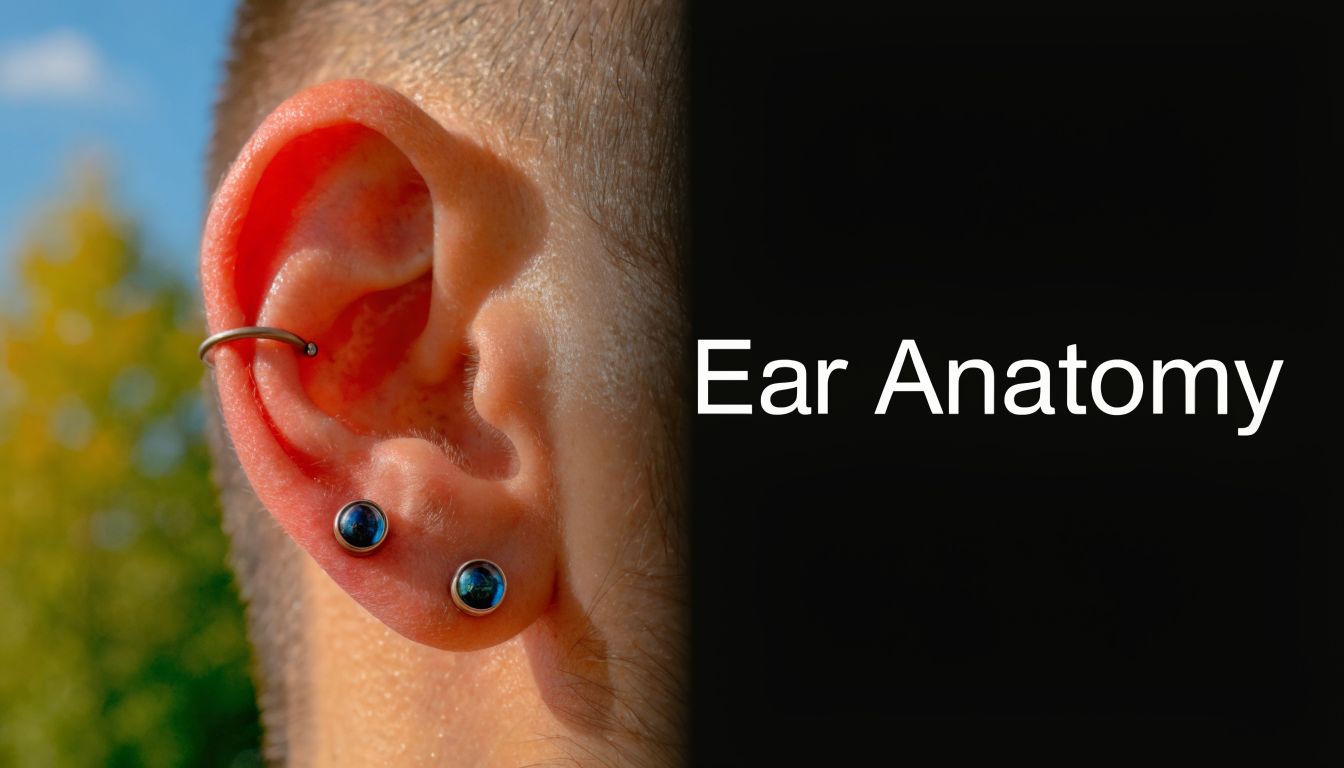
An industrial is often described as one piercing, but structurally it’s two cartilage piercings connected by one straight barbell. Think of it as a scaffold across the upper ear. The jewellery links two points so the angle has to be right at both ends, not just one.
That’s why this piercing is far less forgiving than a standard helix. With a single cartilage piercing, a small placement issue may be annoying but manageable. With an industrial, poor placement at either side changes how the entire bar sits, how pressure is distributed, and whether the piercing stays calm or turns into a constant irritation point.
What a piercer checks first
Before anyone should agree to a traditional industrial, the ear needs an anatomy assessment. The key issue is whether the ear has the ridge structure and angle to let a straight bar pass cleanly without pressing into flat tissue.
When we assess an ear for an industrial, we look at things like:
- Helix shape and whether there’s enough definition for secure entry and exit points
- Spacing and angle between the forward helix area and the outer upper ear
- Bar path so the jewellery won’t sit hard against the flat of the ear
- Overall symmetry from the front and side, especially if you want the piercing to look balanced with your haircut and facial profile
If the ear is too flat for a straight bar, forcing one through usually creates trouble. You may get persistent pressure, migration, irritation, or full rejection.
Why anatomy matters more than preference
Many clients are often surprised to learn this. Wanting a straight industrial doesn’t make your ear suitable for one. Some ears have flatter anatomy that doesn't suit a standard straight-bar industrial, and a piercer may suggest a modified placement or a custom bar instead. That's why an anatomy consultation matters so much before an industrial.
That’s the practical difference between a studio saying yes quickly and a studio taking the time to assess properly. A good piercer isn’t trying to talk you out of the look. They’re trying to stop you wearing a bar your ear is already fighting.
Some ears suit a classic industrial immediately. Others suit a bent industrial better. Some don’t suit either, and honesty is the safest answer.
Straight industrial versus modified options
If your ear doesn’t support a traditional bar, that doesn’t always end the conversation. A modified option may preserve the same general aesthetic while working with your anatomy instead of against it.
A quick comparison helps:
| Option | Best for | Main benefit | Main trade-off |
|---|---|---|---|
| Straight industrial | Ears with strong natural ridges and clean angles | Classic look | Less forgiving if anatomy is marginal |
| Bent industrial | Flatter ear anatomy | Reduces pressure on unsuitable angles | Different visual line from the classic bar |
| Two separate piercings | Clients who like the placement idea but not the bar requirement | More flexibility in healing | Doesn’t create the same scaffold effect |
The right answer is the one your ear can support. That’s the standard to use.
Is an Industrial Piercing Right for Your Look
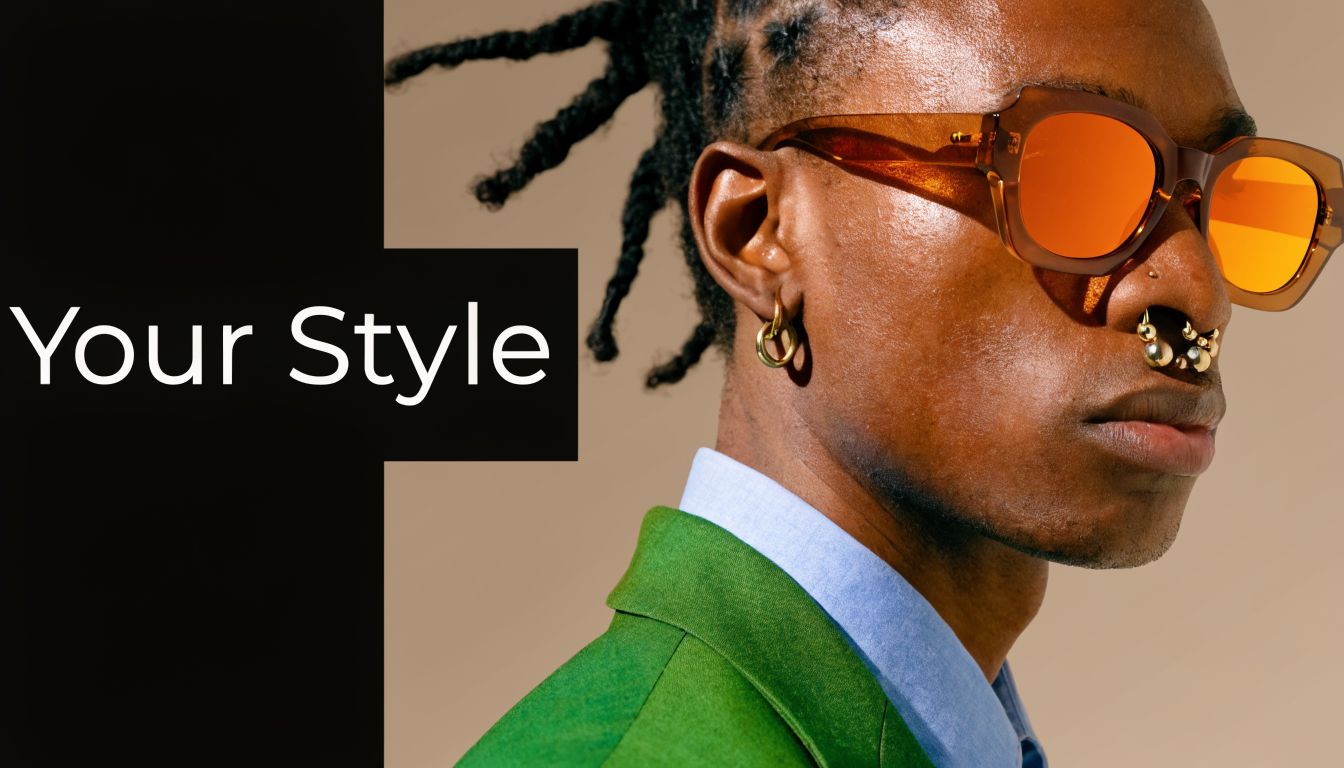
Style is where most men start, but it’s worth looking at style through a practical lens. An industrial doesn’t just sit on the ear. It changes how the side of your face reads. On some men it looks stripped-back and controlled. On others it becomes the first thing people notice.
How the piercing changes your overall look
A standard industrial creates a strong horizontal line across the upper ear. That line tends to suit men who like cleaner shapes in the rest of their style. Think simple black clothing, silver-toned jewellery, sharp trims, minimal accessories. The bar acts almost like a piece of hardware.
If your style leans more expressive, an industrial can still work, but the jewellery choice matters more. A plain titanium bar keeps the look understated. Decorative ends or more elaborate bars push it toward statement jewellery. Neither is wrong, but they say different things.
A useful perspective to consider is:
Minimal look
Best matched with a plain polished titanium barbell. This keeps the industrial crisp and wearable every day.Bold look
Better for men who already wear visible jewellery, tinted glasses, chains, or multiple ear piercings. The industrial becomes part of a fuller visual set.Balanced look
Works well if you want the piercing to stand out without dominating. This usually means keeping the rest of the ear simpler.
Hair makes a bigger difference than most men expect
Hair changes both the appearance and the day-to-day management of an industrial.
With short hair, especially fades or closely clipped sides, the piercing is always visible. That can be exactly what you want. It also means the area gets more exposure to sun, friction, and accidental contact. Freshly cut hair around the ear can irritate the area if your barber is careless, so you need to be prepared to protect it.
With medium or long hair, the problem shifts from exposure to snagging. Hair catches on industrial bars more than many men expect, especially when drying your hair quickly with a towel or pulling clothing over your head.
A few style realities matter here:
- Skin fades and cropped cuts make the industrial look sharper and more intentional
- Longer textured styles can soften the look, but require more care when brushing or tying hair back
- Fringe and beard combinations can draw focus to the centre of the face, so the ear jewellery should feel proportional rather than overloaded
Glasses, hats and headphones
Often, a lot of “I didn’t think about that” problems show up.
Glasses can work perfectly well with an industrial, but only if the arm of the frame doesn’t sit directly on the piercing path. Some men do better wearing slightly different frames during early healing. Headphones are even more variable. Large over-ear cups may press on the ear depending on shape and fit. In-ear options are usually less intrusive for industrial healing.
Hats and helmets matter too. A snug beanie, motorcycle helmet, hard hat, or sports headgear can all create repeated pressure. One isolated knock isn’t ideal. Repeated low-level pressure is worse because it keeps the piercing irritated.
If your work or hobbies involve ear defenders, helmets, or over-ear headphones every day, say that during the consultation. It changes what placement is realistic.
Matching the piercing to face shape and proportions
There isn’t a rigid rulebook here, but there are patterns experienced piercers look for.
Men with a longer face shape often suit the horizontal line of a standard industrial because it adds width at the side of the head. Men with a broader or rounder face may still suit it well, but the jewellery choice matters. Chunkier ends can make the ear look busier, while a slimmer titanium bar tends to stay cleaner.
If your ear sits close to the head, a subtle bar can look refined. If your ear projects more, the industrial can look more prominent and architectural. Again, that isn’t bad. It just affects how bold the finished result feels.
A quick style check before you book helps:
| Question | If the answer is yes | What it suggests |
|---|---|---|
| Do you want a piercing people notice quickly? | The industrial fits that goal | Keep the jewellery simple at first |
| Do you wear glasses daily? | Placement planning matters more | Bring or wear your usual frames to the consultation |
| Do you prefer low-key jewellery? | Choose a plain titanium bar | Avoid decorative ends for the initial look |
| Do you change hairstyles often? | Think ahead about visibility and snagging | Pick placement that still works across different cuts |
The men happiest with their industrial usually aren’t the ones chasing the loudest look. They’re the ones whose style, anatomy, and routine all point in the same direction.
Your Step-by-Step Guide to Getting Pierced at Timebomb
Most nerves settle once you know what happens on the day. The process should feel organised, calm, and specific to your ear. An industrial isn’t something to rush through in a chair because you saw a free slot on the board.
Step one is the consultation, not the needle
The appointment starts with looking at your ear and talking through the placement you want. If your anatomy suits a traditional industrial, we map out how the bar should sit. If it doesn’t, we say so. That honesty is part of the service, not a disappointment.
This is also the point where your routine matters. If you wear glasses, work in a hard hat, train contact sports, or sleep heavily on one side, say it. Those details affect whether the piercing is realistic and how we plan for healing.
Jewellery choice is a safety decision
For initial placement, the standard we recommend is ASTM F136 titanium barbells. In male industrial piercings, that usually means 14G jewellery with a shaft length typically around 32 to 38 mm, as described in this implant-grade jewellery explanation covering titanium versus surgical steel.
The reason isn’t trend or branding. It’s performance in healing tissue. ASTM F136 titanium meets medical implant standards and is far less likely than 316L surgical steel to cause a nickel reaction. 316L surgical steel contains nickel, which is why implant-grade titanium is the better choice for a fresh piercing.
For an industrial, that matters because the bar runs through thin cartilage in a way that leaves little room for a poor material choice.
The details that improve the outcome
Several technical points make a real difference in men’s industrials:
Cartilage thickness
The same implant-grade guidance notes the long bar spans cartilage often around 1.2 to 1.6 mm thick in the common forward helix-to-antihelix configuration, which is why pressure and angle matter so much.Corrosion resistance
Titanium’s reported pH tolerance from 2 to 10 helps resist metal ion leaching during sweat exposure.Infection risk
Good-quality titanium, careful technique and proper aftercare all lower the risk of infection.Surface finish
Professional jewellery should have a mirror-polished finish to reduce tissue trauma.Healing benchmark
Full epithelialisation is described there as taking 6 to 12 months.
For men with broader ear frames, flat-end balls can also help reduce pressure points. That sounds like a small detail, but pressure is one of the main reasons an industrial stays angry.
Ask for free-hand marking during booking if you’re concerned about asymmetry. Good fit matters too, with enough tissue either side of the bar to reduce the risk of migration.
What the actual piercing appointment feels like
Once the plan is agreed, the ear is prepared, the placement is marked, and you’ll be shown the alignment. This part matters. You should understand how the bar will sit before the piercing is done.
Then the two channels are pierced and connected with the barbell. Most men describe the sensation as sharp and pressurised rather than impossible. The second part often feels more intense because the ear is already aware of what’s happening. That’s normal.
Afterwards, the area is usually warm, tender, and slightly throbbing. It won’t look healed and it shouldn’t. You’ll leave with the jewellery fitted for swelling, the area cleaned, and aftercare instructions that match your situation rather than a generic script.
The key thing to expect is this. A good industrial appointment feels deliberate. If it feels rushed, it probably is.
The Essential Healing and Aftercare Roadmap
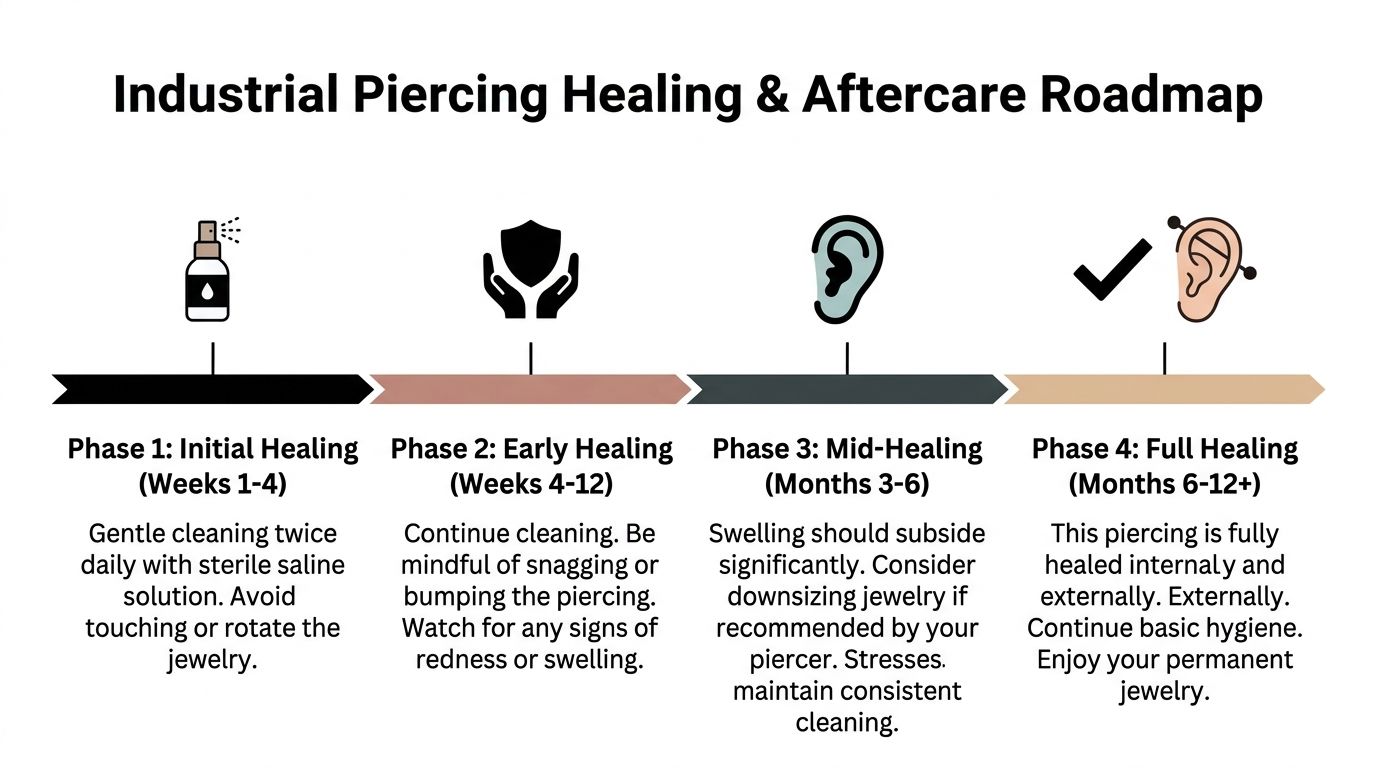
Healing an industrial is a long game. This piercing often looks calmer before it’s healed, and that false confidence is where many men create problems for themselves. If you treat it like a fresh wound for longer than you think necessary, you usually do better than the client who decides it’s fine because the redness faded.
The first phase when it feels tender and obvious
Early healing is all about keeping irritation low. The area may feel hot, swollen, and awkward to forget about because every accidental touch reminds you it’s there. That doesn’t mean something is wrong. It means cartilage is reacting like cartilage does.
Your basic routine should stay simple:
Clean gently with sterile saline
Use a proper sterile product rather than home-mixed solutions. If you need one, this guide to sterile saline spray for piercing aftercare explains what to look for.Leave the jewellery alone
Don’t rotate it. Don’t “free up” dried matter by twisting. Don’t test whether it moves better than yesterday.Dry with care
Let the area air dry or use clean disposable paper if needed. Rough towels are a common cause of snags.Keep pressure off it
Sleeping on it, leaning your head into the sofa arm, or trapping it under headphones can undo a calm week very quickly.
The middle phase when it looks better than it is
This is the phase that tricks people. The ear may look reasonably settled. Tenderness may drop. You may start thinking about changing the jewellery or forgetting to clean it consistently.
Don’t rush that stage.
An industrial often enters a deceptive period where the outside looks acceptable while the inner tissue is still vulnerable. This is when repeated low-grade irritation creates bumps, crusting, and setbacks. Men who train regularly or work physically often hit this phase hard because they feel fine and go back to full routine before the piercing is ready.
Watch for the habits that keep irritation alive:
| Habit | Why it causes problems | Better approach |
|---|---|---|
| Sleeping on the pierced side | Creates repeated pressure and angle stress | Use the other side or a travel pillow style setup |
| Over-ear headphones | Trap heat and press against the upper ear | Switch to alternatives during healing |
| Touching to “check it” | Transfers bacteria and restarts inflammation | Inspect visually only |
| Hair and towel snags | Pull the bar and inflame both holes | Slow down when dressing and drying |
A calm industrial heals because you stop giving it reasons to complain.
Irritation bumps versus genuine infection
This distinction matters. Many clients panic over irritation and ignore real warning signs because they assume all redness means infection. It doesn’t.
An irritation bump is commonly linked to pressure, snagging, sleeping on the piercing, unsuitable aftercare products, or jewellery angle issues. The answer is usually to remove the source of irritation and let the tissue settle. Picking at the bump or changing products every two days usually makes it worse.
A genuine infection is more concerning. If the ear becomes increasingly hot, increasingly swollen, more painful over time rather than less, or you feel unwell alongside local symptoms, contact the studio promptly and seek medical advice when needed. Don’t self-diagnose from random photos online.
What helps and what doesn’t
A straightforward aftercare list works best.
What helps:
- Consistency with saline and hygiene
- Clean pillowcases and clean hats
- Loose awareness of the piercing when changing clothes
- Returning to the studio if the bar seems to sit badly or swelling changes how it fits
What usually doesn’t help:
- Tea tree oil or harsh antiseptics
- Rotating the jewellery
- Removing the bar because it’s annoyed, unless you’ve been professionally advised
- Changing to a shorter bar too early
The final settling period
Industrial healing can stretch out. Even after the worst tenderness has passed, the piercing may still react to pressure or lifestyle mistakes. Patience wins here.
Many men do well by treating the industrial like a part of their routine rather than a drama. Clean it. Protect it. Don’t fiddle with it. If something feels off, ask the studio before trying internet fixes.
By the end of healing, the piercing should feel unremarkable in day-to-day life. That’s the primary goal. Not just a good photo on week two, but a stable result you can wear comfortably long term.
Ready for Your Industrial? Book at Timebomb Today
If you’ve read this far, you probably don’t need more hype. You need a proper anatomy check, clear advice, and a studio that won’t force a standard industrial onto an ear that doesn’t suit one.
That’s the value of booking with experienced piercers who understand how an industrial piercing for guys needs to fit the ear, the jewellery, and the person wearing it. Safety isn’t separate from style here. Good style starts with correct placement, implant-grade jewellery, and realistic aftercare.

How to get in touch
For bookings and piercing enquiries, contact Timebomb Tattoo & Piercing directly:
- Phone 01202 900050 (Bournemouth) / 020 8686 7730 (Croydon)
- WhatsApp 07752 913846 (Bournemouth) / 07902 490584 (Croydon)
If you’re comparing studios and want a straightforward place to start, this guide to professional piercers near me in the UK can help you find the right route to booking.
When to book
Appointments are the best option if you want time for a proper consultation, especially for an industrial where anatomy decides everything. Walk-ins can work for some piercings, but this is one where planning gives you a better outcome.
Book when you can realistically manage the healing period. If you’ve got a contact-heavy holiday, sports event, or work stretch where ear protection is unavoidable, it may be smarter to wait a little and give the piercing a better start.
The best time to get an industrial isn’t when you’re impatient. It’s when you can actually protect it.
If you’re ready, call 01202 900050 (Bournemouth) / 020 8686 7730 (Croydon) or send a WhatsApp message to 07752 913846 (Bournemouth) / 07902 490584 (Croydon) and ask for an anatomy consultation for an industrial.
Your Industrial Piercing Questions Answered
Can I sleep on a new industrial piercing
Not if you can avoid it. Side pressure is one of the fastest ways to keep an industrial inflamed. Most men do better using the opposite side or a travel pillow style setup that keeps the ear suspended rather than compressed.
If you wake up on that side occasionally, don’t panic. What matters is reducing repeated pressure, not chasing perfection.
Can I still go to the gym
Usually yes, but you need common sense. The problem isn’t exercise itself. The problem is sweat, friction, shared surfaces, bumping the ear, and over-ear headphones during healing.
Wipe sweat away carefully, avoid touching the piercing with gym hands, and be selective about exercises or kit that put pressure on the side of the head. If your training includes grappling or frequent contact, protect the piercing and expect healing to be slower.
What about football, rugby or combat sports
Blunt honesty matters. Contact sports and fresh industrials are a bad combination unless you can protect the area reliably. Repeated knocks can irritate the piercing badly and change the healing trajectory.
If you play regularly, speak to your piercer before booking so timing and protection can be discussed properly. It’s better to delay the piercing than to spend months trying to rescue one you keep re-injuring.
Will my glasses be a problem
They can be, but not always. It depends on your ear shape, the frame arm, and the final angle of the bar. Wear your usual glasses to the consultation if possible. That gives the piercer something real to work around.
If the arm sits close to the piercing path, you may need to adjust frame choice during healing.
How painful is it really
It’s a sharp cartilage piercing with a second channel connected by one bar, so most men find it more intense than a lobe and very manageable with preparation. Pain isn’t the difficult part for most clients. Healing discipline is.
Men who struggle most usually aren’t the ones with low pain tolerance. They’re the ones who underestimate the aftercare.
Can I remove it for work or medical reasons
Fresh jewellery shouldn’t be removed casually. Industrials can begin closing or becoming difficult very quickly, and reinserting a long bar through irritated tissue isn’t something to guess your way through.
If you know removal may be required for work, sport, or a medical setting, raise that before getting pierced. Planning beforehand is much easier than emergency improvisation later.
Will the holes stretch over time
Not in the same way as intentionally stretched piercings. A well-healed industrial worn with suitable jewellery should remain stable. Problems are more likely to come from migration, irritation, or trauma than from the piercing “stretching out” on its own.
If the bar starts to sit differently, the area looks thinner, or the jewellery seems closer to the surface, get it checked. Those changes are worth assessing early.
What’s the biggest mistake men make with industrials
Treating them like a quick style upgrade instead of a long-healing cartilage piercing. The men who do best usually accept three things early: their anatomy may limit the design, titanium matters, and the healing period needs patience.
That mindset saves a lot of trouble.
If you’re comparing studios, jewellery standards, and aftercare before booking, Piercing Near Me makes it easier to find a safe, professional option and take the next step with confidence.