
Once seen as a mark of rebellion, male body piercing has well and truly hit the mainstream. It’s no longer about making a radical statement, but about personalising your look. From a single, subtle ear stud to something a bit more adventurous, choosing a piercing is all about owning your style and making it yours.
This guide is here to walk you through all the options, so you can make a choice you feel genuinely good about.
Exploring Male Body Piercing as Modern Self-Expression
Let's be honest, the thought of the piercer's chair can be a little daunting. But in the hands of a professional, getting a piercing is a safe, straightforward, and even empowering experience. The world of men's piercing has moved far beyond its old counter-culture image and is now just another way to express who you are.
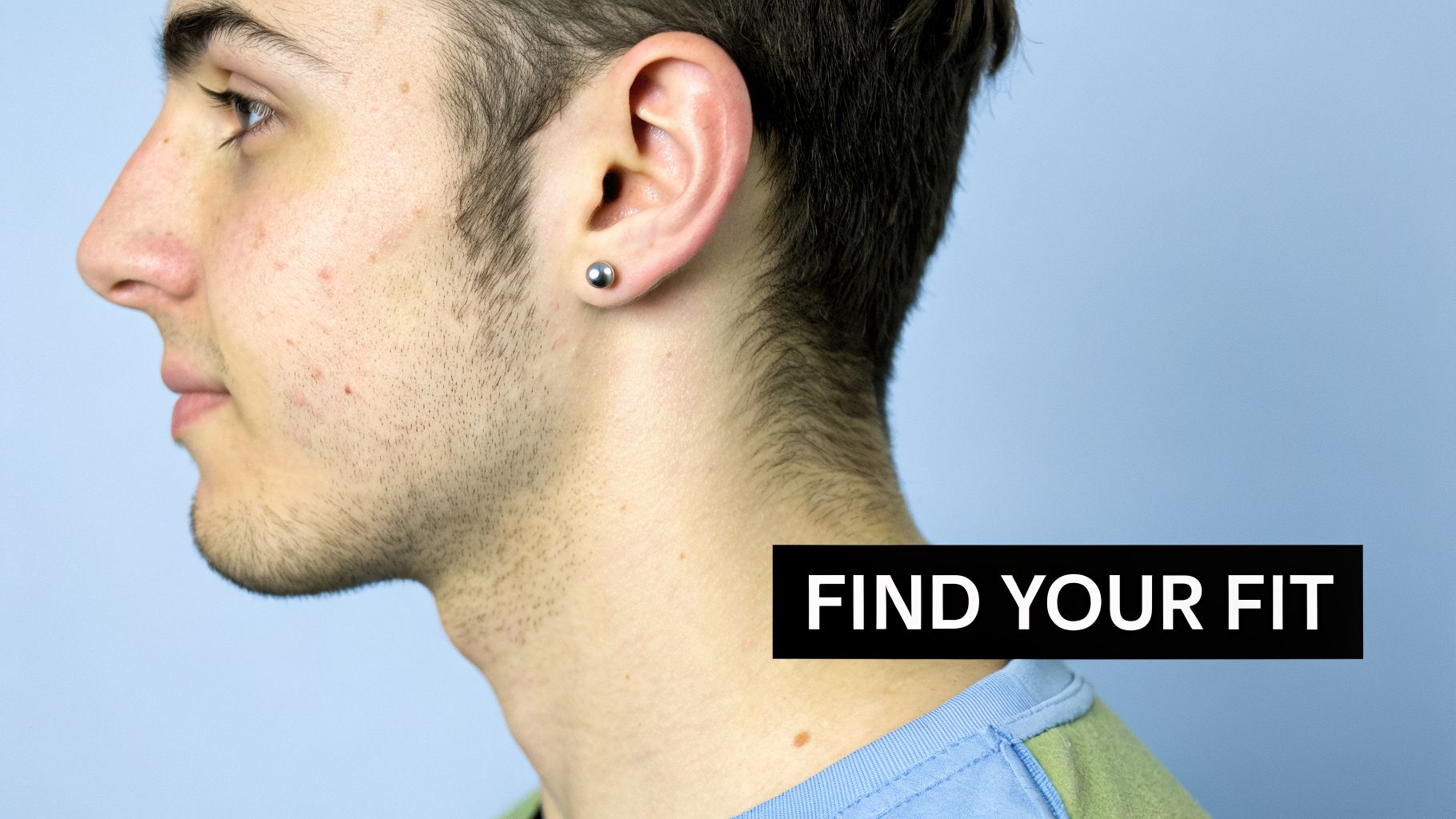
Think of it like choosing a watch or a pair of trainers that are just you. A piercing is a small detail that can say a lot, whether you want something discreet that only you know is there or a piece that catches the eye.
From Ancient Roots to Modern Style
Men wearing piercings isn't a new trend by any means—it has an incredibly rich history. We're talking ancient. The famous 5,000-year-old remains of Ötzi the Iceman had a 7–11 mm gauge ear piercing. Even icons like William Shakespeare were famously pictured wearing an earring back in Elizabethan England.
Fast forward to the UK's punk explosion in the 1970s, when piercings became a powerful symbol of rebellion. Today, that edginess has blended into popular style. With celebrities from Harry Styles to Lewis Hamilton making piercings a common sight, more and more men are heading to professional studios like our own Timebomb locations in Bournemouth and beyond to find a safe, stylish fit. For a deeper dive, check out this great article on the history and trends in male piercings from Vivid Ink.
This whole shift has thankfully busted a lot of old myths. Getting a piercing is now rightly seen as a personal style choice, not some kind of radical act. It’s simply about feeling comfortable in your own skin.
Making the Choice That’s Right for You
So, how do you decide what's right for you? It really comes down to a few key things. Thinking through these points is the best first step you can take.
- Your Style: Are you after an understated look, like a simple lobe stud? Or are you drawn to something more noticeable, like a septum or eyebrow ring?
- Your Day-to-Day: Think about your job or hobbies. Will a new piercing get in the way or be at risk of getting knocked around?
- Your Anatomy: This is a big one. Certain piercings work much better with specific ear shapes or facial structures. This is where an experienced piercer can give you invaluable advice.
Your piercing should feel like a natural extension of you. It's not about jumping on a trend, but about finding a piece of body art that you'll be happy with for the long haul.
We're here to help you figure it all out. If you want to chat through some ideas or just have a few questions, feel free to give our team a call for a no-pressure conversation on 01202 900050 (Bournemouth) / 020 8686 7730 (Croydon).
Finding the Right Piercing for Your Style and Anatomy
So, you’re thinking about getting a piercing? It’s a great way to express your style, but figuring out which one to get can feel like a big decision. The trick is to find that sweet spot where your personal taste, your daily life, and your own unique anatomy all line up.
Let's move past the "What can I get?" stage and start thinking about "What do I want?"
It’s amazing to think how far male piercing has come. What started thousands of years ago as ritual and status has evolved into a modern mark of individuality.
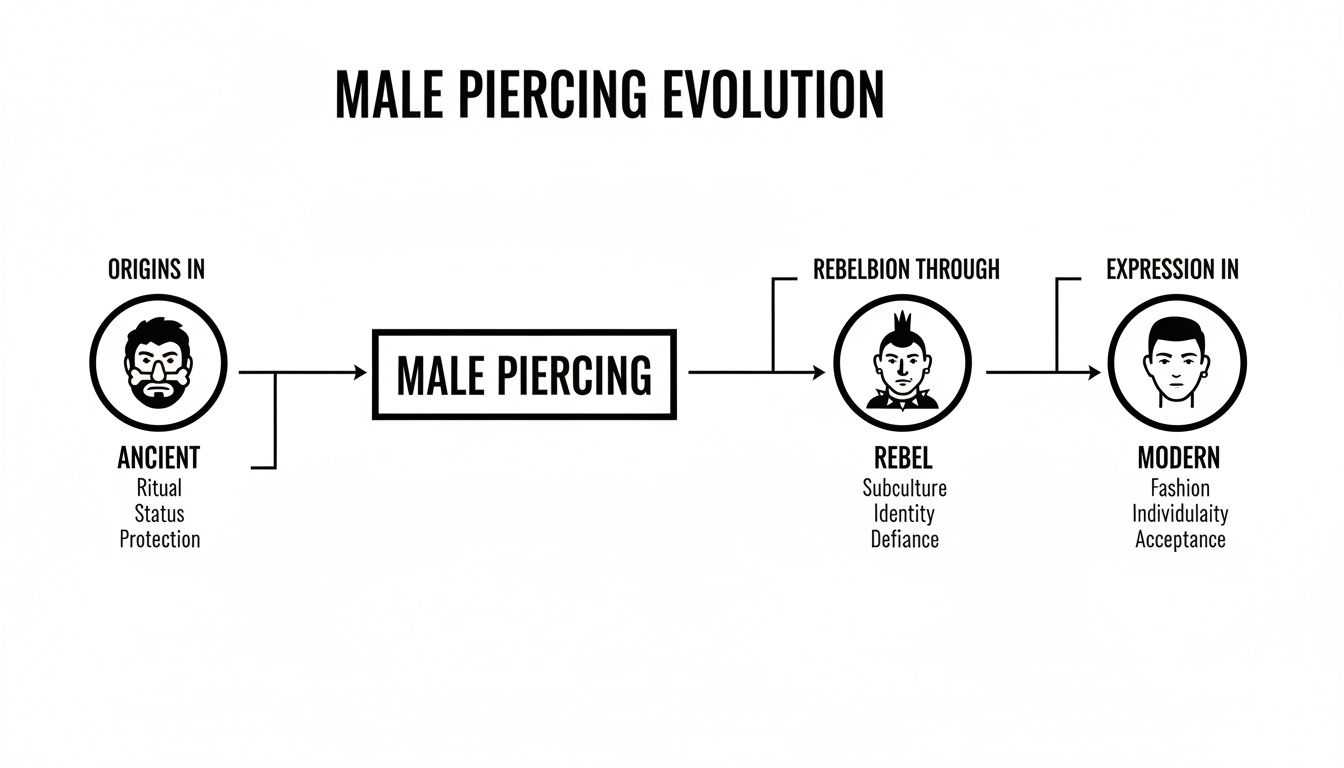
From ancient tradition to punk rebellion and now into mainstream style, it shows just how personal and powerful a piercing can be.
To help you get a clearer picture of your options, here’s a quick-reference table. It breaks down some of the most popular choices, giving you a realistic idea of what to expect in terms of healing and initial pain.
Male Piercing Popularity and Healing Times
| Piercing Type | Average Healing Time | Initial Jewellery Style | Pain Level (1-10) |
|---|---|---|---|
| Earlobe | 6-8 weeks | Stud or Ring | 2/10 |
| Helix (Cartilage) | 6-12 months | Stud or Ring | 5/10 |
| Conch | 6-12 months | Stud | 6/10 |
| Nostril | 4-6 months | Stud or Ring | 4/10 |
| Septum | 2-3 months | Circular Barbell or Ring | 5/10 |
| Eyebrow | 2-4 months | Curved Barbell | 4/10 |
| Nipple | 6-12 months | Straight Barbell | 7/10 |
Remember, these are just averages. Everyone heals differently, but this gives you a solid starting point for planning.
Popular Ear Piercings for Men
The ear is often the first stop on the piercing journey, and for good reason. It’s a canvas with a massive range of possibilities, from the super subtle to the seriously bold.
- Lobe Piercing: This is the classic entry point. Lobes are low on the pain scale, heal pretty quickly (usually around 6-8 weeks), and genuinely suit everyone. You can start with a simple stud and branch out into hoops, plugs, or more intricate jewellery later on.
- Helix Piercing: Located on the upper cartilage rim, a helix piercing adds an instant touch of edge. You can go for a single stud, a snug hoop, or even a few lined up for a 'ladder' effect. Because it’s cartilage, you’re looking at a longer healing time, typically 6-12 months.
- Conch Piercing: Placed right in the inner 'cup' of the ear, the conch has become a hugely popular statement piece. You can get an 'inner' conch (a stud sitting in the bowl of the ear) or an 'outer' conch (a hoop that hugs the edge). Healing time is similar to a helix.
Your own anatomy is a massive factor here. For instance, an industrial piercing (the bar connecting two points on your ear rim) needs a well-defined cartilage ridge. A deep conch bowl is perfect for showcasing a brilliant stud. A quick chat with a professional piercer will clear up what works best for your specific ear shape. For more inspiration, check out our in-depth guide covering many different types of piercing available.
Common Facial Piercings for Men
Facial piercings are a direct and confident expression of your style that can really highlight your features.
- Nostril Piercing: A stud or a ring in the nostril is timeless. It can be as discreet or as obvious as you want, just by changing the jewellery. It’s a very popular male body piercing and usually heals up within 4-6 months. We can place it to best suit the shape of your nose.
- Septum Piercing: This one goes through the 'sweet spot'—a small bit of soft tissue just under the nose cartilage. It looks fantastic with a ring or a circular barbell, but its secret weapon is that it can be flipped up and completely hidden. That's a huge plus if you need a more conservative look for work.
- Eyebrow Piercing: Placed along the brow ridge (usually vertically), this piercing has a classic rebellious vibe. It heals relatively fast, around 2-4 months, but it's in a prime spot for getting snagged on clothing, so you have to be mindful.
When you're thinking about a facial piercing, look at your face shape. A well-placed eyebrow piercing can draw attention to a strong brow, while a septum ring might bring a nice symmetry to your features. It’s all about working with what you’ve got.
Classic Torso Piercings
Looking for something more personal, that’s just for you (and maybe a few others) to see? Torso piercings are a fantastic option.
Nipple Piercing: Whether you get one or both done, nipple piercings have been a popular choice for men for ages. They feel powerful and personal, usually tucked away under your clothes. A straight barbell or a ring are the standard jewellery choices. Healing takes a while, anywhere from 6 months to over a year, and you can expect them to be pretty sensitive at first.
Navel Piercing: Don't just think of this as a 'belly button piercing' for women—it can look great on men, too. A simple barbell or a small ring offers a cool, understated look. The success of this one really depends on your anatomy. You need a clear 'lip' of skin above the navel for the piercing to sit properly and heal well.
At the end of the day, the best piercing is the one that makes you feel more like yourself. Don't hesitate to talk through your ideas, lifestyle, or any worries with a professional. We’re here to give you solid advice and help you land on a choice you'll love.
Feel free to give us a call at 01202 900050 (Bournemouth) / 020 8686 7730 (Croydon) or drop a message on WhatsApp at 07752 913846 (Bournemouth) / 07902 490584 (Croydon) to chat.
Why Jewellery Material and Fit Are Non-Negotiable
Getting a new piercing is only half the story; the jewellery you put in it is just as crucial as the procedure itself. Think of it this way: your fresh piercing is a delicate wound, and your body is working hard to heal around this new object. The material and fit of your first piece of jewellery can make the difference between a smooth heal and a total nightmare.
Putting cheap, low-grade "mystery metal" into a new piercing is asking for trouble. It can easily lead to allergic reactions, nasty irritation, and even infections, turning what should be an exciting process into a real uphill battle.
This is why any reputable studio is incredibly strict about the jewellery they use for initial piercings. It’s not about trying to upsell you on something expensive—it’s about protecting your health and making sure your piercing has the best possible chance to heal perfectly.
Body-Safe Materials We Trust
When we’re talking about jewellery for a brand-new piercing, only a handful of materials are genuinely up to the job. These metals are chosen specifically for their purity and biocompatibility, which simply means your body is far less likely to see them as a threat.
Here’s a rundown of the go-to materials you'll find in our studios:
- Implant-Grade Titanium (ASTM F-136): This really is the gold standard. It’s the exact same stuff used for medical implants like bone pins and screws. It's completely nickel-free, super lightweight, and built to last.
- Surgical Steel (ASTM F-138): A very common and safe option for most people. The only thing to be aware of is that it contains trace amounts of nickel. The nickel is locked within the alloy, so it rarely causes a reaction, but if you have a known severe nickel allergy, titanium is the safer bet.
- Solid 14k or 18k Gold: If you love the look of gold, it has to be solid, not plated. Gold-plated jewellery has a wafer-thin coating that eventually wears off, exposing the base metal underneath (which is often full of nickel) and causing all sorts of problems.
The demand for high-quality materials is growing fast. Market reports show a huge surge in the men's body piercing jewellery scene in the UK, with titanium and surgical steel leading the charge. This is all part of a massive global market valued at nearly USD 60 billion in 2023, which shows just how seriously people are taking material quality now. You can read more about the growth of the male piercing market on Data Insights Market.
Why Jewellery Size and Shape Matter
It's not just about the metal. The size and shape of your initial jewellery are just as important for a healthy heal. A professional piercer isn’t just grabbing something off the shelf that looks cool; they're choosing a piece based on your specific anatomy.
Two key things come into play here:
- Gauge (Thickness): This is the thickness of the post or ring. Using jewellery that’s too thin can create what we call the "cheese-cutter effect," where it can slowly migrate or even slice through the tissue over time.
- Length/Diameter (Fit): Your initial piercing jewellery will always be a bit longer or wider than the piece you’ll wear once it's healed. This is vital to give the area room to swell, which is a completely normal part of the healing process.
A bar that’s too short is a recipe for disaster. As the area swells, the jewellery can get swallowed by the skin, causing pain and serious complications. On the flip side, a bar that’s way too long will constantly catch on your clothes and hair, aggravating the piercing.
Getting this initial sizing right is a massive part of the professional service you're paying for. After the first few weeks, once the swelling has settled, we'll get you back in for a check-up and downsize the post to a snugger, more comfortable fit. This step is essential for the long-term health of your male body piercing.
If you have any questions about jewellery or want to see our range, pop into our studios or give us a call at 01202 900050 (Bournemouth) / 020 8686 7730 (Croydon).
What to Expect During Your Piercing Appointment
Walking into a piercing studio for the first time brings a mix of nerves and pure excitement. It’s totally normal. Knowing exactly what happens during the appointment helps shift the balance from anxious to just plain excited. Our entire process is professional, precise, and focused on your comfort and safety from start to finish.
Let's break down what a typical appointment looks like, so you know what’s coming and can walk in feeling confident.
The Initial Consultation and Placement
First things first, we’ll have a chat. You'll sit down with your piercer to talk through the piercing you’ve chosen and nail down the exact placement. This part is more important than most people realise; even a few millimetres can completely change the look and feel of a piercing.
We'll take a close look at your anatomy to make sure your chosen spot is a winner. For instance, not every ear has the right cartilage ridge for a snug industrial bar, and some navels are better suited to a 'floating' style. Once we've found the perfect position, the area is cleaned with a medical-grade antiseptic, and we'll mark the entry and exit points with a single-use surgical marker.
This is your moment to have the final say. Take a good look in the mirror. Don't be shy about asking for a slight adjustment—we want you to be 100% happy with the mark before we go any further. A good piercer will never rush this part.
The Piercing Procedure Itself
With the spot marked and confirmed, it’s time for the main event. Your piercer will open a brand-new, sterile, single-use needle right in front of you. This is a non-negotiable standard in any professional studio. We never, ever use piercing guns for body piercings because they cause blunt force trauma and can’t be properly sterilised between clients.
People often describe the sensation as a quick, sharp pinch that’s over in a second. Honestly, the anticipation is almost always worse than the piercing itself! We'll guide you to take a deep breath in and then exhale slowly as the needle passes through—it’s a simple trick that really helps relax the body. You can get the full rundown on why needles are the only safe and professional choice in our guide on the differences between a piercing gun vs a needle.
As soon as the needle is through, your piercer will immediately follow it with your chosen sterile jewellery. The end is secured, and that’s it. You’re officially pierced!
Final Checks and Legal Requirements
After a final clean of the area, we'll hand you a mirror so you can check out your new addition. Your piercer will then go over the aftercare instructions clearly, making sure you feel completely confident in how to look after your piercing as it heals.
It's also important to know the legal side of things here in the UK.
- Age of Consent: For most body piercings, you need to be 16 years or older to give consent yourself.
- Under 16s: If you're under 16, you must have a parent or legal guardian with you at the appointment to provide their signed consent. Please be prepared to show a valid ID.
Our goal is simple: for you to walk out of the studio feeling safe, informed, and absolutely stoked about your new piercing. Ready to book your slot? Give us a call on 01202 900050 (Bournemouth) / 020 8686 7730 (Croydon).
Your Essential Guide to Piercing Aftercare and Healing
Getting that new piercing feels amazing, right? But it's crucial to remember that the piercer’s job is only the first step. The next, and arguably most important, part of the journey is all on you: the aftercare. Think of your new piercing like a tiny, delicate wound. It needs the right care and a clean environment to heal perfectly.
Your body is about to do something pretty incredible by healing around a piece of metal. All you need to do is keep the area clean, protect it from bumps and snags, and let your body handle the rest. Nailing the aftercare from day one is the single best way to ensure your new male body piercing heals without a hitch.
The Golden Rule of Aftercare
When it comes to healing a piercing, the main rule is beautifully simple: clean it gently and then leave it well alone. The goal is just to wash away any daily grime or bacteria without causing any irritation to the healing tissue. Your piercer will give you the full rundown, but the absolute best thing you can use is a sterile saline solution.
A sterile saline wound wash is your piercing's best friend. It’s gentle enough not to damage the fragile new cells your body is building, but it’s more than effective at keeping the area clean. Honestly, it's the only cleaning product you should be using.
Why are we so firm about just using saline? Because so many products people think are good for cleaning are way too harsh. Things like rubbing alcohol, hydrogen peroxide, antibacterial soaps, and even tea tree oil can cause massive irritation. They strip away moisture and destroy the very cells your body needs to heal, which only slows things down and can lead to problems.
For a deeper dive into what to look for, you can check out our guide on using saline spray for your piercing.
The 'Dos and Don'ts' of a Happy Piercing
To make it easy, here’s a straightforward list of what to do—and what to avoid—while your piercing is healing. Sticking to this will help you sidestep nearly all the common healing issues we see.
The 'Dos' - Your Healing Checklist:
- Clean Twice Daily: A quick spray with sterile saline solution, once in the morning and once at night, is perfect.
- Pat Dry Gently: After cleaning, use a clean piece of kitchen roll or a non-woven gauze to gently pat the area dry. Bath towels can catch on jewellery and often carry bacteria.
- Wash Your Hands: This one’s a biggie. Always wash your hands thoroughly with soap and water before you even think about touching your piercing.
- Downsize Your Jewellery: Don't forget to come back to your piercer for your scheduled downsize. Swapping the initial long bar for a shorter one is key to preventing snags and irritation later on.
The 'Don'ts' - What to Avoid:
- Don't Twist or Turn: That old advice to twist your earrings is completely wrong! Fiddling with or rotating your jewellery only tears the delicate healing channel (called a 'fistula') and invites bacteria in.
- Don't Over-Clean: More is not better. Cleaning more than twice a day will just dry out and annoy your piercing.
- Don't Use Harsh Products: Stick to saline. No alcohol, peroxide, Dettol, Savlon, or any ointments.
- Don't Swim: Steer clear of swimming pools, hot tubs, lakes, and the sea for at least the first few weeks to avoid nasty infections from contaminated water.
Recognising Normal Healing vs. a Problem
It’s totally normal to be a bit fixated on your new piercing, but you need to know what’s a normal part of the process and what’s a red flag. For the first week or two, a new piercing will likely be a bit red, swollen, and tender. You might also see some clear or whitish fluid that dries into 'crusties' on the jewellery. This is just lymph fluid, and it’s a perfectly normal sign that your body is healing.
The signs of a genuine infection are quite different and much more obvious:
- Thick, yellow, or green pus-like discharge (not the clearish lymph fluid)
- Swelling that gets worse after the first few days instead of better
- A feeling of intense heat or a throbbing pain around the piercing site
- Red streaks spreading out from the piercing
If you spot any of these signs, don't just 'wait and see'. And for any aftercare questions at all, big or small, just drop us a message on WhatsApp at 07752 913846 (Bournemouth) / 07902 490584 (Croydon) so we can help you out.
Lifestyle Tips for a Smooth Heal
Your day-to-day habits have a huge effect on healing. The main goal is to protect your piercing from getting knocked, snagged, or slept on. If you got an ear pierced, try sleeping on your other side or grab a travel pillow and sleep with your ear in the hole. For nipple or navel piercings, be careful with seatbelts and stick to looser clothing that won’t rub against the jewellery.
Of course, your first and best line of defence is choosing a top-tier professional studio from the start. A survey in England found that about 10% of adults have a body piercing somewhere other than their earlobe, and piercings done by non-specialists were more likely to lead to complications.
At Timebomb, our piercers don't just give you a safe, perfectly placed piercing; we arm you with the knowledge to see it through to a perfect heal.
How to Choose a Piercing Studio You Can Trust
Let’s be blunt: not all piercing studios are created equal. When it comes to any kind of male body piercing, your health and safety have to come first, period. Picking the right studio isn’t just about finding someone who can poke a hole where you want it; it's about finding a professional environment where you feel comfortable, respected, and totally confident in the artist's skill.
Your choice of studio is the single biggest factor in how well your piercing turns out and how smoothly it heals. A great studio will give you the right knowledge and a clinically clean setting. A dodgy one, on the other hand, can leave you with a wonky piercing, a world of pain, or a nasty infection.
The Non-Negotiables of a Professional Studio
The moment you walk into a potential studio, put your detective hat on. A professional space just feels clean, organised, and welcoming. Seriously, trust your gut. If a place seems grimy, chaotic, or just gives you a bad vibe, turn around and walk right back out.
Here’s a practical checklist of what you should be looking for every single time:
- Sterile, Single-Use Needles: Ask them about their needles. A pro will only ever use brand-new, single-use needles that they open from a sterile packet right in front of you. If you see a piercing gun anywhere (except maybe for basic lobes, and even then, needles are far better), it's a huge red flag. Never let a gun near cartilage.
- A Clean and Tidy Environment: We're talking clinical-level clean. Surfaces should be spotless, and there needs to be a clear, dedicated space for piercing that’s separate from the waiting area.
- An Impressive Portfolio: Any piercer worth their salt is proud of their work and will have a portfolio ready to show you. Look for clear photos of both fresh and fully healed piercings. You want to see straight, well-placed work with high-quality jewellery.
Think of it like this: you'd never go to a dentist or a doctor who worked in a dirty room. A piercing studio should be held to the exact same standard. This is a procedure that breaks the skin, and it needs to be treated with that level of seriousness.
Questions You Should Always Ask
Looking around is a good start, but you really need to talk to the piercer. The way they handle your questions tells you everything about their experience and professionalism. Don’t ever feel shy about asking—a good piercer wants you to be informed and will be happy to explain their process.
- "Can you explain your sterilisation process?" They should immediately be able to tell you about their autoclave. This is a machine that uses high-pressure steam to sterilise all reusable equipment, like clamps or insertion tapers. If they don't have one or can't explain it, leave.
- "What kind of jewellery do you use for initial piercings?" There are only a few correct answers here: implant-grade titanium, implant-grade surgical steel, or solid 14k/18k gold. Anything else, like coated metals or mystery materials, is a major red flag for a fresh piercing.
- "What does your aftercare involve?" A pro will recommend a simple routine, usually just using a sterile saline solution. If they start suggesting harsh chemicals like alcohol, peroxide, or antibacterial soaps, they aren't up-to-date with modern, safe practices.
At Timebomb Tattoo & Piercing, these standards aren't just a checklist; they're the core of what we do. Whether you visit our Bournemouth studio (Phone: 01202 900050) or our Croydon spot (Phone: 020 8686 7730), you'll find a team dedicated to giving you the safest, cleanest, and most professional experience possible. If you just have a quick question, you can always drop us a message on WhatsApp at 07752 913846 (Bournemouth) / 07902 490584 (Croydon). Choosing a real professional is the single best investment you can make for a piercing you'll love for years to come.
Frequently Asked Questions About Male Piercings
Alright, we've covered a lot of ground, but it's completely normal to still have a few questions buzzing around. Let's tackle some of the most common things we get asked in the studio, so you can feel 100% confident about your decision.
How Much Will My Piercing Hurt?
This is usually the number one question on everyone’s mind! While everyone’s pain threshold is a bit different, most people describe the piercing itself as a quick, sharp pinch that’s over in a flash.
Honestly, the mental build-up and anticipation are almost always worse than the actual sensation. A good piercer is fast, and you’ll likely be surprised at just how quickly it’s done.
How Do I Know if My Piercing Is Infected?
It's easy to mistake the normal signs of a healing body for an infection, so let's clear that up. Some redness, a bit of swelling, and a clear or whitish fluid that forms 'crusties' around the jewellery are all perfectly normal parts of the healing process.
An actual infection looks and feels very different. Keep an eye out for these tell-tale signs:
- Thick, cloudy discharge that’s yellow or green
- The area is hot to the touch, and swelling seems excessive or is getting worse
- A deep, throbbing pain that doesn’t subside
If you see any of these signs, or just feel like something isn't right, don't guess. It’s always better to be safe than sorry, so get in touch with us straight away. You can send a quick picture to our studio WhatsApp at 07752 913846 (Bournemouth) / 07902 490584 (Croydon) for advice.
Can I Get Pierced if I Play Sports?
Yes, you absolutely can. It just calls for a little bit of forward planning. When you come in for your consultation, let us know what sports you play.
We can recommend placements that are less likely to get snagged or knocked about. We'll also talk you through the best ways to protect your new piercing during activity, whether that's using a flexible retainer for games or simply covering it securely while it heals.
What Are the Piercing Age Rules in the UK?
In the UK, the law is very clear. You must be 16 or older to get most body piercings and be able to give your own consent.
For anyone under the age of 16 (which, at our studio, includes standard earlobe piercings), a parent or legal guardian must be present at the appointment to give their consent in person. We'll need to see ID, so please remember to bring it along.
Ready to take the next step on your piercing journey? At Piercing Near Me, we connect you with the trusted professionals at Timebomb Tattoo & Piercing. Book your appointment today for a safe, stylish, and professional experience by visiting Piercing Near Me.