
Getting a new piercing during pregnancy isn't strictly forbidden, but it is strongly advised against, and professional guidance says to wait until at least 3 months after delivery, while many piercings take 6 to 9 months to heal fully. If you're already pregnant and thinking about a fresh piercing, the safest answer is usually not now, because both medical advice and professional piercing standards point to meaningful risks for you and your baby.
A lot of people land on this question in a very ordinary moment. You're getting dressed, you catch sight of your belly, nose, ears, or nipples in the mirror, and you think, "Could I still get that piercing I've wanted for ages?" Or maybe you've just found out you're pregnant and you're wondering what happens to the jewellery you already have.
That question deserves a calm, practical answer. Not shame. Not scare tactics.
From a professional piercer's point of view, working alongside healthcare advice, piercing during pregnancy is usually a wait-it-out situation. The reason isn't that pregnancy suddenly makes self-expression wrong. It's that a new piercing is a healing wound, and pregnancy changes how your body handles healing, infection risk, swelling, and skin tension. Those risks matter for both mother and baby, especially when safer timing is available later.
Thinking About a Piercing While Pregnant
You might be early in pregnancy and feeling mostly yourself. Maybe you've been planning a nostril piercing for months. Maybe you want a navel piercing before your bump changes shape. Maybe it feels like the right time to mark a huge life transition with something personal.
That instinct is understandable. Pregnancy can make people want more ownership over their body, not less.
Still, most reputable piercers and healthcare professionals will give you the same guidance. A new piercing during pregnancy isn't recommended. In a good studio, being told "please come back later" is a sign that the piercer is taking your safety seriously.
Why the answer is usually no for now
A fresh piercing isn't just jewellery placement. It's a controlled wound that needs steady healing, strict hygiene, and a body that can recover well. Pregnancy can make all of that less predictable.
There are also practical issues that clients often don't think about until afterwards:
- Healing takes time: If you get pierced while pregnant, you may still be healing when you're giving birth or settling into life with a newborn.
- Your body is changing fast: Skin can stretch, swell, and become more sensitive.
- Medical priorities shift: If anything goes wrong, even a minor infection becomes one more thing to manage during pregnancy.
Professional instinct: If a piercing can safely wait, it should wait.
The more reassuring way to think about it
This isn't really about being "allowed" or "not allowed". It's about timing. If a body piercing matters to you, postponing it protects the result as well as your health. A piercing done when your body is stable is usually easier to heal, easier to monitor, and less likely to become a stressful problem.
For many clients, that shift in mindset helps. You're not giving up the piercing. You're choosing a better moment for it.
Understanding the Health Risks of Piercing in Pregnancy
The clearest medical concern is infection. In the UK, the NHS advises pregnant people to avoid infections from contaminated needles, including hepatitis B, hepatitis C and HIV, and explains that pregnancy alters the immune system, which makes infection control especially important, as outlined in this NHS-based pregnancy and piercing guidance.
A studio can look spotless and still not be a safe environment if its standards slip. That's why professional piercers focus so heavily on sterile single-use needles, proper setup, hand hygiene, surface disinfection, and safe jewellery handling. During pregnancy, those basics matter even more.
Infection isn't just a local skin problem
Many people think of piercing infection as a small issue. A bit of redness. A bit of discharge. Maybe some soreness. Sometimes that's all it is. But a fresh piercing is an open wound, and when your body is under extra strain, even a "small" problem can become harder to manage.
If you're unsure what a problem piercing looks like, it helps to learn the difference between normal irritation and warning signs of infection in this guide on how to tell if a piercing is infected.
Watch for signs such as:
- Increasing redness: Especially if it spreads rather than settles.
- Heat and throbbing pain: A piercing shouldn't become progressively angrier.
- Unusual discharge: Thick, foul-smelling, or discoloured fluid needs attention.
- General illness: Feeling unwell with a piercing problem is a reason to seek medical help promptly.
Your immune system and healing change during pregnancy
Pregnancy doesn't mean your body is weak. It means your body is busy. Immune function shifts, inflammation can behave differently, and healing may not follow the neat pattern you expect from a routine piercing.
That matters because healing asks a lot of you. Your tissue needs to recover, your body needs to keep the area stable, and aftercare needs to be followed consistently. Pregnancy can bring nausea, fatigue, skin sensitivity, swelling, and changing comfort levels, which can make ideal aftercare harder in real life.
A few examples make this easier to picture:
- An ear piercing that would normally feel manageable may stay sore longer than expected.
- A nostril piercing may become more irritated if you're dealing with congestion or frequent nose wiping.
- A navel piercing faces a much bigger issue. The skin itself is changing shape.
Pregnancy changes the healing environment, even when the piercing procedure itself goes smoothly.
Physical changes can turn a straightforward piercing into a difficult one
Body changes are the third big reason professionals advise waiting. Skin stretches. Soft tissue swells. Clothing fits differently. Jewellery that feels fine one week can become tight, rub constantly, or start sitting at the wrong angle.
This is especially relevant for placements affected by pressure or movement, such as the navel, nipple, dermal and some surface piercings. Even if the piercing is done well, your body may not give it the calm healing conditions it needs.
That doesn't mean every pregnant person will have a complication. It means the variables are stacked against a predictable, low-stress healing process. In piercing, that is usually enough reason to postpone.
Which Piercings to Avoid and Lower Risk Options
Some placements become risky because of mechanical change. Others are more problematic because of daily function, such as feeding, clothing friction, or constant movement. If you're weighing up piercing during pregnancy, it's useful to separate "lower risk than others" from what constitutes "a good idea". Those aren't the same thing.
Pregnancy Piercing Risk Assessment
| Piercing Location | Primary Pregnancy-Related Risk | Recommendation |
|---|---|---|
| Navel | Stretching skin, pressure, migration, irritation | Avoid new piercing during pregnancy |
| Nipple | Breast changes, sensitivity, possible breastfeeding complications | Avoid |
| Genital | Increased sensitivity, swelling, healing unpredictability | Avoid |
| Dermal or surface piercing | High risk of pressure, irritation, rejection | Avoid |
| Nostril or septum | Still carries infection and healing concerns | Lower risk than navel, but still best postponed |
| Earlobe | Simpler anatomy, but still a fresh wound during pregnancy | Lower risk, but still best postponed |
| Cartilage ear piercing | Slower, fussier healing and pressure from sleep or headphones | Postpone |
Piercings to clearly avoid
A new navel piercing is one of the poorest fits for pregnancy. The tissue is in the exact area that will expand, tighten, and shift over time. Even if it starts well, the body changes can quickly make it unstable.
Nipple piercings are another poor choice. Breasts often become more tender and change in size during pregnancy, and later on the area may need to stay as uncomplicated as possible for feeding and comfort.
Dermals, surface piercings and genital piercings also sit in the avoid category. They tend to be less forgiving in healing even under ordinary conditions, and pregnancy doesn't improve those odds.
A placement can be fashionable and still be the wrong choice for this phase of life.
What about ears or a nose piercing
Readers often get mixed messages. Someone says, "It's only a lobe." Another says, "A nostril piercing should be fine." Compared with a new navel or nipple piercing, those placements may be lower risk mechanically because they're less affected by stretching or direct pregnancy-related pressure.
But they still create a wound that needs to heal in a body already doing a great deal of work.
So the practical answer is:
- Earlobes may seem simple: They are simpler, but not risk-free.
- Nostrils and septums may feel manageable: They can still get irritated and still require careful healing.
- Cartilage isn't a shortcut: It often heals more slowly and can be fussy even outside pregnancy.
If you're trying to choose the "safest" new piercing while pregnant, that's usually the wrong question. A better question is, "Which piercing can wait until my body is ready?" In most cases, the answer is all of them.
A more useful alternative
If you're craving the feeling of change, there are safer ways to scratch that itch without making a fresh wound. You could:
- Change existing jewellery: If a healed piercing is stable, a professional jewellery change may give you a new look.
- Plan a future piercing: Pick placement, discuss jewellery, and decide when you'll book after recovery.
- Use non-piercing styling: Ear cuffs, clip-ons, or temporary jewellery can give a similar effect.
That shift often helps clients feel less frustrated. The desire for self-expression is valid. The timing just needs to work with your body, not against it.
Managing Existing Piercings Through Your Pregnancy
If you're already pierced, the advice changes. The question is no longer "Should I get one?" but "How do I look after what I have?" The piercing that causes the most concern in pregnancy is the navel, and for good reason.
For fully healed navel piercings, the main technical risk is migration or rejection as the abdominal wall expands. That tension can thin the skin and even lead to tearing, and if jewellery becomes tight or painful it should be removed to reduce tissue trauma and infection risk, as discussed in this clinical summary of navel piercing complications in pregnancy.
What migration actually looks like
Migration doesn't always start dramatically. Often it begins with subtle changes:
- The bar feels tighter: What once sat comfortably starts pressing into the skin.
- The tissue looks thinner: Less skin appears to hold the jewellery.
- The piercing seems more shallow: The jewellery looks closer to the surface than before.
- Irritation keeps returning: Redness, soreness, and tenderness don't settle.
These signs matter because waiting too long can lead to tearing, rejection, and a more obvious scar.
If your navel jewellery feels tight, painful, or as if it's being pushed outward, don't force it to stay in.
Retainer or removal
A lot of clients ask about flexible pregnancy retainers, often PTFE bars. They can help in some cases, especially where a piercing is old, well healed, and only needs a little extra room. But they aren't a guarantee against migration.
A retainer may be reasonable if:
- The piercing is long healed: Not recent, not temperamental, and not still crusting.
- There is no skin thinning: The channel still looks stable.
- The area isn't painful: Mild awareness is different from pressure or sharp soreness.
Removal is usually the better call if:
- The piercing wasn't fully healed when pregnancy started
- The jewellery is embedding or pulling
- You can see obvious stretching or surface movement
A conservative approach often protects the piercing site better than trying to save jewellery wear at all costs. Daily gentle cleaning can help keep an existing site comfortable, and many people use products like those discussed in this guide to saline spray for piercing, but cleaning alone won't stop migration caused by tension.
Will it close if you take it out
This is one of the biggest worries, and the answer is often more reassuring than people expect. A well-healed piercing may shrink when jewellery is removed, but it doesn't always disappear completely. Some can be reopened later by a professional, while others can be re-pierced once the tissue has settled after birth.
In other words, removing jewellery during pregnancy often protects your options rather than ruining them.
The Right Time Planning Your Post-Pregnancy Piercing
The good news is that "not now" doesn't mean "not ever". If you still want the piercing after pregnancy, planning it properly gives you a much better chance of a calm experience and a strong heal.
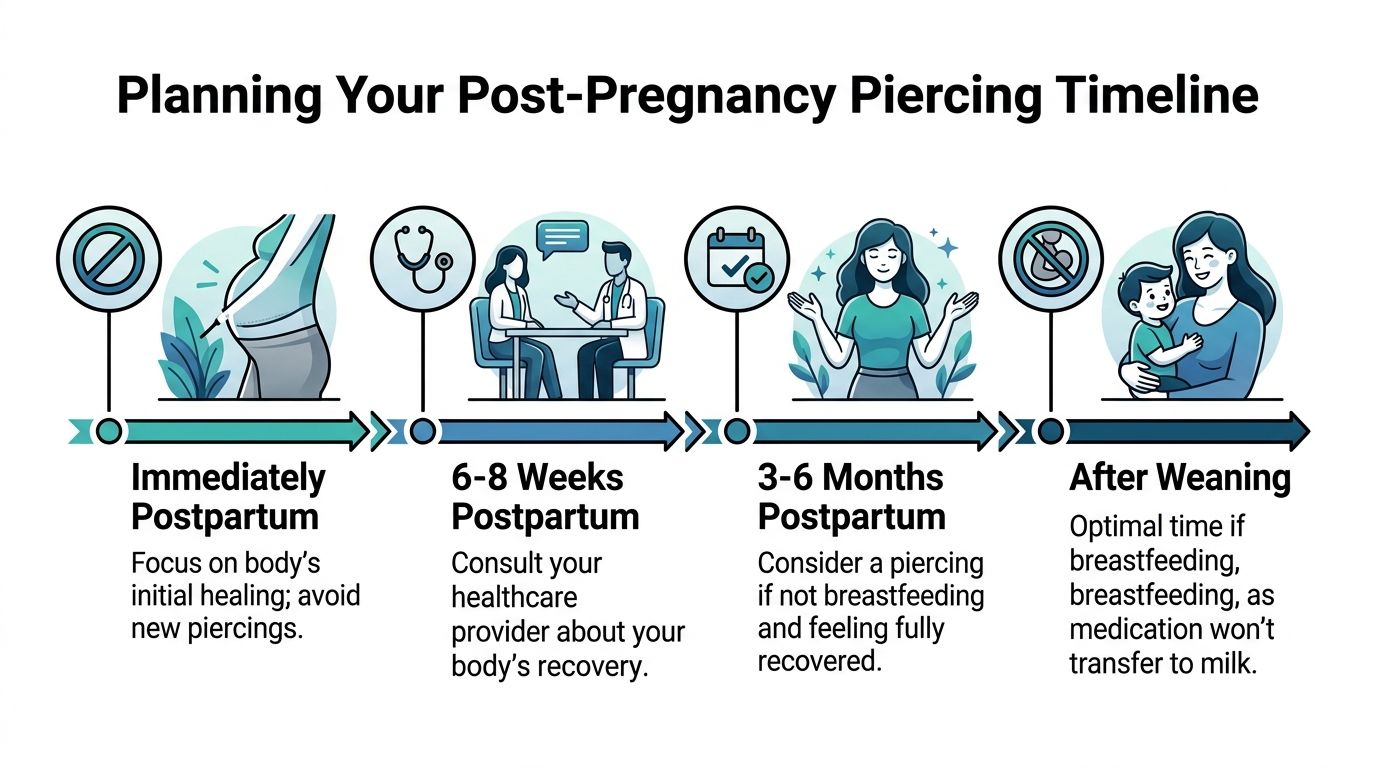
Professional piercing guidance recommends waiting at least 3 months after delivery before getting pierced, and notes that many body piercings take about 6 to 9 months to heal, which is why getting pierced during pregnancy can leave you still healing at birth and into early parenthood, according to the Association of Professional Piercers FAQ.
Why waiting helps so much
Birth is a major physical event whether you have a vaginal delivery or a caesarean. Your body then moves into recovery while you're also coping with sleep disruption, feeding, appointments, and the general intensity of caring for a newborn.
A new piercing adds one more healing demand to that mix. For some people, that may be manageable. For many, it becomes an aftercare job they could do without.
The wait matters for practical reasons:
- Your body needs recovery time: Healing a piercing competes with other recovery work.
- Your routine is unpredictable: Good aftercare is harder when sleep and schedules are all over the place.
- You want a stable baseline: It's easier to judge swelling, irritation, and fit when your body has settled.
What if you're breastfeeding
Breastfeeding doesn't automatically rule out every future piercing forever, but it often changes the timing discussion. Your body is still doing a lot, and if you're considering a nipple piercing, waiting until after weaning is usually the most sensible path.
Even for non-nipple placements, many clients prefer to postpone until feeding is established or finished. That can make life simpler. It removes one more healing variable at a time when you're already giving a lot physically and emotionally.
The best post-pregnancy piercing date is the one that fits your recovery, not the earliest possible slot on the calendar.
A simple timeline mindset
You don't need a perfect timetable. You just need a safe one. Think in stages:
- Immediately after birth: Focus on healing and rest.
- After your postnatal recovery is underway: Check in with your GP or midwife if you have any concerns.
- From 3 months onwards: Consider a new piercing if you're feeling well recovered.
- Later, if needed: Wait longer if breastfeeding, exhausted, or dealing with slow healing.
That patience usually pays off.
Your UK Safety Checklist For Consultations
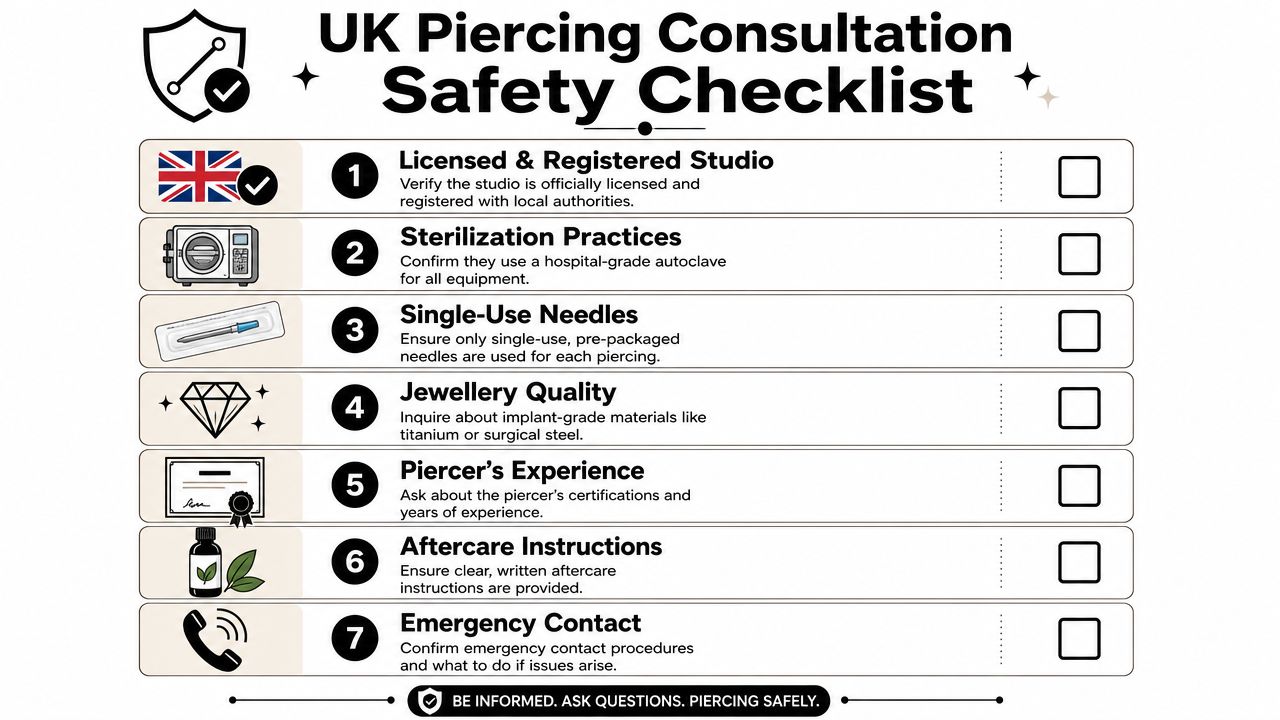
When you're unsure, the best next step isn't guessing. It's asking better questions. In the UK, that usually means speaking with both your midwife or GP and a professional piercer who takes hygiene and client suitability seriously.
Questions for your midwife or GP
Take a short list with you. That makes the conversation much easier.
- Ask about your personal risk factors: If you've had healing issues, skin conditions, or pregnancy complications, ask how that affects piercing decisions.
- Ask about existing piercings: This is especially useful for a navel or nipple piercing that's becoming uncomfortable.
- Ask what warning signs need medical review: Redness, swelling, discharge, pain, or fever all deserve clarity.
- Ask about timing after birth: If you want a post-pregnancy piercing, ask when your recovery is likely to be steady enough.
Questions for a professional piercer
A strong studio won't be defensive about these questions. They should answer them clearly and confidently.
- Do you pierce pregnant clients: A refusal or a firm postponement policy is often a good sign.
- Do you use single-use sterile needles: This should be standard.
- How do you sterilise tools and jewellery-ready equipment: You want a clear explanation, not vague reassurance.
- What jewellery materials do you use: Ask specifically about implant-grade options.
- What happens if an existing piercing starts migrating: A good piercer should give practical, conservative advice.
- Do you give written aftercare: If aftercare is casual or verbal-only, that's not ideal.
- How do you compare needle piercing with device-based methods: If you need background, this explainer on piercing gun vs needle is worth reading before your consultation.
A safe consultation should leave you feeling informed, not pressured.
What good professionalism looks like
If a piercer listens, asks about your health context, and tells you to wait, that isn't lost business handling. It's ethics.
If you're planning a post-pregnancy appointment and want to speak to an experienced team first, you can call 01202 900050 (Bournemouth) / 020 8686 7730 (Croydon) or message 07752 913846 (Bournemouth) / 07902 490584 (Croydon) on WhatsApp for a consultation about timing, jewellery choices, and aftercare.
Booking Your Safe Post-Pregnancy Piercing
For now, the most sensible plan is simple. Keep any existing piercing comfortable, watch for signs of tension or irritation, and get help early if something starts changing. Don't try to "push through" discomfort just to keep jewellery in place.
When the time is right, a good piercing experience should feel straightforward and well organised. You want a clean studio, single-use sterile needles, implant-grade jewellery, calm communication, and aftercare you can follow in real life.
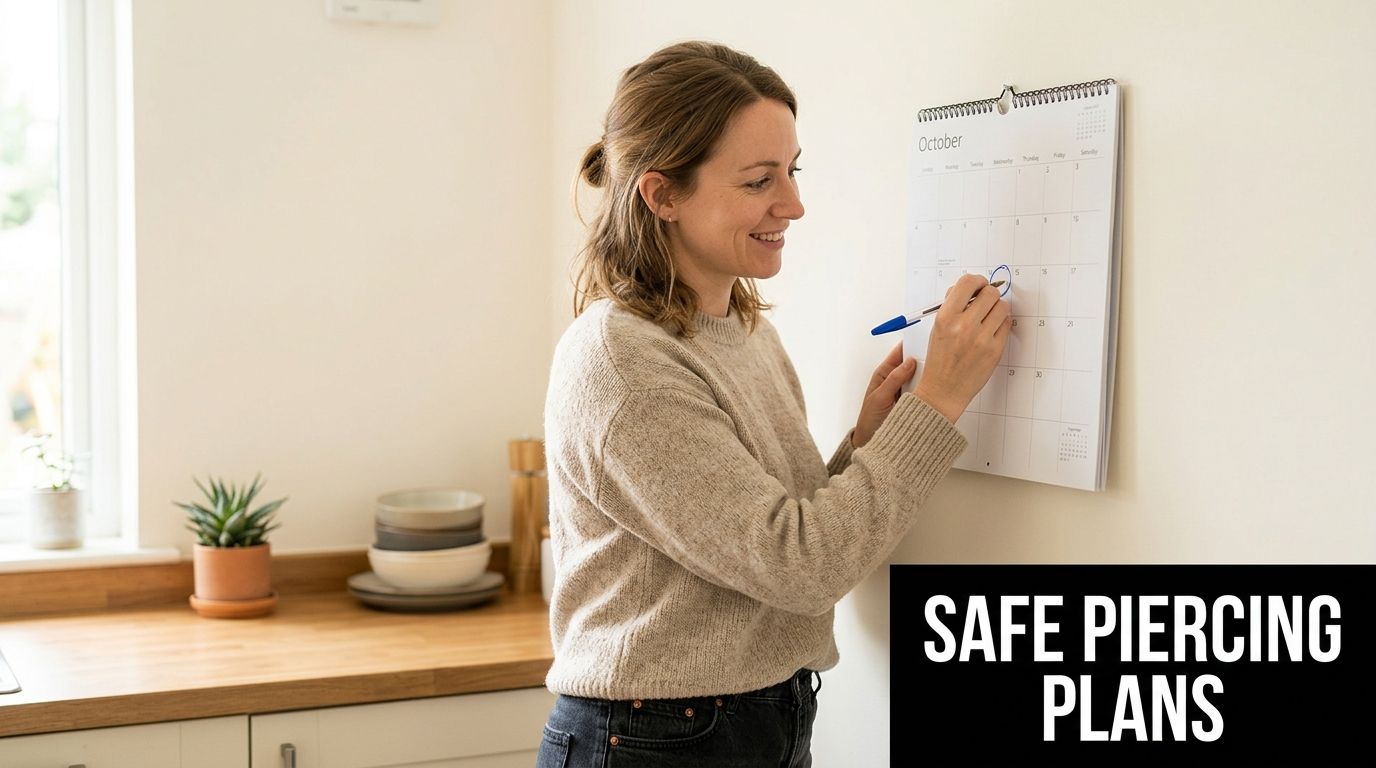
That future appointment can be something to look forward to. For many people, it becomes a small celebration after recovery rather than another thing to manage during pregnancy. It also gives you time to choose your placement carefully, talk through jewellery styles, and book when your body is far more likely to heal well.
If you'd like to plan ahead, speak to the team at Timebomb Tattoo & Piercing about a safe appointment after pregnancy. Call 01202 900050 (Bournemouth) / 020 8686 7730 (Croydon) or send a WhatsApp message to 07752 913846 (Bournemouth) / 07902 490584 (Croydon) to arrange a consultation and talk through your options.
If you're ready to plan a piercing for the right time, Piercing Near Me helps you find safe, professional UK studios and prepare with confidence. You can explore placements, learn about hygiene and healing, and connect with experienced teams in Croydon and Bournemouth for supportive advice before you book.