
A lot of new parents reach this point. Feeding is established, your days are organised around naps and milk, and somewhere in the middle of all that you want to do one thing that feels like you again. A new lobe, a nostril, a fresh bit of jewellery you chose for yourself. That isn't vanity. It's identity.
In the studio, this usually comes up as a practical question rather than a dramatic one. “Can I get pierced while I'm breastfeeding?” The honest answer is that sometimes you can, sometimes you really shouldn't, and the difference depends on placement, timing, healing capacity, and how realistic your aftercare routine will be.
That's where people often get mixed messages. General online advice tends to flatten everything into one answer, when in real life there's a big difference between a healed nipple piercing you already have and a brand-new helix or nostril piercing you want now. There's also a big difference between “possible” and “smart”.
If you're considering piercing while breastfeeding, the safest approach is to treat it like any other health and body decision after birth. Slow down, choose the right piercing, choose the right time, and choose jewellery that gives healing the best chance. If you're already browsing jewellery, start with materials that are appropriate for a healing piercing, such as implant-grade titanium piercing jewellery, not mystery metal bought on impulse.
Reclaiming Your Style While Breastfeeding
New parenthood can make your own reflection feel oddly unfamiliar. You're still you, but your time, body, sleep, clothes, and priorities have all shifted. Wanting a piercing in the middle of that is often less about making a statement and more about reclaiming a sense of normality.
I've seen clients sit down and apologise for even asking, as if wanting a nostril stud or second lobe while nursing is somehow frivolous. It isn't. The important thing is recognising that breastfeeding changes the context around healing. The question isn't whether you're allowed to want it. The question is whether this piercing, at this moment, with your current routine, is a sensible decision.
What usually works in real life
For many breastfeeding clients, lower-fuss placements are the most realistic. Think healed-ear-friendly choices, straightforward anatomy, stable jewellery, and an aftercare plan you can follow when you're tired. Piercings that snag constantly, need frequent downsizing management, or sit where a baby's hands will catch them can become more trouble than they're worth.
A useful way to think about it is this:
- Good candidates now are placements with simple healing demands and low interaction with feeding.
- Poor candidates now are placements likely to be knocked, contaminated, or impossible to leave alone.
- Absolutely separate category means nipple piercings. They need their own rules.
You don't need to give up style while breastfeeding. You do need to choose style that respects healing.
That distinction matters. A new parent doesn't need blanket fear. They need clear advice, delivered calmly, with enough detail to make a good decision once and not have to undo it later.
The Core Safety Principles Explained
The biggest misunderstanding around piercing while breastfeeding is that people jump straight to milk. In practice, the first issue is usually healing, not contamination.
According to UKAPP guidance on breastfeeding and piercing, the core concern is how the body allocates its resources. During breastfeeding, your body is already prioritising milk production and recovery after childbirth. Add a fresh piercing and you've created a new wound that also needs immune attention, tissue repair, and consistency.
Your body is already doing a lot
Healing a piercing isn't passive. Your body has to build and stabilise a channel, manage inflammation, and protect that site from infection. That doesn't stop because you've had a decent night's sleep or because the piercing is small.
If you're breastfeeding, your body's workload is already high. That doesn't mean a non-nipple piercing is automatically unsafe. It means healing may be slower, fussier, or less predictable than it would be at another stage of life.
A piercing needs routine
This is the part people underestimate. A healing piercing wants boring consistency. Clean hands. Minimal touching. Stable jewellery. No picking. No swapping. No random trauma from clothing, toddlers, towels, or tired habits.
A new parent's day is rarely boring or consistent.
That doesn't make piercing impossible. It means the best candidates are people who can answer yes to these questions:
- Can you keep aftercare simple every day? If your routine is chaotic, choose a placement that asks less of you.
- Can you leave it alone? Fidgeting, rotating jewellery, and constant checking slow healing.
- Can you avoid snag risk? Babies grab. Muslins catch. Hair wraps around jewellery.
The baby still matters, even for non-nipple placements
For most piercings away from the breast, the baby isn't at direct risk from the piercing itself. The practical issue is indirect. If your piercing becomes irritated or infected, you're then dealing with pain, stress, medical advice, and potentially treatment at a time when you already have very little spare capacity.
Practical rule: Don't choose a piercing based on what looks easiest in the chair. Choose one based on what will be easiest to heal at home.
This is also why proper technique matters. Needle piercing creates a cleaner wound than blunt-force methods, which is one reason reputable studios are firm about piercing gun vs needle decisions. When healing may already be under more pressure, you want the least traumatic start possible.
Nipple Piercings vs Other Piercings A Crucial Distinction
The conversation must now become more resolute. Nipple piercings are not in the same category as ear, nose, or most other body piercings during breastfeeding.
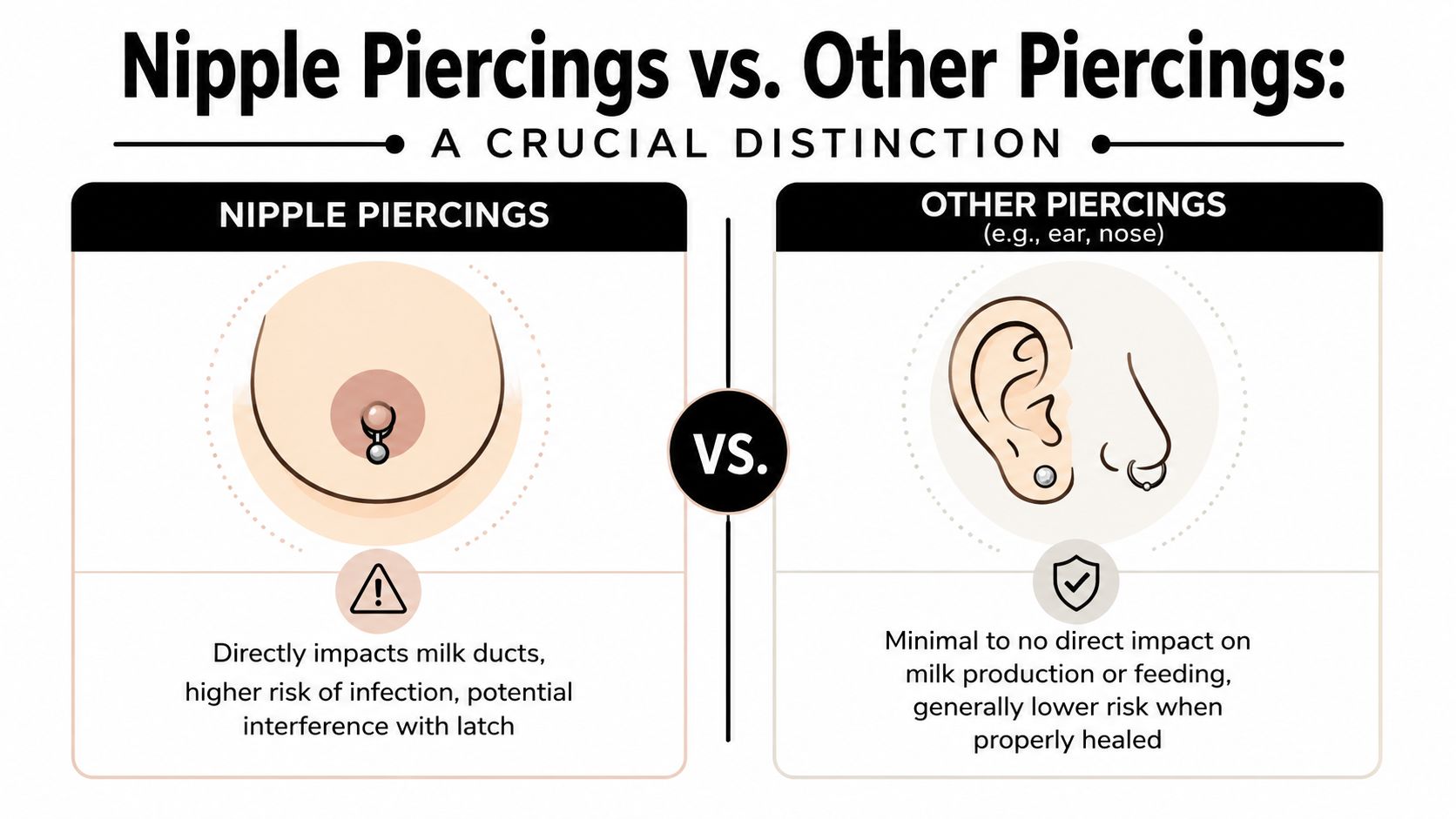
The difference is obvious once you strip it back. A nipple piercing sits directly in tissue involved in feeding. An ear or nostril piercing does not. That alone changes the risk profile.
Why nipple piercings are treated separately
Clinical evidence referenced by InfantRisk on nipple piercing effects describes three cases of breastfeeding difficulties linked to prior nipple piercings. In those cases, the piercings had been done at least seven years before breastfeeding, and the jewellery was not in place during feeding. The issues included poor latching and blocked ducts.
That matters because it shows the problem isn't only “jewellery in the way”. Tissue changes and scarring can still affect feeding much later on.
The same source also supports a very clear safety benchmark. Nipple jewellery should be removed before every feed because it can become a choking hazard and can interfere with latch. That point alone makes a healing nipple piercing during lactation a poor idea in practice.
Side-by-side risk picture
| Placement | Main concern while breastfeeding | Practical reality |
|---|---|---|
| Nipple piercing | Direct effect on feeding tissue, latch, jewellery safety | Strongly discouraged during lactation |
| Ear piercing | General healing and infection management | Often manageable if timing and aftercare are good |
| Nose piercing | Snagging, irritation, hygiene | Usually a placement question, not a feeding question |
| Navel or body piercing | Friction, movement, healing burden | Depends on anatomy, clothing, and recovery stage |
What clients need to know if they already have nipple piercings
If your nipple piercings are old and healed, that still doesn't mean you feed with jewellery in place. You remove it every time. You keep hygiene tight if you're reinserting between feeds. You pay attention to latch, leakage, and any breast symptoms that feel unusual for you.
Nipple piercings don't automatically end breastfeeding, but they do remove any room for casual decision-making.
For a new piercing, my advice is straightforward. If it involves the nipple and you're breastfeeding, wait. Choose another placement now or save that plan for later.
Finding the Right Time When to Get Pierced Postpartum
Timing is where good intentions become good outcomes. Plenty of piercings fail not because the placement was wrong, but because the body and routine weren't ready for them yet.
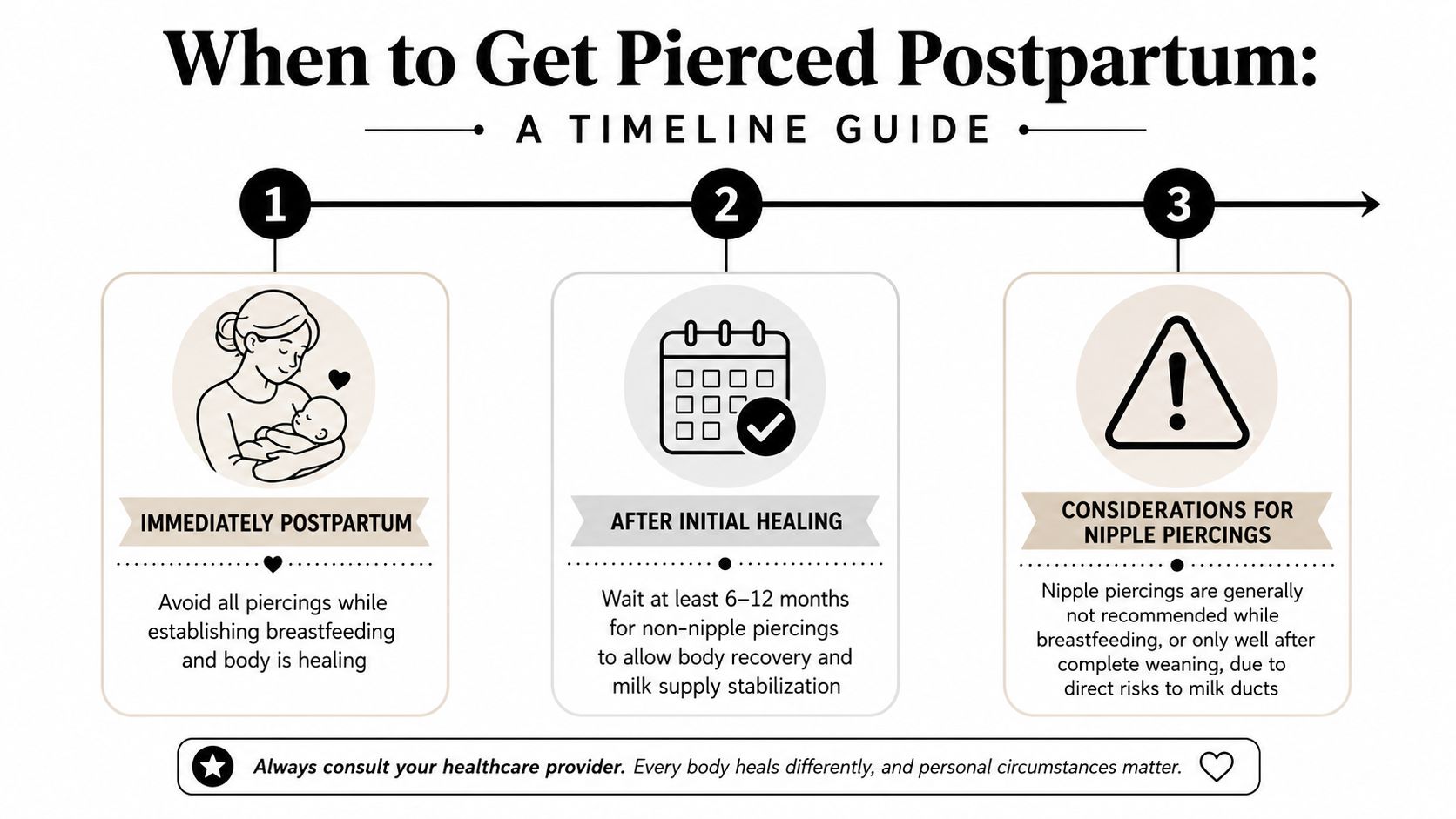
The clearest professional timeline for UK clients comes from the UK Association of Professional Piercers. Their guidance recommends waiting at least 3-6 months postpartum before getting any new piercing while nursing, and waiting until 3-4 months after weaning before nipple piercing so the breast tissue has time to return to a non-lactating state.
A practical timeline you can actually use
The first part of postpartum life is rarely the time to add elective healing. Even if you feel physically capable, your routine may still be unstable, feeding may still be settling, and sleep deprivation can make aftercare surprisingly hard to stay on top of.
A more realistic framework looks like this:
- Very early postpartum means your body is still recovering and feeding is still being established. Most clients do better by waiting.
- Once you're several months in and your routine is steadier, some non-nipple piercings may become realistic.
- For nipple piercing, the clock starts after weaning is complete, not while breastfeeding is still tapering.
Why waiting helps
Waiting does more than reduce hassle. It gives you better odds of clean healing because you're making the decision from a more stable baseline. You can sit for the appointment comfortably, keep your hands off the jewellery, notice changes properly, and avoid making aftercare one more thing that slips because the baby had a difficult night.
Here's the simplest version.
If you need the piercing now for emotional relief, choose a lower-maintenance non-nipple placement later in the breastfeeding journey. If you want nipple piercing, save it for after weaning and recovery.
Patience is hard when the piercing feels tied to getting a piece of yourself back. But in the studio, waiting is often what protects that goal rather than delaying it. A well-timed piercing is usually the one you keep.
Managing Risks Infection and Healing Challenges
People often ask the wrong question about infection. They ask whether it's likely. The more useful question is whether you're set up to deal with it properly if healing goes off track.
There isn't large-scale UK outcome data in the material available for breastfeeding parents with new piercings. What does stay constant is the principle noted by The Lactation Network on nipple piercings and breastfeeding. A local infection can become more serious and may require medical treatment you'd rather avoid while nursing. That's why studio hygiene and precise aftercare matter so much.
What makes healing harder after birth
Most postpartum clients aren't dealing with one single obstacle. They're dealing with small pressures stacking up.
- Interrupted sleep can make everything harder to manage, including cleaning and monitoring.
- Constant physical contact with a baby increases the chance of accidental knocks and grabs.
- Compressed time means aftercare gets rushed or skipped when the day goes sideways.
- Clothing friction becomes more relevant if you're wearing feeding bras, breast pads, layered tops, or carrying a baby against your chest.
None of that means a piercing will fail. It means you should choose one with a margin for error.
What helps and what doesn't
What helps is boring professionalism. Sterile single-use needles. Implant-grade jewellery. Correct sizing. Placement that suits your anatomy. Calm aftercare. Fast response if something starts looking wrong.
What doesn't help is trying to “tough it out” with poor jewellery, sleeping on a fresh cartilage piercing because there's no other comfortable position, or deciding that because the site is small the consequences are small too.
A breastfeeding parent is already using their body intensively. Adding a piercing can work, but only if you respect the healing load.
A piercing problem rarely starts as a dramatic event. More often it starts with a snag, missed cleaning, pressure from jewellery that's not ideal, or a client who waited too long to ask for help.
That's why I'm far more comfortable piercing a parent who wants straightforward advice and will follow it than one who is shopping for permission.
Your Step-by-Step Aftercare Plan for Breastfeeding
Aftercare needs to fit your day, not compete with it. If the plan is too fiddly, it won't happen consistently. That's where trouble starts.
A routine that works for tired people
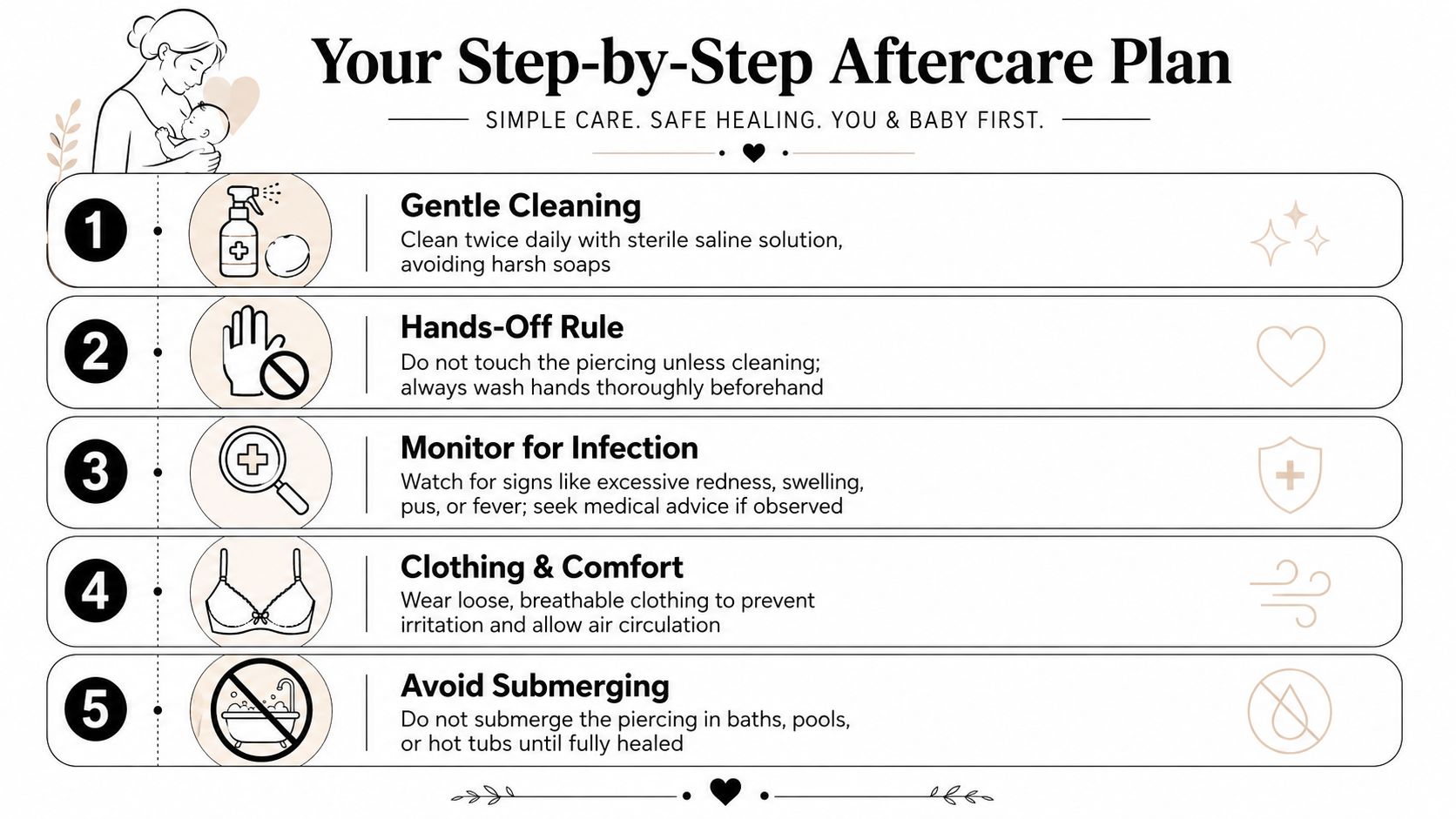
For most non-nipple piercings, keep it simple and repeatable.
Clean at set points in the day
Tie aftercare to things that already happen. Morning wash. Evening wind-down. If you use a proper saline spray for piercing aftercare, keep it where you'll remember it, not in a drawer you only open once a week.Wash your hands before touching anything
Not “quickly”. Properly. If you don't need to touch the piercing, don't.Leave the jewellery still
Don't rotate it. Don't test whether it's sore. Don't swap ends because one looks cuter with that outfit.Protect it from baby-level chaos
Hair tied back. Avoid textured clothing near the site. Be conscious of cuddle angles and muslin cloths.
Jewellery choices that make life easier
Low-profile jewellery is often the difference between easy healing and constant irritation. For ear work, a well-fitted flat-back labret is often much easier to live with than jewellery that catches on clothing or bedding. For nostrils, secure and appropriately fitted jewellery matters more than decorative shape in the early healing period.
A good piece of initial jewellery should do three things:
- Stay stable
- Allow for normal swelling
- Avoid unnecessary protrusion
Know normal healing from trouble
Some tenderness, mild swelling, and a bit of crusting can be part of normal healing. What needs attention is a site that starts becoming increasingly angry rather than gradually settling.
Watch for changes such as:
- Worsening redness that spreads rather than settles
- Increasing pain instead of normal sensitivity
- Obvious discharge that looks concerning rather than simple dried lymph
- Feeling unwell at the same time as the piercing becomes more irritated
If that happens, contact your piercer promptly and seek medical advice when needed. Don't remove jewellery on a panic impulse unless a professional tells you to. That can complicate drainage and assessment.
If the piercing is on or near the chest
This isn't the section for nipple piercing. That was covered earlier. But if you're healing anything near clothing pressure points, choose breathable fabrics, reduce rubbing, and avoid positions where a baby carrier, strap, or bra edge repeatedly presses into the site.
Aftercare shortcut: If a product stings, coats the site, smells heavily perfumed, or promises to “speed healing”, it usually doesn't belong anywhere near a fresh piercing.
Simple care is nearly always the best care.
Why Your Choice of Studio Matters More Than Ever
When you're breastfeeding, the margin for sloppy work gets smaller. That's why your choice of studio matters more now than it might have at another point in life.
A good studio won't just say yes because you're ready to spend money. They'll ask the right questions. How far postpartum are you? What piercing do you want? Are you breastfeeding directly, pumping, or mixed feeding? What does your day look like? Are you choosing a placement you can realistically protect and clean?
What to expect from a reputable piercer
You should expect clear answers and a willingness to say no when no is the safer answer. You should also expect proper technique and proper materials.
That means:
- Single-use sterile needles rather than piercing guns for appropriate placements
- Implant-grade jewellery such as titanium, niobium, or suitable quality gold
- Placement advice based on anatomy, not trends
- Aftercare that is personalised, not copied from a generic sheet with no context
The right studio acts like a safety filter
A reputable piercer is part technician, part risk manager. They spot the issue you haven't thought about yet. The side you always sleep on. The baby sling strap that will rub your new jewellery. The cartilage choice that looks lovely online but would be a nuisance for your current routine.
That's especially important for breastfeeding clients because the right answer is often narrower than “yes” or “no”. It might be “yes, but not that placement”. Or “yes, but wait a bit longer”. Or “no to nipples, yes to a better option”.
If you want straightforward advice from experienced professionals, call 01202 900050 (Bournemouth) / 020 8686 7730 (Croydon) or message 07752 913846 (Bournemouth) / 07902 490584 (Croydon) on WhatsApp. A proper consultation is often the fastest way to work out whether piercing while breastfeeding is sensible for you now, or whether a short delay will give you a much better result later.
If you're looking for safe, professional guidance, Piercing Near Me helps you find reputable studios and clear advice without the guesswork. If you're weighing up piercing while breastfeeding, want help choosing a lower-risk placement, or need to talk through timing, jewellery, and aftercare, start there or speak to the studio directly on 01202 900050 (Bournemouth) / 020 8686 7730 (Croydon) or WhatsApp 07752 913846 (Bournemouth) / 07902 490584 (Croydon).