
You've probably seen them already. A neat little silver hoop sitting close to the lobe, stacked with studs, maybe paired with a helix ring, and the whole ear looks polished without trying too hard. That's usually when the question lands in the studio. “Can I wear sterling silver huggies in my new piercing?” or “I've just had my ear done, can I swap to these now?”
That's where fashion advice and piercing advice often split.
A Sterling Silver Huggie can be a lovely choice for a settled, comfortable piercing. It is not the same thing as suitable jewellery for a fresh piercing. Those are two different jobs. One is about style in a healed channel. The other is about giving tissue the best chance to calm down, stabilise, and heal without extra irritation.
In the studio, I'd always rather disappoint someone for a minute than let them put the wrong jewellery into an angry ear. If your piercing is new, tender, crusting, swollen, or still changing day to day, material and fit matter more than appearance. If it's well healed, the conversation changes, and sterling silver huggies may be perfectly reasonable.
The Allure of the Sterling Silver Huggie
A lot of clients come in with the same reference point. They've saved a few ear-stack photos, found a pair of small silver hoops online, and want that clean close-to-the-ear look. It makes sense. Huggies are easy to wear, they suit casual and dressed-up styling, and they work especially well if you like multiple piercings without the ear feeling overloaded.
There's also something familiar about the shape. Hoop earrings have been around for a very long time. Archaeological evidence places gold hoop earrings in ancient Mesopotamia around 5,000 years ago, and hoop earrings were worn in ancient Egypt around 1,500 BC, including by men, women, and even cats in cultural depictions, as noted in this history of huggie and hoop styling. The modern huggie is a much smaller, more fitted version of one of jewellery's oldest forms.
Why people like them so much
A huggie does something larger hoops don't. It sits close. That gives the ear a tidier silhouette and usually feels less flashy than a full hoop. For healed lobe piercings especially, that can be exactly what people want for everyday wear.
Clients usually want them for one of three reasons:
- Low-profile styling that works at work, in the gym, and day to day
- Stacking potential with studs or other small hoops
- A secure feel compared with larger earrings that move around more
The mistake isn't liking sterling silver huggies. The mistake is assuming a pretty earring is automatically appropriate for a piercing that's still healing.
What retailers often skip
Most product pages talk about the finish, the shine, and how “comfortable” the hoop is. They don't usually ask the more important questions a piercer asks first.
- Is the piercing fully healed or just less sore than last week?
- Is the material suitable for prolonged wear in that piercing?
- Will the size sit correctly on your anatomy?
- Will the closure cause pressure or rubbing where the piercing sits?
That's why the same pair of huggies can be absolutely fine for one client and a bad idea for another. The earring itself might not be the problem. Timing, placement, and fit usually are.
Decoding the Sterling Silver Huggie
A sterling silver huggie has two parts worth understanding properly. First, the metal. Second, the shape and mechanism. If you know those two things, you'll shop much more confidently and avoid a lot of the usual mistakes.
What sterling silver actually means
Sterling silver isn't pure silver. In UK hallmarking law, it means an alloy containing 92.5% silver, which is why it's often marked 925, as described in Linjer's sterling silver huggie product information. The remaining alloy metal improves strength, and that matters a lot in a small hinged hoop.
For a huggie, you don't just need the metal to look good. You need it to cope with repeated opening and closing without the closure becoming loose or distorted. The 7.5% alloy content helps with that mechanical strength, particularly in spring hinge or click-closure designs, and UK consumers can also look for hallmarking as a practical check of metal standard.
What makes a huggie a huggie
A huggie is a very small hoop designed to sit snugly around the lobe or another ear placement. It isn't one standard size, and it isn't one standard closure either.
Common formats include:
- Click closure hoops where a hinged post clicks into place
- Hinged segment styles that open on a small built-in hinge
- Very close-fitting hoops intended to sit tight to the ear rather than hang below it
Consider the difference between a trainer and a formal shoe. Both go on your foot, but they are built for different use. Similarly, a decorative huggie for a healed piercing is not automatically built for the demands of a healing piercing.
Hallmarking matters more than branding
If you're buying silver in the UK, the hallmark matters more than a marketing phrase. A listing can say “silver look” or “925 style” and still leave people confused. A proper hallmark gives you a stronger basis for trusting what the metal is supposed to be.
Practical rule: If you're buying a sterling silver huggie for regular wear, check the hallmark first and the sales copy second.
That doesn't tell you whether it belongs in a fresh piercing. It does tell you whether the piece is being presented as precious metal jewellery.
Are Sterling Silver Huggies Safe for My Piercing
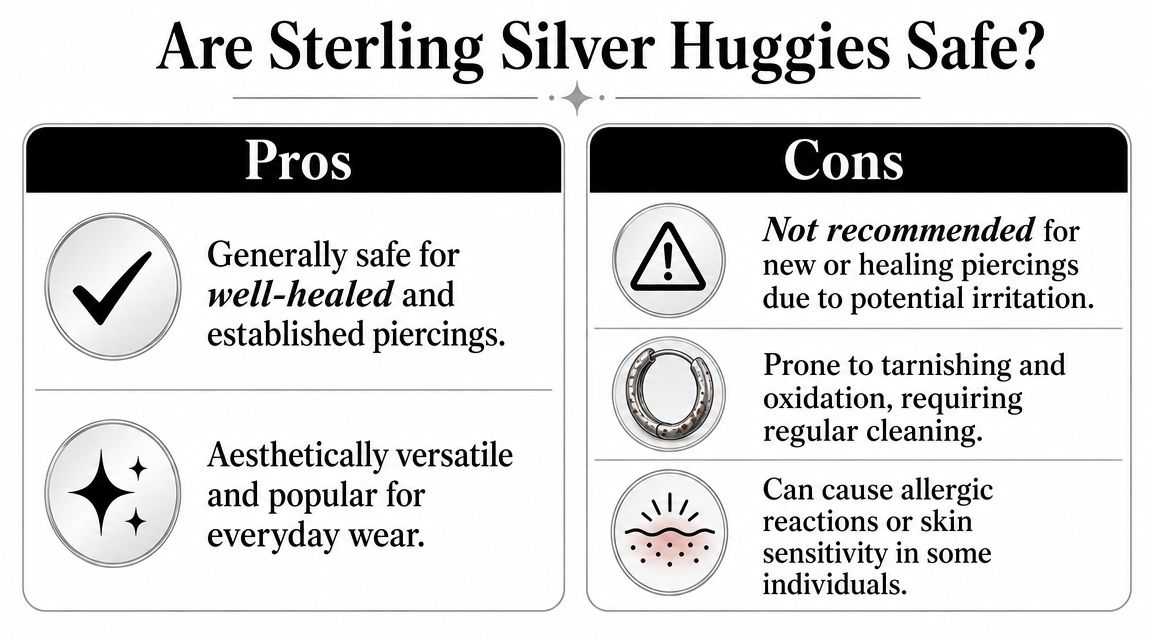
The short answer is simple. Sterling silver huggies are generally for fully healed piercings, not for fresh or healing ones.
That's the point many fashion retailers blur. They describe sterling silver as elegant, minimal, or comfortable, but those words don't answer the piercing question. A healing piercing needs jewellery chosen for biocompatibility, surface quality, stability, and room for the tissue to settle.
Why they're a poor choice for healing
Sterling silver is not the preferred material for initial or healing piercings. The NHS identifies nickel allergy as one of the most common causes of allergic contact dermatitis, and UK piercing guidance commonly points clients towards implant-grade titanium or 14ct+ gold for new piercings, as summarised in this overview of silver huggies and material suitability.
That matters because people often hear “silver” and assume “gentle.” In a healing piercing, that's the wrong shortcut. What matters is whether the jewellery is suitable for tissue that is still reactive. Fresh piercings don't need fashion metal. They need stable, low-allergen jewellery with the least chance of creating extra problems.
Fashion jewellery for healed piercings, implant-grade jewellery for new piercings.
What I tell clients in the studio
If a piercing is still healing, I look at a few obvious signs before we even discuss a style change:
- Ongoing tenderness means leave it alone
- Crust, irritation, or pressure means don't move into a snug hoop
- Cartilage that still reacts to sleeping on it or catching hair needs more time
- A piercing that feels “mostly fine” is not always a healed piercing
Many problems often start when someone swaps too early into a close-fitting hoop because the front view looks good. Then the ear gets sore, the ring rotates through angry tissue, and the client thinks the piercing has “randomly gone bad”. Usually it hasn't. It's been asked to cope with jewellery it wasn't ready for.
If your piercing is new, wear the right thing first
For fresh piercings, choose jewellery made for healing. If you're comparing materials, start with implant-grade titanium piercing jewellery and treat sterling silver as something to consider later, once the piercing is stable and calm.
That approach is less exciting than buying the prettiest pair straight away. It also gives you a much better chance of ending up able to wear those prettiest pairs comfortably later on.
A Guide to Huggie Sizing and Fit
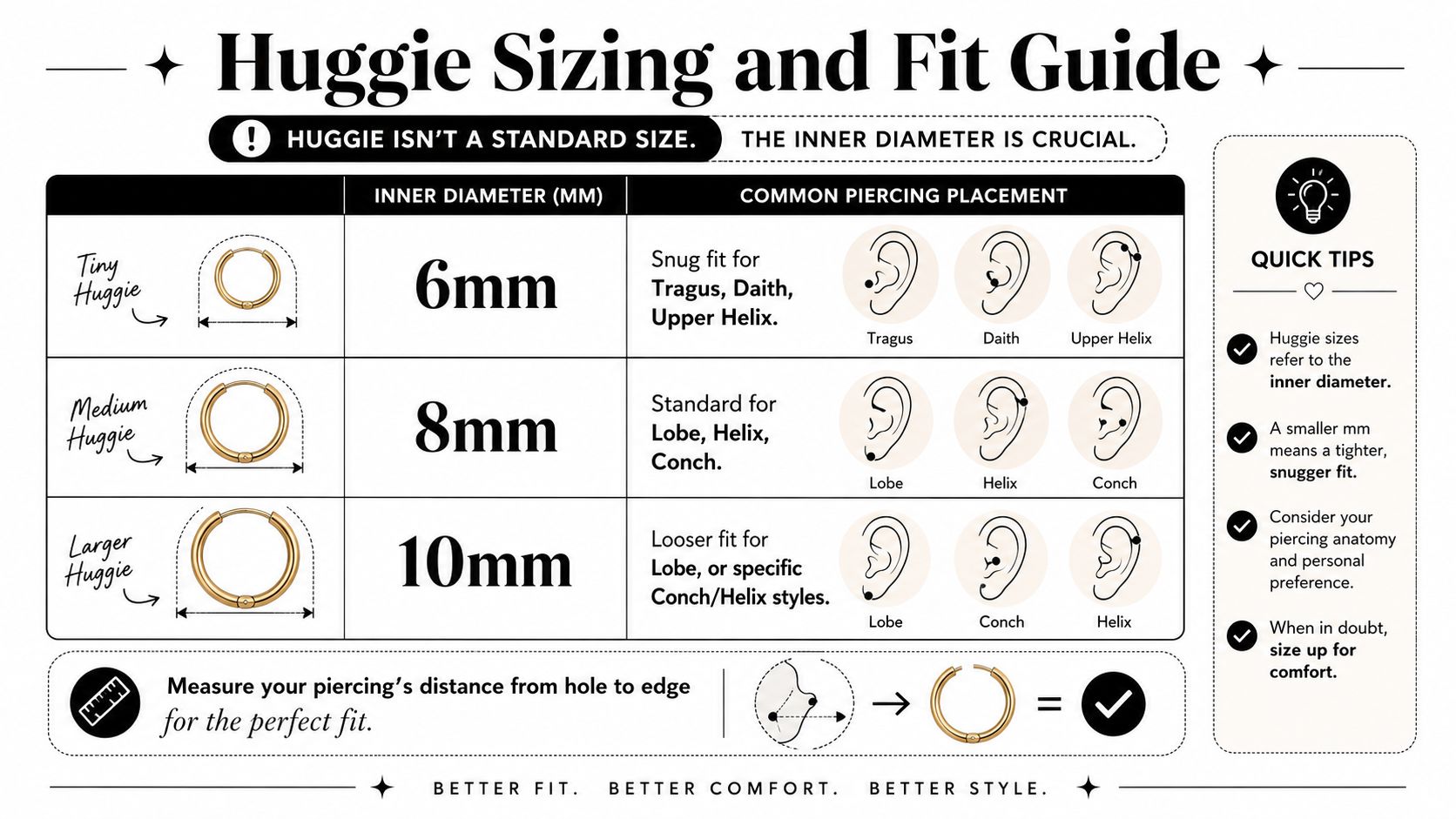
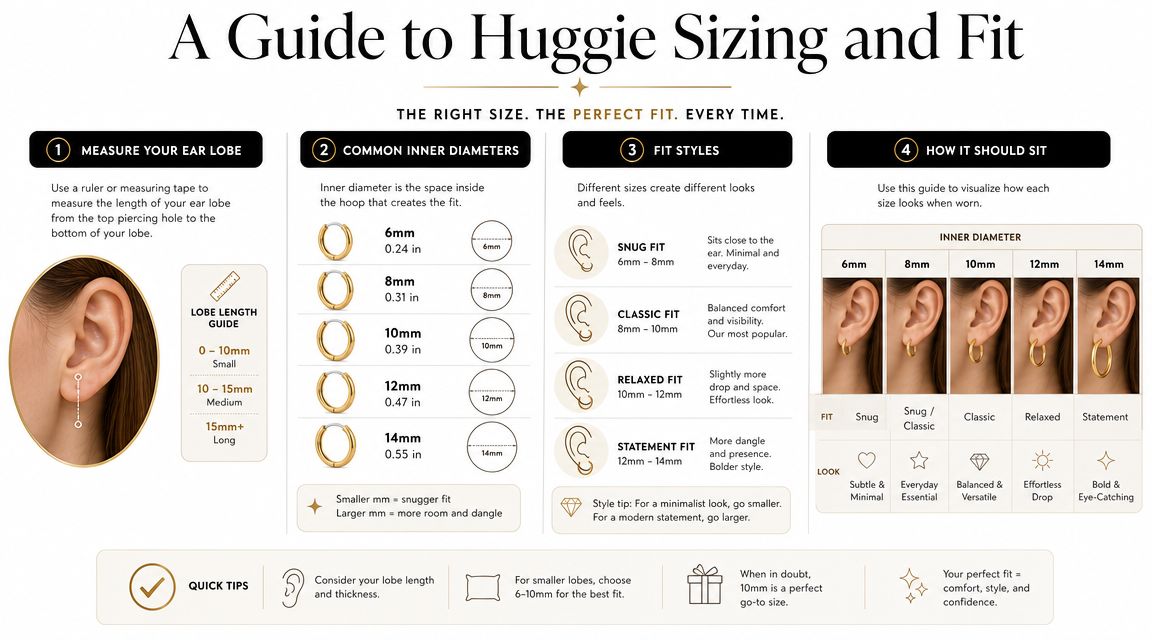
Most fit problems come from one assumption. People think “huggie” is a size. It isn't. It's a style. The measurement that matters most is the inner diameter.
UK-facing product information shows huggies commonly sit in a very small range, with examples from 7 mm inner diameter to 8.5 mm and 9.5 mm, while broader guidance places huggies around 5 mm to 14 mm, according to Wolf Circus product guidance on sterling silver huggie hoops. Smaller huggies sit closer to the ear, but they also become much less forgiving if your piercing placement or ear thickness doesn't match.
How to judge fit properly
You need to think about the distance between the piercing hole and the edge of the ear, plus the thickness of the tissue the hoop has to pass around. A hoop can be technically small enough to close, but still be too tight to wear comfortably.
Use this simple approach:
- Look at the placement. A low lobe piercing usually gives more room than an upper lobe or helix.
- Consider tissue thickness. A thicker lobe needs more space than a very fine one.
- Think about the profile you want. Snug is not the same as compressed.
- Account for movement. If a hoop sits in cartilage, even a neat fit can become irritating if there's rubbing.
What works and what usually doesn't
A small huggie can look excellent in a lobe that was pierced with hoop wear in mind. The same size can be miserable in a higher lobe or cartilage placement. That's why buying by photo alone causes trouble.
A few practical truths:
- Very snug hoops look polished but leave almost no room for anatomical variation.
- Slightly larger hoops often look better in real life than on a product page because the ear doesn't appear pinched.
- Cartilage needs more caution because poor fit can create pressure and migration risk.
For clients considering a ring in helix, conch, or similar placements, it helps to compare options made specifically for those areas, such as ear cartilage piercing ring styles, before committing to a fashion huggie.
If a huggie only fits when you force the closure or pull the ear into position, it doesn't fit.
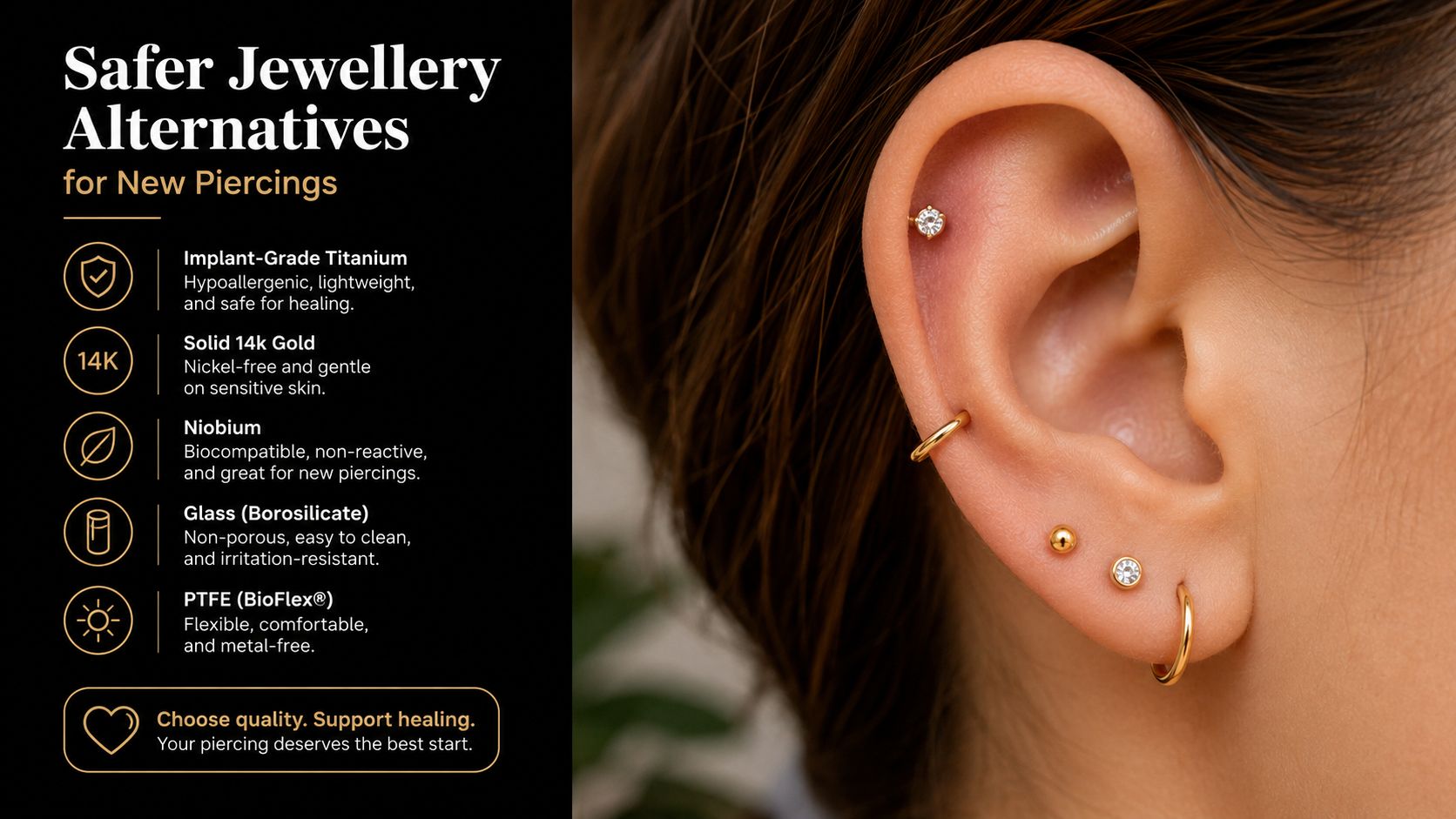
Safer Jewellery Alternatives for New Piercings
If the goal is a healthy new piercing, sterling silver shouldn't be the starting point. The better route is to heal with jewellery designed for that stage, then move into decorative options later when the piercing has proven itself stable.
That usually means implant-grade titanium or 14ct+ gold. Both are used because they are more appropriate for sensitive, healing tissue than sterling silver.
Why professionals start with different materials
Titanium is the workhorse in many piercing studios for good reason. It's chosen for biocompatibility and low allergen risk. Gold can also be an excellent option when the alloy quality is appropriate for piercing use. Both are standard choices when the priority is healing rather than immediate fashion flexibility.
Sterling silver has a place. It's just usually later in the process.
Piercing Jewellery Material Comparison
| Material | Best For | Allergy Risk | Our Professional Recommendation |
|---|---|---|---|
| Sterling silver | Healed lobe piercings and established piercings where the wearer already tolerates the metal well | Can be an issue for some wearers, especially if the piercing is reactive or not fully settled | Good as fashion jewellery for healed piercings only |
| Implant-grade titanium | New piercings and longer-term wear in sensitive placements | Low | First choice for most initial piercings |
| 14ct+ gold | New piercings when the jewellery is piercing-appropriate and well made | Low when alloy quality is appropriate | Strong option for clients who want a premium healing material |
The trade-off clients need to understand
This is usually where people worry they're being told to give up style. They aren't. They're being told to separate healing jewellery from fashion jewellery.
That distinction protects the piercing.
A sensible sequence looks like this:
- Get pierced with titanium or appropriate gold
- Let the piercing settle properly
- Downsize or change under professional guidance where needed
- Move into sterling silver huggies once the piercing is healed and tolerant
If you're still choosing a studio or trying to compare what different places offer, Piercing Near Me lists practical information about booking, studio locations, and jewellery standards for people looking around Croydon and Bournemouth.
Styling and Caring For Your Jewellery
Once a piercing is healed and happy, sterling silver huggies can be a very wearable part of your rotation. They work especially well in first and second lobes, and they pair neatly with flat-back studs, tiny stones, or a slightly chunkier hoop lower down for contrast.
How to style them without overloading the ear
The cleanest combinations usually come from mixing shapes rather than repeating the same hoop in every placement.
Try combinations like:
- Small huggie in the first lobe with a simple stud above it
- Matched silver huggies across multiple lobe piercings if the ear anatomy supports the same diameter
- One close silver hoop with one understated cartilage piece rather than several tight rings competing for space
A curated ear looks better when each piece has room to read properly.
Keeping sterling silver in good condition
Sterling silver can tarnish, so maintenance matters. Clean it gently, dry it properly, and store it somewhere that doesn't encourage moisture build-up. If a huggie clasp starts feeling misaligned, don't keep forcing it. Hinged jewellery can wear poorly if it's repeatedly snapped shut at an angle.
For your ear itself, keep one rule in mind. If changing jewellery causes irritation, stop and reassess. A healed piercing should tolerate a jewellery change without drama. If it doesn't, something about the material, fit, timing, or handling may be wrong.
If you need a refresher on proper aftercare habits, especially if a piercing is still settling, read how to clean a new piercing before experimenting with snug hoops.
A beautiful earring isn't worth much if the piercing wearing it stays sore.
For expert advice on piercing placement and jewellery selection, call our friendly team on 01202 900050 (Bournemouth) / 020 8686 7730 (Croydon) or send a message on WhatsApp to 07752 913846 (Bournemouth) / 07902 490584 (Croydon) to book a consultation at our Croydon or Bournemouth studios.
If you're weighing up a Sterling Silver Huggie for a current piercing, or you want to plan a new one safely from the start, Piercing Near Me is a practical place to compare options, learn what jewellery is appropriate for healing, and book with studios that prioritise placement, sterile technique, and aftercare. For direct advice, call 01202 900050 (Bournemouth) / 020 8686 7730 (Croydon) or message WhatsApp 07752 913846 (Bournemouth) / 07902 490584 (Croydon).